
LAWU-114 · Lesson 5 of 12 · 21 min
Using, distinguishing and disclosing authority
▶ Video coming soon A video version of this lesson is on the way.
Kinsella begins the fifth class by handing out the four fictional Westmarch cases again, this time with a question at the top: "Which of these cases hurts Coldbrook?" Most of Section B points to Pell v. City of Brennan Falls, where the Westmarch Court of Appeals held that a mandatory 8-dollar parking fee was a charge, reasoning that courts should look to substance rather than labels. Jordan Kimura adds Ibarra, because although its willfulness standard is demanding, it also holds that the statutory list of recreational purposes is illustrative, which matters less here. Marcus Webb points out that Quill, the corn maze case, is the best case for Coldbrook but contains a dangerous sentence: the result "could differ by pressure or practice." "Every brief has a Pell," Kinsella says. "Today is about what to do with it."
The weight of authority, revisited
In the fall, Section B learned the hierarchy of authority: mandatory authority binds a court, and persuasive authority may influence it. A Westmarch trial court is bound by decisions of the Westmarch Supreme Court and, under the usual rule in state systems, by published decisions of the Westmarch Court of Appeals. Stavros and Ibarra, as supreme court decisions, bind every Westmarch court. Pell and Quill bind the trial court, and the court of appeals would ordinarily follow its own published decisions. Decisions from other states interpreting similar recreational use statutes would be persuasive only. In a brief, the weight of an authority determines how much work it can do: a binding case can establish a rule; a persuasive case can only suggest how the court should resolve an open question.
Within the binding cases, writers distinguish holdings from dicta. The holding is the rule necessary to the decision; dicta are statements that go beyond what the court needed to decide. Quill's statement that the result could differ by pressure or practice is arguably dicta, because the court found no pressure in that case. Coldbrook might note that the statement was not necessary to the decision. But characterizing an opponent's best language as "mere dicta" is a familiar move, and judges are skeptical of it, especially when the language comes from a case that is otherwise favorable. Kinsella's advice: if the dictum hurts, answer it on its own terms first, and mention its status as dicta only as a secondary point.
Analogizing to favorable authority
Analogy is the core of common law reasoning: like cases should be decided alike. To use a favorable case well, the writer shows that the facts that mattered to the court in the precedent are present in the client's case. For Coldbrook, the key facts in Quill were that the donation box had a suggested amount, that the money went to a charity rather than the owner, and that payment was not required to enter the maze. Each of those facts appears at Coldbrook: a suggested five dollars, money going to the 4-H club, and no requirement to pay. The brief should make the comparison explicit, often fact by fact, rather than citing Quill and leaving the reader to work out the parallels.
Analogies also work at the level of reasoning. Quill reasoned that treating voluntary donations as charges would discourage owners from allowing charitable collections and would contradict the Act's purpose of encouraging free access. That reasoning applies to Coldbrook whether or not every fact matches, and Coldbrook's brief can use it to tie the analogy back to Stavros's purpose holding. Kinsella calls this "analogizing to the why," and says it is often more persuasive than a list of matching facts, because it shows the court that the precedent's own logic requires the result.
Distinguishing unfavorable authority
To distinguish a case is to show that a difference in facts or reasoning makes the precedent inapplicable. A good distinction identifies a difference that mattered to the court's reasoning, not just any difference. Pell involved a parking fee that every visitor had to pay; the court reasoned that a mandatory payment for access is a charge whatever it is called. Coldbrook's hayride involved a voluntary donation to a third party that no one was required to pay. That difference goes to the heart of Pell's reasoning, so it is a strong distinction. By contrast, pointing out that Pell involved a city park while Coldbrook is a private farm is a weak distinction, because nothing in Pell's reasoning depended on public ownership, and the Act's definition of owner covers both.
Distinguishing is most persuasive when it accepts the precedent rather than attacking it. Coldbrook's brief need not argue that Pell was wrong. It can embrace Pell's principle, substance over labels, and show that the substance at Coldbrook was a donation, not a fee. Kinsella says this is one of the most effective moves in brief writing: "Take the other side's best case and show that its own reasoning helps you." Garrow's lawyer will try the same move with Quill, arguing that Quill's pressure or practice language describes Coldbrook, where a volunteer stood at the wagon steps with the bucket.
The duty to disclose adverse authority
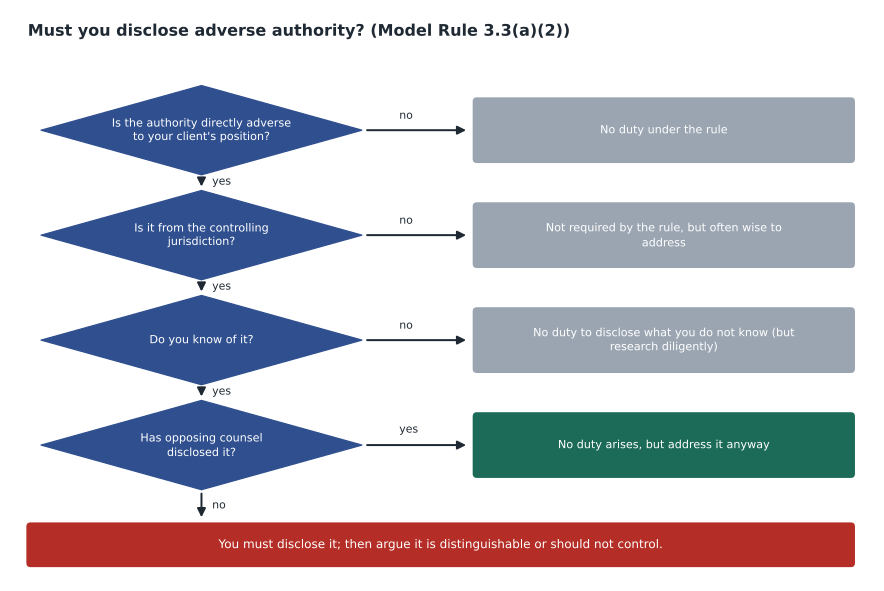
Some adverse authority must be disclosed even if the other side does not cite it. Model Rule of Professional Conduct 3.3(a)(2) provides that a lawyer shall not knowingly fail to disclose to the tribunal legal authority in the controlling jurisdiction known to the lawyer to be directly adverse to the position of the client and not disclosed by opposing counsel. The rule has several limits: the authority must be from the controlling jurisdiction, it must be directly adverse, the lawyer must know of it, and the duty arises only if opposing counsel has not disclosed it. The comment to the rule explains that the underlying concept is that legal argument is a discussion seeking to determine the legal premises properly applicable to the case, so a court should not be misled about the state of the law.
In practice, the disclosure duty rarely forces a lawyer to do anything a good advocate would not do anyway, because the opponent usually cites its best authority and the court will find it regardless. The rule matters most when the other side misses something, for example when opposing counsel is inexperienced or self-represented. Courts have sanctioned lawyers who concealed controlling adverse cases, and the reputational harm can be worse than the sanction. Kinsella's practical rule is simple: if a case hurts and the judge is likely to find it, cite it first and explain why it does not control. "The judge will think better of you for raising it," she says, "and you get to frame it."
Policy arguments
When the authorities do not resolve an issue, or to reinforce an argument that they do resolve, briefs make policy arguments: arguments about the consequences of a ruling. Policy arguments are strongest when they are tied to the purpose of the governing law as the courts have described it. Stavros said the Recreational Use Act exists to encourage owners to open land for public recreation, so Coldbrook can argue that treating charitable donation buckets as charges would lead owners to forbid such collections or close their land altogether, which is precisely the result the legislature sought to avoid. Garrow can answer with a policy argument of her own: that the Act protects owners who give the public free access, not owners who create an expectation of payment, and that reading the charge exception too narrowly would let owners collect money while escaping liability.
Policy arguments have limits. Courts are reluctant to override clear statutory text on policy grounds, and a brief that leads with policy when the text is against it signals weakness. Kinsella suggests treating policy as the third step: text first, precedent second, policy third, each reinforcing the last.
| Task | Technique | Coldbrook example |
|---|---|---|
| Use a favorable case | Analogize facts and reasoning explicitly | Quill: suggested donation, money to charity, no requirement to pay |
| Meet an unfavorable case | Distinguish on a difference that mattered to the court | Pell's fee was mandatory; Coldbrook's donation was voluntary |
| Embrace the opponent's principle | Show its reasoning favors you | Pell's substance-over-labels test: the substance here was a gift |
| Handle troublesome dicta | Answer it on the merits, then note its status | Quill's pressure or practice language: there was no pressure here |
| Reinforce with policy | Tie consequences to the law's stated purpose | Stavros: the Act encourages free public access |
| Disclose controlling adverse law | Cite it first and explain why it does not control | Raise Pell before Garrow does, if she has not |
Citation signals and parentheticals
How an authority is cited conveys how strongly it supports the proposition. Under The Bluebook, no signal means the authority directly states the proposition or is quoted; "see" means it clearly supports the proposition by inference; "cf." means it supports the proposition by analogy; "but see" means it clearly supports a contrary proposition. Using the wrong signal can mislead the court, and a careful judge or clerk will notice. Explanatory parentheticals after a citation tell the reader why the case matters without a full paragraph of description, for example: Quill v. Fenwick Farms, 51 Westm. App. 2d 302, 306 (2021) (holding that a donation box with a suggested three-dollar contribution to a food bank was not a charge). Parentheticals are efficient, but they work best for supporting cases; the central precedents deserve full explanation in the text.
Persuasive authority from other jurisdictions
Nearly every state has a recreational use statute, many modeled on a 1965 model act published by the Council of State Governments, so courts often look to other states' decisions when their own courts have not resolved a question. If the Westmarch cases left the charge question open, Coldbrook could cite decisions from other states holding that voluntary donations are not charges, and Garrow could cite decisions finding that a required payment of any kind is. When using out-of-state authority, the brief should explain why it is persuasive: the other state's statute uses the same language, the court's reasoning is sound, or a clear majority of states agree. A single out-of-state case cited without explanation does little. Kinsella reminds the class that in the closed universe they may use only the four Westmarch cases, but in practice a researcher would check how courts across the country have read the same statutory phrase.
String citations
A string citation lists several authorities for one proposition. Strings are useful when the point is that many courts agree, but long strings are hard to read and often hide weak cases among strong ones. Most judges prefer one or two well-chosen authorities, explained, to a paragraph of citations. When a string is necessary, order it by weight, put binding authority first, and consider parentheticals so the reader knows what each case adds.
Quoting and characterizing accurately
Model Rule 3.3(a)(1) forbids knowingly making a false statement of law to a tribunal, and misdescribing a case is a false statement of law. Quotations must be exact, with alterations shown in brackets and omissions shown with ellipses, and a quotation must not be trimmed so that it means something different from the original. Characterizations must be fair: if Quill said the result "could" differ by pressure or practice, a brief may not say Quill "held" that pressure creates a charge. Kinsella shows the class a real-world pattern she saw repeatedly as a staff attorney: a brief quoting a sentence from an opinion's description of a party's argument as though it were the court's holding. "Read the whole paragraph," she says. "Always."
Exercise: the Pell paragraph
Section B's assignment for the week is to write the paragraph in Coldbrook's brief that deals with Pell. Hannah's draft begins by stating Pell's holding and reasoning fairly, then turns: "Pell's principle that courts look past labels to substance supports Coldbrook. In Pell, every visitor had to pay eight dollars to park, and the city kept the money; the fee was a price of access whatever the city called it. At Coldbrook, by contrast, no one had to pay anything to ride, the sign said the ride was free, and every dollar went to the 4-H club. In substance as well as in name, the bucket held gifts to a charity, not a fee asked in return for permission to enter." Kinsella marks it as a model of distinguishing by embracing the precedent's own reasoning.
Worked problem
Distinguishing a case on the right ground
Garrow argues that Quill does not help Coldbrook because Quill involved a corn maze and an unattended donation box, while Coldbrook had a volunteer holding the bucket at the wagon steps. Draft Coldbrook's response.
Show solution
- Identify the difference Garrow relies on: an attended bucket versus an unattended box.
- Ask whether that difference mattered to Quill's reasoning: Quill focused on whether payment was required as a condition of access, and said pressure or practice could change the result.
- Concede what is true: the volunteer was present.
- Show why the difference does not create pressure or a practice of requiring payment: the sign said free, the volunteer did not ask riders for money, no one was turned away.
- Tie back to the definition of charge.
Answer: "Garrow emphasizes that a 4-H volunteer held the bucket, but Quill did not turn on whether a donation container was attended. It turned on whether payment was a condition of access, and it recognized that pressure or practice might make a nominal donation into a price. The record shows neither. The sign told riders the hayride was free; the volunteer held the bucket without asking riders for money; riders who gave nothing rode like everyone else. A volunteer standing near a charity's bucket does not transform a gift to 4-H into 'the admission price or fee asked in return for' permission to ride."
Summary and key terms
- Binding authority can establish a rule; persuasive authority can only suggest how to resolve an open question.
- Analogize explicitly, fact by fact, and to the precedent's reasoning as well as its facts.
- Distinguish on differences that mattered to the court's reasoning; the strongest distinctions embrace the precedent's principle.
- Model Rule 3.3(a)(2) requires disclosing known, directly adverse authority from the controlling jurisdiction that the opponent has not disclosed; good practice is to address it first in any event.
- Policy arguments work best tied to the law's stated purpose and as reinforcement after text and precedent.
- Use Bluebook signals accurately, quote exactly and characterize holdings fairly.
Practice problems
Work each problem on paper first, then reveal the answer to check.
What makes a distinction strong rather than weak?
Show answer
It rests on a difference that mattered to the precedent's reasoning, not on an incidental difference.
List the four limits on the duty in Model Rule 3.3(a)(2).
Show answer
The authority must be from the controlling jurisdiction, directly adverse, known to the lawyer and not disclosed by opposing counsel.
What does the signal cf. indicate?
Show answer
That the authority supports the proposition by analogy.
Why is calling an opponent's best language mere dicta a risky first response?
Show answer
Judges are skeptical of the move; the language should be answered on its merits first.
Lesson quiz · 5 questions
Score 60% or more to complete this lesson.
Create a free account to save your progress, take quizzes and earn a certificate.