
LAWU-113 · Lesson 9 of 12 · 20 min
Covenants, equitable servitudes and common interest communities
▶ Video coming soon A video version of this lesson is on the way.
In 1980, Eleanor Ashby bought Lot 14 in Callowhill Shores, a subdivision of small cabin lots on the south shore of the lake, as a guest cabin. Her deed said the lot was conveyed "subject to the Declaration of Covenants, Conditions and Restrictions recorded in 1972," which created the Callowhill Shores Owners Association, required every lot owner to pay annual assessments for the private road and beach, limited lots to "single-family residential use," and required association approval for exterior changes. The 1972 declaration also contained a clause forbidding sale or rental to anyone who was not white. In 2024, the association amended the declaration by a two-thirds vote of lot owners to ban rentals of less than thirty days. Margaret, who inherited Lot 14 under the residuary clause with Paul, listed the cabin on a short-term rental website in June 2025. The association fined her 2,500 dollars and sued to enjoin further rentals.
"Servitudes are private land use law," Vandermolen says. "Before zoning existed, developers used them to plan whole neighborhoods. Today more than one in four Americans lives in a community governed by an owners association, and most new housing comes with a declaration. You will read hundreds of these documents in practice."
Real covenants
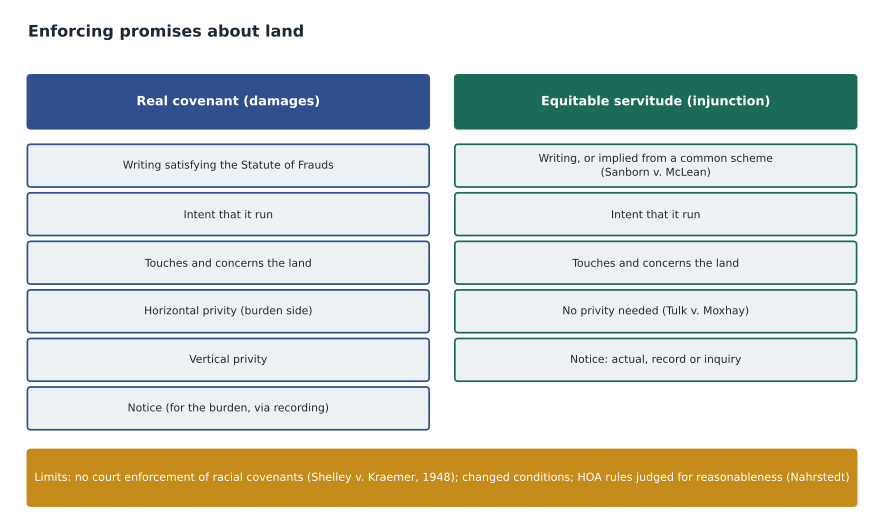
A real covenant is a promise about the use of land, enforceable at law (usually by damages) not only between the original parties, who are bound by contract, but also by and against later owners. A covenant can be negative (a promise not to do something, such as build commercial structures) or affirmative (a promise to do something, such as pay assessments or maintain a fence). For the burden of a real covenant to run to a later owner of the burdened land, the traditional requirements are: (1) a writing satisfying the Statute of Frauds; (2) intent that the covenant run, often shown by language binding "successors and assigns"; (3) the covenant must touch and concern the land; (4) horizontal privity between the original parties; (5) vertical privity between an original party and the successor; and (6) notice to the successor, actual or record.
Horizontal privity refers to the relationship between the original covenanting parties. Most American courts require that the covenant have been made in a conveyance of an interest in land between them, such as a deed from a developer to a buyer (grantor-grantee privity); neighbors who simply sign a contract with each other lack horizontal privity. Vertical privity refers to the relationship between an original party and a successor; it exists when the successor took the same estate (for example, a buyer of the fee from the original owner), but not when the successor is an adverse possessor or takes a lesser estate in some courts. The requirements for the benefit to run are usually less strict: horizontal privity is often not required.
The touch and concern requirement asks whether the covenant affects the parties as owners of land rather than as individuals. Restrictions on use plainly touch and concern. Affirmative covenants to pay money were once suspect, but Neponsit Property Owners' Association v. Emigrant Industrial Savings Bank, 278 N.Y. 248 (1938), held that a covenant to pay annual charges for the maintenance of roads, parks and beaches in a residential development touched and concerned the land, because it affected the owner's legal relations as an owner, and that the association could enforce it as the owners' agent even though it owned no benefited land.
Equitable servitudes
When a plaintiff seeks an injunction rather than damages, courts apply the more flexible law of equitable servitudes. The founding case is Tulk v. Moxhay, 2 Ph. 774 (Ch. 1848), in which the buyer of Leicester Square in London promised to keep the garden in the square open and unbuilt. A later buyer, who had notice of the promise but had not made it, planned to build. The court enjoined him, reasoning that it would be unjust for a buyer who paid less because of the restriction to escape it simply by reselling. An equitable servitude runs to a successor if the parties intended it to run, it touches and concerns the land, and the successor had notice. No privity of estate is required.
Equitable servitudes can also be implied from a common scheme of development. In Sanborn v. McLean, 233 Mich. 227 (1925), the McLeans planned to build a gas station on their lot in a Detroit residential subdivision. Their own deed contained no restriction, but most other lots in the subdivision, sold by the same developers, were restricted to residential use. The Michigan Supreme Court held that a reciprocal negative easement arose when the developers sold restricted lots as part of a general plan, binding the developers' remaining lots, including the one later sold to the McLeans, and that the McLeans had inquiry notice because the uniformly residential character of the neighborhood would have led a prudent buyer to check the deeds of other lots. Not all states imply servitudes this way; California, for example, requires the restriction to appear in a recorded document in the burdened lot's chain of title.
The Restatement approach
The Restatement (Third) of Property: Servitudes, published in 2000, tries to unify easements, covenants and equitable servitudes into a single law of servitudes. It largely abandons horizontal privity and replaces the touch and concern test with a rule that servitudes are valid unless they are illegal, unconstitutional or violate public policy, including servitudes that are arbitrary, spiteful, unreasonably burden fundamental rights or impose unreasonable restraints on alienation or competition. Courts have adopted parts of it, but the traditional elements remain the law in many states and on the bar exam.
Ending covenants: changed conditions and other defenses
A court may refuse to enforce a covenant when conditions in the neighborhood have changed so much that the covenant can no longer achieve its purpose. The test is demanding. In Western Land Co. v. Truskolaski, 88 Nev. 200 (1972), a developer wanted to build a supermarket on land in a Reno subdivision restricted to single-family homes, arguing that traffic and commercial growth nearby had changed the area. The Nevada Supreme Court refused to lift the restriction, holding that it still had substantial value to the residents within the subdivision, whatever had happened outside. Other defenses include abandonment (widespread violations the plaintiffs tolerated), unclean hands, acquiescence, laches, and the relative hardship of an injunction.
Racial covenants and public policy
Racially restrictive covenants were widespread in the first half of the twentieth century, often required by developers and encouraged by federal mortgage underwriting guidelines. In Shelley v. Kraemer, 334 U.S. 1 (1948), the Supreme Court held that judicial enforcement of such covenants by state courts is state action that violates the Equal Protection Clause. The covenants themselves remained in many recorded documents. The Fair Housing Act now makes it unlawful to make or publish such restrictions, and many states have created procedures that allow owners or associations to strike or record a notice disavowing discriminatory language. The racial clause in the Callowhill Shores declaration is void and unenforceable; Vandermolen tells the class that Westmarch's fictional statute lets the association remove it by board vote, and the association has not done so.
Common interest communities
Planned communities, condominiums and cooperatives are governed by a declaration recorded before lots or units are sold, bylaws, and rules adopted by an elected board. Owners automatically become members of the association, pay assessments secured by a lien on their property, and agree to abide by the rules. Courts review association decisions with varying deference. Recorded restrictions in the original declaration are usually given strong deference; board rules adopted later get closer scrutiny.
Nahrstedt v. Lakeside Village Condominium Association, 8 Cal. 4th 361 (1994), is the leading case. Natore Nahrstedt kept three cats in her condominium in violation of a recorded restriction banning most pets, and the association fined her. The California Supreme Court held that recorded use restrictions in a declaration are presumptively valid and must be enforced uniformly unless the restriction is arbitrary, imposes burdens on the use of land that substantially outweigh its benefits, or violates a fundamental public policy. Reasonableness is judged by reference to the community as a whole, not the individual owner. Justice Arabian's dissent argued that a ban on cats kept indoors was arbitrary. California later adopted a statute protecting owners' ability to keep at least one pet in common interest developments created after 2001.
Federal and state statutes override some restrictions. The Freedom to Display the American Flag Act of 2005 bars associations from prohibiting reasonable flag displays, a Federal Communications Commission rule limits restrictions on small satellite dishes and antennas, and many states protect solar panels, clotheslines and drought-tolerant landscaping. Fair housing law requires reasonable accommodations, such as an exception to a pet ban for an assistance animal. And courts have held that group homes for people with disabilities are a residential use; Hill v. Community of Damien of Molokai, 121 N.M. 353 (1996), held that a group home for people with AIDS was a single-family residential use and that enforcing the covenant against it would violate the Fair Housing Act.
Short-term rentals and Lot 14
Section B splits on Margaret's case. Priya argues that the 2024 amendment was adopted by the procedure the declaration allowed and that, under Nahrstedt, a rule against short-term rentals is presumptively valid because it serves community interests in security, quiet and a residential character. Jordan argues that Margaret bought into, or rather inherited, a community whose original declaration allowed rentals, and that some courts have refused to enforce amendments that impose new, unexpected restrictions on a minority of owners, or have required amendments to be reasonable. Daniel adds a separate argument: even without the amendment, does renting a cabin to vacationers violate the 1972 requirement of "single-family residential use"? Courts are split; some hold that vacationers use a home residentially, while others treat rentals for a few nights as commercial.
"The fine," Vandermolen adds, "must also follow the declaration's procedures: notice, a hearing and a schedule of fines. Associations lose more cases on procedure than on substance."
Governing the association: boards, assessments and liens
Owners associations are run by elected boards with power to adopt rules, collect assessments, maintain common areas and enforce the declaration. When an owner challenges a board's decision, courts often apply a deferential standard. In Levandusky v. One Fifth Avenue Apartment Corp., 75 N.Y.2d 530 (1990), a cooperative board ordered a shareholder to restore a steam riser he had moved during a renovation. The New York Court of Appeals adopted a standard similar to the business judgment rule: courts will not second-guess a board acting in good faith, within its authority and for the purposes of the cooperative. Other courts ask whether the board acted reasonably.
Assessments are the lifeblood of an association, and unpaid assessments become a lien on the owner's unit. Under the Uniform Common Interest Ownership Act, adopted in some states, part of the association's lien, usually several months of assessments, has priority even over a first mortgage. In SFR Investments Pool 1, LLC v. U.S. Bank (2014), the Nevada Supreme Court held that an association's foreclosure of that super-priority portion could wipe out a first mortgage. Associations can also foreclose for unpaid assessments in many states, which has made assessment collection one of the most litigated areas of community association law. The Callowhill Shores association's 2,500-dollar fine against Margaret, if unpaid, may become a lien on Lot 14 if the declaration says fines are secured like assessments.
| Element | Real covenant (burden) | Equitable servitude |
|---|---|---|
| Writing | Required | Required, or implied from a common scheme |
| Intent to run | Required | Required |
| Touch and concern | Required (Neponsit for assessments) | Required |
| Horizontal privity | Required in most states | Not required (Tulk v. Moxhay) |
| Vertical privity | Required | Not required |
| Successor had notice | Required against later purchasers | Actual, record or inquiry (Sanborn) |
| Remedy | Damages | Injunction |
Worked problem
The garage studio and the architectural rule
In 2026 Margaret also plans to convert the cabin's detached boathouse on Lot 14 into a sleeping studio. The 1972 declaration requires association approval for "any exterior alteration." The association's architectural committee denies approval without explanation, though it approved a similar conversion for a board member's lot in 2023. What arguments does Margaret have?
Show solution
- Validity: approval requirements in a recorded declaration are generally valid and enforceable against successors with record notice.
- Standard of review: many courts require architectural decisions to be made reasonably and in good faith, applying the declaration's standards consistently; some apply a business judgment rule to board decisions.
- Uniformity: approving the board member's similar project while denying Margaret's without reasons suggests arbitrary or discriminatory enforcement, a ground courts use to refuse enforcement.
- Remedy: Margaret may ask a court to order approval or to bar enforcement, and the association may need to follow its own procedures before denying.
Answer: Margaret has a strong argument that the denial was arbitrary because the committee gave no reasons and approved a similar conversion for a board member; the approval requirement is valid, but it must be applied reasonably and uniformly.
Summary and key terms
- Real covenants run at law when there is a writing, intent, touch and concern, horizontal and vertical privity and notice; affirmative assessment covenants touch and concern (Neponsit).
- Equitable servitudes require intent, touch and concern and notice, but no privity (Tulk v. Moxhay), and may be implied from a common scheme (Sanborn).
- The Restatement (Third) of Servitudes simplifies the elements and focuses on public policy.
- Changed conditions must defeat the covenant's purpose within the restricted area (Western Land Co.).
- Courts may not enforce racial covenants (Shelley v. Kraemer); the Fair Housing Act bars them and many states provide removal procedures.
- Recorded association restrictions are presumptively valid unless arbitrary, unduly burdensome or against public policy (Nahrstedt); statutes protect flags, dishes, solar panels and reasonable accommodations.
Practice problems
Work each problem on paper first, then reveal the answer to check.
Why did the covenant in Neponsit run with the land even though it required payment of money?
Show answer
Paying for roads, parks and beaches used by the owners affected their legal relations as landowners, so it touched and concerned the land.
How did the McLeans have notice of a restriction not in their deed in Sanborn v. McLean?
Show answer
The uniformly residential neighborhood put them on inquiry notice to check the deeds of other lots from the common developer.
What did Shelley v. Kraemer hold?
Show answer
Judicial enforcement of racially restrictive covenants by state courts is state action violating equal protection.
Under Nahrstedt, when will a court refuse to enforce a recorded condominium restriction?
Show answer
When it is arbitrary, imposes burdens that substantially outweigh its benefits, or violates a fundamental public policy, judged for the community as a whole.
Lesson quiz · 5 questions
Score 60% or more to complete this lesson.
Create a free account to save your progress, take quizzes and earn a certificate.