
LAWU-113 · Lesson 2 of 12 · 21 min
Adverse possession
▶ Video coming soon A video version of this lesson is on the way.
Vandermolen starts the second class with a survey. In June 2025, Eleanor Ashby's children hired a surveyor to map Ashby Point before deciding what to do with it. The survey showed that the garage and vegetable garden of their eastern neighbor, Victor Szabo, sat about fourteen feet over the boundary line, on Ashby land. An old wire fence, which everyone had treated as the line for decades, stood fourteen feet inside the true boundary. "Who owns the strip?" she asks. Priya Natarajan answers immediately: the Ashbys hold record title, so they do. "Record title is where the analysis starts," Vandermolen says. "Today we learn how it can end."
Adverse possession allows a person who possesses another's land in the right way for long enough to acquire title to it. The doctrine works through statutes of limitations. Every state limits the time within which an owner may sue to recover possession of land. When that period runs, the owner's action is barred, and courts treat the possessor as holding a new title, not merely a defense. The possessor can then sue to quiet title and sell the land like any other owner.
Why the law rewards a trespasser
Students often find adverse possession troubling, and Vandermolen asks them to say why. Hannah Lindqvist calls it legalized theft. Jordan Kimura, who served as an Army logistics officer, says that after twenty years everyone, including the neighbors and the tax assessor, treats the possessor as the owner, and the law should match reality. Courts and scholars offer several justifications. Statutes of limitations protect defendants from stale claims after evidence has been lost. The doctrine quiets titles and makes land marketable by ending old disputes. It penalizes owners who sleep on their rights. And, as Oliver Wendell Holmes wrote, a thing enjoyed and used as one's own for a long time takes root in one's being and cannot be torn away without resentment.
Most adverse possession disputes today are not about squatters taking whole farms. They involve boundary errors: a fence, driveway, garage or garden that crosses the line, built by someone who thought the land was theirs. The doctrine resolves those disputes by giving the land to the person who has treated it as their own, after the owner had years to object.
The elements
The elements are stated in slightly different words in different states, but most require possession that is (1) actual, (2) open and notorious, (3) exclusive, (4) continuous, and (5) adverse or hostile, under a claim of right, (6) for the statutory period. Some states add requirements, such as color of title (a written instrument that appears to convey title but is defective) or payment of property taxes. The burden of proof is on the adverse possessor, and many states require clear and convincing evidence.
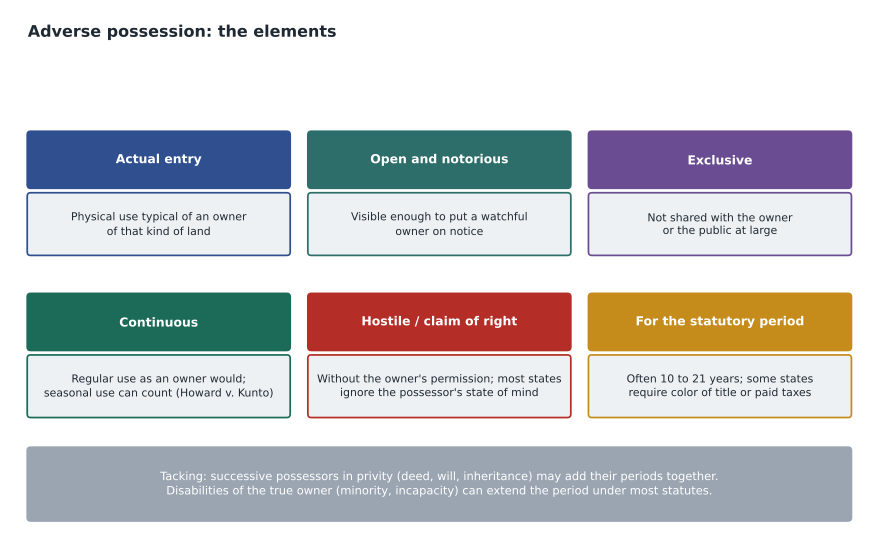
Actual possession means physical use of the land of the kind an owner would make, given the land's character. A residential lot is actually possessed by building on it, fencing it and maintaining it; wild woodland may be actually possessed by cutting timber or hunting regularly. Open and notorious possession is possession visible enough that an owner who inspected the land would notice it. In Marengo Cave Co. v. Ross, 212 Ind. 624 (1937), the owner of a commercial cave had for decades exhibited a part of the cave that lay under a neighbor's land. The Indiana Supreme Court held that the possession was not open and notorious because the neighbor had no reasonable way to know the cave extended under his property; secret possession cannot start the clock.
Exclusive possession means the possessor does not share control with the true owner or the general public; sharing with family or tenants is fine. Continuous possession means use as regular as an owner's would be, not use every day. Interruptions by the true owner, such as a successful re-entry or a lawsuit, stop the clock; a later possession must start over.
Hostility and the state of mind
The hostility element causes the most confusion. Possession is hostile if it is without the owner's permission; permission defeats adverse possession, because a tenant or licensee holds for the owner. Beyond that, states have taken three approaches to the possessor's state of mind. Under the objective standard, followed by most states, the possessor's state of mind is irrelevant: it does not matter whether the possessor knew the land belonged to someone else. Under the good-faith standard, the possessor must have believed in good faith that the land was theirs. Under the aggressive trespass standard, followed by few courts, the possessor must have known the land belonged to another and intended to take it anyway.
Mannillo v. Gorski, 54 N.J. 378 (1969), is the leading boundary case. The Gorskis' steps and concrete walk encroached about fifteen inches onto their neighbor's land. The New Jersey Supreme Court rejected the old rule that a possessor who mistakenly believed the land was theirs could not claim it, and adopted the objective standard. But it held that a minor encroachment along a boundary is not open and notorious unless the true owner actually knew of it, because a small intrusion is not obvious without a survey. In such cases the court may require the owner to convey the strip at fair value rather than order removal of the structure.
Van Valkenburgh v. Lutz, 304 N.Y. 95 (1952), shows how the elements can fail. William Lutz had for years used a vacant wooded lot near his home as a garden and built a shack there. The New York Court of Appeals held that he had not proved title, partly because his garden covered only part of the lot and because, in an earlier lawsuit, he had admitted that the lot belonged to others. New York has since amended its statute, in 2008, to provide that some de minimis uses, such as lawn mowing and plantings across a boundary, are deemed permissive and not adverse.
The statutory period and tacking
Statutory periods vary from as short as five years (California, with payment of taxes) to twenty-one years (Pennsylvania). Some states shorten the period for possessors with color of title or who pay taxes. Westmarch, in the Ashby files, has a ten-year period.
The possessor need not personally hold the land for the full period. Successive possessors may tack their periods together if they are in privity, meaning that the later possessor took possession by a voluntary transfer from the earlier one, such as a deed, will, inheritance or even an oral transfer. A trespasser who ousts another trespasser cannot tack. In Howard v. Kunto, 3 Wash. App. 393 (1970), a series of owners occupied a summer house that, because of a surveying mistake, sat on the lot next to the one described in their deeds. The Washington Court of Appeals held that summer-only use of a summer home was continuous, because that is how an owner would use it, and that the owners could tack because each had delivered possession of the house to the next, even though the deeds described different land.
The true owner's disabilities can extend the period. Most statutes give an owner who is a minor, legally incompetent or imprisoned when the possession begins additional time after the disability ends. Disabilities that arise after the clock starts do not count, and disabilities of later owners do not count.
Other ways boundary disputes are settled
Adverse possession is not the only doctrine that moves a boundary. Under the doctrine of agreed boundaries, neighbors who are uncertain about the true line and agree on a line, then occupy according to it, are bound by the agreement. Under acquiescence, a line both owners treat as the boundary for a long period, often the statutory period, becomes the legal line. Estoppel can bind an owner who points out a wrong line to a neighbor who builds in reliance on it. And many states have good-faith improver statutes, which let a court that finds an encroachment order the landowner to sell the land to the innocent improver at fair value, or order the improver to pay for the land, rather than requiring a garage or house to be torn down. These doctrines often resolve the cases that a survey turns up, like the Szabo strip, without the all-or-nothing result of adverse possession.
| Approach | What is required | Example |
|---|---|---|
| Objective (majority) | State of mind irrelevant; use without permission is enough | Mannillo v. Gorski (N.J. 1969) |
| Good faith | Possessor honestly believed the land was theirs | Some states by statute or case law |
| Aggressive trespass | Possessor knew the land was another's and intended to take it | A few older decisions |
| Permission | Defeats hostility under every approach | Tenants, licensees, co-owners without ouster |
Adverse possession of personal property and of government land
Chattels can be acquired by adverse possession too, but open and notorious possession of a painting or jewelry rarely gives the owner real notice. O'Keeffe v. Snyder, 83 N.J. 478 (1980), involved three Georgia O'Keeffe paintings stolen from a gallery in 1946 and found decades later. The New Jersey Supreme Court applied a discovery rule: the statute of limitations does not begin to run until the owner knows, or with reasonable diligence should know, of the cause of action and the identity of the possessor. An owner who diligently searches, for example by reporting the theft to an art loss registry, keeps the claim alive. New York takes a different approach, the demand and refusal rule, under which the period runs against a good-faith purchaser only after the owner demands return and is refused.
Land owned by the United States and, in most states, by state and local governments cannot be acquired by adverse possession. The Quiet Title Act and federal statutes protect federal land, and many states protect public land, including roads and parks, by statute.
Recent statutes on squatters
News stories about squatters occupying vacant houses led several states to change their procedures. Florida's 2024 law, enacted as House Bill 621, allows an owner to ask the county sheriff to remove an unauthorized person from a residential dwelling quickly if the owner swears that the person is not a tenant, family member or co-owner and was never authorized to be there; it also made false documents and damage by squatters crimes. Other states, including Georgia and New York, adopted similar rules for removing intruders. Vandermolen points out that these statutes deal with possession disputes over the short term; they do not change the elements of adverse possession, which still requires years of open possession without permission.
Back to the Szabo strip
Vandermolen gives the class the facts. In 2010, Dale Prentiss, who then owned the Szabo lot, built a two-car garage and fenced vegetable garden reaching up to the old wire fence, believing the fence marked the line. In 2014 he sold his lot to Victor Szabo by a deed that described only the record lot, not the strip. Prentiss handed Szabo the keys to the garage and showed him the garden. Szabo has used both every year since. Eleanor Ashby, who walked the property often, once complimented Prentiss on his tomatoes. No one asked anyone's permission.
Daniel works through the elements. Actual: a garage and fenced garden are the kind of use an owner makes. Open and notorious: a garage is about as visible as possession can be, and Eleanor saw it. Exclusive: only Prentiss and then Szabo used it. Continuous: the garage stood throughout, and gardening is seasonal by nature. Hostile: there was no permission, and under the objective standard it does not matter that Prentiss believed the fence was the line. Period: Prentiss possessed from 2010 to 2014 and Szabo from 2014 to 2025, a total of fifteen years, more than Westmarch's ten. Tacking: although the deed did not describe the strip, Prentiss delivered possession of it to Szabo, which is enough privity under Howard v. Kunto.
Margaret Cole's lawyer, Vandermolen adds, will argue Mannillo: if the encroachment was too minor for a reasonable owner to notice without a survey, it was not open and notorious. "Is fourteen feet with a garage on it minor?" she asks. Most of Section B says no. Paul Ashby, practical as ever, has already suggested selling Szabo the strip for a fair price and a recorded boundary-line agreement, which would avoid litigation. "That is how most of these end," Vandermolen says. "With a survey, a lawyer and a deed."
Worked problem
The seasonal dock
Since 2013, Victor Szabo has also put a small floating dock into Lake Callowhill each May and removed it each October, anchoring it to a post he set on the Ashby shoreline twenty feet past his line. He mows a path from his yard to the post. The Ashbys never objected. Has Szabo acquired the shoreline strip by adverse possession under a ten-year statute?
Show solution
- Actual and open: a dock, a post and a mowed path are visible uses of the kind an owner of lakefront land would make.
- Continuous: seasonal use can be continuous if it matches how an owner would use similar land, as Howard v. Kunto held for a summer home.
- Exclusive: if the Ashbys and the public also use the shoreline, exclusivity is doubtful; the facts must be developed.
- Hostile: no permission was given, so the possession is adverse under the objective standard.
- Scope: adverse possession reaches only the land actually possessed; a court may limit any title to the path and post area, or find only a prescriptive easement for access.
Answer: Szabo has a plausible claim, but it is weaker than his garage claim. Seasonal use can be continuous, yet exclusivity and the area actually possessed are contestable; a court might instead find a prescriptive easement to cross the shoreline to his dock.
Summary and key terms
- Adverse possession operates through statutes of limitations; when the period runs, the possessor acquires a new title.
- The elements are actual, open and notorious, exclusive, continuous and hostile possession for the statutory period; some states require color of title or payment of taxes.
- Secret possession does not start the clock (Marengo Cave); minor boundary encroachments may not be open and notorious without actual knowledge (Mannillo).
- Most states use an objective test for hostility; permission defeats a claim.
- Successive possessors in privity may tack (Howard v. Kunto); disabilities at the start of possession extend the period.
- Personal property claims often use a discovery rule (O'Keeffe v. Snyder); government land is usually exempt; recent squatter statutes speed removal of intruders without changing the doctrine.
Practice problems
Work each problem on paper first, then reveal the answer to check.
Why did the possession in Marengo Cave Co. v. Ross fail?
Show answer
It was not open and notorious: the neighbor could not reasonably have known that the exhibited cave extended under his land.
What did Mannillo v. Gorski hold about mistaken possessors?
Show answer
Their state of mind does not matter (objective standard), but a minor boundary encroachment is not open and notorious unless the owner actually knew of it.
Under Howard v. Kunto, why could the summer owners tack even though their deeds described the wrong lot?
Show answer
Each owner voluntarily delivered possession of the house to the next, which supplied privity; summer-only use of a summer home was also continuous.
What is the discovery rule of O'Keeffe v. Snyder?
Show answer
The limitations period for stolen personal property begins when the owner knows, or with reasonable diligence should know, of the claim and the possessor's identity.
Lesson quiz · 5 questions
Score 60% or more to complete this lesson.
Create a free account to save your progress, take quizzes and earn a certificate.