
LAWU-113 · Lesson 8 of 12 · 21 min
Easements
▶ Video coming soon A video version of this lesson is on the way.
A dirt lane runs from the Ashby farmhouse west across the Lund farm to County Road 9. Until 1961, Ashby Point and the Lund farm were a single 160-acre tract owned by Eleanor's father, Walter Ashby. That year he sold the western 120 acres to Arne and Ingrid Lund and kept the 40 lakeside acres. The deed said nothing about the lane, which Walter had used for years to haul hay and reach the county road. Ashby Point had no other road access until 1988, when the county built Lakeshore Drive along the north shore. The Ashbys kept using the lane anyway, for deliveries, firewood and, since 2019, for the propane truck. In April 2026, Karin Lund, Arne and Ingrid's daughter, put a locked gate across it. "Who wins?" Vandermolen asks. "It depends on how the easement was created, if it exists at all. There are five ways. Learn all five."
What an easement is
An easement is a nonpossessory right to use land owned by another, or to prevent the owner from making certain uses. The land burdened by the easement is the servient estate; the land benefited, if any, is the dominant estate. An affirmative easement lets the holder do something on the servient land, such as cross it, run a pipeline under it or fish in its pond. A negative easement lets the holder prevent the servient owner from doing something, such as building above a certain height. English law recognized only a few negative easements (light, air, support and water flow in an artificial stream); American law has been similarly cautious, and most modern restrictions on land use are created as covenants, studied next class, or as statutory conservation easements.
An easement appurtenant benefits a particular parcel and passes automatically with it; the right to use a lane to reach a farmhouse belongs to whoever owns the farmhouse. An easement in gross benefits a person or company without regard to land ownership, such as a utility's right to run power lines. Commercial easements in gross are freely transferable; personal ones traditionally were not. A profit, or profit a prendre, is a right to enter land and take something from it, such as timber, minerals or game. A license is permission to enter land, such as a ticket to a concert; it is revocable at will unless it has become irrevocable by estoppel or is coupled with an interest.
Express easements
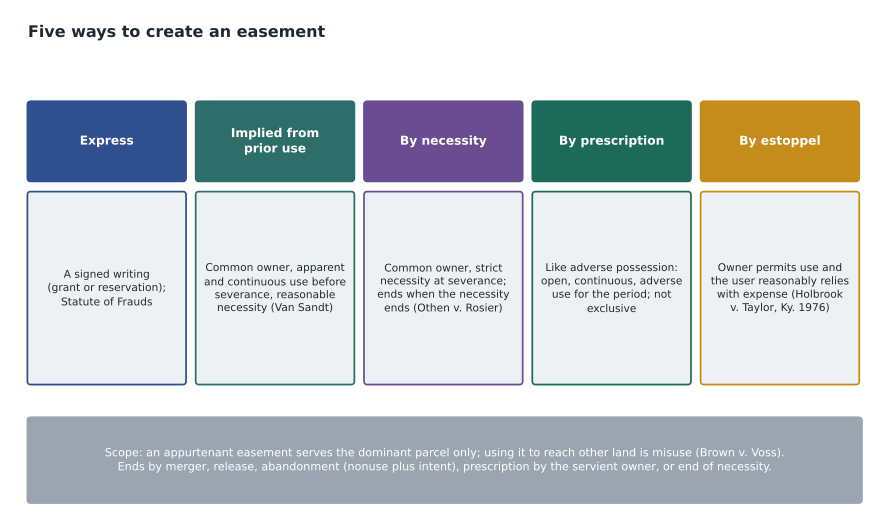
An express easement is created by a writing that satisfies the Statute of Frauds, usually a deed. It may be granted (the owner of the servient land conveys it to another) or reserved (an owner who sells land keeps an easement over it). At common law, a grantor could not reserve an easement in favor of a third party. Willard v. First Church of Christ, Scientist, 7 Cal. 3d 473 (1972), rejected that rule. Genevieve McGuigan owned two lots, one used for parking by the church across the street. When she sold the lot to Petersen, she insisted that the deed reserve an easement for the church's parking. Petersen sold to Willard by a deed that did not mention the easement. The California Supreme Court held that the reservation in favor of the church was valid, because the old rule served no purpose and would defeat the grantor's clear intent. Many, but not all, states follow Willard.
Implied easements: prior use and necessity
When an owner divides land, the law may imply an easement even though the deed is silent. An easement implied from prior use (sometimes called a quasi-easement) requires: (1) common ownership of the dominant and servient parcels; (2) a use of one part of the land for the benefit of the other that was apparent and continuous before the land was severed; and (3) reasonable necessity for the use after severance. Courts imply the easement because the parties probably assumed it would continue. In Van Sandt v. Royster, 148 Kan. 495 (1938), the plaintiff discovered that his basement had flooded with sewage from a lateral sewer line that ran under his lot from neighboring houses, built when the lots were in common ownership. The Kansas Supreme Court held that an easement for the sewer had been implied when the lots were divided: the line was apparent enough because a buyer would have known that modern houses have plumbing connections, even if the pipe itself was buried.
An easement by necessity requires (1) common ownership of the two parcels, (2) severance of that ownership, and (3) strict necessity at the time of severance, typically because the parcel sold or kept is landlocked. Prior use is not required. The easement lasts only as long as the necessity. In Othen v. Rosier, 148 Tex. 485 (1950), Othen claimed a road across his neighbor's land as his only way out. The Texas Supreme Court denied an easement by necessity because he could not show that the necessity existed when the common owner divided the land decades earlier, and denied a prescriptive easement because his use had been permissive and shared with the owner.
Section B applies these rules to the lane. Walter Ashby owned both parcels until 1961, satisfying common ownership. The lane was visible and regularly used to haul hay before the sale, satisfying apparent and continuous prior use. At severance, Ashby Point had no other road access, so the lane was more than reasonably necessary; it was strictly necessary. Marcus concludes that the Ashbys have both an implied easement from prior use and an easement by necessity, arising in 1961. "But what happened in 1988?" Vandermolen asks. Hannah sees it: when Lakeshore Drive was built, the necessity ended, and with it the easement by necessity. The easement implied from prior use, however, does not depend on continuing strict necessity, so it likely survives.
Prescriptive easements
An easement by prescription arises from use that resembles adverse possession: open and notorious, continuous, and adverse (without permission) for the statutory period. Exclusivity is usually not required in the same sense, because an easement holder shares the land with the owner, though many courts require that the claimant's use not depend on the owner's or public's similar use. Permission defeats a prescriptive claim, and many courts presume permission when the owner opened the way to the public or when neighbors share a road in a rural area. A few states, by statute, allow owners to prevent prescription by posting signs or recording notices.
The Ashbys' use of the lane since 1988 might independently support a prescriptive easement if it was not permissive. The Lunds will argue that they allowed the use as good neighbors, which makes it permissive and defeats prescription. Daniel, who loves facts, wants to know whether anyone ever asked permission. Margaret recalls that her mother sent the Lunds a ham every Christmas "for the lane." Vandermolen grins. "That ham may be the most important evidence in the case."
Easements by estoppel and irrevocable licenses
A license is ordinarily revocable, but a licensor who allows a licensee to spend substantial money or labor in reasonable reliance on the license may be estopped from revoking it. In Holbrook v. Taylor, 532 S.W.2d 763 (Ky. 1976), the Taylors used a road across the Holbrooks' land with their permission to build and reach a new house, spending about 25,000 dollars and maintaining the road. When the Holbrooks later blocked the road, Kentucky's highest court held that the Taylors had an easement by estoppel because they had relied on the permission to their detriment and the Holbrooks knew it. Courts disagree about how long such an easement lasts; some limit it to the period needed to recover the licensee's investment.
Scope, transfer and misuse
The scope of an express easement depends on the language and the parties' intent; the scope of an implied or prescriptive easement depends on the use that gave rise to it, with room for normal evolution. A lane used by horse-drawn wagons may now be used by cars and trucks, but not as a highway for a new subdivision. An appurtenant easement may be used only for the benefit of the dominant parcel. In Brown v. Voss, 105 Wash. 2d 366 (1986), the owner of a lot with an express access easement bought an adjacent lot and planned a house straddling both. The Washington Supreme Court agreed that extending the easement to benefit the new lot was a misuse, but it upheld the trial court's refusal to enjoin it, because the burden on the servient owner had not increased and an injunction would have left the new house without access. The decision is controversial; many courts would have granted the injunction.
The Ashbys' propane truck is heavier than a hay wagon, Vandermolen notes. Is that within the scope of a 1961 implied easement for farm use? Most courts would say that serving a farmhouse with fuel is a normal evolution of residential and agricultural access. Using the lane to reach a new subdivision on the north meadow would not be.
Ending an easement
Easements end by the terms of the grant, by merger (when one person comes to own both the dominant and servient estates), by written release, by abandonment (nonuse alone is not enough; the holder must intend to abandon, shown by conduct such as removing a bridge), by prescription (the servient owner adversely blocks the use for the statutory period), by estoppel, and, for easements by necessity, when the necessity ends. A taking by eminent domain of the servient estate can also extinguish the easement, with compensation to the holder.
Railroad rights-of-way show how much turns on classification. In Preseault v. United States, 100 F.3d 1525 (Fed. Cir. 1996), the federal Rails-to-Trails Act converted an abandoned railroad easement in Vermont into a recreational trail. The Federal Circuit held that the railroad held only an easement limited to railroad purposes, that the easement had been abandoned, and that the government's use of the land for a trail was a taking requiring compensation to the owners of the underlying fee. In Marvin M. Brandt Revocable Trust v. United States, 572 U.S. 93 (2014), the Supreme Court held that rights-of-way granted to railroads under an 1875 statute were easements, so when the railroad abandoned one, the land was freed of the burden and the landowner, not the United States, held it.
Light, air, views and conservation easements
American courts have refused to create negative easements for light, air or views by implication or prescription. In Fontainebleau Hotel Corp. v. Forty-Five Twenty-Five, Inc., 114 So. 2d 357 (Fla. Dist. Ct. App. 1959), the owners of the Eden Roc hotel in Miami Beach sought to stop the Fontainebleau from building a tower that would shade the Eden Roc's pool and beach in the afternoon. The court held that a landowner has no legal right to the free flow of light and air across a neighbor's land, absent an express easement or statute. Owners who want to protect a view or sunlight must bargain for an express easement or covenant, and some states protect solar access by statute.
Conservation easements are the main modern exception to American hostility to negative easements. Every state authorizes them by statute, many based on the Uniform Conservation Easement Act of 1981. A landowner grants a land trust or government agency a perpetual easement restricting development, farming practices or timber cutting, and the easement binds all later owners. Donating a qualified conservation easement can produce a federal income tax deduction, which has led to abuses; Congress in 2022 limited deductions for certain syndicated conservation easement transactions. The north meadow's future, Vandermolen observes, might be protected more durably by a conservation easement than by Eleanor's defeasible fee.
| Doctrine | Key requirement | Case |
|---|---|---|
| Reservation for a third party | Allowed where it carries out the grantor's intent (California and many states) | Willard v. First Church of Christ, Scientist |
| Implied from prior use | Apparent, continuous prior use; reasonable necessity | Van Sandt v. Royster |
| Necessity | Strict necessity at severance; ends with necessity | Othen v. Rosier |
| Estoppel | Detrimental reliance on permission | Holbrook v. Taylor |
| Misuse | Use for a non-dominant parcel; remedy may vary | Brown v. Voss |
| Abandonment and rail trails | Nonuse plus intent; trail use may be a taking | Preseault; Brandt |
Worked problem
The gate across the lane
Karin Lund locks a gate across the lane in April 2026 and offers the Ashbys a key for 2,000 dollars a year. The Ashbys sue for a declaration that they hold an easement and an injunction removing the gate. Evaluate their claims.
Show solution
- Express easement: none; the 1961 deed is silent.
- Implied from prior use: common ownership until 1961; the hay lane was apparent and continuous before severance; reasonable necessity existed then and arguably continues, since the lane is the practical route for heavy deliveries; the easement likely exists.
- Necessity: strict necessity existed in 1961, creating an easement by necessity, but it ended in 1988 when Lakeshore Drive gave access.
- Prescription: use since 1988 for more than ten years may qualify if adverse; the Lunds' argument that the use was neighborly permission, and the annual ham, may defeat it.
- Scope and remedy: propane deliveries are a normal evolution of residential access; a court may order the gate removed or require the Lunds to provide a key without charge.
Answer: The Ashbys' strongest claim is an easement implied from prior use created in 1961, which survives the end of necessity; the easement by necessity ended in 1988, and prescription depends on proving the use was not permissive.
Summary and key terms
- Easements are nonpossessory rights; they may be affirmative or negative, appurtenant or in gross; profits allow taking resources; licenses are revocable permissions.
- Express easements require a writing; many states allow reservation for a third party (Willard).
- Implied easements arise from apparent, continuous prior use with reasonable necessity (Van Sandt) or from strict necessity at severance, which ends when the necessity ends (Othen).
- Prescriptive easements require open, continuous, adverse use for the statutory period; permission defeats them.
- Reliance on a license can create an easement by estoppel (Holbrook).
- An appurtenant easement serves only the dominant land; remedies for misuse vary (Brown v. Voss).
- Easements end by merger, release, abandonment, prescription, estoppel or end of necessity; rail-trail conversions can be takings (Preseault; Brandt).
Practice problems
Work each problem on paper first, then reveal the answer to check.
What did Willard v. First Church of Christ, Scientist hold?
Show answer
A grantor may reserve an easement in favor of a third party, here the church's parking right, when that carries out the grantor's intent.
Why was the buried sewer line in Van Sandt v. Royster 'apparent'?
Show answer
A reasonable buyer would know a modern house has plumbing connections, so the use was discoverable on inspection even though the pipe was underground.
Why did Othen fail to establish an easement by necessity?
Show answer
He could not show that strict necessity existed when the common owner divided the land.
What did Brandt hold about railroad rights-of-way granted under the 1875 Act?
Show answer
They were easements, so when abandoned, the land was freed of the burden and belonged to the owner of the underlying fee, not the United States.
Lesson quiz · 5 questions
Score 60% or more to complete this lesson.
Create a free account to save your progress, take quizzes and earn a certificate.