
LAWU-113 · Lesson 1 of 12 · 21 min
Possession and acquisition
▶ Video coming soon A video version of this lesson is on the way.
Professor Esther Vandermolen begins the first Property class by putting a battered accordion file on the lectern. "These are the Ashby files," she says. "They are fictional, but every problem in them is one I saw in practice. Eleanor Ashby died in March 2025 at eighty-eight. She left a lake property in Westmarch, a duplex in Brennan Falls, a will drafted by a lawyer who should have known better, two children who do not agree about anything, and neighbors with long memories. By the end of the semester you will be able to answer every question in this file." Vandermolen spent ten years as a real estate litigator and six as underwriting counsel for a title insurance company before she began teaching. "Title insurers pay claims when lawyers forget the basics," she tells Section B. "My job is to make sure that is never you."
She writes a single question on the board: *What does it mean to own something?* Hannah Lindqvist suggests that ownership means you can do what you want with a thing. Daniel Reyes, who spent three years as a paralegal, says ownership means a court will back you up when someone takes it. Vandermolen nods at both. "Property is not a relationship between a person and a thing. It is a set of relationships among people with respect to a thing. The law gives an owner a bundle of rights: to possess, to use, to exclude, to transfer and to destroy, among others. Different estates, different co-owners and different neighbors can hold different sticks in the bundle. That is the whole course."
The bundle of rights and the right to exclude
The Supreme Court has called the right to exclude one of the most essential sticks in the bundle. Kaiser Aetna v. United States, 444 U.S. 164 (1979), used that phrase when it held that the government could not force a private marina owner to open a pond to the public without paying compensation. In Cedar Point Nursery v. Hassid, 594 U.S. 139 (2021), the Court relied on the same idea to hold that a California regulation giving union organizers access to farms for part of the year was a per se physical taking. State courts protect the right to exclude in private disputes too. In Jacque v. Steenberg Homes, 563 N.W.2d 154 (Wis. 1997), a mobile home company dragged a home across the Jacques' snowy field after being told not to; the Wisconsin Supreme Court upheld 100,000 dollars in punitive damages even though the actual damage was nominal, because the owner's right to say no deserved real protection.
The right to exclude has limits. Owners who open land to the public may have to admit people on reasonable terms, and some states protect access by farmworkers' advisers, as State v. Shack, 58 N.J. 297 (1971), held in New Jersey. Civil rights statutes forbid excluding people from public accommodations because of race and other protected traits. The right to exclude, like every stick in the bundle, is defined by law rather than by nature.
First possession: Pierson v. Post
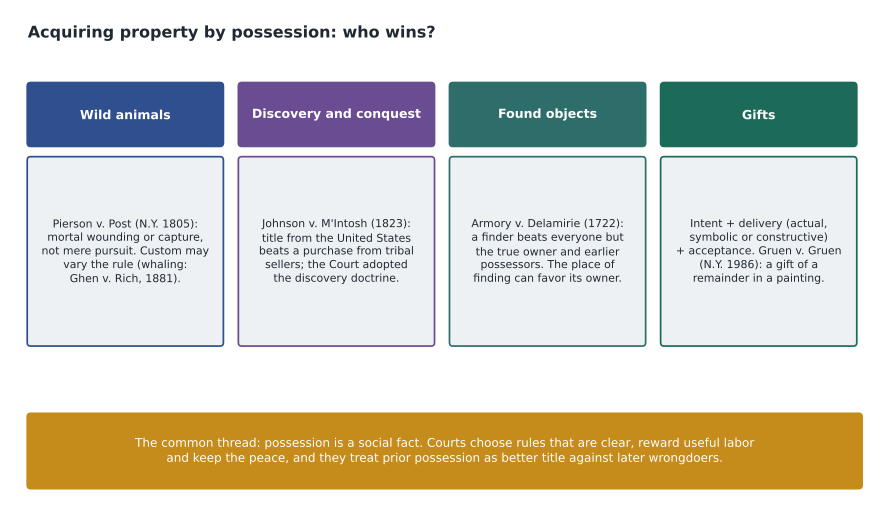
Most first-year Property courses begin with a fox. In Pierson v. Post, 3 Cai. R. 175 (N.Y. Sup. Ct. 1805), Post was hunting a fox with hounds on a beach on Long Island when Pierson, knowing the fox was being pursued, killed it and carried it off. Post sued. The majority held that pursuit alone gave Post no property in the fox. A wild animal becomes property only when the hunter deprives it of its natural liberty, by killing it, mortally wounding it while continuing pursuit, or trapping it. The majority valued certainty: a rule based on capture is easy to apply and avoids endless quarrels. Justice Livingston dissented, arguing that hunters' custom should decide and that a rule rewarding the pursuer would better encourage the killing of foxes, which he called noxious beasts.
Custom has sometimes prevailed. In Ghen v. Rich, 8 F. 159 (D. Mass. 1881), a whaler killed a fin-back whale with a bomb lance; the whale sank and washed ashore three days later, where a man found it and sold the blubber. The court applied the custom of the Cape Cod whaling industry, under which the whale belonged to the whaler whose lance was found in it, because without that rule the industry could not survive. Popov v. Hayashi, 2002 WL 31833731 (Cal. Super. Ct. Dec. 18, 2002), addressed Barry Bonds' record-setting home run ball: Popov had the ball in his glove when a mob knocked him down, and Hayashi emerged with it. The court held that Popov had a pre-possessory interest and that the fair solution was to sell the ball and divide the proceeds equally.
Vandermolen asks the class why these cases matter for land. Marcus Webb, who worked at a battery-storage startup before law school, points out that the same choice between clear rules and fuzzy standards shows up everywhere: in groundwater, oil and gas, and even radio spectrum. Oil and gas law once treated oil as "fugitive" like a wild animal, giving rise to the rule of capture, under which a landowner owns what he pumps from beneath his land even if it drains a neighbor's pool. States later adopted well spacing and correlative-rights rules because pure capture caused waste.
Discovery and conquest: Johnson v. M'Intosh
The first possession rule has a darker side. In Johnson v. M'Intosh, 21 U.S. (8 Wheat.) 543 (1823), the plaintiffs claimed land in what is now Illinois through purchases made from the Piankeshaw and Illinois nations in 1773 and 1775. The defendant claimed the same land through a later grant from the United States. Chief Justice Marshall held that the defendant's title prevailed. Under the doctrine of discovery, he wrote, the European nation that discovered land acquired the exclusive right to extinguish the Indian title of occupancy by purchase or conquest; the United States succeeded to that right. Tribes retained a right of occupancy but could not convey title to private purchasers.
Marshall acknowledged that the doctrine might seem extravagant but said courts of the conqueror could not question it. The case remains good law on the federal government's exclusive power to acquire tribal land, and federal statutes since the Nonintercourse Act of 1790 have barred purchases of tribal land without federal approval. It is also widely criticized. Jordan Kimura notes that the Supreme Court, in City of Sherrill v. Oneida Indian Nation, 544 U.S. 197 (2005), cited the doctrine while denying a tribe's attempt to restore sovereignty over reacquired land. Vandermolen adds that modern property law also includes tribal land held in trust by the United States, which follows special federal rules. "Every chain of title in the United States starts somewhere," she says. "Know where."
Finders
Finders' cases teach the idea of relative title: in most disputes, the question is not who owns the thing against the world but who has the better claim between the two parties in court. In Armory v. Delamirie, 1 Strange 505 (K.B. 1722), a chimney sweep's boy found a jewel and took it to a goldsmith's shop to be valued. The apprentice removed the stones and offered the boy a trifle. The court held that the finder, though not the owner, had a property interest good against everyone but the rightful owner, and awarded damages measured by the value of the finest jewel that would fit the socket.
Where the item is found matters. Courts traditionally distinguish lost property (accidentally parted with), mislaid property (intentionally placed somewhere and then forgotten) and abandoned property (intentionally relinquished). In McAvoy v. Medina, 93 Mass. (11 Allen) 548 (1866), a customer found a pocketbook on a table in a barbershop. The court held that the pocketbook was mislaid, not lost, so the shop owner had the better right to keep it for the true owner, who would likely return to the place where she had set it down. In Hannah v. Peel, [1945] K.B. 509, a soldier billeted in a house found a brooch in a window frame. The owner of the house had never lived there. The court awarded the brooch to the soldier, because the owner had never possessed the house or known of the brooch.
Objects embedded in the soil usually go to the landowner, on the theory that the owner possesses everything in the land. Treasure trove, gold or silver coins or bullion hidden long ago, went to the finder under the traditional English rule, but American courts are divided and many states have replaced these categories with statutes. A typical lost-property statute requires the finder to turn the item over to the police, advertise it, and wait a set period; if no owner appears, title vests in the finder.
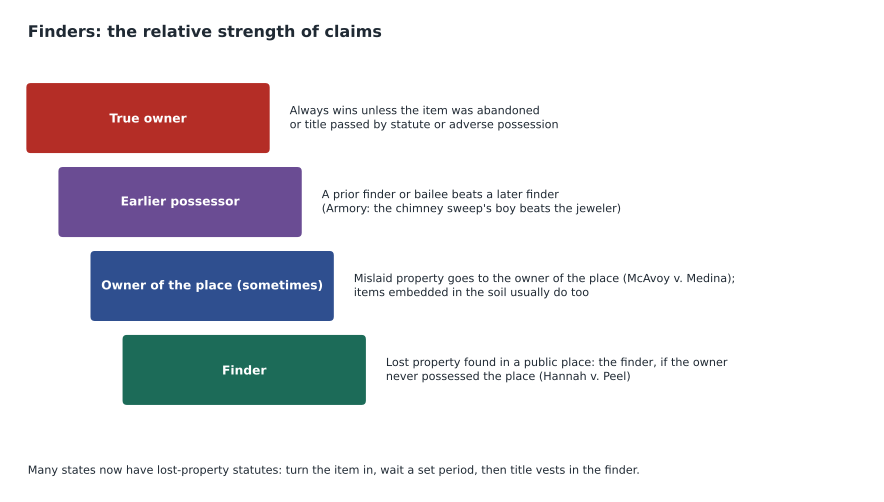
Vandermolen opens the Ashby file. In April 2025, while clearing the boathouse at Ashby Point, Eleanor's grandson Owen Cole pried up a loose floorboard and found a rusted tin holding forty gold coins dated between 1908 and 1927. The same weekend, his sister Lily found a diamond ring in the gravel of the county's public boat launch next door. Daniel argues that the coins belong to the estate as the landowner, because they were deliberately hidden in the building, and that the ring belongs to Lily unless the owner turns up. Priya Natarajan points out that Westmarch's fictional lost-property statute would require Lily to turn the ring in to the sheriff and wait ninety days. "Good," Vandermolen says. "Notice that neither answer depends on who is the more deserving person. It depends on categories that are supposed to predict where the owner will look."
Gifts
A gift of personal property requires three things: donative intent, delivery and acceptance. Delivery is the element that causes trouble. Courts accept actual delivery of the thing itself, constructive delivery of a means of access such as a key, and symbolic delivery of something that represents the item, such as a signed writing. The requirement protects donors against hasty promises and protects courts against fabricated claims, because a promise to make a gift in the future is unenforceable without consideration.
In Gruen v. Gruen, 68 N.Y.2d 48 (1986), a father wrote letters to his son giving him a Klimt painting while keeping the right to possess it for life. After the father died, his widow argued that there had been no delivery. The New York Court of Appeals held that the father had made a valid present gift of a remainder interest, keeping a life estate for himself; physical delivery of the painting was impractical and unnecessary, because the father intended to keep possession, and the letters were sufficient symbolic delivery. Gifts causa mortis, made in contemplation of imminent death, are revocable if the donor recovers. Newman v. Bost, 122 N.C. 524 (1898), refused to find a gift of furniture in a house when a dying man handed over keys to a bureau, because delivery of keys was effective only for the bureau's contents.
The Ashby file has its own gift. In 2015 Eleanor wrote to her granddaughter Chloe: "I want you to have Grandpa's watercolor of the lake. It is yours now, though I would like it to stay over the fireplace while I live." The painting was still on the wall when Eleanor died. Paul Ashby, Chloe's father, says it belongs to Chloe. Margaret says it passed under the residuary clause of the will. Hannah applies Gruen: the letter shows a present intent to give a remainder, and the letter itself is a symbolic delivery of that interest. "And acceptance?" Vandermolen asks. "Presumed when the gift is beneficial," Hannah says.
| Setting | Rule | Leading authority |
|---|---|---|
| Wild animals | Capture or mortal wounding with continued pursuit; custom may govern an industry | Pierson v. Post; Ghen v. Rich |
| Contested catch | A pre-possessory interest may justify dividing the value | Popov v. Hayashi |
| Tribal land | Only the United States could extinguish Indian title of occupancy | Johnson v. M'Intosh |
| Finders | Finder beats all but the true owner and prior possessors | Armory v. Delamirie |
| Mislaid items | Owner of the place holds for the true owner | McAvoy v. Medina |
| Lost items, absent owner of place | Finder may prevail | Hannah v. Peel |
| Gifts | Intent, delivery (actual, constructive, symbolic), acceptance | Gruen v. Gruen |
Worked problem
The ring at the boat launch
Lily Cole finds a diamond ring in the gravel of a county-owned public boat launch on Lake Callowhill. She shows it to a park employee, who demands it, saying the county owns everything found on county land. Lily refuses and gives it to the sheriff under Westmarch's lost-property statute. Ninety days later no owner has claimed it. Who has the better claim, Lily or the county?
Show solution
- Classify the item: a ring in loose gravel at a boat launch was probably dropped accidentally, so it is lost rather than mislaid.
- Apply the common law: for lost items in a public place open to all, the finder usually prevails over the owner of the place, unless the item was embedded in the soil or the owner had exclusive possession of the area.
- Apply the statute: Lily followed the procedure, and after the waiting period title vests in the finder.
- Consider the county's argument: it may claim that employees' finds belong to the employer or that its ordinance governs, but Lily is not an employee and the statute controls.
Answer: Lily has the better claim. The ring was lost, not mislaid, in a place open to the public, and she complied with the lost-property statute, so title vests in her after the waiting period.
Summary and key terms
- Property is a set of relationships among people about things; owners hold a bundle of rights, of which the right to exclude is among the most important (Kaiser Aetna; Jacque; Cedar Point).
- Pierson v. Post chose a clear capture rule for wild animals; custom can supply the rule for an industry (Ghen v. Rich); Popov divided a contested home run ball.
- Johnson v. M'Intosh held that only the United States could acquire tribal land, adopting the doctrine of discovery; it remains law and remains controversial.
- Finders win against everyone except the true owner and earlier possessors (Armory); mislaid property goes to the owner of the place (McAvoy); statutes now govern many finds.
- A gift requires intent, delivery and acceptance; a gift of a remainder with a retained life estate is valid with symbolic delivery (Gruen).
Practice problems
Work each problem on paper first, then reveal the answer to check.
Why did the majority in Pierson v. Post deny Post any property in the fox?
Show answer
Pursuit alone did not deprive the fox of its natural liberty; only capture or mortal wounding with continued pursuit does, and a clear rule avoids quarrels.
What did Johnson v. M'Intosh hold about purchases of land from tribes?
Show answer
Private purchasers could not acquire title from tribes; under the discovery doctrine only the United States could extinguish the Indian right of occupancy.
How does mislaid property differ from lost property in the finders' cases?
Show answer
Mislaid property was intentionally set down and forgotten, so the owner of the place keeps it for the true owner; lost property was accidentally dropped and may go to the finder.
Why was there a valid gift in Gruen v. Gruen without physical delivery?
Show answer
The father gave a remainder while keeping a life estate, so handing over the painting was not required; his letters were adequate symbolic delivery.
Lesson quiz · 5 questions
Score 60% or more to complete this lesson.
Create a free account to save your progress, take quizzes and earn a certificate.