
LAWU-113 · Lesson 11 of 12 · 21 min
Zoning and takings
▶ Video coming soon A video version of this lesson is on the way.
At the very tip of Ashby Point sits a narrow wooded parcel of four tenths of an acre, called the point lot. Eleanor bought it separately in 1975 from a neighbor and always talked about building a small cabin there. In 2025, Merrin County adopted a Shoreland Protection Ordinance forbidding new structures within 150 feet of the lake's ordinary high-water mark, to protect water quality and the lake's loon nesting areas. Almost all of the point lot lies within 150 feet of the water. In 2026, the county denied Paul and Margaret a permit to build a cabin there. The same month, when they applied to rebuild the collapsing boathouse on the main parcel, the county said it would grant the permit only if they dedicated a ten-foot public walking easement along their shoreline and paid a 15,000-dollar shoreline impact fee set by a county fee schedule. "Public land use law," Vandermolen says, "is where property meets constitutional law. Today we cover the tools governments use and the limits the Fifth Amendment places on them."
The rise of zoning
Before zoning, the main legal tool for controlling incompatible land uses was nuisance law, which allows a landowner to recover damages or an injunction against a neighbor's unreasonable and substantial interference with the use and enjoyment of land. Nuisance law is reactive and unpredictable, and cities began to regulate land use in advance. New York City adopted the first comprehensive zoning ordinance in 1916. The Department of Commerce published the Standard State Zoning Enabling Act in the 1920s, which most states adopted in some form.
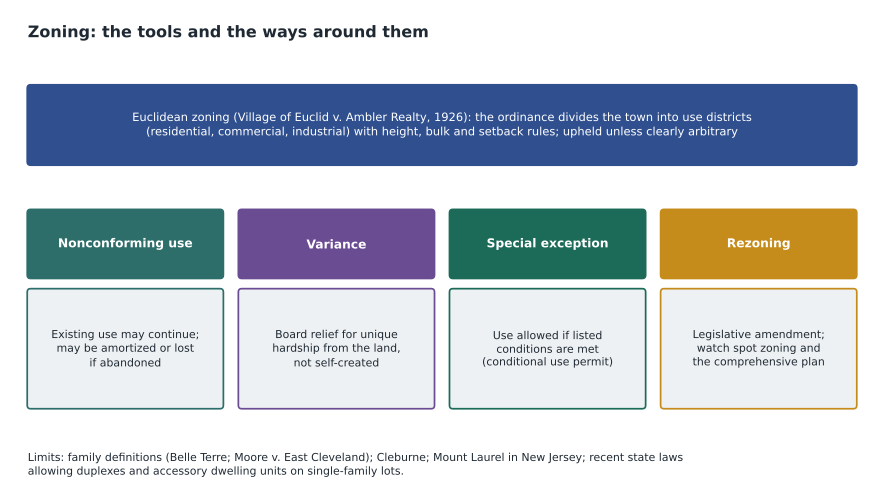
In Village of Euclid v. Ambler Realty Co., 272 U.S. 365 (1926), Ambler Realty owned 68 acres in a Cleveland suburb and challenged an ordinance that zoned part of its land for residential use, reducing its value for industry. The Supreme Court upheld the ordinance against a due process challenge, holding that zoning is a valid exercise of the police power unless clearly arbitrary and unreasonable, having no substantial relation to public health, safety, morals or general welfare. The opinion described apartment houses in single-family neighborhoods as "mere parasites," a phrase that has drawn heavy criticism for its role in entrenching exclusionary zoning.
How zoning works
A typical Euclidean ordinance divides the municipality into districts, residential, commercial, industrial and so on, with permitted uses and rules on height, bulk, lot size and setbacks. Several tools provide flexibility. A nonconforming use, which existed lawfully before the ordinance, may usually continue but not expand; some ordinances require it to end after an amortization period, which most courts uphold if reasonable, though Pennsylvania rejected amortization in PA Northwestern Distributors, Inc. v. Zoning Hearing Board, 526 Pa. 186 (1991). A variance, granted by a board of adjustment, allows a deviation from the ordinance when strict application would cause unnecessary hardship arising from the property's unique characteristics, not created by the owner, and the variance would not harm the neighborhood. A special exception or conditional use permit allows a listed use when stated conditions are met. Rezoning is a legislative act amending the map; it must be consistent with the comprehensive plan and may be challenged as spot zoning when it singles out a small parcel for special treatment.
Limits on exclusionary zoning
Zoning can be used to keep people out. In Village of Belle Terre v. Boraas, 416 U.S. 1 (1974), the Court upheld an ordinance limiting land use to single-family dwellings and defining "family" to exclude more than two unrelated people living together, as a rational way to preserve quiet neighborhoods. But in Moore v. City of East Cleveland, 431 U.S. 494 (1977), it struck down an ordinance that made it a crime for a grandmother to live with two grandsons who were cousins, because the definition intruded on the extended family, protected by substantive due process. In City of Cleburne v. Cleburne Living Center, 473 U.S. 432 (1985), the Court held that requiring a special permit for a group home for people with intellectual disabilities, while not requiring one for similar uses, rested on irrational prejudice and failed rational basis review.
State courts and legislatures have gone further. In Southern Burlington County NAACP v. Township of Mount Laurel, 67 N.J. 151 (1975), the New Jersey Supreme Court held that developing municipalities must make realistically possible a fair share of the region's need for low- and moderate-income housing, and later cases and the state's Fair Housing Act built an enforcement system around that duty. More recently, several states have overridden single-family-only zoning: Oregon in 2019 and California in 2021 required many cities to allow duplexes or lot splits on single-family lots, and many states now require local governments to allow accessory dwelling units. Westmarch, in the Ashby files, adopted such a law in 2025, which is why Margaret can add a small rental apartment above the farmhouse garage without a variance.
The Takings Clause
The Fifth Amendment provides: "nor shall private property be taken for public use, without just compensation." The clause applies to the states through the Fourteenth Amendment. It permits the government to take property by eminent domain for public use but requires payment of just compensation, usually fair market value. It also applies when the government takes property without formal condemnation, through physical invasion or regulation; the owner may then sue for compensation in an inverse condemnation action. Since Knick v. Township of Scott, 588 U.S. 180 (2019), owners may bring takings claims against local governments directly in federal court without first seeking compensation in state court.
Public use has been read broadly. Berman v. Parker, 348 U.S. 26 (1954), upheld condemnation for urban renewal, and Hawaii Housing Authority v. Midkiff, 467 U.S. 229 (1984), upheld transfers of land from large landowners to tenants to break up a concentrated market. In Kelo v. City of New London, 545 U.S. 469 (2005), the Court, five to four, upheld the city's condemnation of homes for a waterfront development plan expected to create jobs and tax revenue, holding that economic development is a public purpose. The decision prompted a strong backlash, and most states adopted statutes or constitutional amendments limiting condemnation for economic development.
Regulatory takings
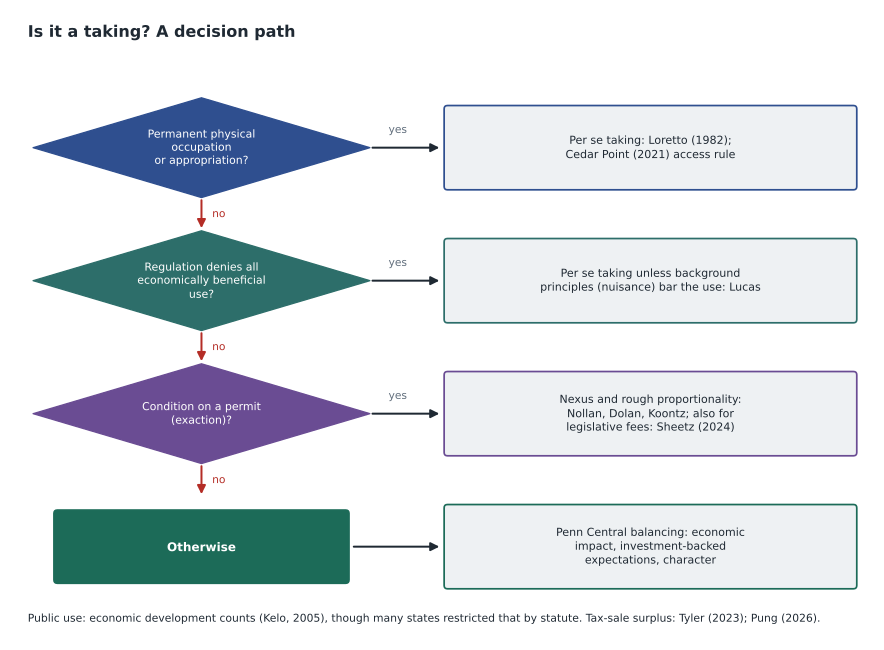
The idea that a regulation can go so far as to become a taking began with Pennsylvania Coal Co. v. Mahon, 260 U.S. 393 (1922), in which Justice Holmes held that a statute forbidding coal mining that caused subsidence under houses, which made it commercially impracticable to mine coal the company had expressly reserved, was a taking. "While property may be regulated to a certain extent," he wrote, "if regulation goes too far it will be recognized as a taking." Most regulatory takings claims today are decided under Penn Central Transportation Co. v. New York City, 438 U.S. 104 (1978), which upheld New York's denial of permission to build a tower above Grand Central Terminal under its landmarks law. The Court weighed the economic impact of the regulation, the extent to which it interfered with distinct investment-backed expectations, and the character of the government action. Few owners win under Penn Central.
Two categories are per se takings. A permanent physical occupation, however small, is a taking: Loretto v. Teleprompter Manhattan CATV Corp., 458 U.S. 419 (1982), involved a law requiring landlords to allow cable boxes and wires on their buildings. Cedar Point Nursery v. Hassid, 594 U.S. 139 (2021), extended the per se rule to a regulation granting union organizers access to farms three hours a day for 120 days a year, holding that the government had appropriated a right to invade, whether or not the access was permanent. And a regulation that deprives land of all economically beneficial use is a taking unless the use was already forbidden by background principles of state property and nuisance law: Lucas v. South Carolina Coastal Council, 505 U.S. 1003 (1992), involved a beachfront owner barred from building houses on two lots by a coastal protection statute passed after he bought them.
Later cases refined these rules. Palazzolo v. Rhode Island, 533 U.S. 606 (2001), held that buying land after a regulation was adopted does not automatically bar a takings claim. Tahoe-Sierra Preservation Council v. Tahoe Regional Planning Agency, 535 U.S. 302 (2002), held that a temporary moratorium on development was not a per se taking and must be analyzed under Penn Central. Lingle v. Chevron U.S.A. Inc., 544 U.S. 528 (2005), rejected the idea that a regulation is a taking simply because it fails to substantially advance a legitimate state interest. Murr v. Wisconsin, 582 U.S. 383 (2017), addressed the denominator problem: when the Murr family owned two adjacent riverfront lots and a local rule merged them for development purposes, the Court considered the two lots together as the relevant parcel and held there was no taking.
Exactions
Governments often grant permits on conditions. The Court has held that such conditions are subject to heightened scrutiny when the government demands property or money as the price of a permit. In Nollan v. California Coastal Commission, 483 U.S. 825 (1987), the commission required beachfront owners to dedicate a public walking easement along their beach as a condition of rebuilding their house; the Court held that there was no essential nexus between the condition (lateral beach access) and the harm caused by the house (blocking the view of the ocean from the road). Dolan v. City of Tigard, 512 U.S. 374 (1994), added that the condition must be roughly proportional, by an individualized determination, to the project's impact. Koontz v. St. Johns River Water Management District, 570 U.S. 595 (2013), applied the test to demands for money and to permit denials based on refusal to meet a condition. Sheetz v. County of El Dorado, 601 U.S. 267 (2024), held that the test applies to conditions imposed by legislation, such as a county's traffic impact fee schedule, not only to conditions imposed ad hoc by administrators.
Tax foreclosure and the surplus
In Tyler v. Hennepin County, 598 U.S. 631 (2023), a Minnesota county seized a ninety-four-year-old woman's condominium for about 15,000 dollars in unpaid taxes, sold it for 40,000 dollars and kept the surplus. A unanimous Court held that keeping the surplus was a taking. In Pung v. Isabella County, decided on June 23, 2026, the Court addressed how to measure what the owner is owed. Justice Alito's opinion held that just compensation is measured by the price obtained at a fairly conducted tax sale, not the property's higher fair market value; a home assessed at 194,000 dollars had sold for 76,000. The Court rejected an Eighth Amendment excessive-fines claim and sent the case back to decide whether the sale was conducted fairly.
The Ashby permits
Section B takes the county's actions one at a time. The point lot: Paul argues that the shoreland rule leaves it with no economically beneficial use, a Lucas taking. The county answers, citing Murr, that the point lot should be considered together with the adjacent Ashby Point land the family owns, so the regulation leaves substantial value; it also argues that protecting water quality may reflect background principles of public nuisance law and the public trust. Jordan notes that if the point lot is treated alone, Lucas looks strong; if it is merged, Penn Central applies and the family likely loses. "Murr makes that a multifactor question," Vandermolen says: "state and local treatment of the lots, their physical characteristics, and the value of the property under the regulation."
The boathouse permit: the walking easement looks like Nollan all over again. Rebuilding an existing boathouse in the same footprint does not obviously create a need for public lateral access along the shore; without a nexus, the condition is unconstitutional, and even with one, Dolan requires rough proportionality. The 15,000-dollar fee set by a county schedule must also satisfy Nollan and Dolan after Sheetz; the county must show that the fee is related and roughly proportional to the boathouse's impact on the shoreline. Priya suggests that a fee for erosion control during construction might pass, while a fee for unrelated parks would not.
| Category | Rule | Cases |
|---|---|---|
| Public use | Broad; economic development counts (many states restrict) | Berman; Midkiff; Kelo |
| Regulation going too far | Ad hoc balancing | Pennsylvania Coal; Penn Central |
| Physical occupation or appropriation | Per se taking | Loretto; Cedar Point |
| Total wipeout | Per se taking unless background principles | Lucas |
| Relevant parcel | Multifactor test | Murr |
| Exactions | Essential nexus and rough proportionality, including money and legislation | Nollan; Dolan; Koontz; Sheetz |
| Tax-sale surplus | Keeping the surplus is a taking; measured by fair sale price | Tyler (2023); Pung (2026) |
Worked problem
The loon nesting moratorium
In spring 2026 the county also imposed an eighteen-month moratorium on all construction within 300 feet of Lake Callowhill while it studied loon nesting areas. A neighbor whose house construction was halted sues, claiming a per se taking for the eighteen months. Evaluate the claim.
Show solution
- Identify the test: a temporary moratorium is not a physical appropriation or a permanent total wipeout.
- Tahoe-Sierra: temporary development moratoria are analyzed under Penn Central, considering the whole time span of the property interest, not just the moratorium period.
- Penn Central factors: economic impact of an eighteen-month delay, interference with investment-backed expectations (a halted project), and the character of the action (a planning pause to protect wildlife).
- Prediction: most such claims fail, though a moratorium that is extended repeatedly or imposed in bad faith could be different.
Answer: The claim is unlikely to succeed. Under Tahoe-Sierra, a temporary moratorium is not a per se taking, and a reasonable eighteen-month planning pause will usually survive Penn Central balancing.
Summary and key terms
- Euclid upheld comprehensive zoning as a police power measure unless clearly arbitrary; nonconforming uses, variances, special exceptions and rezoning provide flexibility.
- Belle Terre upheld a narrow family definition; Moore protected the extended family; Cleburne struck an irrational group home permit; Mount Laurel and recent state laws attack exclusionary zoning.
- The Takings Clause requires just compensation for takings for public use; public use includes economic development (Kelo), though many states limit it; Knick opened federal courts.
- Regulatory takings are judged under Penn Central, with per se rules for physical occupations and appropriations (Loretto; Cedar Point) and total wipeouts (Lucas).
- Murr governs the relevant parcel; Tahoe-Sierra treats temporary moratoria under Penn Central.
- Exactions require nexus and rough proportionality (Nollan; Dolan), including money (Koontz) and legislative fees (Sheetz).
- Keeping a tax-sale surplus is a taking (Tyler); compensation is measured by a fair sale price (Pung, 2026).
Practice problems
Work each problem on paper first, then reveal the answer to check.
What did Village of Euclid v. Ambler Realty hold?
Show answer
Comprehensive zoning is a valid exercise of the police power unless clearly arbitrary and unreasonable, without substantial relation to public health, safety, morals or welfare.
Why was the regulation in Cedar Point Nursery a per se taking?
Show answer
It appropriated a right to physically invade the growers' property, even though the access was limited in time.
What did Sheetz v. County of El Dorado add to exaction law?
Show answer
Nollan and Dolan apply to permit conditions imposed by legislation, such as fee schedules, not only to ad hoc administrative conditions.
How did Pung v. Isabella County measure compensation for a tax-sale surplus?
Show answer
By the price obtained at a fairly conducted tax sale, not the property's fair market value, leaving the fairness of the sale for remand.
Lesson quiz · 5 questions
Score 60% or more to complete this lesson.
Create a free account to save your progress, take quizzes and earn a certificate.