
LAWU-113 · Lesson 10 of 12 · 21 min
Land transactions, recording acts and title
▶ Video coming soon A video version of this lesson is on the way.
Vandermolen holds up a sheet of yellowed paper in a plastic sleeve. "In 2017, Eleanor Ashby signed and handed this deed to her nephew Simon Pryor. It gives him the two-acre orchard lot at the south edge of Ashby Point. Simon put it in a desk drawer and never recorded it. He has kept beehives on the orchard lot and mowed it ever since." In May 2026, not knowing about the deed, Paul and Margaret sold the orchard lot to Ben Ortiz for 85,000 dollars by a general warranty deed. Ortiz's title search showed record title in Eleanor. He recorded his deed on May 20, 2026. Simon, hearing of the sale, recorded his deed on June 3. "Two deeds to the same land from what appear to be the same source," Vandermolen says. "This is what recording acts are for, and what title insurance is for when they fail."
The contract of sale
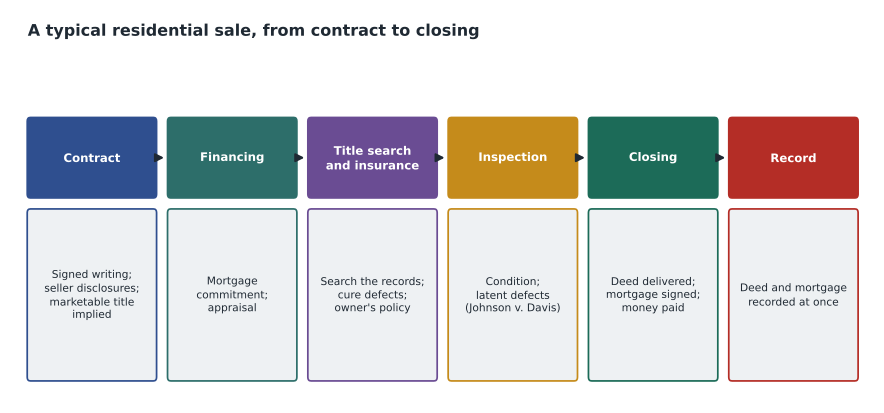
A typical sale of land proceeds in two stages: a contract, signed after the parties agree on price and terms, and a closing, at which the seller delivers a deed and the buyer pays. Between the two, the buyer arranges financing, searches title, buys title insurance and inspects the property. The Statute of Frauds requires the contract to be in a writing signed by the party to be charged, identifying the parties and the land and stating the price. Courts recognize exceptions, especially part performance (the buyer takes possession, pays some of the price or makes improvements) and equitable estoppel. In Hickey v. Green, 14 Mass. App. Ct. 671 (1982), a seller orally agreed to sell a lot and accepted a deposit check; relying on the deal, the buyers sold their own home. When the seller backed out for a higher offer, the Massachusetts Appeals Court ordered specific performance, finding that the buyers' reliance made it unconscionable to raise the statute.
Every contract of sale carries an implied promise that the seller will convey marketable title at closing: title reasonably free from doubt, which a prudent buyer would accept, and which does not expose the buyer to litigation. In Lohmeyer v. Bower, 170 Kan. 442 (1951), the buyers of a house discovered that it violated a recorded restriction requiring two-story houses and a zoning ordinance setback; the Kansas Supreme Court held that the existing violations made title unmarketable and allowed the buyers to rescind, though the mere existence of zoning ordinances or restrictions would not.
Disclosure and the condition of the property
The old rule of caveat emptor put the risk of defects on the buyer, unless the seller actively concealed them or lied. Most states now require sellers of residential property to disclose known material defects, by statute and often on a standard form. In Johnson v. Davis, 480 So. 2d 625 (Fla. 1985), sellers told buyers that a roof had no problems when they knew it leaked; the Florida Supreme Court held that a seller of a home who knows of facts materially affecting its value that are not readily observable by the buyer must disclose them. Stambovsky v. Ackley, 169 A.D.2d 254 (N.Y. App. Div. 1991), added a famous twist: a seller who had promoted her house in the press and in a magazine as haunted could not hide behind caveat emptor when the buyer, an outsider, had no way to discover the house's reputation; the court allowed rescission. Builders of new homes are subject to an implied warranty of quality in most states.
Under the doctrine of equitable conversion, when the contract is signed the buyer becomes the equitable owner and the seller holds legal title in trust as security for the price. Traditionally, that meant the buyer bore the risk of loss if the house burned before closing. Many states have changed the rule by statute, often adopting the Uniform Vendor and Purchaser Risk Act, which leaves the risk on the seller until the buyer takes possession or legal title.
Deeds and their warranties
A deed must identify the parties and the land, contain words of conveyance and be signed by the grantor. It takes effect on delivery, meaning the grantor's intent that it be presently effective, usually shown by handing it to the grantee. Recording is not required for a deed to be valid between the parties; Simon's deed was effective in 2017 when Eleanor handed it to him, so from that moment Eleanor no longer owned the orchard lot.
Deeds differ in the promises they make. A general warranty deed contains six covenants of title. The present covenants, broken if at all at the moment of delivery, are the covenant of seisin (the grantor owns the estate conveyed), the covenant of the right to convey, and the covenant against encumbrances. The future covenants, which run with the land and are broken only when the grantee is disturbed, are the covenants of general warranty and quiet enjoyment (to defend against lawful claims) and the covenant of further assurances. A special warranty deed covers only defects arising while the grantor owned the land, and a quitclaim deed makes no promises at all. In Brown v. Lober, 75 Ill. 2d 547 (1979), buyers discovered that a prior owner held two thirds of the mineral rights; the covenant of seisin had been broken at delivery more than ten years earlier and was time-barred, but the Illinois Supreme Court held that the covenant of quiet enjoyment had not been broken because the mineral owner had not yet asserted the rights.
The recording system
Every county keeps public land records in which deeds, mortgages, easements and other instruments may be recorded and indexed, usually by the names of grantors and grantees, and in some places by parcel. Recording gives constructive notice of the instrument to later purchasers. Recording acts decide disputes between competing claimants who derive title from the same grantor. Without them, the common law rule of first in time, first in right would apply: Simon's 2017 deed would beat Ortiz's 2026 deed, because Eleanor had nothing left to pass to her children.
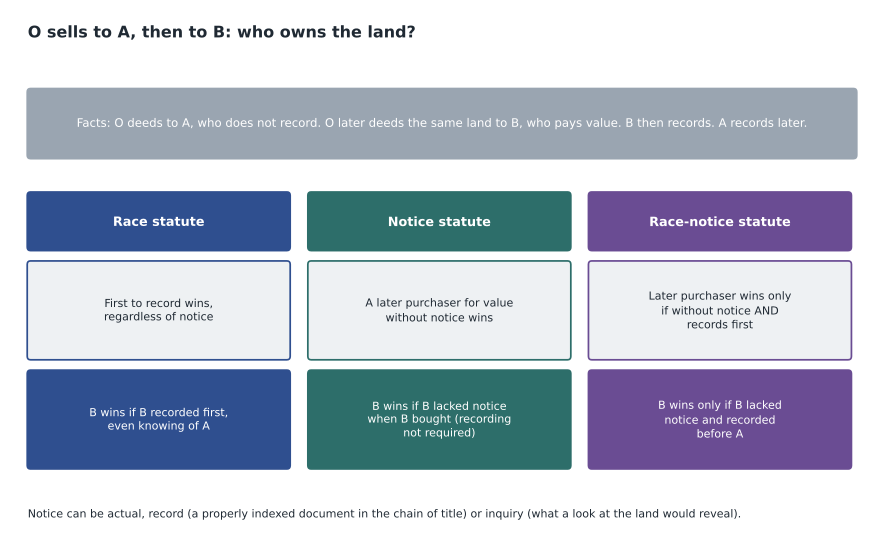
There are three types of recording acts. Under a race statute, the first purchaser to record wins, regardless of notice; North Carolina and Louisiana are the main examples for conveyances. Under a notice statute, a later purchaser for value without notice of the earlier conveyance wins, whether or not she records first. Under a race-notice statute, a later purchaser wins only if she both took without notice and recorded first. About half the states have notice statutes and about half race-notice. Recording acts protect only purchasers for value (and in many states mortgagees and judgment creditors), not donees or heirs. A purchaser must pay more than nominal value, though not full market value.
Actual, record and inquiry notice
A purchaser has actual notice if she actually knows of the earlier conveyance. She has record (constructive) notice of instruments properly recorded and indexed in her chain of title. She has inquiry notice of facts that a reasonable purchaser would have discovered by investigating, especially by inspecting the land and asking the people in possession. Most states charge a buyer with notice of the rights of anyone in open possession of the land, because a buyer who looks at the property and sees someone else living or working there should ask why.
The chain of title concept limits record notice. A searcher looks up the grantor index backward to find each owner's source of title and then the grantee index forward under each owner's name for the period that owner held title. An instrument that a reasonable search would not find is not in the chain of title and gives no constructive notice. A wild deed, recorded by someone whose own deed was never recorded, is outside the chain; so, in many states, is a deed recorded after a later deed to someone else. Courts divide on deeds from a common grantor to neighboring lots: Guillette v. Daly Dry Wall, Inc., 367 Mass. 355 (1975), held that a buyer was charged with notice of a restriction contained in a deed from the same developer to a neighboring lot, because the deed referred to a common plan. Recorded instruments must also be properly executed: in Messersmith v. Smith, 60 N.W.2d 276 (N.D. 1953), a deed with a defective acknowledgment was not entitled to be recorded and so did not give constructive notice. Descriptions must be adequate: Luthi v. Evans, 223 Kan. 622 (1978), held that a "Mother Hubbard" clause assigning "all other" leases in a county without describing them did not give record notice to a later purchaser.
Applying Westmarch's race-notice statute to the orchard lot
Westmarch has a race-notice statute. To win, Ortiz must show that he (1) paid value, (2) took without notice of Simon's deed, and (3) recorded before Simon. He paid 85,000 dollars, and he recorded on May 20, before Simon's June 3 recording. The question is notice. Ortiz had no actual notice and no record notice, since Simon's deed was not recorded when Ortiz bought. But Ortiz walked the orchard lot in April 2026 and saw six beehives and freshly mowed grass. He asked Margaret, who said a neighbor kept bees there "with Mom's permission." He never spoke to Simon.
Hannah argues that the beehives put Ortiz on inquiry notice: someone was openly using the land, and a reasonable buyer would have asked that person directly, which would have revealed the deed. Daniel argues that Ortiz did inquire, of the record owners' successors, and was told the use was permissive; a buyer should not have to interrogate every beekeeper. Vandermolen says courts divide but that most would expect the buyer to ask the possessor. If Ortiz had inquiry notice, he is not protected, and Simon's earlier deed prevails under the first-in-time rule.
Title insurance, Torrens and marketable title acts
Because recording acts leave gaps (forgeries, unrecorded rights of possessors, errors in the index), nearly all buyers and lenders buy title insurance. An owner's policy insures that title is vested as stated, subject to listed exceptions, and pays losses up to the policy amount. Standard policies often except rights of parties in possession and matters a survey would show, unless the buyer pays for extended coverage. If Ortiz bought only a standard owner's policy, the insurer may deny his claim under that exception. Ortiz also has claims against Paul and Margaret under their general warranty deed: the covenant of seisin was broken at delivery, because they did not own the orchard lot.
A few jurisdictions offer Torrens registration, under which a court proceeding establishes title and a certificate issued by the registrar is conclusive, but the system has largely faded in the United States. Many states have marketable title acts, which extinguish old interests, such as ancient restrictions and possibilities of reverter, unless they are re-recorded within a set period, typically thirty or forty years. Electronic recording is now widespread under the Uniform Real Property Electronic Recording Act.
Mortgages in brief
A mortgage is a security interest in land that secures a debt, usually a promissory note. In lien theory states, the mortgage is a lien and the borrower keeps title; in title theory states, the lender holds legal title until the debt is paid. If the borrower defaults, the lender may foreclose, judicially or, in many states, by a nonjudicial power of sale. The borrower has an equity of redemption, a right to pay off the debt and stop foreclosure before the sale, and some states give a statutory right to redeem after the sale. Courts police foreclosure sales for fairness. In Murphy v. Financial Development Corp., 126 N.H. 536 (1985), the New Hampshire Supreme Court held that a foreclosing lender must exercise good faith and due diligence to obtain a fair price, not merely follow statutory procedures. Most states allow a deficiency judgment if the sale brings less than the debt, though some limit deficiencies on home loans.
| Issue | Rule | Authority |
|---|---|---|
| Oral contract for land | Statute of Frauds, with part performance and estoppel exceptions | Hickey v. Green |
| Marketable title | Existing violations can make title unmarketable | Lohmeyer v. Bower |
| Seller disclosure | Must disclose known latent material defects | Johnson v. Davis; Stambovsky v. Ackley |
| Deed covenants | Seisin breached at delivery; quiet enjoyment on disturbance | Brown v. Lober |
| Recording acts | Race, notice or race-notice; protect purchasers for value | State statutes |
| Chain of title | Only properly recorded, indexed and described instruments give record notice | Guillette; Messersmith; Luthi |
| Foreclosure | Lender must seek a fair price in good faith | Murphy v. Financial Development Corp. |
Worked problem
If Ortiz had asked Simon
Change one fact: in April 2026 Ortiz knocks on Simon Pryor's door, asks about the beehives, and Simon says, "Aunt Eleanor gave me that lot years ago." Ortiz buys anyway, records first, and claims protection under Westmarch's race-notice statute. Would the answer differ under a race statute?
Show solution
- Race-notice: Ortiz now has actual notice of Simon's claim, so he cannot be a purchaser without notice; Simon prevails under first in time.
- Race statute: notice is irrelevant; the first purchaser for value to record wins.
- Is Simon a purchaser? Simon took by gift, so even in a race state he is not protected against later purchasers; Ortiz recorded first and paid value.
- Policy: race statutes promote certainty at the cost of rewarding a buyer with knowledge; most states reject that result.
Answer: Under Westmarch's race-notice statute, actual notice defeats Ortiz and Simon keeps the lot; under a pure race statute, Ortiz would win because he paid value and recorded first, whatever he knew.
Summary and key terms
- Land contracts must satisfy the Statute of Frauds, subject to part performance and estoppel (Hickey); sellers impliedly promise marketable title (Lohmeyer).
- Most states require sellers to disclose known latent material defects (Johnson v. Davis; Stambovsky).
- Deeds take effect on delivery; general warranty deeds contain present and future covenants (Brown v. Lober).
- Recording acts are race, notice or race-notice and protect only purchasers for value; notice may be actual, record or inquiry.
- Record notice is limited to instruments properly recorded, indexed and described in the chain of title (Guillette; Messersmith; Luthi).
- Title insurance, warranty covenants, Torrens and marketable title acts fill gaps; foreclosing lenders must act in good faith (Murphy).
Practice problems
Work each problem on paper first, then reveal the answer to check.
Why did the buyers in Hickey v. Green get specific performance despite the Statute of Frauds?
Show answer
They reasonably relied on the oral agreement by selling their own home, making it unconscionable for the seller to raise the statute.
What disclosure duty did Johnson v. Davis impose?
Show answer
A home seller must disclose known facts materially affecting value that are not readily observable by the buyer.
Why was the covenant of seisin claim in Brown v. Lober barred?
Show answer
It was breached at delivery more than ten years earlier, so the statute of limitations had run; the covenant of quiet enjoyment had not yet been breached.
Under a race-notice statute, what must a later purchaser show to win?
Show answer
That she paid value, took without notice of the earlier conveyance, and recorded before the earlier grantee.
Lesson quiz · 5 questions
Score 60% or more to complete this lesson.
Create a free account to save your progress, take quizzes and earn a certificate.