
LAWU-113 · Lesson 7 of 12 · 20 min
Landlord and tenant: habitability, eviction and fair housing
▶ Video coming soon A video version of this lesson is on the way.
On January 9, 2026, during a cold snap, the furnace in the downstairs unit at 412 Sycamore Street stopped working. The tenant, Aisha Rahman, a nurse's aide who had rented the unit since June 2025 for 1,450 dollars a month, called Margaret the same day. Margaret's repairman could not get a replacement part for twelve days. Aisha bought two space heaters for 240 dollars, sent her children to stay with her mother, and on February 1 paid only half the month's rent, with a letter explaining why. On February 3 she called the Brennan Falls code enforcement office. An inspector visited on February 10 and cited the unit for the furnace outage and a missing smoke detector. On February 24, Margaret served Aisha with a notice that her lease, ending May 31, 2026, would not be renewed. "Every doctrine in today's class is in those six weeks," Vandermolen says.
From caveat lessee to the implied warranty of habitability
Under the traditional common law, a tenant took the premises as they were. The landlord made no implied promise that the premises were fit to live in, had no duty to repair, and, because lease covenants were independent, the tenant had to keep paying rent even if the landlord broke an express promise to repair. The rule made some sense for agrarian leases, where the tenant leased land and could fix simple buildings herself. It made little sense for urban apartment dwellers who lease a set of rooms in a building with complex systems controlled by the landlord.
Javins v. First National Realty Corp., 428 F.2d 1071 (D.C. Cir. 1970), changed the law. Tenants of an apartment complex in Washington, D.C., withheld rent, alleging some 1,500 violations of the housing code. Judge Skelly Wright, writing for the court, held that a warranty of habitability, measured by the standards of the housing code, is implied by operation of law into leases of urban dwelling units, that the warranty cannot be waived, and that the tenant's duty to pay rent depends on the landlord's performance of the warranty. Breach could be a defense to an eviction for nonpayment. Within a few decades, almost every state adopted the implied warranty by judicial decision or statute, often through the Uniform Residential Landlord and Tenant Act.
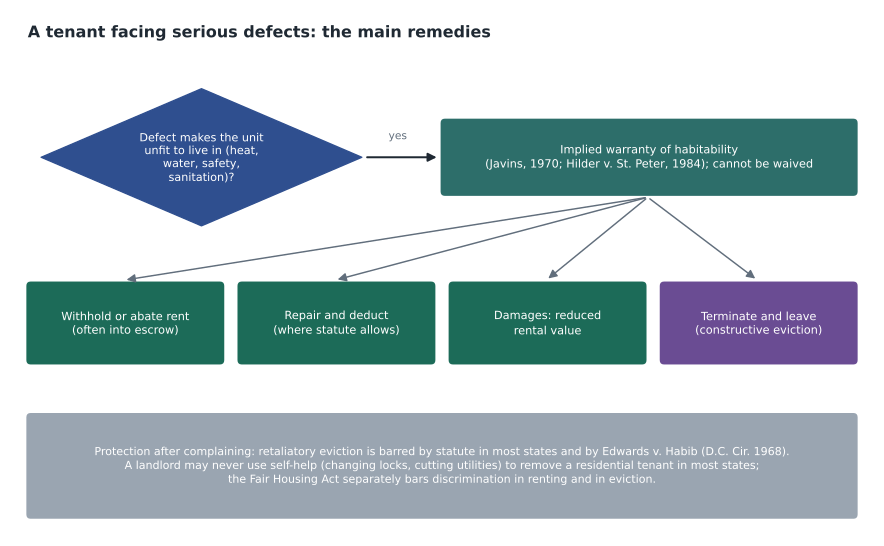
Hilder v. St. Peter, 144 Vt. 150 (1984), is a frequently taught later case. Stella Hilder rented an apartment in Rutland, Vermont, that had a broken window, a toilet that would not flush, leaking sewage, a broken lock and no hot water; the landlord promised repairs he never made. The Vermont Supreme Court held that the warranty is implied in all residential leases, that it covers defects that render the premises unsafe, unsanitary or unfit to live in, whether or not the defect violates a housing code, and that a tenant may withhold rent, use repair and deduct, seek damages, or even recover punitive damages for willful and wanton conduct, after giving the landlord notice and a reasonable time to repair.
Remedies for breach
The remedies available vary by state. Most allow the tenant to withhold rent, sometimes paying it into court or an escrow account, and to raise the breach as a defense in an eviction for nonpayment. Many allow repair and deduct, letting the tenant make repairs and deduct the cost from rent, usually up to a cap of one month's rent and after notice. Damages are typically measured as the difference between the agreed rent and the fair rental value of the premises in their defective condition, or by a percentage reduction for the loss of use. The tenant may also terminate the lease and move out. Courts disagree on whether the warranty applies to commercial leases; most say no, though a few, citing unequal bargaining power, have extended it to small commercial tenants.
Constructive eviction
Before the warranty of habitability, tenants relied on the covenant of quiet enjoyment, implied in every lease, which protects the tenant's possession against interference by the landlord. An actual eviction, such as locking the tenant out of all or part of the premises, suspends the duty to pay rent. A constructive eviction occurs when the landlord's act or failure to act, in breach of a duty, substantially interferes with the tenant's use and enjoyment, the tenant gives notice, the landlord fails to cure within a reasonable time, and the tenant moves out within a reasonable time. The tenant who stays cannot claim constructive eviction.
In Reste Realty Corp. v. Cooper, 53 N.J. 444 (1969), a commercial tenant's basement offices flooded repeatedly whenever it rained, because of a driveway the landlord controlled. After the landlord failed to fix the problem, the tenant left. The New Jersey Supreme Court held that the flooding breached an implied covenant of quiet enjoyment and amounted to a constructive eviction, ending the tenant's obligation to pay rent. Constructive eviction remains important for commercial tenants, who usually cannot use the warranty of habitability, but it forces the tenant to take the risk of moving out before a court decides whether the interference was substantial.
Retaliatory eviction
Tenants who complain to housing authorities are vulnerable to landlords who respond by ending the tenancy. In Edwards v. Habib, 397 F.2d 687 (D.C. Cir. 1968), Yvonne Edwards, a month-to-month tenant, reported sanitary code violations; after an inspection found more than forty, her landlord served notice to quit. The D.C. Circuit held that she could raise retaliation as a defense to eviction, reasoning that allowing landlords to punish tenants for reporting violations would frustrate the housing code. Most states now prohibit retaliation by statute, often creating a presumption of retaliation if the landlord acts against the tenant within a set period, commonly six months to a year, after the tenant complains or organizes. The landlord can rebut the presumption with a legitimate reason, such as nonpayment unrelated to the complaint.
Applying the doctrines to Aisha Rahman
Section B takes the Sycamore Street facts in order. The furnace failure in January in a cold climate rendered the unit unfit to live in, breaching the implied warranty. Aisha gave notice immediately. Twelve days without heat may be a reasonable time to repair if the part was truly unavailable, but Margaret could have supplied temporary heat. Daniel suggests that Aisha's damages are the reduction in rental value for twelve days plus the cost of the heaters; withholding half a month's rent (725 dollars) may exceed that, so a court might order her to pay part of it. Westmarch's fictional statute permits rent withholding into escrow after written notice.
The nonrenewal notice is the bigger problem for Margaret. It came two weeks after the city inspection Aisha requested. Under Westmarch's statute, which creates a presumption of retaliation for any adverse action within six months of a good-faith complaint to a government authority, Margaret must show a legitimate, non-retaliatory reason for not renewing. Hannah asks what reasons would count. Vandermolen lists them: nonpayment unrelated to the complaint, serious lease violations, a good-faith plan to occupy or sell the unit. "Margaret says she wants her son Owen to live there," she adds. "Is that credible? That is a fact question."
Fair housing
The Fair Housing Act of 1968, 42 U.S.C. sections 3601 to 3619, as amended in 1974 and 1988, makes it unlawful to refuse to sell or rent, to set different terms, to make discriminatory statements or advertisements, or to otherwise make housing unavailable because of race, color, religion, sex, familial status, national origin or disability. The 1988 amendments added familial status and disability and require reasonable accommodations in rules and policies and permission for reasonable modifications for tenants with disabilities. Many states and cities add protected traits, such as sexual orientation, gender identity, source of income (for example, housing vouchers) and age.
There are narrow exemptions. The "Mrs. Murphy" exemption, in section 3603(b)(2), covers rooms or units in a dwelling with no more than four units if the owner lives in one of them, and section 3603(b)(1) exempts certain sales or rentals of single-family homes by owners without a broker. But the ban on discriminatory statements and advertisements in section 3604(c) applies even to exempt owners, and the Civil Rights Act of 1866, 42 U.S.C. section 1982, as interpreted in Jones v. Alfred H. Mayer Co., 392 U.S. 409 (1968), bars racial discrimination in all property transactions, with no exemption.
A plaintiff may prove discrimination by showing intentional disparate treatment, often using the burden-shifting framework from employment law, or by showing disparate impact: a facially neutral policy that has an unjustified discriminatory effect. In Texas Department of Housing and Community Affairs v. Inclusive Communities Project, Inc., 576 U.S. 519 (2015), the Supreme Court held that disparate impact claims are cognizable under the Fair Housing Act, while emphasizing robust causation requirements and defendants' freedom to pursue valid interests. In January 2026, HUD proposed to remove its regulation describing the disparate impact standard, saying it would leave the standard to the courts; the Supreme Court's decision, not the regulation, is the source of the claim.
Vandermolen points out one fair housing angle in the Ashby file. Margaret's online advertisement for the upstairs unit said "ideal for a quiet professional; no kids." Margaret does not live in the duplex, so the Mrs. Murphy exemption does not apply. And even an owner who qualified for the exemption could not publish that advertisement, because section 3604(c) bans statements indicating a preference based on familial status regardless of any exemption.
Eviction procedure
When a landlord seeks to evict, state law requires a written notice, often a short pay-or-quit notice for nonpayment or a longer notice to end a periodic tenancy, followed by a summary court proceeding. These proceedings move fast, with hearings sometimes held within a week or two, and most tenants appear without lawyers. Habitability and retaliation are raised as defenses in that proceeding, and many courts require a tenant who withholds rent to deposit it with the court. If the landlord wins, a sheriff or marshal carries out the judgment; self-help is barred in most states. Because an eviction filing can follow a tenant for years in tenant screening reports, several states now allow eviction records to be sealed when the tenant wins or the case is dismissed, and several cities and states, beginning with New York City in 2017, guarantee lawyers to some tenants facing eviction. Vandermolen tells the class that Aisha Rahman's habitability defense would be raised in exactly such a proceeding if Margaret sued her for the February rent.
| Protection | Rule | Source |
|---|---|---|
| Implied warranty of habitability | Residential premises must be fit to live in; not waivable | Javins; Hilder v. St. Peter; URLTA |
| Constructive eviction | Substantial interference, notice, failure to cure, tenant leaves | Reste Realty v. Cooper |
| Retaliatory eviction | No adverse action because tenant complained | Edwards v. Habib; state statutes |
| Fair housing | No discrimination on protected traits in renting or sales | Fair Housing Act, 42 U.S.C. 3604 |
| Disparate impact | Neutral policies with unjustified discriminatory effects | Inclusive Communities (2015) |
| Statewide rent caps | Annual increase limits | Oregon and California (2019); Washington (2025) |
Rent regulation and eviction policy
Rent control has a long and contested history in American cities, notably New York. For decades most states banned local rent control. Oregon (2019) and California (2019) adopted statewide limits on annual rent increases for many units, and Washington became the third state to do so in May 2025, capping most increases at seven percent plus inflation, with a ten percent maximum. Other reforms include just-cause eviction requirements, which forbid ending tenancies without listed reasons, and a right to counsel for tenants facing eviction in several cities and states. During the COVID-19 pandemic, the federal Centers for Disease Control and Prevention imposed a nationwide eviction moratorium, which the Supreme Court held exceeded the agency's statutory authority in Alabama Association of Realtors v. Department of Health and Human Services, 594 U.S. 758 (2021).
Worked problem
The lead paint inspection
In April 2026, Aisha Rahman's three-year-old son tests positive for elevated lead levels, and a health inspector finds peeling lead paint on a window sill in the downstairs unit, built in 1924. Margaret never gave Aisha the federal lead disclosure form. Margaret then demands that Aisha move out early so she can repaint. What claims and defenses does Aisha have?
Show solution
- Warranty of habitability: peeling lead paint in a unit occupied by a young child makes the premises unsafe, breaching the warranty; Aisha may withhold or abate rent and seek damages under state law.
- Federal disclosure: for housing built before 1978, landlords must give tenants a lead hazard pamphlet and disclose known lead hazards before the lease; failure can lead to civil penalties and damages.
- Retaliation: a demand to leave soon after a health inspection triggered by the tenant's situation may be presumed retaliatory under a state statute.
- Fair housing: refusing to rent to families with children to avoid lead obligations would be familial status discrimination.
Answer: Aisha has a strong habitability claim, a federal lead disclosure claim and a retaliation defense; Margaret must abate the hazard, and she cannot force Aisha out early without a legitimate, non-retaliatory reason.
Summary and key terms
- Javins implied a nonwaivable warranty of habitability into urban residential leases and made rent dependent on it; Hilder extended it to all residential leases and listed remedies.
- Remedies include withholding, repair and deduct, damages measured by lost rental value, and termination.
- Constructive eviction requires substantial interference, notice, failure to cure and abandonment (Reste Realty).
- Retaliatory eviction is barred by Edwards v. Habib and state statutes, often with a presumption after a complaint.
- The Fair Housing Act bars discrimination on seven federal traits; the advertising ban applies even to exempt owners; section 1982 bars racial discrimination without exemption.
- Inclusive Communities recognized disparate impact claims; HUD proposed in 2026 to remove its regulation, leaving the standard to courts.
- Statewide rent caps now exist in Oregon, California and Washington.
Practice problems
Work each problem on paper first, then reveal the answer to check.
What did Javins hold about the tenant's duty to pay rent?
Show answer
It depends on the landlord's performance of the implied warranty of habitability, which is measured by the housing code and cannot be waived.
What must a tenant do to claim constructive eviction?
Show answer
Show substantial interference caused by the landlord's breach, give notice, allow a reasonable time to cure, and move out within a reasonable time.
Why could Yvonne Edwards defend her eviction in Edwards v. Habib?
Show answer
Evicting a tenant in retaliation for reporting housing code violations would frustrate the code, so retaliation was a defense.
Does the Mrs. Murphy exemption allow an exempt owner to advertise 'no children'?
Show answer
No. Section 3604(c)'s ban on discriminatory statements and advertisements applies even to exempt owners.
Lesson quiz · 5 questions
Score 60% or more to complete this lesson.
Create a free account to save your progress, take quizzes and earn a certificate.