
LAWU-113 · Lesson 5 of 12 · 20 min
Concurrent ownership and marital property
▶ Video coming soon A video version of this lesson is on the way.
"The only thing harder than dividing property across time," Vandermolen says, "is sharing it at the same time." Eleanor Ashby's will left the Ashby Point house parcel "to my son Paul and my daughter Margaret as joint tenants with right of survivorship, and not as tenants in common." Margaret, who lives in Brennan Falls, spends every summer in the farmhouse. Paul, an accountant in Denver, visits once a year and wants to sell. In February 2026, without telling his sister, Paul signed a deed conveying his interest in Ashby Point to himself as trustee of the Paul Ashby Revocable Trust. In May 2026 he filed a partition action. "By the end of today you will know what Paul's deed did, whether Margaret owes him rent, and what a court will do with the partition."
Three forms of co-ownership
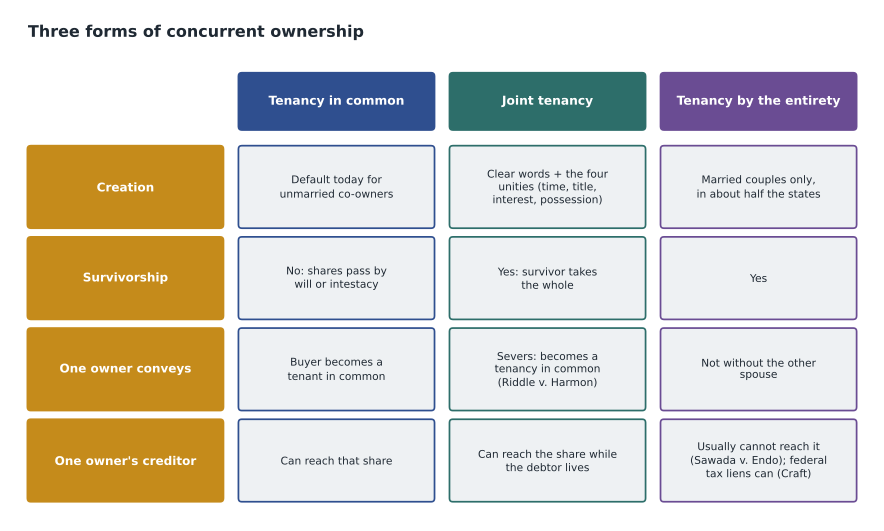
When two or more people own property at the same time, each owns an undivided interest in the whole, not a physical part. American law recognizes three main forms. In a tenancy in common, each co-tenant owns an undivided share that may be unequal, may be transferred during life and passes at death by will or intestacy. In a joint tenancy, the co-tenants hold equal shares with a right of survivorship: when one dies, the survivors take the whole and the deceased tenant's share vanishes. In a tenancy by the entirety, available only to married couples in roughly half the states, the spouses hold together with survivorship, and neither can transfer or encumber the property alone.
At common law, a conveyance to two people was presumed to create a joint tenancy. Today every state presumes a tenancy in common unless the instrument clearly states an intent to create a joint tenancy, usually with words like "as joint tenants with right of survivorship." The common law required four unities for a joint tenancy: the tenants must take their interests at the same time, by the same instrument (title), in equal shares (interest), with equal rights to possess the whole (possession). Eleanor's will satisfies all four.
Severance of a joint tenancy
A joint tenant can destroy the right of survivorship by severing the joint tenancy, converting it into a tenancy in common. Severance usually occurs when one joint tenant conveys her interest to a third party: the transferee becomes a tenant in common with the remaining tenants, because the unities of time and title are broken. Severance may be secret and unilateral. The other joint tenants need not consent or even know.
At common law, a joint tenant could not sever by conveying to herself, because a person could not convey to herself; lawyers used a "strawman" conveyance, deeding to a friend who deeded back. In Riddle v. Harmon, 102 Cal. App. 3d 524 (1980), Frances Riddle, terminally ill, executed a deed granting her interest in the home she held with her husband to herself, intending to sever so she could leave her share by will. The California Court of Appeal held the self-conveyance effective, abandoning the strawman fiction. California later codified the result, requiring the severing instrument to be recorded before the severing tenant's death in some circumstances, to prevent a tenant from hiding a severance and keeping it secret if she survives. Many states now follow Riddle.
Other events raise harder questions. In Harms v. Sprague, 105 Ill. 2d 215 (1984), one of two joint tenants mortgaged his interest to secure a friend's loan and then died. The Illinois Supreme Court held that, because Illinois treats a mortgage as a lien rather than a transfer of title, the mortgage did not sever the joint tenancy; the survivor took the whole property free of the mortgage, which died with the mortgagor's interest. In title theory states, a mortgage may sever. Leases by one joint tenant, agreements between the tenants, divorce and murder (under slayer statutes) also raise severance issues.
Paul's deed to himself as trustee is a conveyance to a different legal capacity. Under Riddle, and in most states today, it severs the joint tenancy, so Paul's trust and Margaret are now tenants in common, each with a one-half share. Margaret's survivorship expectation is gone, and she learned of it from the partition complaint. Hannah thinks this is unfair. Vandermolen says many students react the same way, but survivorship is an expectancy, not a vested right, and the law has always let each joint tenant leave.
Rights and duties among co-tenants
Each co-tenant has the right to possess the whole property. A co-tenant who lives on the property alone does not owe rent to the others unless she has ousted them, meaning she has refused their demand to share possession or otherwise denied their rights, or unless the co-tenants agreed otherwise. In Spiller v. Mackereth, 334 So. 2d 859 (Ala. 1976), two co-owners held a building; when the commercial tenant left, Spiller moved his own goods in, and Mackereth sent a letter demanding that he either vacate half or pay rent. The Alabama Supreme Court held that the letter was not a demand for possession, so there was no ouster and Spiller owed no rent. A co-tenant who collects rent from third parties, however, must account to the others for their shares of the net rents.
Co-tenants must share carrying costs. A co-tenant who pays more than her share of property taxes or mortgage interest can usually obtain contribution from the others, though a co-tenant in sole possession may have that claim offset by the rental value of her occupancy. Repairs and improvements are treated differently: a co-tenant generally cannot force the others to contribute to them, but a court will credit her for the increase in value they produce when the property is partitioned or sold.
Applying these rules, Section B concludes that Margaret owes Paul no rent for her summers in the farmhouse, because he never demanded to share possession and she never excluded him. Margaret paid the 2025 property taxes of 8,200 dollars and spent 21,000 dollars replacing the farmhouse roof. She can seek contribution of 4,100 dollars toward the taxes, possibly offset by the value of her exclusive use, and a credit for the roof's added value at partition.
Partition
Any co-tenant may ask a court to end the co-ownership by partition. A court may divide the land physically (partition in kind) or order it sold and divide the proceeds (partition by sale). Traditionally, partition in kind was preferred, and sale was ordered only when physical division was impractical or would greatly reduce value. In Delfino v. Vealencis, 181 Conn. 313 (1980), the Delfinos owned an undivided 99/144 interest in a twenty-acre tract, roughly two thirds, and wanted to develop a subdivision; Helen Vealencis lived on the land and ran a garbage-hauling business there. The Connecticut Supreme Court reversed an order of sale, holding that the trial court had not given enough weight to Vealencis's interest in her home and livelihood and that partition in kind was practicable.
In practice, many courts order sales, which often bring low prices and can force families off land held for generations. The problem has fallen especially hard on heirs' property, land inherited without a will by many relatives over generations, much of it owned by Black families in the South. Speculators buy a tiny share from one heir and then force a sale. The Uniform Partition of Heirs Property Act, adopted in more than twenty states, gives co-tenants notice, an appraisal, a right to buy out the petitioner's share, and a preference for partition in kind when it is fair.
For Ashby Point, Vandermolen asks whether a court could divide the land. Jordan points out that the house parcel includes the farmhouse, boathouse and shoreline; a physical division might give Margaret the house and Paul an equal value of shoreline and woods. Daniel argues that a sale would bring more, because buyers want the whole lakefront. "That is exactly the fight," Vandermolen says. "A court that follows Delfino will look hard at whether a fair division in kind is possible before forcing a sale."
Leases and mortgages by one co-tenant
One co-tenant may lease her interest without the others' consent, but she cannot give the lessee greater rights than she has. In Swartzbaugh v. Sampson, 11 Cal. App. 2d 451 (1936), a husband who held a walnut orchard in joint tenancy with his wife leased part of it to a boxing promoter over her objection. The California Court of Appeal held that the lease was valid as to the husband's interest and that the wife could not eject the lessee, because the lessee stood in the husband's shoes with a right to possess the whole along with her; her remedy was to share in the rent or seek partition. A mortgage by one co-tenant likewise encumbers only her share, as Harms v. Sprague illustrates for joint tenancies.
| Issue | General rule | Authority or note |
|---|---|---|
| Possession | Each co-tenant may possess the whole | No rent owed absent ouster or agreement (Spiller) |
| Rents from third parties | Must account to co-tenants for net rents | Accounting action |
| Taxes and mortgage interest | Contribution from co-tenants | May be offset by value of sole occupancy |
| Repairs and improvements | No forced contribution | Credit for added value at partition |
| Partition | Any co-tenant may demand it | In kind preferred if fair (Delfino); sale common |
| Heirs' property | Buyout rights and appraisal | Uniform Partition of Heirs Property Act |
Marital property
Most states follow the common law system of separate property, under which property acquired during marriage belongs to the spouse who earned or acquired it. Two features soften that system. First, at divorce, courts divide marital property by equitable distribution, considering contributions of both spouses, including homemaking. Second, at death, a surviving spouse who is disinherited can claim an elective share, typically one third or one half of the deceased spouse's estate; the Uniform Probate Code's version scales the share to the length of the marriage and counts nonprobate transfers.
Nine states follow community property: Arizona, California, Idaho, Louisiana, Nevada, New Mexico, Texas, Washington and Wisconsin. Earnings and property acquired by either spouse during marriage belong equally to both, while property owned before marriage or acquired by gift or inheritance is separate. At divorce or death, each spouse owns half the community. A few other states allow couples to opt into community property for certain trusts.
Divorce cases test the boundary of property. In re Marriage of Graham, 194 Colo. 429 (1978), held that a professional degree earned during marriage is not marital property subject to division, though contributions to it may affect maintenance. In Elkus v. Elkus, 169 A.D.2d 134 (N.Y. App. Div. 1991), a New York court treated the increase in value of an opera singer's career during the marriage as marital property. New York later amended its statute, effective 2016, so that the value of enhanced earning capacity from a license or degree is not treated as marital property, though the court may consider contributions to it.
Tenancy by the entirety and creditors
Tenancy by the entirety protects married couples from the creditors of one spouse in most states that recognize it. In Sawada v. Endo, 57 Haw. 608 (1977), the Sawadas won a judgment against Kokichi Endo for injuries from a car accident; after the accident, Endo and his wife conveyed their home, held by the entirety, to their sons. The Hawaii Supreme Court held that the creditors of one spouse could not reach entireties property, so the conveyance did not defraud them. Federal law is different. In United States v. Craft, 535 U.S. 274 (2002), the Supreme Court held that a husband's interest in entireties property was "property" or "rights to property" to which a federal tax lien could attach. Since Obergefell v. Hodges, 576 U.S. 644 (2015), married same-sex couples may hold property by the entirety wherever the estate exists.
Worked problem
Survivorship after the trust deed
Suppose Paul's February 2026 deed to himself as trustee had never been recorded, and Paul died in August 2026, before Margaret learned of it. Paul's will leaves everything to his daughter Chloe. Margaret claims the whole of Ashby Point by survivorship. Chloe claims a half interest as a tenant in common. What result in a Riddle jurisdiction?
Show solution
- Identify the original estate: Paul and Margaret took as joint tenants with right of survivorship under Eleanor's will.
- Severance by self-conveyance: Riddle allows a joint tenant to sever by conveying to herself or, as here, to herself as trustee, converting the joint tenancy into a tenancy in common.
- Recording requirement: some states, following California's statute, require the severing instrument to be recorded before the severing tenant's death, or within a short time after, to be effective against the survivor.
- Apply: if Westmarch has no recording requirement, the severance was effective when Paul delivered the deed, and his half passes through the trust or will to Chloe; if it has one and the deed was not recorded, Margaret takes by survivorship.
Answer: In a Riddle jurisdiction without a recording rule, Paul's deed severed the joint tenancy and Chloe takes his half; if Westmarch requires recording before death, the unrecorded deed fails and Margaret takes the whole by survivorship.
Summary and key terms
- Co-owners hold undivided interests; tenancy in common is the default, joint tenancy requires clear words and the four unities, and tenancy by the entirety is for married couples in about half the states.
- A joint tenant may sever unilaterally, even secretly; self-conveyance severs in many states (Riddle); a mortgage may not sever in lien theory states (Harms v. Sprague).
- A co-tenant in possession owes no rent absent ouster (Spiller); co-tenants must account for third-party rents and share taxes; improvements are credited at partition.
- Partition in kind is preferred where fair (Delfino); the Uniform Partition of Heirs Property Act protects families from forced sales.
- Common law states use equitable distribution and the elective share; nine states use community property.
- Entireties property is generally immune from one spouse's creditors (Sawada) but not from federal tax liens (Craft).
Practice problems
Work each problem on paper first, then reveal the answer to check.
What did Riddle v. Harmon hold?
Show answer
A joint tenant may sever a joint tenancy by conveying her interest to herself, without using a strawman.
Why did the mortgage in Harms v. Sprague not survive the mortgagor's death?
Show answer
In a lien theory state the mortgage did not sever the joint tenancy, so the survivor took the whole and the mortgage, attached only to the deceased tenant's interest, was extinguished.
When must a co-tenant in sole possession pay rent to the other co-tenants?
Show answer
Generally only if she has ousted them or agreed to pay; mere sole occupancy is not enough (Spiller v. Mackereth).
What did United States v. Craft hold about entireties property?
Show answer
A federal tax lien can attach to one spouse's interest in property held by the entirety.
Lesson quiz · 5 questions
Score 60% or more to complete this lesson.
Create a free account to save your progress, take quizzes and earn a certificate.