
LAWU-113 · Lesson 6 of 12 · 21 min
Landlord and tenant: leases, assignment and abandonment
▶ Video coming soon A video version of this lesson is on the way.
Vandermolen opens the landlord-tenant unit by asking how many students in Section B rent their homes. Nearly every hand goes up. "Then you already have a leasehold estate," she says, "and some of you have already breached your lease without knowing it. Today we cover how leases are created, what the landlord must deliver, what happens when a tenant transfers or walks away, and why the old law treated a lease as a conveyance of land rather than a contract." The Ashby file for this unit concerns the duplex at 412 Sycamore Street, now managed by Margaret as life tenant. The upstairs unit was leased to Nikhil Rao, a graduate student, for one year from June 1, 2025 to May 31, 2026, at 1,300 dollars a month.
A lease is both a conveyance and a contract
At common law, a lease was a conveyance of an estate in land for a period. The tenant got possession; the landlord kept a reversion. Covenants in the lease, such as the tenant's promise to pay rent and the landlord's promise to repair, were independent: if the landlord broke a promise, the tenant still had to pay rent and could only sue for damages. Modern law treats the residential lease increasingly as a contract, with dependent covenants and implied terms, while keeping the property law framework of estates and privity. The tension between the two views runs through every topic in this unit.
Types of tenancies
There are four leasehold estates. A term of years lasts for a fixed period, whether one month or ninety-nine years, and ends automatically without notice. A periodic tenancy continues from period to period (month to month or year to year) until one party gives notice; at common law, notice for a year-to-year tenancy was six months, and for shorter periods, one full period, though statutes now set most notice periods. A tenancy at will lasts as long as both parties wish and ends when either gives notice, often by statute after a short period. A tenancy at sufferance arises when a tenant holds over after the lease ends without the landlord's consent.
When a tenant holds over, the landlord may treat the tenant as a trespasser and evict, or may elect to hold the tenant to a new periodic tenancy, often month to month for residential leases. Accepting rent after the term ends is usually treated as such an election. Statutes in many states limit the holdover rule or require damages at a set rate.
Delivering possession
What must a landlord deliver at the start of the lease? Under the English rule, followed by most states, the landlord must deliver actual possession: if a prior tenant is still holding over, the landlord is in breach, and the new tenant may terminate or recover damages. Under the American rule, the landlord need only deliver the legal right to possession; removing a holdover tenant is the new tenant's problem. In Hannan v. Dusch, 154 Va. 356 (1930), the Virginia Supreme Court of Appeals adopted the American rule, reasoning that the landlord is not responsible for the wrongful acts of a third party and the new tenant can sue the holdover. The Uniform Residential Landlord and Tenant Act and most modern decisions take the English rule, which matches the expectations of tenants who have arranged to move in on a specific day.
Transferring the tenant's interest: assignment and sublease
Unless the lease says otherwise, a tenant may transfer her interest. The law distinguishes two kinds of transfer. In an assignment, the tenant transfers her entire remaining interest in the leased premises. The assignee steps into privity of estate with the landlord and becomes liable directly to the landlord on covenants that run with the land, such as the covenant to pay rent. In a sublease, the tenant transfers less than her entire interest, most often by keeping a reversion, even a single day at the end of the term. The subtenant is in privity with the tenant but not with the landlord, so the landlord cannot sue the subtenant for rent; the landlord sues the original tenant, who sues the subtenant.
In both cases, the original tenant remains liable to the landlord on her promise to pay rent, because privity of contract continues. Only a novation, in which the landlord agrees to release the original tenant and accept the transferee in her place, ends that liability.
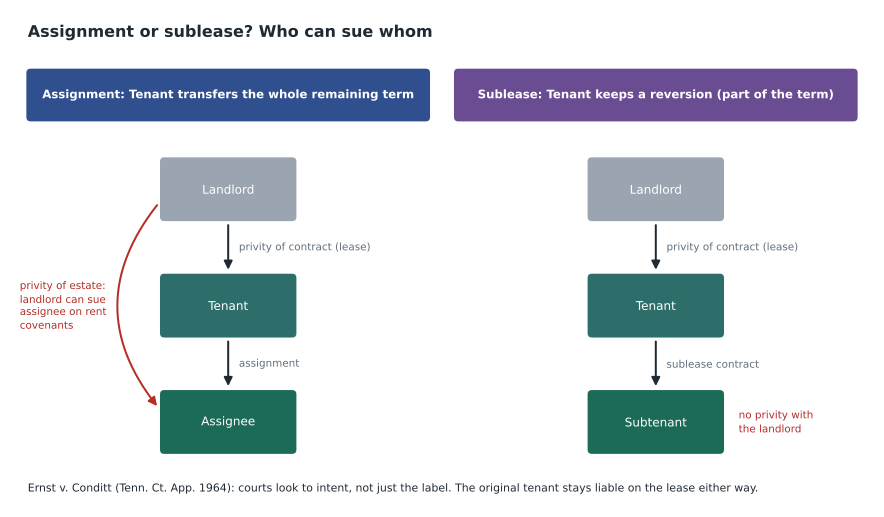
Courts traditionally applied a mechanical test: a transfer of the entire remaining term is an assignment, whatever the parties call it. In Ernst v. Conditt, 390 S.W.2d 703 (Tenn. Ct. App. 1964), the Ernsts leased land for a go-kart track to Rogers, who transferred it to Conditt by a document labeled a "sublease" for the rest of the term. When Conditt stopped paying rent, the Ernsts sued him. The court held that the transfer was an assignment, because Rogers kept no reversionary interest, and that Conditt was liable for the rent. The court said it would look to the parties' intent, but the transfer of the whole term was strong evidence of an assignment.
Restrictions on transfer
Most leases restrict transfer, often requiring the landlord's written consent. If a lease requires consent but says nothing about its standard, may the landlord refuse for any reason? The traditional rule allowed arbitrary refusals. Kendall v. Ernest Pestana, Inc., 40 Cal. 3d 488 (1985), changed that for commercial leases in California: when a lease requires consent, the landlord may refuse only for a commercially reasonable objection, such as the proposed assignee's poor credit or an incompatible use, not simply to extract higher rent. The court relied on the policy against restraints on alienation and the implied covenant of good faith and fair dealing. Courts are divided on residential leases; many residential leases and some statutes expressly require that consent not be unreasonably withheld.
A landlord who accepts rent from a transferee with knowledge of the transfer may be held to have waived the consent requirement. And under the Rule in Dumpor's Case, an old English doctrine, a landlord who consents to one assignment waives the restriction for all later transfers; many states have abandoned the rule, and careful leases provide that consent to one transfer is not consent to others.
Back to the upstairs unit
In September 2025, Nikhil Rao took a job in Chicago. He signed a document titled "Sublease Agreement" with his friend Jess Albright, giving her the apartment "from October 1, 2025 through May 31, 2026," the entire remaining term. Rao's lease said: "Tenant shall not assign or sublet without Landlord's written consent, which shall not be unreasonably withheld." Rao asked Margaret for consent. She refused, citing Jess's small dog, although the lease allowed pets with a 300-dollar deposit. Jess moved in anyway. Margaret accepted Jess's rent checks for October, November and December, cashing each one. In February 2026, Jess stopped paying and left in March.
Priya works through the issues. The transfer was an assignment under Ernst, because Rao kept no part of the term despite the label. Margaret's refusal was likely unreasonable under the lease's express standard, since the lease allowed pets with a deposit. By accepting rent from Jess for three months with knowledge of the transfer, Margaret probably waived her objection. As an assignee in privity of estate, Jess is directly liable for rent for the period she held the estate, and Rao remains liable on his contract for the rest of the term. "So Margaret can sue both," Daniel concludes, "but can she just leave the apartment empty and collect from both until May?"
Abandonment and the duty to mitigate
When a tenant abandons the premises and stops paying rent, the landlord at common law had three options: accept the surrender and end the lease; do nothing and sue for rent as it came due, leaving the premises empty; or relet on the tenant's account and sue for any shortfall. Treating the lease as a conveyance, many courts held that the landlord had no duty to relet.
Sommer v. Kridel, 74 N.J. 446 (1977), rejected that rule for residential leases in New Jersey. James Kridel signed a two-year lease for an apartment, then wrote before moving in that his wedding had been canceled and he could not pay. The landlord ignored a prospective tenant who wanted the apartment and sued Kridel for the full rent. The New Jersey Supreme Court held that a residential landlord must make reasonable efforts to mitigate damages by reletting, that the landlord bears the burden of proving reasonable diligence, and that fairness required treating the lease like other contracts. A majority of states now require landlords to mitigate, at least in residential leases, and the Uniform Residential Landlord and Tenant Act imposes the duty.
Margaret listed the upstairs unit online in April and found a new tenant for June 1. A court applying Sommer would ask whether she made reasonable efforts once Jess left in March. If similar apartments in Brennan Falls rent within a few weeks, she may recover only the rent for a reasonable vacancy period plus reletting costs, not the full three months.
Security deposits and self-help eviction
Most states regulate residential security deposits, capping their amount, requiring the landlord to hold them in a separate account, and requiring a written list of deductions within a set time after the lease ends, often with double or treble damages for wrongful withholding. Deductions are allowed for unpaid rent and damage beyond normal wear and tear.
May a landlord retake possession without going to court? At common law, a landlord entitled to possession could use reasonable force. Berg v. Wiley, 264 N.W.2d 145 (Minn. 1978), involved a landlord who changed the locks on a restaurant while the tenant was closed for remodeling. The Minnesota Supreme Court held that the landlord could not use self-help to recover possession when the tenant objected; the landlord must use judicial process. Most states now forbid self-help against residential tenants entirely, and many forbid it against commercial tenants. Summary eviction procedures, which give landlords a fast court hearing, are the substitute.
A life tenant who leases faces one more problem, Vandermolen reminds the class. Margaret can lease only what she owns. If she dies during a lease term, the lease ends, because her life estate ends, unless the remaindermen agree to continue it. Careful leases signed by life tenants disclose that limit.
Commercial lease terms and the tenant's duties
Commercial leases are negotiated documents, often dozens of pages long, and courts generally enforce them as written. Common terms include percentage rent, under which a retail tenant pays a base rent plus a share of sales above a threshold; common area maintenance charges, passing through the costs of parking lots and shared spaces; use clauses limiting what the tenant may sell; radius clauses barring a competing store nearby; and continuous operation clauses requiring the tenant to stay open. Courts disagree on whether a percentage rent clause implies a duty to keep operating; many refuse to imply one unless base rent is nominal.
Every tenant, residential or commercial, owes the landlord duties to pay rent, to avoid waste, and not to use the premises for illegal purposes. A tenant who damages the premises beyond normal wear and tear is liable for the cost of repair. Landlords, for their part, can be liable in tort for injuries caused by dangerous conditions in common areas they control and, in some states, for failing to take reasonable precautions against foreseeable crimes. Kline v. 1500 Massachusetts Avenue Apartment Corp., 439 F.2d 477 (D.C. Cir. 1970), held a landlord liable to a tenant assaulted in a hallway after the landlord removed security measures it had once provided.
| Topic | Rule | Authority |
|---|---|---|
| Term of years | Fixed period; ends without notice | Common law |
| Periodic tenancy | Renews until notice, usually one period (statutes vary) | Common law and statutes |
| Delivering possession | English rule (majority): actual possession; American rule: legal right only | Hannan v. Dusch (American rule) |
| Assignment vs sublease | Whole remaining term = assignment; reversion kept = sublease | Ernst v. Conditt |
| Consent to transfer | Commercial landlord may not refuse unreasonably (California) | Kendall v. Ernest Pestana |
| Abandonment | Residential landlord must mitigate | Sommer v. Kridel |
| Self-help | Landlord must use judicial process over tenant's objection | Berg v. Wiley |
Worked problem
The holdover and the new tenant
Margaret leases the upstairs unit to Ana Ruiz starting June 1, 2026. The previous occupant refuses to leave until June 20. Ana stays with a friend for three weeks and pays 600 dollars for storage. Can Ana recover from Margaret? Would the answer change under the American rule?
Show solution
- Identify the issue: the landlord's duty to deliver possession at the start of the term.
- English rule (majority and URLTA): the landlord must deliver actual possession; failure is a breach, so Ana may recover damages such as storage costs and abate rent, or terminate.
- American rule (Hannan v. Dusch): the landlord need only deliver the legal right to possession; Ana's remedy is against the holdover, not Margaret.
- Note Westmarch law: if Westmarch follows the URLTA, the English rule applies by statute.
Answer: Under the majority English rule, Margaret breached by failing to deliver actual possession, and Ana can recover her storage costs and avoid rent for the three weeks; under the American rule, Ana would have to pursue the holdover occupant instead.
Summary and key terms
- A lease is both a conveyance of an estate and a contract; modern law increasingly applies contract principles to residential leases.
- The four leaseholds are the term of years, periodic tenancy, tenancy at will and tenancy at sufferance; holdovers may be evicted or held to a new periodic tenancy.
- Most states require the landlord to deliver actual possession (English rule); some follow the American rule (Hannan v. Dusch).
- An assignment transfers the whole remaining term and creates privity of estate with the landlord; a sublease does not (Ernst v. Conditt); the original tenant stays liable absent a novation.
- California requires commercial landlords to have reasonable grounds to refuse consent (Kendall); accepting rent can waive objections.
- Most states require residential landlords to mitigate after abandonment (Sommer v. Kridel) and forbid self-help eviction (Berg v. Wiley).
Practice problems
Work each problem on paper first, then reveal the answer to check.
Why was Conditt liable directly to the Ernsts for rent?
Show answer
The transfer of the entire remaining term was an assignment, putting Conditt in privity of estate with the landlords despite the 'sublease' label.
What did Kendall v. Ernest Pestana require of commercial landlords?
Show answer
Where a lease requires consent to assignment, the landlord may refuse only for a commercially reasonable objection, not arbitrarily or to raise rent.
What did Sommer v. Kridel hold?
Show answer
A residential landlord must make reasonable efforts to relet after a tenant abandons, and the landlord bears the burden of proving reasonable diligence.
Under the American rule of delivery, what must a landlord deliver?
Show answer
Only the legal right to possession; the new tenant must remove a holdover tenant (Hannan v. Dusch).
Lesson quiz · 5 questions
Score 60% or more to complete this lesson.
Create a free account to save your progress, take quizzes and earn a certificate.