
LAWU-113 · Lesson 3 of 12 · 21 min
Estates and future interests
▶ Video coming soon A video version of this lesson is on the way.
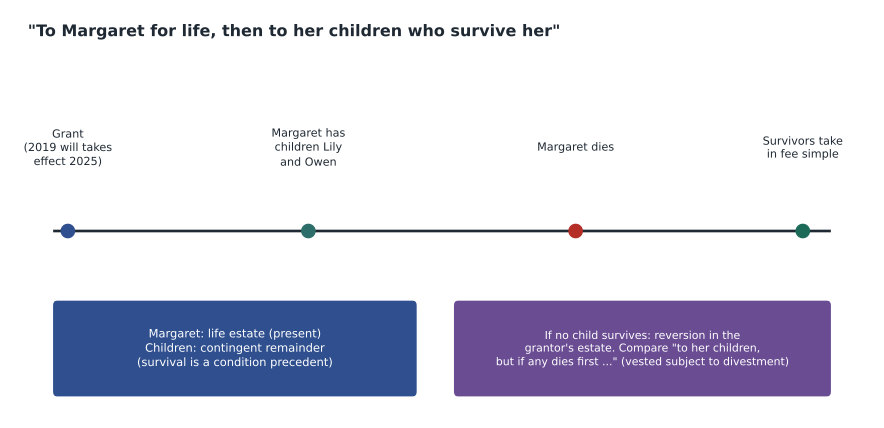
"Ownership can be divided in two ways," Vandermolen says as the third class begins. "Among people at the same time, which we will study as concurrent ownership, and across time, which we start today." She projects a clause from Eleanor Ashby's 2019 will: *I give my duplex at 412 Sycamore Street, Brennan Falls, to my daughter Margaret for life, then to her children who survive her.* "Margaret is collecting rent today. Who else owns an interest in that building right now, and what kind?" Jordan Kimura guesses that Margaret's children, Lily and Owen, own it later. "They own something now," Vandermolen says. "A future interest is a present property right to possession in the future. You can sell it, mortgage it, and in some cases lose it. Learning to name these interests is learning a language. Once you speak it, wills and deeds become readable."
Why estates exist
The system of estates in land comes from English feudal tenure, under which land was held from a lord in return for services. Over centuries, the interests of the tenant became freely transferable and inheritable, and the feudal incidents disappeared. What survived was a vocabulary for dividing ownership over time. American law inherited that vocabulary and simplified it. Most states have abolished the fee tail, the Rule in Shelley's Case and the destructibility of contingent remainders, but the basic categories remain, and every bar exam tests them.
A present estate gives the right to possess now. A future interest gives the right to possess later, if at all. Every future interest is created at the same time as a present estate, and the two together add up to full ownership. The key skill is reading the words of a grant to identify which estate and which future interest have been created, and in whom.
Present estates
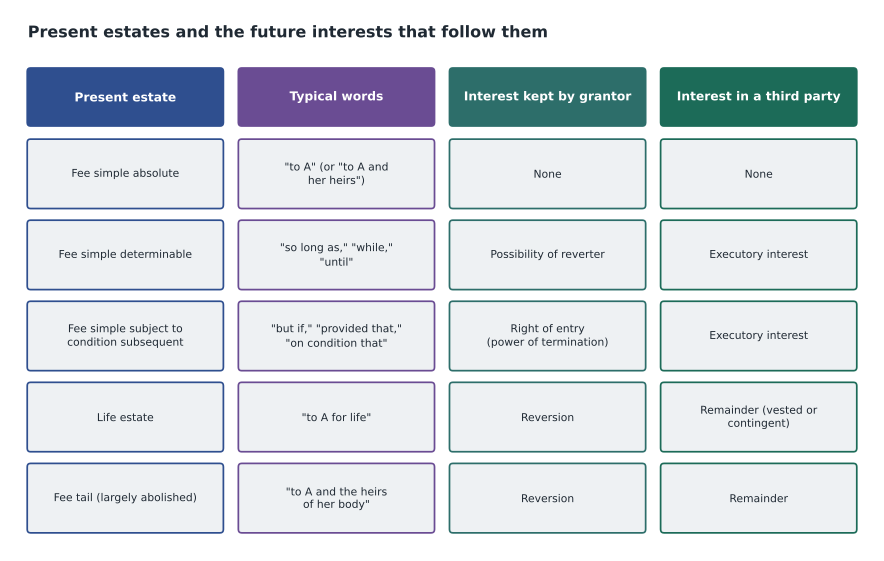
The fee simple absolute is the largest estate: potentially infinite in duration, freely transferable during life, devisable by will and inheritable. At common law a fee simple required the words "to A and her heirs"; today "to A" is enough, and a grant is presumed to convey a fee simple unless a smaller estate is clearly intended. The words "and her heirs" are words of limitation that describe the estate A takes; they give A's heirs nothing while A lives. A living person has no heirs, only heirs apparent.
The fee simple determinable lasts until a stated event occurs and then ends automatically. It is created by durational words such as "so long as," "while," "during" or "until." The grantor keeps a possibility of reverter. The fee simple subject to condition subsequent does not end automatically; instead, the grantor has a right of entry (also called a power of termination) and must act to end the estate after the condition is broken. It is created by conditional words such as "but if," "provided that" or "on condition that," usually with language saying the grantor may re-enter. When a defeasible fee is followed by an interest in a third party rather than the grantor, the third party's interest is an executory interest, and the present estate is called a fee simple subject to an executory limitation.
Courts prefer the fee simple subject to condition subsequent when the language is ambiguous, because it avoids automatic forfeiture. Mahrenholz v. County Board of School Trustees, 93 Ill. App. 3d 366 (1981), involved a 1941 deed conveying land "to be used for school purpose only; otherwise to revert to Grantors herein." The Illinois Appellate Court held that the words created a fee simple determinable and a possibility of reverter, because "only" and "otherwise to revert" showed that the estate was meant to last only while the land was used for school purposes. The distinction mattered: the plaintiffs had acquired the reversionary interest from the grantors' heirs, and Illinois law treated possibilities of reverter and rights of entry differently on transfer.
The life estate lasts for the life of a person, usually the grantee ("to A for life") but sometimes another ("to A for the life of B," an estate pur autre vie). A life tenant may use the land and keep its income but must not commit waste. Voluntary or affirmative waste is active harm, such as tearing down buildings or removing minerals not already being mined. Permissive waste is failure to maintain the property, pay taxes or pay mortgage interest. Ameliorative waste is a change that increases value, such as replacing a house with an apartment building; modern courts allow it when the change is reasonable and the property can no longer be used as before. Melms v. Pabst Brewing Co., 104 Wis. 7 (1899), refused to award damages for tearing down a mansion that had become surrounded by factories, because the change was reasonable and increased the land's value.
Courts sometimes must decide whether a will created a life estate at all. In White v. Brown, 559 S.W.2d 938 (Tenn. 1977), a holographic will left a house to the testator's niece "to live in and not to be sold." The Tennessee Supreme Court relied on a statutory presumption that a will passes the testator's entire interest unless a smaller estate is clearly intended, held that the niece took a fee simple, and struck the restraint on sale as void. In Baker v. Weedon, 262 So. 2d 641 (Miss. 1972), an elderly life tenant who could not afford to maintain a farm asked to sell it; the remaindermen preferred to wait for a highway to raise its value. The Mississippi Supreme Court held that a court of equity may order a sale of land subject to a life estate when necessary to protect all interests, but it suggested the court first consider a sale of part of the land or a mortgage to meet the life tenant's needs.
Future interests kept by the grantor
A grantor who conveys less than everything keeps a future interest. There are three. The reversion follows a life estate or a term of years: "O to A for life" leaves O a reversion, which becomes possessory when A dies. The possibility of reverter follows a fee simple determinable. The right of entry follows a fee simple subject to condition subsequent. Reversions are always vested, because nothing must happen before they become possessory except the natural end of the prior estate.
Future interests in third parties: remainders
A remainder is a future interest in a grantee that can become possessory on the natural end of the prior estate, such as the end of a life estate. It never cuts short a prior estate. A remainder is vested if it is given to an ascertained person and is not subject to any condition precedent other than the end of the prior estate. It is contingent if it is given to an unascertained person (such as "A's heirs" while A lives, or "children who survive A") or is subject to a condition precedent (such as "to B if B reaches 25").
Vested remainders come in three types. An indefeasibly vested remainder is certain to become possessory and cannot be lost: "O to A for life, then to B." A vested remainder subject to open is given to a class with at least one member that may grow: "O to A for life, then to A's children," when A has one child, C, and may have more. A vested remainder subject to divestment is vested but may be cut short by a condition subsequent: "O to A for life, then to B, but if B dies before A, to C." The difference between a condition precedent and a condition subsequent often turns on word order. "To A for life, then to B if B survives A" makes survival a condition precedent, so B's remainder is contingent. "To A for life, then to B, but if B does not survive A, to C" makes B's remainder vested subject to divestment and C's interest an executory interest.
Why does classification matter? At common law, contingent remainders were destructible: if the contingency had not occurred when the prior estate ended, the remainder failed. Contingent remainders were also not freely transferable, and they are subject to the Rule Against Perpetuities, while vested remainders (other than those subject to open) are not. Most states have abolished destructibility, and modern statutes make all future interests transferable, but the Rule Against Perpetuities still makes classification essential.
Executory interests
An executory interest is a future interest in a grantee that can become possessory only by cutting short a prior estate (a shifting executory interest, which divests another grantee) or by springing out of the grantor at a future time (a springing executory interest, as in "O to A when A marries"). Executory interests became possible after the Statute of Uses of 1536 and the Statute of Wills of 1540. They are treated as contingent for purposes of the Rule Against Perpetuities. A grant "to the Merrin County Land Trust so long as the meadow is kept as a nature preserve, and if it ceases to be so kept, to my grandchildren" gives the land trust a fee simple determinable (some would say a fee simple subject to an executory limitation) and the grandchildren a shifting executory interest.
| Grant | Present estate | Future interest |
|---|---|---|
| O to A for life, then to B | A: life estate | B: indefeasibly vested remainder |
| O to A for life, then to B if B reaches 30 (B is 20) | A: life estate | B: contingent remainder; O: reversion |
| O to A for life, then to A's children (A has one child, C) | A: life estate | C: vested remainder subject to open |
| O to A for life, then to B, but if B dies before A, to C | A: life estate | B: vested remainder subject to divestment; C: shifting executory interest |
| O to A so long as used as a school | A: fee simple determinable | O: possibility of reverter |
| O to A, but if liquor is sold, O may re-enter | A: fee simple subject to condition subsequent | O: right of entry |
| O to A when A marries | O: fee simple subject to executory limitation | A: springing executory interest |
Old rules that still matter
Three ancient doctrines complete the picture. The Rule in Shelley's Case turned "to A for life, then to A's heirs" into a fee simple in A; nearly every state has abolished it. The Doctrine of Worthier Title turned "O to A for life, then to O's heirs" into a reversion in O; it survives in some states as a rule of construction. The fee tail, which passed land only to the grantee's lineal descendants, has been abolished or converted to a fee simple in most states, though a few still recognize it in modified form.
The duplex and the Ashby will
Vandermolen returns to the Sycamore Street duplex. Under the will, Margaret has a life estate. Her children Lily and Owen have a contingent remainder, because survival of Margaret is a condition precedent and the takers cannot be identified until her death. Eleanor's estate holds a reversion, which passes under the residuary clause to Paul and Margaret equally, and will become possessory only if neither child survives Margaret. Margaret may lease the building and keep the rent, but she must pay property taxes and keep the building in repair; letting the roof fail would be permissive waste. If she wanted to sell the duplex, she could sell only her life estate, which few buyers want. Hannah asks whether a court could order a sale of the whole building, as in Baker v. Weedon. "If the life tenant and the remaindermen cannot agree, and a sale is needed to protect everyone, many courts will," Vandermolen says. "But the minor remaindermen and unborn children need a guardian ad litem. Contingent remainders make deals slow."
Paul's lawyer has also noticed that the will gives the north meadow to the Merrin County Land Trust "so long as" it remains a nature preserve, with a gift over to grandchildren who reach twenty-five. "Classify it," Vandermolen says. Marcus answers: the land trust has a fee simple subject to an executory limitation, and the grandchildren have a shifting executory interest. "Good. Next class we find out whether that executory interest is valid. Bring your perpetuities nightmares."
Worked problem
The waste claim
Margaret, life tenant of the Sycamore Street duplex, plans to replace the building's original wood windows with vinyl ones and to convert the detached garage into a studio apartment she can rent. Lily and Owen, the contingent remaindermen, object. Margaret has also not paid the second-half property taxes for 2025. Analyze whether Margaret is committing waste.
Show solution
- Identify the estate: Margaret holds a life estate and owes duties to the holders of future interests not to commit waste.
- Windows: routine replacement that maintains the building is not waste; if the change reduced value or historic character, remaindermen could argue voluntary waste.
- Garage conversion: a change that increases value is ameliorative waste; modern courts often allow it when reasonable (Melms), but some require consent or court approval.
- Taxes: a life tenant must pay property taxes to the extent of the income from the property; failing to pay is permissive waste that threatens a tax sale.
- Standing: contingent remaindermen can sue to prevent waste, though courts may weigh the uncertainty of their interests.
Answer: The window replacement is probably not waste and the garage conversion may be permitted as reasonable ameliorative waste, but failing to pay property taxes is permissive waste that Lily and Owen can sue to stop.
Summary and key terms
- Present estates include the fee simple absolute, the defeasible fees and the life estate; future interests include reversions, possibilities of reverter, rights of entry, remainders and executory interests.
- Durational words create a fee simple determinable; conditional words create a fee simple subject to condition subsequent (Mahrenholz).
- Life tenants may use the land but must not commit voluntary or permissive waste; reasonable ameliorative waste is often allowed (Melms); courts may order sales to protect all interests (Baker v. Weedon).
- A remainder is vested if given to an ascertained person without a condition precedent; otherwise it is contingent.
- Executory interests cut short a prior estate or spring from the grantor and are treated as contingent for perpetuities purposes.
- Shelley's Case, Worthier Title, destructibility and the fee tail are mostly abolished, but classification still matters for the Rule Against Perpetuities.
Practice problems
Work each problem on paper first, then reveal the answer to check.
Why did the court in Mahrenholz find a fee simple determinable?
Show answer
The words 'only' and 'otherwise to revert' showed the estate was to last only while the land was used for school purposes, ending automatically, with a possibility of reverter.
What is the difference between a vested remainder subject to divestment and a contingent remainder?
Show answer
A contingent remainder is subject to a condition precedent or given to unascertained persons; a remainder subject to divestment is vested but can be cut short by a condition subsequent.
In 'O to A for life, then to A's children,' when A has one child, what does the child hold?
Show answer
A vested remainder subject to open, because the class of A's children may grow.
What did White v. Brown hold about a devise 'to live in and not to be sold'?
Show answer
Under Tennessee's presumption in favor of passing the testator's whole interest, the niece took a fee simple and the restraint on sale was void.
Lesson quiz · 5 questions
Score 60% or more to complete this lesson.
Create a free account to save your progress, take quizzes and earn a certificate.