
LAWU-113 · Lesson 4 of 12 · 20 min
The Rule Against Perpetuities and restraints on alienation
▶ Video coming soon A video version of this lesson is on the way.
Vandermolen writes the rule on the board in John Chipman Gray's words and reads it aloud slowly: *No interest is good unless it must vest, if at all, not later than twenty-one years after some life in being at the creation of the interest.* "Twenty-five words," she says, "that have humbled more lawyers than any other sentence in property law. The California Supreme Court once held that a lawyer who drafted a will violating the rule was not negligent, because the rule is so hard that even careful lawyers get it wrong." She is referring to Lucas v. Hamm, 56 Cal. 2d 583 (1961). "Do not take comfort from that case. Modern courts are less forgiving, and the drafting fix is easy."
What the rule is for
The rule limits dead-hand control: the power of a person, through a will or deed, to dictate who will own property far into the future. Contingent interests that might vest generations later make land hard to sell and develop, because no one can give a buyer complete title while unidentified future owners might appear. English courts developed the rule in the seventeenth century, beginning with the Duke of Norfolk's Case (1682), to balance the wishes of the dead against the needs of the living. The rule allows a person to control property through the lives of people they knew, plus twenty-one years, roughly enough to reach a grandchild's majority.
Which interests the rule applies to
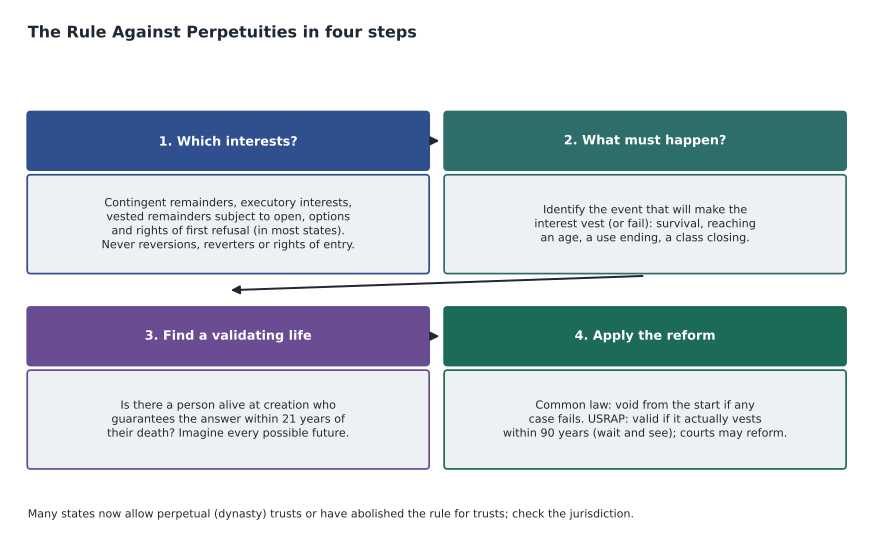
The rule applies to contingent remainders, executory interests and vested remainders subject to open (class gifts). It does not apply to interests kept by the grantor, such as reversions, possibilities of reverter and rights of entry, because those are treated as vested. It does not apply to indefeasibly vested remainders or vested remainders subject to divestment. Most states also apply it to options to purchase land and to rights of first refusal not attached to a lease, because they restrain the marketability of land, though some states exempt rights of first refusal or commercial options.
The test: what might happen
Under the common law rule, an interest is void from the start if there is any possible way, however unlikely, that it might vest more than twenty-one years after the death of every person alive when the interest was created. The court does not wait to see what actually happens. The analyst searches for a validating life: a person alive at the creation of the interest whose life, plus twenty-one years, guarantees that the interest will either vest or fail. If no such person exists, the interest is void and is struck from the grant, and the rest of the grant is read as if the void words were not there.
Interests are created when the instrument takes effect: for a will, at the testator's death; for a deed, at delivery; for a revocable trust, when it becomes irrevocable, usually at the settlor's death. That timing often saves will gifts, because the testator's children are then lives in being.
The classic traps
Three famous hypotheticals show how strict the what-might-happen test is. In the fertile octogenarian, a grant "to A for life, then to A's children for life, then to A's grandchildren" fails even if A is eighty, because the law conclusively presumes that anyone can have children at any age; A could have another child after the grant, that child could have children more than twenty-one years after the death of everyone now alive, and the grandchildren's class would not close in time. Jee v. Audley, 1 Cox 324 (Ch. 1787), is the source of the presumption.
In the unborn widow, "to A for life, then to A's widow for life, then to A's children then living" fails because A's eventual widow might be someone not yet born, and the children's interest, which depends on surviving the widow, could vest too late. In the slothful executor, a gift "to my issue living when my estate is distributed" fails because distribution might theoretically take more than twenty-one years. The administrative contingency cases show the rule's reputation for producing results no one intended.
Class gifts follow an all-or-nothing rule: a gift to a class is valid only if the interest of every member must vest within the period. If the interest of even one possible member might vest too late, the whole class gift fails. Age contingencies greater than twenty-one years are a common source of trouble: "to my grandchildren who reach 25" in a deed by a living grantor is void, because a grandchild born after the grant could reach twenty-five more than twenty-one years after the deaths of everyone now alive.
Charities and commercial interests
Gifts from one charity to another are exempt: "to the Red Cross, but if it ceases to operate a blood bank, to the American Heart Association" is valid. A gift over from a charity to a private person is not exempt. Possibilities of reverter and rights of entry following charitable gifts are not subject to the rule at all, which is why grantors who want land back can draft in their own favor. Brown v. Independent Baptist Church of Woburn, 325 Mass. 645 (1950), involved land devised to a church "so long as" it held services in accordance with its creed, with a gift over to named private persons. The gift over was void under the rule; the court struck it, leaving a fee simple determinable in the church and a possibility of reverter in the testator's estate, which passed to her residuary heirs when the church stopped using the land.
Options raise the rule in commercial settings. In Symphony Space, Inc. v. Pergola Properties, Inc., 88 N.Y.2d 466 (1996), a nonprofit arts center sold its Manhattan building in 1978 and leased it back, with an option to repurchase that could be exercised during several windows extending to 2003. The New York Court of Appeals held that the option, which was not attached to a lease in the ordinary way and could be exercised beyond the period, violated New York's statutory version of the rule. The court refused to create an exception for commercial options, reasoning that options restrain the alienability of land just as contingent interests do. Symphony Space kept its building.
Reform: wait and see, reformation and USRAP
Most states have changed the common law rule. Some adopted wait-and-see: instead of asking whether an interest might vest too late, courts wait to see whether it actually does. Some allow courts to reform an invalid interest, using cy pres, to come as close as possible to the grantor's intent within the period, for example by reducing an age contingency from twenty-five to twenty-one. The Uniform Statutory Rule Against Perpetuities (USRAP), adopted in many states, keeps the common law rule but adds an alternative: an interest that fails the common law test is still valid if it actually vests or fails within ninety years after its creation. If, after ninety years, the interest is still contingent, the court reforms it.
A growing number of states have abolished the rule for interests in trust or extended the period to hundreds of years, allowing so-called dynasty trusts that can last indefinitely and avoid federal estate and generation-skipping transfer taxes at each generation. Delaware, South Dakota and Alaska were early leaders. Many of these states still apply some limit to interests in land held outside trust. Vandermolen tells the class that whether the rule applies, and in what form, is always a question of the specific state's statute.
| Approach | Test | Effect of a violation |
|---|---|---|
| Common law | Must vest, if at all, within a life in being plus 21 years; consider any possibility | Interest void from creation and struck |
| Wait and see | Did the interest actually vest within the period? | Void only if it in fact vests too late |
| Reformation (cy pres) | Can the grant be revised close to the grantor's intent? | Court rewrites, for example reducing an age to 21 |
| USRAP | Common law test, or actual vesting within 90 years | Reform after 90 years if still contingent |
| Abolition for trusts | No time limit (or a very long one) for trust interests | Dynasty trusts permitted |
Restraints on alienation
The policy favoring free alienation also limits direct restraints on transfer. A disabling restraint, which says that any attempted transfer is void ("to A, and A shall have no power to sell"), is void when attached to a fee simple. A forfeiture restraint, which takes the property away if the owner tries to transfer it ("to A, but if A sells, to B"), is also generally void on a fee simple but may be valid on a life estate. A promissory restraint, which is a covenant not to transfer, is usually void on a fee simple. Courts uphold reasonable restraints with legitimate purposes and limited scope, such as rights of first refusal at market price, restrictions in condominium and cooperative documents, and restrictions protecting affordable housing programs.
Mountain Brow Lodge No. 82 v. Toscano, 257 Cal. App. 2d 22 (1967), shows the line between a use restriction and a restraint on alienation. The Toscanos conveyed land to a lodge, "restricted for the use and benefit of the second party, only," providing that if the lodge failed to use the property or tried to sell it, title would revert. The California Court of Appeal held that the clause restricting the land's use to the lodge's benefit was a valid limitation on use, creating a fee simple subject to condition subsequent, but that the clause forbidding sale was an invalid restraint on alienation. White v. Brown, from the last class, struck a restraint on sale attached to a devise construed as a fee simple.
The north meadow
Back to the Ashby will: the north meadow goes "to the Merrin County Land Trust so long as the meadow is kept as a nature preserve, and if it ceases to be so kept, to those of my grandchildren who reach the age of 25." Eleanor died in 2025, so the interests were created then. Priya applies the common law rule. The grandchildren's executory interest depends on two things: the meadow ceasing to be a preserve, which could happen centuries from now, and grandchildren reaching twenty-five. No life in being can guarantee that the preserve will end within twenty-one years after it. The gift over is void.
"What happens when you strike it?" Vandermolen asks. Following Brown v. Independent Baptist Church, Priya reads what remains: "to the Merrin County Land Trust so long as the meadow is kept as a nature preserve." That is a fee simple determinable in the land trust, with a possibility of reverter in Eleanor's estate, which passed under the residuary clause to Paul and Margaret. The possibility of reverter is not subject to the rule. Daniel notes the irony: Eleanor wanted the meadow to go to her grandchildren if the preserve ended, and the rule hands it to her children instead.
Westmarch, the class learns, has adopted USRAP. Under the ninety-year wait-and-see alternative, the grandchildren's interest is valid if it actually vests or fails by 2115. If the land trust stops maintaining the preserve in, say, 2040, and grandchildren have reached twenty-five by then, they take. Only if the interest remains contingent in 2115 will a court reform it. "The drafting fix," Vandermolen says, "was a perpetuities saving clause: a provision that any interest not vested within twenty-one years after the death of the last survivor of my children and grandchildren living at my death shall vest at that time in the persons then entitled. Eleanor's lawyer left it out."
Worked problem
A trust for great-grandchildren
In a deed of trust signed in 2026, a living grantor, Ruth, transfers investments to a trustee "to pay the income to my children for their lives, then to distribute the principal to my grandchildren who reach age 30." Ruth is alive and has two children and one grandchild. Is the gift to grandchildren valid under the common law rule? Under USRAP?
Show solution
- Identify the interest: the grandchildren hold a contingent interest (a class gift subject to an age contingency), subject to the rule.
- Common law: Ruth is alive, so she could have more children, and those children could have grandchildren who reach 30 more than 21 years after the deaths of everyone alive in 2026; the all-or-nothing class rule voids the entire gift.
- USRAP: the gift is valid if it actually vests or fails within 90 years after 2026, that is, by 2116; most likely all grandchildren will reach 30 or die before then.
- Reformation: if any interest remains contingent in 2116, the court reforms it to carry out Ruth's intent as closely as possible.
Answer: The gift fails under the common law rule because of afterborn children and the age-30 contingency, but it is likely valid under USRAP's ninety-year wait-and-see period, with reformation available if needed.
Summary and key terms
- The rule limits dead-hand control and protects marketability; it applies to contingent remainders, executory interests, class gifts and, in most states, options.
- Interests in the grantor (reversions, reverters, rights of entry) are not subject to the rule; charity-to-charity gifts are exempt.
- At common law an interest is void if any possibility exists that it will vest too late (fertile octogenarian, unborn widow, slothful executor); class gifts are all-or-nothing.
- Striking a void gift over can leave a fee simple determinable and a possibility of reverter (Brown v. Independent Baptist Church).
- Symphony Space applied the rule to a commercial repurchase option.
- Reforms include wait and see, reformation and USRAP's 90-year period; many states allow perpetual trusts.
- Disabling, forfeiture and promissory restraints on a fee simple are generally void; reasonable restraints and use restrictions can be upheld (Mountain Brow Lodge).
Practice problems
Work each problem on paper first, then reveal the answer to check.
When is an interest created in a will for perpetuities purposes?
Show answer
At the testator's death, so people alive then, such as the testator's children, can serve as measuring lives.
Why is 'to A for life, then to A's widow for life, then to A's children then living' void at common law?
Show answer
A's widow could be someone not yet born, and the children's interest, which depends on surviving her, could vest more than 21 years after all lives in being.
What did Symphony Space hold?
Show answer
A commercial option to repurchase a building, exercisable beyond the perpetuities period, violated New York's rule; the court refused to exempt commercial options.
Under USRAP, what saves an interest that fails the common law test?
Show answer
It is valid if it actually vests or fails within 90 years after creation; otherwise a court reforms it.
Lesson quiz · 5 questions
Score 60% or more to complete this lesson.
Create a free account to save your progress, take quizzes and earn a certificate.