
LAWU-113 · Lesson 12 of 12 · 23 min
Capstone: solving a property problem
▶ Video coming soon A video version of this lesson is on the way.
For the last class, Vandermolen sets the Ashby files aside. "You know that family too well by now," she says. "An exam gives you a new set of facts and an hour. Here is a new set of facts. Read them twice, chart the parties, then take one issue at a time." She hands out a three-page problem about a building in downtown Brennan Falls. Everything in it is fictional, and the State of Westmarch, as in earlier lessons, has a ten-year adverse possession and prescription period, a race-notice recording statute, a retaliation statute with a six-month presumption, a statute presuming a tenancy in common unless a deed expressly creates a right of survivorship, and the Uniform Residential Landlord and Tenant Act.
The facts: Millbrook Commons
Millbrook Commons is a three-story brick building at 18 Millbrook Street. The ground floor is leased to a cafe; the second floor holds two apartments, 2A and 2B. Behind the building is a small parking lot, Lot 7, bought separately in 2015. Rosalind Dunmore owned the building for forty years. In 2010 she deeded it, and in 2015 Lot 7, "to my children Theo Dunmore and Iris Dunmore, jointly." Rosalind died in 2023.
Theo moved into apartment 2A in 2021 and has paid nothing since. Iris lives in Seattle. In March 2026, Iris wrote to Theo: "Either let me rent out half of the building's space or pay me half the fair rent for 2A." Theo did not answer, and in April he changed the locks on the building's shared basement storage room, telling Iris by text that she "had no business in the basement." In May 2026 Iris filed for partition and an accounting. Theo wants to keep the building.
The cafe tenant, Bramble and Bean LLC, has a lease from 2022 to 2032 that says: "Tenant shall not assign this lease without Landlord's written consent, which Landlord may withhold in its sole and absolute discretion." In September 2026, Bramble and Bean agreed to sell its business to Harbor Hill Coffee Company, a regional chain with excellent credit, and asked for consent to assign. Theo refused unless the rent was raised by a fifth; Iris would consent. In apartment 2B, tenant Marisol Ochoa, a month-to-month tenant since 2024, had no hot water for three weeks in October 2026, and black mold spread across the bathroom ceiling after a roof leak. She reported the conditions to city code enforcement on October 20. On November 2, Theo served her a thirty-day notice to quit.
The building's only rear access, used for deliveries and trash, is a paved twelve-foot alley across the neighboring lot, now owned by Quarry Lane Partners LLC. Both lots belonged to Rosalind's father until he sold the neighboring lot in 1955. The alley, with a gate, was then used for coal deliveries to the building's boiler room. Deliveries have used it ever since. Quarry Lane has announced plans to build over the alley in 2027. The 1952 subdivision plat for the block, recorded and referenced in every deed, provides: "No lot shall be used for the sale of intoxicating liquors." Three other businesses on the block have sold beer and wine for more than twenty years without objection. Harbor Hill wants to serve wine.
In 2019, Theo and Iris signed a mortgage to Lakeland Credit Union to finance a new roof, covering the building and Lot 7. The credit union did not record it until August 2026. In June 2026, Theo and Iris sold Lot 7 to Gwen Patel for 95,000 dollars; her title search found no mortgage, and she recorded her deed on June 15. Finally, the city told the owners that a permit to add a rooftop deck and elevator would require them to dedicate a six-foot strip along Millbrook Street for a protected bike lane and to pay a 9,000-dollar transportation impact fee under a citywide fee schedule. A 2025 downtown rezoning allows a fourth floor, which would add value to the building.
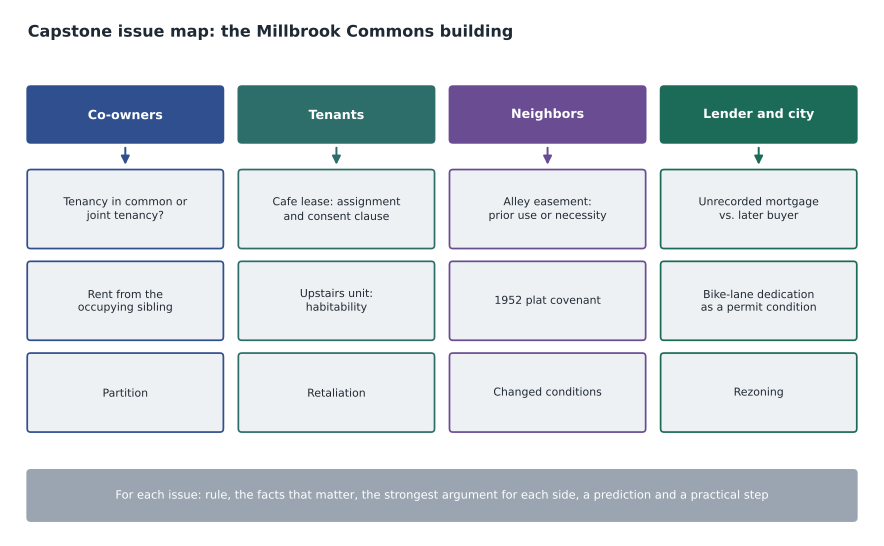
Method
Vandermolen reminds Section B of her method. First, chart the parties and their interests: Theo and Iris (co-owners), Bramble and Bean and Harbor Hill (commercial tenant and proposed assignee), Marisol Ochoa (residential tenant), Quarry Lane (neighbor), Lakeland Credit Union (lender), Gwen Patel (buyer of Lot 7) and the city. Second, for each relationship, identify the doctrine and its elements. Third, use the facts as signals; nearly every fact in an exam problem is there for a reason. Fourth, argue both sides and predict. Fifth, end each issue with a practical step a client could take. "Property problems almost always end in a deed, a lease amendment or a settlement," she says. "Show you know how."
Issue 1: What kind of co-ownership?
Rule: modern statutes presume a tenancy in common unless the instrument clearly expresses an intent to create a joint tenancy with survivorship; Westmarch requires express words of survivorship. Facts: the deeds say "jointly," without mentioning survivorship. Arguments: Theo might argue that "jointly" signals a joint tenancy and that Rosalind meant her children to inherit from each other. Iris would answer that "jointly" describes co-ownership generally and courts have often held it insufficient to overcome the statutory presumption. Prediction: under Westmarch's statute, Theo and Iris are tenants in common, each with a one-half undivided interest. The distinction matters less for partition than for death, but it also means either may convey or devise a share freely. Practical step: whichever form they want, they should sign a corrective deed stating it plainly.
Issue 2: Does Theo owe Iris rent? Has he ousted her?
Rule: each co-tenant may possess the whole; a co-tenant in sole possession owes no rent to others absent ouster or agreement (Spiller v. Mackereth). Ouster requires a refusal of a co-tenant's demand to share possession or conduct denying her rights. A co-tenant who collects rent from third parties must account for net rents, and co-tenants share taxes and carrying costs. Facts: Iris's March letter demanded either access to rent out half the space or payment of half the fair rent for 2A. Theo ignored it and then locked her out of the basement storage room, telling her she had no business there. Arguments: Theo will cite Spiller, where a letter demanding rent or that the occupant vacate half was not a demand for possession. Iris will argue that her letter did demand shared use and that the lockout and text were an express denial of her right to possess, which is ouster under any test. Prediction: the lockout, combined with the text, is strong evidence of ouster from at least April 2026; Theo likely owes Iris half the fair rental value of the space he excludes her from from that time, though probably not for 2021 to 2026. Separately, Theo must account to Iris for half the net rent from the cafe and apartment 2B if he has been collecting it.
Issue 3: Partition
Rule: any co-tenant may demand partition; partition in kind is preferred where practicable and fair (Delfino v. Vealencis), otherwise the court orders a sale and divides the proceeds after credits for contributions and improvements. Facts: a single three-story building with a separate cafe and two apartments; Lot 7 has already been sold; the 2025 rezoning increases the building's value. Arguments: Theo might propose a division in kind by converting the building to condominium units, giving him the apartments and Iris the cafe space of equal value. Iris will argue that a single small building cannot be fairly divided and that a sale will bring the best price, especially with fourth-floor potential. Prediction: most courts would order a sale of a small mixed-use building, but a court could approve a condominium conversion if values can be equalized, and many courts give the co-tenant who wants to keep the property a chance to buy out the other at appraised value. Practical step: negotiate a buyout by Theo at an appraised value, with credits for his share of taxes and the roof loan and debits for any rent owed after ouster.
Issue 4: The cafe assignment
Rule: absent a lease restriction, a tenant may assign; where a lease requires consent without stating a standard, a growing number of courts, following Kendall v. Ernest Pestana for commercial leases, require a commercially reasonable objection. But parties may expressly agree that consent may be withheld in the landlord's sole discretion, and most courts, including California's after Kendall by statute, enforce such clauses, sometimes subject to the duty of good faith. Facts: the lease expressly allows refusal "in its sole and absolute discretion"; the assignee has excellent credit; Theo demands a rent increase; Iris would consent. Arguments: Harbor Hill and Bramble and Bean will argue that the implied covenant of good faith limits even sole discretion and that demanding more rent is opportunistic. Theo will answer that the clause means exactly what it says and that the parties bargained for it. A further wrinkle is that the landlord is two co-tenants who disagree; the lease may require both landlords to act, or allow either to manage, and a court may treat a refusal by one co-owner as no consent at all. Prediction: the express sole-discretion clause will probably be enforced in most states, so Theo's refusal is valid unless the lease or Westmarch law imposes a good-faith limit; the co-owners' disagreement adds leverage for a negotiated rent adjustment. Practical step: negotiate consent with a modest rent increase or a guaranty from Harbor Hill's parent company.
Issue 5: Apartment 2B: habitability and retaliation
Rule: residential leases carry a nonwaivable implied warranty of habitability (Javins; Hilder; URLTA); remedies include rent abatement, repair and deduct within limits, damages and termination. Retaliatory eviction is barred (Edwards v. Habib), and Westmarch presumes retaliation when a landlord takes adverse action within six months after a tenant's good-faith complaint to a government authority. Facts: three weeks without hot water and spreading black mold after a roof leak; a code complaint on October 20; a notice to quit on November 2. Arguments: Theo may argue that a month-to-month tenancy can be ended for any reason with proper notice and that he needs the unit for renovation. Ochoa will invoke the statutory presumption, triggered by the thirteen-day gap, and the conditions breaching the warranty. Prediction: the notice to quit is presumptively retaliatory, and Theo must prove a legitimate non-retaliatory reason; a vague renovation plan is unlikely to suffice. Ochoa also has a claim for abatement for the period without hot water and for mold remediation. Practical step: fix the roof and mold promptly, abate October's rent, and withdraw the notice.
Issue 6: The alley
Rule: an easement implied from prior use arises on severance of commonly owned land when a use was apparent and continuous before severance and is reasonably necessary afterward (Van Sandt v. Royster). An easement by necessity requires strict necessity at severance. A prescriptive easement requires open, continuous, adverse use for the statutory period. Facts: common ownership until 1955; a paved, gated alley used for coal deliveries before the sale; continuous delivery use since; the building fronts on Millbrook Street, so it is not landlocked. Arguments: Quarry Lane will argue there was never strict necessity, since the front door gives access, and that later deliveries were permissive neighborly use. The owners will argue that the alley was plainly visible and regularly used for the building's service needs when the lots were divided, and that rear access for deliveries and trash is reasonably necessary for a commercial building. Prediction: no easement by necessity, but a strong easement implied from prior use, created in 1955; its scope includes modern deliveries and trash pickup as a normal evolution of coal deliveries. A prescriptive easement is an alternative if the post-1955 use was adverse. Practical step: record an easement agreement with Quarry Lane, or seek a declaratory judgment before construction begins.
Issue 7: The liquor covenant
Rule: a restriction in a recorded plat referenced in every deed binds later owners with record notice as an equitable servitude; it is enforced unless defenses apply, including abandonment through widespread unchallenged violations and changed conditions that defeat its purpose within the restricted area (Western Land Co. v. Truskolaski). Facts: three businesses on the same block have sold beer and wine for more than twenty years without objection; downtown has changed since 1952. Arguments: a neighbor seeking to enforce will argue that the covenant still protects the block's character. Harbor Hill will argue abandonment: the restriction has been openly violated on the block for decades, so it no longer serves its purpose, and laches or acquiescence bars selective enforcement. Prediction: the abandonment and acquiescence defenses are strong because the violations are within the restricted block itself, which distinguishes Western Land. Practical step: ask the court for a declaratory judgment, or obtain releases from neighboring owners if few remain who could enforce.
Issue 8: The unrecorded mortgage and Lot 7
Rule: under a race-notice statute, a later purchaser for value without notice who records first takes free of an earlier unrecorded interest; recording acts protect mortgagees as purchasers, and a mortgage is a conveyance for this purpose. Facts: the 2019 mortgage covered Lot 7 but was recorded only in August 2026; Patel paid 95,000 dollars, searched title, had no notice, and recorded on June 15. Arguments: the credit union might argue that Patel had inquiry notice because the building's new roof suggested financing; that argument is weak, because a new roof on a different parcel does not reveal a mortgage on a parking lot. Prediction: Patel takes Lot 7 free of the mortgage. The mortgage remains valid on the building, and between the parties to it, Theo and Iris remain liable on the note; the credit union may have a claim against them for the value of the released security. Practical step: the credit union should record promptly and the owners should use some of the Lot 7 proceeds to pay down the loan.
Issue 9: The city's permit conditions
Rule: a permit condition demanding property or money must have an essential nexus to a legitimate interest and be roughly proportional to the project's impact (Nollan; Dolan; Koontz), including conditions in a legislative fee schedule (Sheetz). Facts: a rooftop deck and elevator; the city demands a six-foot street strip for a bike lane and a 9,000-dollar transportation impact fee. Arguments: the city will say that more intense use adds trips that justify transportation improvements; the owners will say a rooftop deck and elevator add few or no trips and have no relationship to a bike lane. Prediction: the dedication probably fails Nollan's nexus test or Dolan's proportionality test unless the city makes an individualized finding of increased traffic; the fee is subject to the same analysis after Sheetz and must be tied to the project's actual impact. Practical step: ask the city for its individualized impact findings and negotiate a reduced fee.
| Issue | Prediction | Key authority |
|---|---|---|
| Form of co-ownership | Tenancy in common under Westmarch's statute | Statutory presumption |
| Rent from Theo | Owed from the April 2026 ouster | Spiller v. Mackereth |
| Partition | Likely sale or buyout; condominium division possible | Delfino v. Vealencis |
| Cafe assignment | Sole-discretion clause probably enforced | Kendall (contrast) |
| Apartment 2B | Habitability breach; notice presumptively retaliatory | Javins; Edwards v. Habib |
| Alley | Easement implied from prior use; no necessity | Van Sandt v. Royster |
| Liquor covenant | Likely abandoned on the block | Western Land (distinguished) |
| Lot 7 mortgage | Patel takes free | Race-notice statute |
| Permit conditions | Likely fail nexus or proportionality without findings | Nollan; Dolan; Sheetz |
Worked problem
A thirty-minute version
On a timed exam you might get only the co-owner facts: the deed "to Theo and Iris, jointly," Theo's sole occupancy since 2021, Iris's demand letter, the basement lockout, and Iris's partition suit. Outline the answer you would write in thirty minutes.
Show solution
- Form: statutory presumption of tenancy in common; 'jointly' likely insufficient for survivorship.
- Possession and rent: Spiller rule; analyze whether the March letter was a demand for possession and whether the April lockout and text were ouster; conclude rent owed from April.
- Accounting: Theo must account for net rents from third-party tenants; shares of taxes and costs.
- Partition: preference for in kind (Delfino) versus practicality of a single building; likely sale or buyout; credits and debits.
- Close with a practical recommendation: appraisal and buyout.
Answer: A strong answer moves from the form of co-ownership to rent, accounting and partition, uses Spiller and Delfino, commits to predictions on ouster from April 2026 and a likely sale or buyout, and ends with a practical buyout recommendation.
Summary and key terms
- Start by charting parties and interests, then take one relationship at a time.
- State each rule with its elements, use the facts as signals, argue both sides, predict and recommend a practical step.
- Co-ownership questions turn on form, ouster, accounting and partition (Spiller; Delfino).
- Lease questions turn on the consent clause and on habitability and retaliation (Kendall; Javins; Edwards).
- Servitude questions turn on how an easement arose and on covenant defenses (Van Sandt; Western Land).
- Title questions apply the recording act to each competing claimant; public law questions apply the takings and exaction tests (Nollan; Dolan; Sheetz).
Practice problems
Work each problem on paper first, then reveal the answer to check.
Why might the basement lockout matter more than Theo's years of rent-free occupancy?
Show answer
Sole occupancy alone does not create rent liability, but excluding a co-tenant and denying her rights is ouster, which does.
Why is there probably no easement by necessity for the alley?
Show answer
The building fronts on Millbrook Street, so there was no strict necessity at severance; the easement rests instead on apparent prior use and reasonable necessity.
Why does Gwen Patel take Lot 7 free of the 2019 mortgage?
Show answer
Under the race-notice statute she paid value, had no notice and recorded before the credit union did.
What must the city show to justify the bike-lane dedication?
Show answer
An essential nexus between the condition and the project's impact and rough proportionality based on an individualized determination.
Lesson quiz · 5 questions
Score 60% or more to complete this lesson.
Create a free account to save your progress, take quizzes and earn a certificate.