
LAWU-112 · Lesson 9 of 12 · 23 min
Inchoate crimes
▶ Video coming soon A video version of this lesson is on the way.
Mendenhall projects a series of text messages onto the screen. They come from the Westmarch problem: a group chat that Devon Pike started three weeks before the night at Riverside Salvage, titled "copper run." Pike wrote that the warehouse had been closed for months and was "full of wire." Kellan Shaw replied that he could get bolt cutters. Tara Quinn wrote "I can drive if you split it with me." Then, a week later, Shaw messaged a friend, Mateo, offering him a share if he would help carry the wire; Mateo never answered. "Suppose the police had read this chat the day before and arrested all three," she says. "No copper taken, no one hurt. Have they committed a crime?" The answer, she explains, is yes: the inchoate crimes of attempt, solicitation and conspiracy punish steps toward a crime before it is completed.
Why punish incomplete crimes?
Inchoate means begun but not completed. The inchoate crimes allow the law to intervene before harm occurs and to punish people who have shown, by their conduct, that they are dangerous and blameworthy, even if luck or the police prevented the harm. They raise a basic tension: the earlier the law intervenes, the more effectively it prevents harm, but the closer it comes to punishing thoughts, the act requirement discussed in the second lesson. Each inchoate crime draws the line differently.
Attempt: the mental state
An attempt requires the intent to commit the target offense and conduct that goes beyond mere preparation toward committing it. The mental state is demanding: attempt is a specific intent crime even when the target offense is not. A person can be guilty of reckless manslaughter, but not of attempted reckless manslaughter, because one cannot intend to cause a result recklessly. In People v. Kraft, 133 Ill. App. 3d 294 (1985), the court held that attempted murder requires the specific intent to kill; intent to cause serious bodily harm, which would suffice for murder if death resulted, is not enough for attempted murder. Most courts agree. The Model Penal Code's section 5.01(1) requires that the actor act with the purpose of committing the crime, though for circumstance elements the mental state required for the completed offense is enough, and for result crimes belief that the result will occur suffices.
Attempt: the conduct
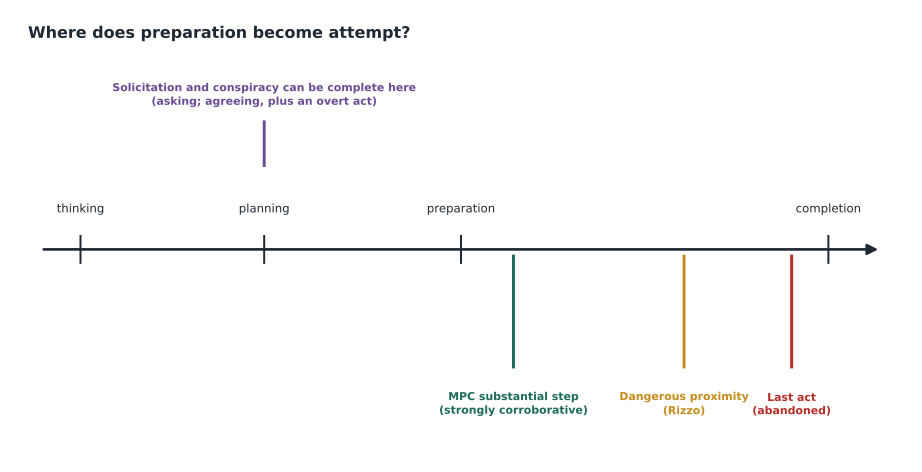
The harder question is how far the defendant must go. Courts have used several tests. The last act test, now abandoned, required that the defendant have done everything he planned to do. The dangerous proximity test, associated with Justice Holmes, asks whether the defendant came dangerously close to completing the crime, considering the gravity of the harm and the likelihood of success. In People v. Rizzo, 246 N.Y. 334 (1927), four men drove around Manhattan looking for a payroll clerk they planned to rob, but never found him before police arrested them. The New York Court of Appeals reversed their attempted robbery conviction because they had not come dangerously near to committing the crime; the victim was never even present.
Other tests include the physical proximity test, the indispensable element test (has the defendant obtained everything needed to commit the crime?), the probable desistance test (would an ordinary person have stopped at this point?) and the unequivocality or res ipsa loquitur test (would an observer, seeing the conduct, know that the defendant intended to commit the crime?). Each produces different results on the same facts.
The Model Penal Code adopted the substantial step test, now followed by most states and federal courts. Under section 5.01(1)(c), a person attempts a crime if he purposely does or omits to do anything that, under the circumstances as he believes them to be, is an act or omission constituting a substantial step in a course of conduct planned to culminate in the crime. Section 5.01(2) provides that conduct is not a substantial step unless it is strongly corroborative of the actor's criminal purpose, and lists examples that may be sufficient: lying in wait for or searching for the victim; enticing the victim to the place of the crime; reconnoitering the place; unlawfully entering a structure where the crime will be committed; possessing materials to be used in the crime that are specially designed for unlawful use or that serve no lawful purpose under the circumstances; and soliciting an innocent agent to engage in conduct constituting an element of the crime. Under the Code, the Rizzo defendants, who were searching for their victim while armed, would likely be guilty.
United States v. Jackson, 560 F.2d 112 (2d Cir. 1977), applied the test to men who twice drove to a bank with guns, masks and handcuffs, planning to rob it, but left the first time because they arrived too late and the second because they spotted the police. The Second Circuit upheld their attempted robbery convictions: reconnoitering, possessing the tools and approaching the bank were substantial steps strongly corroborating their purpose.
Impossibility
Sometimes a defendant does everything he intends, but the crime cannot be completed because the facts are not as he believes. Traditionally, courts distinguished factual impossibility, which was not a defense, from legal impossibility, which was. A pickpocket who reaches into an empty pocket is guilty of attempted larceny; factual circumstances unknown to him prevented completion. But in People v. Jaffe, 185 N.Y. 497 (1906), a man who bought cloth he believed was stolen, but which had actually been returned to its owner's control and so was no longer stolen, was held not guilty of attempting to receive stolen property, on the ground that what he intended to do was not a crime. The distinction proved unworkable, since nearly any case can be described either way.
The Model Penal Code abolished the impossibility defense for cases where the defendant's conduct would be a crime if the circumstances were as he believed them to be (section 5.01(1)(a)). Most states now follow this approach. In People v. Dlugash, 41 N.Y.2d 725 (1977), the defendant fired bullets into a man who had already been shot by another person and may already have been dead. The New York Court of Appeals held that he could be convicted of attempted murder if he believed the victim was alive, because under New York's statute, modeled on the Code, impossibility is no defense if the crime could have been committed had the circumstances been as the defendant believed. A defense survives only for true legal impossibility, where the defendant mistakenly believes that conduct is criminal when it is not, such as a person who brings in goods believing, wrongly, that they are subject to customs duty. The Code also allows a court to reduce the grade or dismiss when conduct is so inherently unlikely to result in a crime that neither the conduct nor the actor presents a public danger (section 5.05(2)), the classic example being an attempt to kill by witchcraft.
Abandonment
Under the Code's section 5.01(4), a person who abandons an attempt has an affirmative defense if the abandonment is complete and voluntary, reflecting a renunciation of criminal purpose. Abandonment is not voluntary if it is motivated by circumstances that increase the probability of detection or make the crime more difficult, or by a decision to postpone or to choose a different victim. The Jackson defendants who left because they saw police did not voluntarily renounce. Many states recognize the defense; some do not.
Solicitation
Solicitation is commanding, encouraging or requesting another person to commit a crime, with the intent that the person commit it. The crime is complete when the request is made, whether or not the other person agrees. The Model Penal Code's section 5.02 defines solicitation broadly to cover any crime and provides that it is no defense that the communication failed to reach the person solicited, if the actor's conduct was designed to communicate. Shaw's message to Mateo, offering a share of the copper if he would help carry it, is a solicitation to commit burglary and theft, complete when sent, even though Mateo never replied.
Conspiracy: the agreement
Conspiracy is an agreement between two or more persons to commit a crime, together with, in most jurisdictions, an overt act in furtherance of the agreement. Unlike attempt and solicitation, conspiracy does not merge into the completed crime: a defendant can be convicted of both conspiracy to commit burglary and burglary. Prosecutors favor conspiracy charges because they allow evidence of every co-conspirator's statements in furtherance of the conspiracy to be used against all (Federal Rule of Evidence 801(d)(2)(E)), permit joint trials, and, in some jurisdictions, make each conspirator liable for crimes committed by the others.
The agreement need not be express or written; it may be inferred from conduct. In Interstate Circuit, Inc. v. United States, 306 U.S. 208 (1939), the Supreme Court inferred an agreement among film distributors from their parallel acceptance of a letter proposal. But mere association, knowledge or presence is not enough. The group chat at Riverside Salvage, in which each participant expressly agreed to a role, provides unusually direct evidence. The overt act requirement, which exists in most jurisdictions and in the general federal conspiracy statute, 18 U.S.C. § 371, can be satisfied by any act by any conspirator in furtherance of the agreement, even a lawful one, such as Shaw's purchase of bolt cutters.
The mental state for conspiracy is the intent to agree and the intent that the crime be committed. Knowledge alone may not be enough. In People v. Lauria, 251 Cal. App. 2d 471 (1967), the operator of a telephone answering service knew that some of his customers were prostitutes using the service for their business. The California Court of Appeal held that knowledge that his services were being used for illegal purposes did not make him a conspirator; intent could be inferred from a stake in the venture, such as charging inflated prices, from the absence of any legitimate use for the services, or from a volume of business with the criminal enterprise grossly out of proportion to legitimate demand, but none was shown. The court suggested that knowledge alone might suffice for serious crimes.
Bilateral and unilateral agreement
The common law required a bilateral agreement: at least two people genuinely agreeing. If the only other party was an undercover officer feigning agreement, there was no conspiracy. The Model Penal Code adopted a unilateral approach in section 5.03(1): a person is guilty of conspiracy if he agrees with another person that they will commit a crime, so the focus is on the defendant's own agreement. Many states follow the Code, so a defendant who agrees with an undercover officer can be convicted. Federal courts generally still require a bilateral agreement.
Wharton's Rule and the scope of conspiracies
Wharton's Rule provides that an agreement between two people to commit a crime that by definition requires two participants, such as adultery, bigamy or dueling, is not a conspiracy. Iannelli v. United States, 420 U.S. 770 (1975), held that the rule is a presumption of legislative intent, not a constitutional requirement, and does not apply to a federal gambling statute requiring five or more participants. Related rules exempt people whom the statute protects or whose participation it necessarily contemplates; Gebardi v. United States, 287 U.S. 112 (1932), held that a woman who agreed to be transported across state lines for immoral purposes could not be convicted of conspiracy to violate the Mann Act, which did not make her conduct criminal.
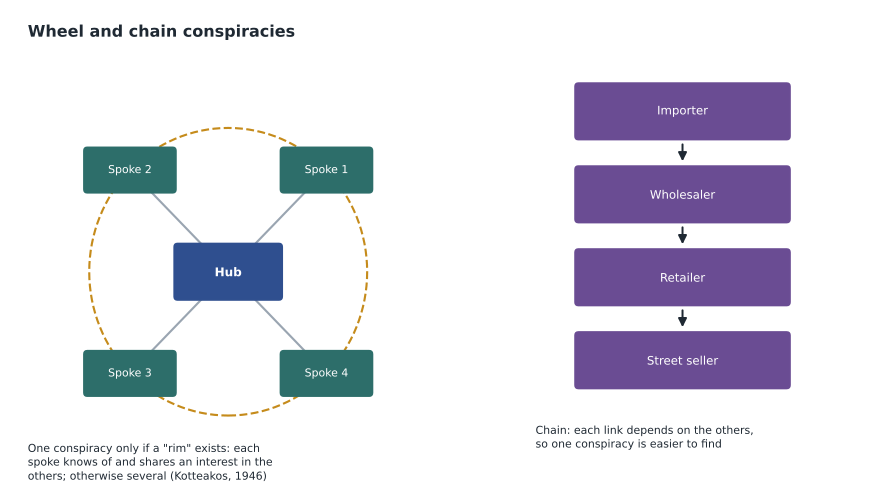
Large conspiracies raise questions about scope: is there one conspiracy or many? Courts use the images of a wheel (a central hub connected to spokes, which form a single conspiracy only if there is a rim connecting the spokes, meaning each knows of and shares an interest in the others' participation) and a chain (successive links in a distribution network, which can form a single conspiracy because each depends on the others). Kotteakos v. United States, 328 U.S. 750 (1946), reversed convictions where the government proved several separate conspiracies with a common hub but charged one.
Pinkerton liability
Under Pinkerton v. United States, 328 U.S. 640 (1946), a conspirator is liable for substantive crimes committed by co-conspirators in furtherance of the conspiracy and within its scope, if the crimes were reasonably foreseeable as a necessary or natural consequence of the agreement. Pinkerton was convicted of tax offenses committed by his brother while Pinkerton was in prison, because they were committed in furtherance of their ongoing conspiracy. The doctrine applies in federal courts and some states; the Model Penal Code rejected it, and many states require accomplice liability instead, which demands proof that the defendant intended to aid the specific crime.
In the Westmarch problem, Pinkerton would make Shaw and Quinn liable for Pike's assault on Abbott if a violent confrontation with a watchman was reasonably foreseeable as a natural consequence of a night-time burglary of a warehouse. Shaw's lawyer will argue that the plan was to strip copper from an empty building and no one expected anyone to be there; the prosecutor will reply that warehouses often have security, and that the group's decision to go at night shows they anticipated the possibility of discovery. Westmarch, following the Code, rejects Pinkerton, so the question will instead be one of accomplice liability, the subject of the next lesson.
| Crime | Conduct | Mental state | Merges with completed crime? |
|---|---|---|---|
| Attempt | Substantial step strongly corroborating purpose (MPC) | Purpose to commit the crime | Yes |
| Solicitation | Commanding, encouraging or requesting another to commit a crime | Purpose that the crime be committed | Yes |
| Conspiracy | Agreement, plus an overt act in most jurisdictions | Purpose to agree and that the crime be committed | No at common law and federally; the MPC bars conviction of both in most cases |
Worked problem
The undercover buyer
Shaw, after the warehouse incident, offers to sell an undercover Westmarch detective posing as a scrap buyer "as much copper as you want, stripped from closed buildings." They agree on a price for a future delivery, and the detective gives him 200 dollars as a deposit. Shaw then drives to another closed building, cuts the fence and is arrested in the yard with bolt cutters before entering. Westmarch follows the MPC. What inchoate crimes has Shaw committed?
Show solution
- Conspiracy: Westmarch follows the Code's unilateral approach (section 5.03), so Shaw's agreement with the detective is a conspiracy even though the detective did not genuinely agree; in a bilateral jurisdiction, such as federal court, it would not be.
- Overt act: if required, accepting the deposit and driving to the building suffice.
- Attempted burglary: cutting the fence and entering the yard with bolt cutters is a substantial step strongly corroborating his purpose, under section 5.01(2) (reconnoitering, unlawfully entering a structure or curtilage, possessing tools).
- Abandonment does not apply; he was arrested, not voluntarily renouncing.
- Merger: under MPC section 5.05(3), a person may not be convicted of more than one inchoate offense for conduct designed to commit the same crime, so he may be convicted of either conspiracy or attempt to commit that burglary, not both.
Answer: Shaw is guilty of conspiracy under Westmarch's unilateral rule and of attempted burglary under the substantial step test, but under the MPC he may be convicted of only one inchoate offense directed at the same burglary.
Summary and key terms
- Inchoate crimes punish steps toward a crime before completion: attempt, solicitation and conspiracy.
- Attempt requires purpose to commit the crime (Kraft: no attempted murder without intent to kill) and conduct beyond preparation; the MPC's substantial step test (Jackson) reaches earlier than dangerous proximity (Rizzo).
- The MPC and most states reject impossibility as a defense when the crime would be complete if the facts were as the defendant believed (Dlugash), rejecting Jaffe; true legal impossibility remains a defense.
- Voluntary and complete abandonment is an affirmative defense under the MPC.
- Solicitation is complete on the request, whether or not accepted.
- Conspiracy requires an agreement (inferable from conduct), intent (Lauria) and usually an overt act; the MPC adopts a unilateral approach; Wharton's Rule, Gebardi and wheel-and-chain analysis limit it; Pinkerton imposes liability for foreseeable crimes of co-conspirators, but the MPC rejects it.
Practice problems
Work each problem on paper first, then reveal the answer to check.
Why did the Rizzo defendants escape liability for attempted robbery?
Show answer
Under the dangerous proximity test, they never came dangerously near to committing the robbery because they never found the intended victim.
Would the Rizzo defendants be guilty under the MPC's substantial step test?
Show answer
Likely yes, because searching for the intended victim while armed is listed as conduct that may be a substantial step strongly corroborating criminal purpose.
How did Dlugash resolve the question of impossibility?
Show answer
It held that the defendant could be convicted of attempted murder if he believed the victim was alive, because impossibility is no defense when the crime would have been committed had the circumstances been as he believed.
Why was the answering-service operator in Lauria not a conspirator?
Show answer
He only knew that prostitutes used his service; there was no evidence of intent, such as a special stake in the venture, inflated prices or business grossly disproportionate to legitimate use.
Lesson quiz · 5 questions
Score 60% or more to complete this lesson.
Create a free account to save your progress, take quizzes and earn a certificate.