
LAWU-112 · Lesson 10 of 12 · 23 min
Accomplice liability
▶ Video coming soon A video version of this lesson is on the way.
"Tara Quinn never entered the warehouse," Mendenhall says to open the tenth class. "She never touched the copper, never saw Lou Abbott and never laid a hand on anyone. She sat in a car with the engine running. Yet the prosecutor has charged her with burglary, theft and, under the old felony murder rule, murder. How can that be?" The answer is accomplice liability, the doctrine that makes a person who intentionally helps another commit a crime guilty of that crime as if she had committed it herself. It is one of the most important and most criticized doctrines in criminal law, because it can make peripheral participants liable for the full weight of crimes they did not personally commit.
Complicity is not a separate crime
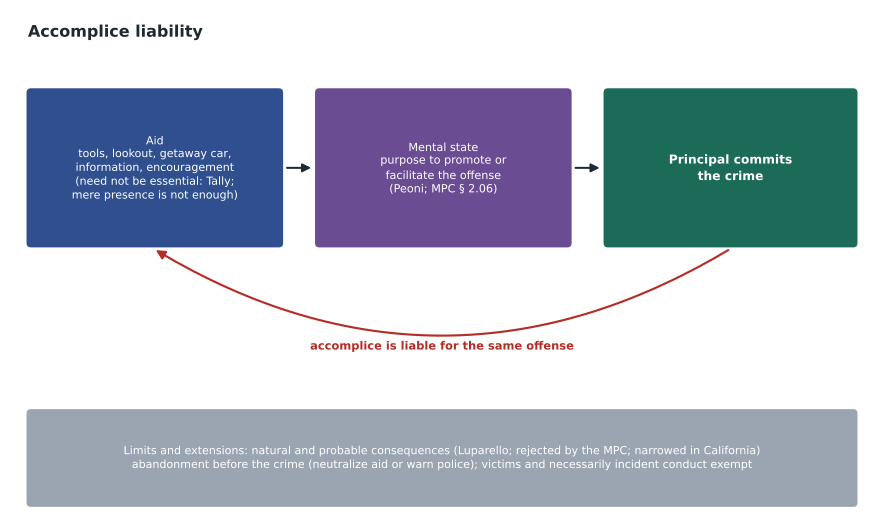
Accomplice liability does not create a separate offense of aiding and abetting. Instead, it is a theory by which a person becomes liable for the crime committed by another. The accomplice is convicted of the substantive offense, such as burglary, and faces the same punishment as the principal. The federal statute, 18 U.S.C. § 2, provides that whoever aids, abets, counsels, commands, induces or procures the commission of an offense is punishable as a principal. The Model Penal Code's section 2.06 makes a person legally accountable for the conduct of another when, with the purpose of promoting or facilitating the commission of the offense, he solicits the other to commit it, or aids or agrees or attempts to aid the other in planning or committing it, or, having a legal duty to prevent the offense, fails to make a proper effort to do so.
The common law distinguished principals in the first degree (who committed the crime), principals in the second degree (who were present and aided, such as a lookout), accessories before the fact (who aided beforehand but were not present) and accessories after the fact (who helped the felon escape after the crime). Modern statutes have abolished the first three distinctions, treating all as accomplices. Accessories after the fact are treated differently: they are guilty of a separate, lesser offense, such as hindering prosecution or obstruction of justice, because they did not contribute to the crime itself.
The act of aiding
Almost any assistance can be enough: providing tools, acting as a lookout, driving the getaway car, giving information or encouragement. The aid need not be essential or even significant. State ex rel. Attorney General v. Tally, 102 Ala. 25 (1894), is the classic case. Judge Tally learned that his brothers-in-law were pursuing a man named Ross to kill him, and that a relative of Ross had sent a telegram warning him. Tally sent a telegram to the telegraph operator in the town where Ross was, telling him not to deliver the warning. The operator complied, and the brothers-in-law killed Ross. The Alabama Supreme Court held Tally guilty as an accomplice, saying that the assistance need not contribute to the criminal result in the sense that the result would not have occurred without it; it is enough that it facilitated the result, even if the result would probably have occurred anyway.
Mere presence at the scene, even with knowledge that a crime is being committed, is not aiding. Something more is required: words or conduct that encourage or assist, or a prior agreement to help if needed. In Hicks v. United States, 150 U.S. 442 (1893), the Supreme Court reversed the murder conviction of a man who was present at a killing and allegedly laughed and said words that could have been encouragement, because the jury had not been properly instructed that the words must have been intended to encourage the killing. Daniel asks whether a person who stands silently by in a group, adding to the intimidation, has aided. Mendenhall says courts have often found encouragement from presence combined with a shared plan or a role, such as standing guard.
Attempted aid
At common law, an accomplice is liable only if the principal actually commits the crime and the accomplice's aid actually reached the principal, at least as encouragement. Tally's telegram worked. If the operator had ignored it, Tally would not have been an accomplice to the murder. The Model Penal Code goes further: under section 2.06(3)(a)(ii), a person who agrees or attempts to aid another in planning or committing the offense is an accomplice, even if the aid is ineffective. And under section 5.01(3), a person who engages in conduct designed to aid another to commit a crime that would make him an accomplice is guilty of attempt, even if the crime is not committed or attempted by the other.
The mental state of the accomplice
The accomplice must act with the purpose of promoting or facilitating the crime. This double intent requirement means the accomplice must intend to assist the principal and intend that the principal commit the offense. Knowledge that one's assistance will help a crime is usually not enough. The leading statement is Judge Learned Hand's opinion in United States v. Peoni, 100 F.2d 401 (2d Cir. 1938): the accomplice must in some sort associate himself with the venture, participate in it as in something that he wishes to bring about, and seek by his action to make it succeed. Peoni sold counterfeit bills to Regno, who sold them to Dorsey, who tried to pass them; Peoni was not an accomplice to Dorsey's possession, because he had no stake in what Regno did with the bills after the sale.
Purpose versus knowledge matters most for suppliers of goods and services who know their customers may use them for crime. A hardware store that sells crowbars, knowing that some customers will use them for burglary, is not an accomplice. But courts sometimes find purpose where the supplier has a stake in the venture or where the crime is very serious. State v. Gladstone, 78 Wash. 2d 306 (1971), reversed the conviction of a man who, asked by an undercover informant where he could buy marijuana, gave the name and address of another seller and drew a map. The Washington Supreme Court held that there was no evidence that Gladstone communicated with the seller or had any interest in the sale; he did not associate himself with the venture.
Rosemond v. United States, 572 U.S. 65 (2014), applied the intent requirement to a federal statute punishing using or carrying a firearm during a drug trafficking crime. The Court held that an accomplice to that offense must have advance knowledge that a confederate would carry a gun, so that he can choose whether to participate. A person who joins a drug deal without knowing a gun is involved, and learns of it only when it is too late to withdraw, does not have the intent required to aid the firearm offense.
Mental state for results and circumstances
What if the offense requires recklessness or negligence as to a result? Courts have generally allowed accomplice liability for reckless and negligent crimes. In State v. McVay, 47 R.I. 292 (1926), the Rhode Island Supreme Court held that a man who urged a steamboat captain and engineer to operate a boat with a defective boiler, which exploded and killed passengers, could be an accessory to manslaughter. The Model Penal Code agrees: section 2.06(4) provides that when causing a particular result is an element of an offense, an accomplice in the conduct causing the result is an accomplice in the commission of that offense if he acts with the kind of culpability, if any, with respect to the result that is sufficient for the commission of the offense. So a passenger who encourages a driver to race on a crowded street, aware of the risk, may be an accomplice to reckless manslaughter if a pedestrian is killed.
Natural and probable consequences
Many states go further, holding an accomplice liable not only for the crime he intended to aid, but also for any other crime committed by the principal that was a natural and probable consequence of the intended crime. In People v. Luparello, 187 Cal. App. 3d 410 (1986), Luparello asked friends to help him find his former girlfriend by getting information from a man who knew her whereabouts, "at any cost." One of the friends killed the man. The California Court of Appeal upheld Luparello's murder conviction because the killing was a reasonably foreseeable consequence of the criminal plan he aided. The doctrine is similar to Pinkerton liability for conspirators.
Critics argue that the doctrine lets accomplices be convicted of serious crimes, including murder, on a negligence standard, even though the principal must be proved to have acted with intent or extreme recklessness. The Model Penal Code rejects the doctrine; its section 2.06 requires purpose to promote the specific offense. California itself has narrowed it: People v. Chiu, 59 Cal. 4th 155 (2014), held that the doctrine cannot support a conviction of first degree premeditated murder, and Senate Bill 1437 (2018) eliminated it as a basis for murder liability entirely, followed by Senate Bill 775 (2021), which extended those limits to attempted murder and manslaughter.
| Approach | Accomplice liable for | Authority |
|---|---|---|
| Purpose (majority and MPC) | Crimes he purposely aided, with the culpability required for any result | Peoni; MPC section 2.06 |
| Knowledge for serious crimes (minority) | Crimes he knowingly facilitated | Some courts and statutes |
| Natural and probable consequences | The intended crime plus foreseeable crimes by the principal | Luparello; narrowed in California by Chiu and SB 1437 |
| Pinkerton (conspiracy) | Foreseeable crimes of co-conspirators in furtherance | Pinkerton; rejected by the MPC |
The relationship between accomplice and principal
Because the accomplice's liability derives from the principal's crime, there must be a crime. But the principal need not be convicted. The principal may have been acquitted in a separate trial, may be unknown, or may have a personal defense such as duress or insanity that excuses him but does not mean no crime occurred. Standefer v. United States, 447 U.S. 10 (1980), upheld the conviction of a man for aiding a revenue agent to accept unlawful payments even though the agent had been acquitted in a separate trial. And a person who uses an innocent agent, such as a child or a person deceived into acting, to commit a crime is guilty as a principal himself.
Can an accomplice be convicted of a more serious crime than the principal? Many courts say yes when the accomplice has a more culpable mental state. If A provokes B into a heat of passion and hands him a knife, intending that B kill the victim, B may be guilty only of voluntary manslaughter, while A, who acted coolly and with premeditation, may be guilty of murder. In Regina v. Richards, [1974] Q.B. 776, an English court reached the opposite result, holding that a wife who hired men to beat her husband badly enough to keep him home could not be convicted of a more serious offense than the men who did the beating; the decision has been widely criticized.
Abandonment and exemptions
A person who has aided a crime can sometimes avoid liability by withdrawing before the crime is committed. The Model Penal Code's section 2.06(6)(c) provides a defense if the person terminates his complicity before the commission of the offense and either wholly deprives his prior aid of effectiveness, gives timely warning to the police, or otherwise makes a proper effort to prevent the crime. Simply walking away is not enough if one's earlier help, such as supplying a weapon, remains effective. Some exemptions also apply: a victim of the crime, such as a minor in a statutory rape case, cannot be an accomplice to it, and a person whose conduct is inevitably incident to the offense, such as a buyer in an illegal sale (where the statute punishes only the seller), is not an accomplice unless the statute provides otherwise (MPC section 2.06(6)(a) and (b)).
Applying the doctrine to Tara Quinn
Mendenhall turns to Quinn. Aid: driving the others to the warehouse and waiting with the engine running to take them away is classic getaway-driver assistance, and her message in the group chat shows agreement to help. Mental state: she must have acted with the purpose of promoting or facilitating the burglary and theft. Her message, "I can drive if you split it with me," shows a stake in the venture, strong evidence of purpose under Peoni. Her defense is that she believed the warehouse was abandoned and the copper free for the taking; if credited, that mistake negates the knowledge that the property belonged to another, so she lacked the mental state required for theft and burglary. The jury may doubt that claim, given the plan to go at night and to cut a lock.
As for Abbott's death, Westmarch rejects natural and probable consequences liability, so Quinn is an accomplice to homicide only if she acted with the culpability required for the homicide offense. For manslaughter, the prosecution would need to prove that she was aware of a substantial risk that someone would be killed during the burglary and consciously disregarded it, a difficult case on these facts. Under the felony murder presumption in Westmarch's code, however, an accomplice in a burglary during which a death occurs is presumed to have acted with extreme indifference, and Quinn will have to rebut that presumption. Priya observes that this is precisely the kind of case that drove California, Colorado, Illinois and Minnesota to narrow felony murder liability for participants who did not kill.
Worked problem
The friend who lends a car
Mateo, the friend whom Shaw solicited, never joins the copper run. But the day before, Shaw asks to borrow Mateo's pickup truck "to haul some scrap," and Mateo, who has seen the group chat because Shaw showed it to him, lends it without comment, saying only "bring it back with gas." Shaw uses the truck to carry the copper to Fry's scrap yard. Westmarch follows MPC section 2.06. Is Mateo an accomplice to theft?
Show solution
- Aid: lending the truck used to carry stolen copper is aid; it need not be essential (Tally).
- Mental state: MPC section 2.06 requires purpose to promote or facilitate the theft, not just knowledge that the truck might be used for it.
- Evidence of purpose: Mateo had seen the chat, so he likely knew what the truck was for, but he asked for no share, showed no stake in the venture and only asked for the gas to be replaced; under Peoni and Gladstone, knowledge without a stake usually is not purpose.
- Contrary evidence: lending a truck for a known theft, especially if he had earlier been offered a share, may let a jury infer that he wished the venture to succeed; the decision is a jury question.
- Other liability: Mateo did not agree to the theft, so he is not a conspirator; if he later helped hide the copper, he might be guilty of hindering prosecution as an accessory after the fact.
Answer: Mateo is probably not an accomplice under the MPC's purpose requirement, because the evidence shows knowledge but no stake in or desire to promote the theft, although a jury could infer purpose from the circumstances. In a jurisdiction that accepts knowledge for some crimes, his liability would be stronger.
Summary and key terms
- Accomplice liability makes one who intentionally aids a crime guilty of that crime (18 U.S.C. section 2; MPC section 2.06); accessories after the fact commit a separate lesser offense.
- Any aid suffices, even if not essential (Tally), but mere presence is not enough (Hicks); the MPC also covers agreeing or attempting to aid.
- The accomplice must act with purpose to promote or facilitate the offense (Peoni; Gladstone); Rosemond requires advance knowledge of a gun for the federal firearm offense.
- For result crimes, the accomplice needs the culpability required for the result, so complicity in reckless or negligent crimes is possible (McVay; MPC section 2.06(4)).
- The natural and probable consequences doctrine (Luparello) extends liability to foreseeable crimes; the MPC rejects it and California has narrowed it (Chiu; SB 1437; SB 775).
- The principal need not be convicted (Standefer); abandonment requires neutralizing aid or warning police; victims and necessarily incident participants are exempt.
Practice problems
Work each problem on paper first, then reveal the answer to check.
Why was Judge Tally an accomplice even though Ross might have died anyway?
Show answer
Because aid need only facilitate the crime, not be a but-for cause of it; preventing the warning telegram made the killing easier.
What did Judge Hand require in Peoni?
Show answer
That the accomplice associate himself with the venture, participate in it as something he wishes to bring about, and seek by his action to make it succeed.
What did Rosemond hold about aiding a federal firearm offense during a drug crime?
Show answer
That the accomplice must have advance knowledge that a confederate would carry a gun, so that he can choose whether to participate.
How does the MPC treat the natural and probable consequences doctrine?
Show answer
It rejects it, requiring purpose to promote the specific offense and the culpability required for any result element.
Lesson quiz · 5 questions
Score 60% or more to complete this lesson.
Create a free account to save your progress, take quizzes and earn a certificate.