
LAWU-112 · Lesson 7 of 12 · 21 min
Rape and sexual offenses
▶ Video coming soon A video version of this lesson is on the way.
Mendenhall begins the seventh class with a short statement. "Today's subject is difficult, and some of you may have personal experience with it. We will discuss the law carefully and without graphic detail. If you need to step out at any point, you may, and you will not be asked why." She then explains why the topic matters for every lawyer. The law of sexual assault has changed more in the last fifty years than almost any other area of criminal law, and it is still changing. It raises the deepest questions about how the law defines consent, what role force should play, how much the defendant's mental state matters, and how the criminal process treats complainants.
The common law definition
At common law, rape was carnal knowledge of a woman, not the defendant's wife, by force and against her will. Each element carried assumptions that reformers would later reject. Only women could be victims and only men perpetrators. Husbands were exempt, on the theory, articulated by the seventeenth-century English jurist Matthew Hale, that a wife gave irrevocable consent to her husband at marriage. And force and lack of consent were separate elements, so that even a clearly nonconsensual act was not rape without proof of force.
Courts often required the complainant to show that she resisted to the utmost, and later that she offered earnest or reasonable resistance, as proof of both force and nonconsent. Special evidentiary rules reflected suspicion of complainants: corroboration requirements, prompt complaint requirements, jury instructions warning that rape charges are easy to make and hard to defend against, and wide latitude to cross-examine complainants about their sexual history. These rules made convictions rare except in cases involving strangers and serious violence.
The reform movement
Beginning in the 1970s, reformers changed the law in nearly every state. Statutes became gender-neutral and broadened to cover a range of sexual acts. The utmost resistance requirement was abolished, and many states eliminated resistance requirements altogether. Corroboration and prompt complaint rules were repealed. Rape shield laws limited evidence of complainants' sexual history; Federal Rule of Evidence 412, adopted in 1978, generally excludes evidence of a victim's other sexual behavior or sexual predisposition in civil and criminal proceedings, with narrow exceptions. Federal Rule of Evidence 413, adopted in 1994, went the other direction for defendants, allowing evidence that a defendant committed other sexual assaults to be admitted in a sexual assault prosecution.
The marital exemption also fell. In People v. Liberta, 64 N.Y.2d 152 (1984), the New York Court of Appeals struck down the state's marital exemption as a violation of equal protection, holding that there is no rational basis for distinguishing between marital and nonmarital rape. By the early 1990s every state had eliminated or limited the exemption, though a few states still treat some spousal offenses differently, for example by imposing shorter reporting periods or lower grades.
The force requirement
The most contested question has been the role of force. Many statutes still define the most serious forms of rape as sexual penetration by forcible compulsion, and courts have struggled to decide what force means when a complainant submits out of fear without being physically overpowered. In State v. Rusk, 289 Md. 230 (1981), the complainant drove a man she had met at a bar to his home; he took her car keys, and she accompanied him into his apartment, afraid and unfamiliar with the neighborhood. She testified that she submitted after he lightly choked her when she began to cry. The intermediate appellate court reversed his conviction, finding insufficient evidence of force or reasonable fear. The Maryland Court of Appeals reinstated the conviction, holding that the reasonableness of her fear was a question for the jury. Dissenting judges argued that the evidence of force was too thin.
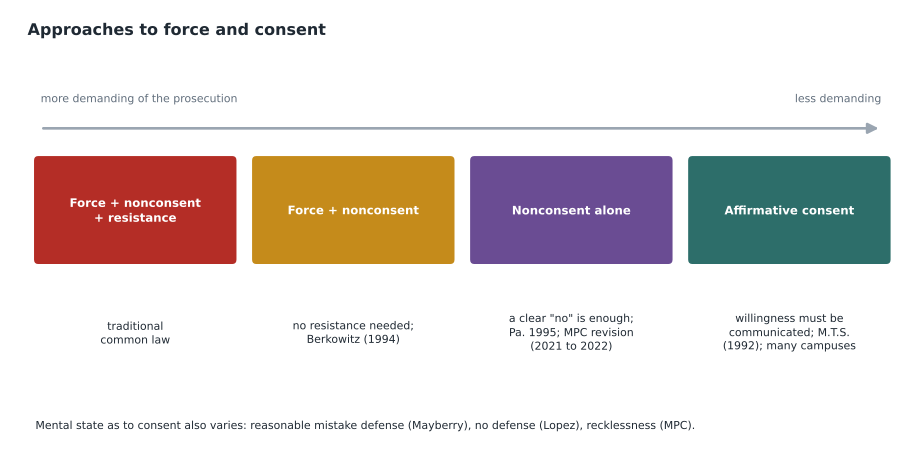
Commonwealth v. Berkowitz, 537 Pa. 143 (1994), went the other way. A college student went into a male student's dormitory room looking for his roommate. She testified that he had sex with her while she repeatedly said "no" and that he locked the door, but that he did not physically restrain her beyond lying on top of her. The Pennsylvania Supreme Court reversed his rape conviction because the evidence did not show forcible compulsion; her verbal refusals proved nonconsent but not force. The decision prompted the Pennsylvania legislature in 1995 to create a new offense of sexual assault, defined as sexual intercourse without the complainant's consent, without any force requirement.
State in the Interest of M.T.S., 129 N.J. 422 (1992), adopted a different view. The New Jersey Supreme Court interpreted the state's statute, which required physical force, to mean that the force inherent in the act of penetration itself is enough when the act occurs without the affirmative and freely given permission of the victim. Permission could be expressed by words or actions that, viewed in light of all the circumstances, would demonstrate to a reasonable person that the alleged victim had affirmatively and freely given authorization. In effect, M.T.S. turned a force requirement into a consent requirement.
Consent and nonconsent
Today most states have some offense of sexual assault without consent, either alongside forcible rape or as a lesser grade. They differ on what consent means. A no-means-no approach treats a verbal refusal or other expression of unwillingness as establishing nonconsent. An affirmative consent approach requires that the person have communicated willingness through words or conduct, so that silence or passivity alone is not consent. Some state criminal statutes and many college and university disciplinary codes use affirmative consent definitions; others define consent more broadly in terms of the person's actual willingness, as shown by all the circumstances.
The Model Penal Code, then and now
The 1962 Model Penal Code's sexual offense provisions, in Article 213, were modern for their time in some respects, but retained the marital exemption, focused heavily on force and treated corroboration and prompt complaint as requirements. They were widely criticized. In 2021 and 2022 the American Law Institute's members approved a comprehensive revision, drafted by reporters Stephen Schulhofer and Erin Murphy, that treats sexual assault as a crime against sexual autonomy rather than primarily a crime of violence. The revision grades offenses by the means used, with separate sections for sexual assault by physical force or restraint, sexual assault of an incapacitated, vulnerable or legally restricted person, sexual assault by extortion and by prohibited deception, and lower-grade offenses for sexual penetration or contact without consent.
The revision defines consent in terms of a person's willingness to engage in a specific act, which may be expressed or inferred from behavior, both words and conduct, in light of all the circumstances. It provides that neither verbal nor physical resistance is required to establish lack of consent, that a clear verbal refusal establishes lack of consent, and that consent may be withdrawn. The ALI debated and declined to adopt a pure affirmative consent standard for criminal liability. The revised provisions also abolished the marital exemption and the corroboration and prompt complaint rules. Like the rest of the Code, they are a model; states decide whether to adopt them.
Incapacity
Every state criminalizes sexual acts with a person who cannot consent because of incapacity: unconsciousness, sleep, intoxication to the point of being unable to understand the nature of the act, or a mental disability that prevents understanding. Statutes typically require that the defendant knew or should have known of the incapacity. Intoxication cases are the most difficult in practice, because the line between impaired judgment and legal incapacity is hard to draw and witnesses' memories are often affected. Many states distinguish between intoxication the defendant caused, such as by secretly drugging the victim, which is usually treated more severely, and voluntary intoxication by the victim, which may or may not reach the level of incapacity depending on the facts.
Deception
The law has traditionally distinguished between fraud in the factum, deception about the nature of the act itself, and fraud in the inducement, deception about some collateral matter that leads a person to agree. Fraud in the factum vitiates consent: a doctor who tells a patient he is performing a medical procedure when he is in fact engaging in a sexual act commits rape. Fraud in the inducement traditionally did not. In Boro v. Superior Court, 163 Cal. App. 3d 1224 (1985), a man called a woman, falsely claimed to be a doctor, told her she had a deadly disease and said that intercourse with a donor was the only cure; she agreed. The court held that the facts did not constitute rape under the statute then in force, because she knew the nature of the act. The California legislature then amended the law to cover consent induced by fraudulent representations of professional purpose. Other common examples are impersonating a spouse or partner, which many states now cover by statute, and the 2021 to 2022 MPC revision includes a narrowly defined offense of sexual assault by prohibited deception.
Mental state as to consent
What must the defendant know about the complainant's lack of consent? States take different positions. Some, following People v. Mayberry, 15 Cal. 3d 143 (1975), allow a defense of honest and reasonable mistake about consent. Others, such as Massachusetts in Commonwealth v. Lopez, 433 Mass. 722 (2001), have held that a mistake as to consent is not a defense at all, effectively imposing strict liability on the consent element when force is proved. Under the Model Penal Code's general default, recklessness would be required: the defendant must have consciously disregarded a substantial risk that the person did not consent. The revised Article 213 generally requires recklessness as to nonconsent. The choice matters most in cases where the parties' accounts of what was communicated differ.
| Approach | Rule | Example |
|---|---|---|
| Reasonable mistake defense | An honest and reasonable belief in consent is a defense | Mayberry (Cal. 1975) |
| No mistake defense | Belief in consent is no defense when force is proved | Lopez (Mass. 2001) |
| Recklessness | Must consciously disregard a substantial risk of nonconsent | MPC default; revised Article 213 |
Statutory rape and offenses against minors
As discussed in the mens rea lesson, sexual offenses against minors are often strict liability as to age, though some states allow a reasonable mistake of age defense, particularly when the minor is close to the age of consent. Ages of consent in the United States range from 16 to 18, depending on the state. Many states have close-in-age exemptions, often called Romeo and Juliet provisions, that reduce or eliminate liability for consensual activity between teenagers close in age. Offenses involving younger children carry severe penalties, and federal law adds offenses involving interstate travel and the internet.
Procedure and the complainant
Reform has also reached the criminal process. Rape shield laws protect complainants from humiliating and irrelevant questioning, although courts must allow evidence when excluding it would violate the defendant's constitutional rights, for example evidence that someone else was the source of physical evidence. Many states have extended or eliminated statutes of limitations for sexual offenses, particularly against children, and have adopted procedures for testing backlogged sexual assault evidence kits. On campuses, colleges and universities handle sexual misconduct through disciplinary processes under Title IX of the Education Amendments of 1972, whose federal regulations have been revised several times in recent years; these are civil and administrative proceedings, separate from criminal prosecution, with different standards of proof.
Applying the law
Mendenhall closes with a hypothetical that she says comes up, in some form, in every state's courts. Two adults leave a party and go to one of their apartments. Both have been drinking. One testifies that she said she was tired and wanted to sleep, turned away, and did not physically resist because she was afraid and frozen. The other testifies that she did not say no and that he thought she was willing. Jordan points out that the outcome depends almost entirely on the jurisdiction's definitions. Under a forcible-compulsion statute like the one in Berkowitz, the prosecution may fail. Under a nonconsent statute, the question is whether her words and conduct expressed unwillingness. Under an affirmative consent standard, the question is whether she communicated willingness. And under each, the defendant's mental state as to consent must be analyzed under the jurisdiction's rule.
Worked problem
Comparing three statutes
Two adults are in a dormitory room. One says "no, I don't want to" twice and pulls away, but does not otherwise resist; the other proceeds. No weapon, threat or restraint is used beyond the act itself. Analyze liability under (1) a statute requiring forcible compulsion as interpreted in Berkowitz; (2) Pennsylvania's 1995 sexual assault statute, requiring intercourse without consent; and (3) a statute modeled on the revised MPC's offense of sexual penetration without consent, requiring recklessness as to nonconsent.
Show solution
- Under the forcible compulsion statute as interpreted in Berkowitz, verbal refusals prove nonconsent but not force; without additional physical force, threats or restraint, the most serious charge would likely fail.
- Under a nonconsent statute, the clear verbal refusals establish lack of consent; no force is required, so the elements are satisfied if the jury believes the account.
- Under the revised MPC approach, a clear verbal refusal establishes lack of consent, and continuing after hearing "no" twice shows at least conscious disregard of the risk of nonconsent, satisfying recklessness.
- Evidence issues: the complainant's sexual history would generally be inadmissible under a rape shield rule.
- The credibility of the two accounts remains a question for the jury in every jurisdiction.
Answer: The most serious forcible rape charge would likely fail under a Berkowitz-type statute, but the defendant would likely be guilty under a nonconsent statute or a statute modeled on the revised MPC, because the clear verbal refusals establish lack of consent and proceeding after them shows at least recklessness.
Summary and key terms
- Common law rape required force and nonconsent, often with resistance, exempted husbands, and was surrounded by evidentiary rules suspicious of complainants.
- Reforms since the 1970s made statutes gender-neutral, abolished resistance and corroboration requirements, adopted rape shield laws (FRE 412) and eliminated the marital exemption (Liberta).
- Courts have struggled with the force requirement (Rusk; Berkowitz); M.T.S. treated the act itself as force absent affirmative permission, and many states added nonconsent offenses.
- The ALI's 2021 to 2022 revision of MPC Article 213 grades offenses by means, defines consent as willingness expressed by words or conduct, requires no resistance, treats a clear refusal as establishing nonconsent and generally requires recklessness.
- Incapacity, deception (fraud in the factum versus inducement; Boro) and mental state as to consent (Mayberry; Lopez) are key issues; offenses against minors are often strict liability as to age.
Practice problems
Work each problem on paper first, then reveal the answer to check.
Why did the Pennsylvania Supreme Court reverse the rape conviction in Berkowitz?
Show answer
The complainant's repeated verbal refusals proved nonconsent, but the statute required forcible compulsion, and the court found insufficient evidence of force beyond the act itself.
How did M.T.S. reinterpret New Jersey's physical force requirement?
Show answer
It held that the force inherent in penetration satisfies the requirement when the act occurs without affirmative and freely given permission, effectively making nonconsent the key question.
On what ground did Liberta strike down New York's marital exemption?
Show answer
Equal protection: there was no rational basis for distinguishing marital from nonmarital rape.
What is the difference between Mayberry and Lopez on mistake as to consent?
Show answer
Mayberry allows an honest and reasonable belief in consent as a defense; Lopez held that mistake as to consent is not a defense under Massachusetts law.
Lesson quiz · 5 questions
Score 60% or more to complete this lesson.
Create a free account to save your progress, take quizzes and earn a certificate.