
LAWU-112 · Lesson 4 of 12 · 21 min
Causation
▶ Video coming soon A video version of this lesson is on the way.
Mendenhall starts the fourth class with the medical examiner's report from the Westmarch problem. Lou Abbott, 63, had coronary artery disease and had undergone a bypass operation three years earlier. After Devon Pike shoved him, Abbott fell and struck his head and shoulder on the concrete. A passing truck driver found him about forty minutes later and called 911. The ambulance took another twenty minutes because the nearest station was handling a highway crash. Abbott died at the hospital two hours after the shove. The examiner's conclusion: death from a heart attack triggered by the stress and physical trauma of the assault, with the delay in treatment a contributing factor. "So," she asks, "did Pike cause Abbott's death? Did anyone?"
Why causation matters
Causation is an element only of result crimes, offenses defined by a harmful outcome, such as homicide, assault causing bodily injury or arson causing damage. Conduct crimes, such as perjury, possession or driving while intoxicated, have no result element and no causation issue. For result crimes, the prosecution must prove that the defendant's conduct caused the result, and causation can make the difference between murder and attempted murder, or between manslaughter and no homicide at all.
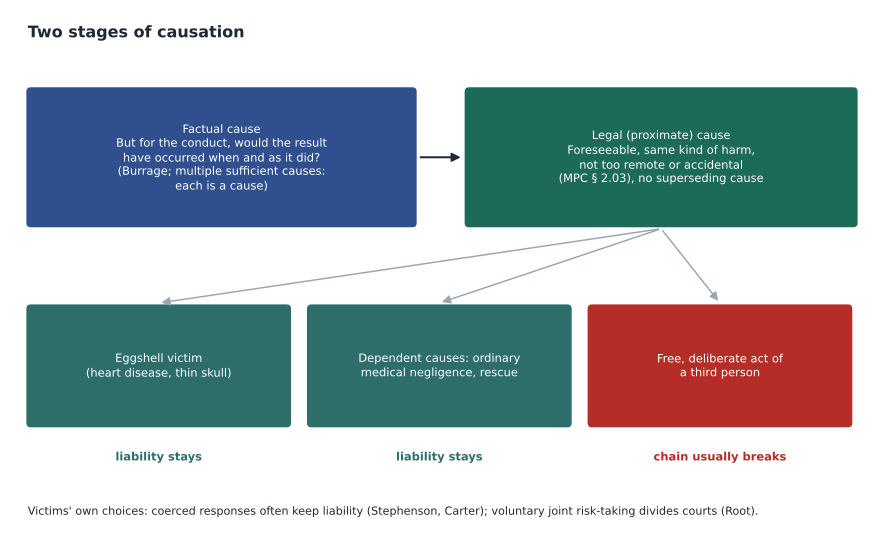
Causation has two parts. The first is factual causation, also called cause in fact or but-for causation: would the result have occurred when it did but for the defendant's conduct? The second is legal causation, also called proximate cause: is the connection between the conduct and the result close enough, and free enough of intervening events, that it is fair to hold the defendant responsible? Daniel notes that tort law uses the same two parts; Mendenhall agrees but warns that criminal courts often apply proximate cause more demandingly, because the stakes are punishment rather than compensation.
Factual causation
The but-for test asks whether the result would have occurred in the same way and at the same time without the defendant's conduct. Shortening someone's life counts: a defendant who poisons a person already dying of cancer, killing him a week sooner than the cancer would have, has caused his death. In Oxendine v. State, 528 A.2d 870 (Del. 1987), a father was convicted of manslaughter after his six-year-old son died following two beatings, one by the father's girlfriend and a later one by the father. The Delaware Supreme Court reduced the conviction because the state's medical evidence did not establish that the father's later blows, as opposed to the earlier beating, caused or accelerated the death; it was not enough that his blows might have contributed.
The Supreme Court applied the but-for test strictly in Burrage v. United States, 571 U.S. 204 (2014). A federal statute imposed a 20-year mandatory minimum when death "results from" the use of a drug the defendant distributed. The user had taken several drugs, and experts could not say he would have survived without the heroin Burrage sold. The Court held that "results from" requires but-for causation unless the drug was independently sufficient to cause death; being merely a contributing factor was not enough.
The but-for test breaks down when two independent causes are each sufficient. If two people independently shoot a victim at the same moment, each wound fatal, neither is a but-for cause, since the victim would have died from the other. Courts and the Model Penal Code handle this by treating each as a cause; some courts use a substantial factor test. Code section 2.03(1)(a) defines factual cause as an antecedent but for which the result would not have occurred, and the commentary indicates that the result must be described specifically, so each shooter caused the death as it actually occurred.
Legal causation and the Model Penal Code
Even when a defendant's conduct is a but-for cause, the law may decline to hold him responsible for results that are too remote or accidental. The common law asked whether the result was the direct or natural and probable consequence of the conduct, or whether an intervening cause superseded it. The Code reframes the question as a matter of culpability. Under section 2.03(2) and (3), when purpose, knowledge, recklessness or negligence must be shown as to a result, the actual result must be within the purpose or contemplation of the actor (or the risk of which he was aware, or should have been aware), or must involve the same kind of injury or harm as the probable result, and must not be "too remote or accidental in its occurrence to have a just bearing on the actor's liability or on the gravity of his offense." The final clause leaves the jury a large measure of judgment.
The eggshell victim
A defendant takes the victim as he finds him. If the victim has an unusual vulnerability, such as a thin skull, a bleeding disorder or heart disease, and the defendant's conduct triggers a death that would not have happened to an ordinary person, the defendant has still caused the death. This rule is long settled in both tort and criminal law. In the Westmarch problem, Pike's lawyer cannot argue that the shove would not have killed a healthy man; Abbott's heart condition does not break the chain of causation. The more serious question is whether Pike had the mental state required for murder or manslaughter, an issue for later lessons.
Hannah raises a related category: victims who refuse treatment for religious reasons. In Regina v. Blaue, [1975] 1 W.L.R. 1411, an English court held that a defendant who stabbed a woman was guilty of manslaughter even though she would likely have survived had she accepted a blood transfusion, which she refused as a Jehovah's Witness. The court applied the eggshell principle to the whole person, including her beliefs. American courts have generally agreed.
Intervening causes
The hardest causation problems involve an intervening cause: an event that occurs after the defendant's conduct and contributes to the result. Courts ask whether the intervening cause was a dependent one, a normal response to the situation the defendant created, or an independent one, a coincidence that the defendant's conduct merely put the victim in a position to encounter. Dependent intervening causes generally do not break the chain unless they are abnormal; independent ones break it unless they were foreseeable.
Medical negligence is the most common dependent intervening cause. Medical treatment of an injury is a normal response to it, and ordinary negligence in treatment is foreseeable, so it does not relieve the original wrongdoer of liability. Only gross negligence or intentional misconduct by doctors, so extreme as to be the sole cause of death, supersedes. In People v. Saavedra-Rodriguez, 971 P.2d 223 (Colo. 1998), a stabbing victim died after allegedly negligent medical treatment; the Colorado Supreme Court held that only grossly negligent treatment would break the chain. In Abbott's case, the twenty-minute ambulance delay is even weaker as a superseding cause: delays in emergency response are entirely foreseeable.
People v. Kibbe, 35 N.Y.2d 407 (1974), is the classic case of a victim's predicament. The defendants robbed a severely intoxicated man and abandoned him at night, partially undressed and without his glasses, on the shoulder of a rural highway in freezing weather. He sat down in the road, and a passing truck driver struck and killed him. The New York Court of Appeals upheld murder convictions under a depraved indifference theory: the death was a foreseeable result of leaving a helpless person in that position, and the truck driver's conduct, even if negligent, was not a superseding cause.
Victims' own choices
When the intervening act is the victim's own free choice, causation is more contested. In Stephenson v. State, 205 Ind. 141 (1932), the defendant kidnapped and sexually assaulted a woman, who then took poison and died. The Indiana Supreme Court upheld his murder conviction because her act was a response to the condition he created, which left her distracted and irresponsible. Commonwealth v. Carter, 481 Mass. 352 (2019), upheld the involuntary manslaughter conviction of a young woman who, through texts and a phone call, pressured her boyfriend to carry out his suicide, and told him to get back into a truck filling with carbon monoxide when he got out. The court held that her wanton or reckless pressure, in light of his fragile mental state, could overcome his willpower and so cause his death.
Courts are more reluctant to impose liability when the victim knowingly assumes a risk in a joint activity. In Commonwealth v. Root, 403 Pa. 571 (1961), the defendant agreed to a drag race on a highway, and his opponent swerved into oncoming traffic and was killed. The Pennsylvania Supreme Court reversed the defendant's involuntary manslaughter conviction, holding that the stricter proximate cause standard of criminal law required a more direct causal connection than tort law; the deceased's own reckless choice to swerve was the direct cause. Other courts, such as the Florida court in Velazquez v. State, 561 So. 2d 347 (Fla. Dist. Ct. App. 1990), reached the same result in a drag-racing case on the ground that the deceased's voluntary participation broke the chain. Some courts disagree and hold drag racers liable for deaths of other participants, especially when the racing is a joint venture that endangers bystanders.
Third parties' free and deliberate acts
The free, deliberate and informed act of a third person intending to exploit the situation the defendant created traditionally breaks the chain. If a defendant wounds a victim and another person later finds the wounded victim and deliberately kills him, the first defendant is liable for the wounding, not the death. This principle becomes important in felony murder cases where a police officer or victim, rather than a felon, fires the fatal shot, a subject for the homicide lessons. Courts are divided on whether a felon can be liable for a killing done by someone resisting the felony.
| Intervening event | Usual result | Example |
|---|---|---|
| Victim's preexisting condition | Defendant still liable (eggshell victim) | Abbott's heart disease |
| Ordinary medical negligence | Defendant still liable | Saavedra-Rodriguez |
| Grossly negligent or intentional medical misconduct as sole cause | May break the chain | Rare cases |
| Foreseeable accident to a helpless victim | Defendant still liable | Kibbe |
| Victim's response to defendant's coercion | Often defendant still liable | Stephenson; Carter |
| Victim's voluntary joint risk-taking | Courts divided | Root; Velazquez |
| Third person's free, deliberate act | Usually breaks the chain | Later deliberate killer |
Causation in the running problem
Mendenhall asks Section B to analyze Abbott's death. Factual causation: but for Pike's shove, Abbott would not have fallen, and the medical examiner says the assault triggered the heart attack, so the shove is a but-for cause (unlike Oxendine, where the evidence could not attribute the death to the defendant's blows). Legal causation: the eggshell rule defeats any argument based on Abbott's heart disease; the delay before the truck driver found him and the slow ambulance are dependent, foreseeable intervening events, not superseding causes. Shaw's failure to call 911, if Shaw had a duty, is an omission that also contributed to the delay; but an omission by a co-felon does not relieve Pike, since both may be liable. The causal link from Pike to Abbott's death is strong. The open questions are mental state and, for Shaw and Quinn, whether the law attributes Pike's conduct to them.
Priya pushes back: is it fair to hold someone responsible for a death caused largely by a hidden heart condition? Mendenhall responds that the law's answer is that causation is about connection, not fairness in the abstract; fairness enters through mental state. A defendant who shoves an old man may be guilty only of misdemeanor assault if he did not perceive a risk of death, even though he caused the death. The grading of homicide by culpability is how the law calibrates responsibility for unexpected consequences.
Worked problem
The fleeing burglar and the police chase
Late one night a burglar breaks into a store in Brennan Falls. An officer sees him leave and gives chase in her patrol car with lights and siren on. The burglar runs a red light at high speed, and the officer follows. Another driver, entering the intersection on a green light, swerves to avoid the burglar and collides with the officer's car; the other driver is killed. Westmarch's manslaughter statute requires recklessly causing death. Did the burglar cause the death?
Show solution
- Factual cause: but for the burglar's flight through the red light, the officer would not have been in the intersection at high speed and the other driver would not have swerved; the burglar's conduct is a but-for cause.
- Legal cause: the officer's pursuit is a dependent intervening cause, a normal response to the burglar's flight; police pursuits of fleeing suspects are foreseeable, and so is the risk that innocent drivers will be hurt.
- The other driver's swerve is a reflexive response to the danger, not a free and deliberate act that would supersede.
- MPC section 2.03(3): the death is the same kind of harm (a traffic death) as the risk created by fleeing through red lights, and not too remote or accidental to bear on liability.
- Mental state: whether the burglar was aware of and consciously disregarded the risk of a fatal crash is a jury question; fleeing at high speed through a red light at night strongly suggests recklessness.
Answer: Yes. The burglar's flight is a factual and legal cause of the death; the officer's foreseeable pursuit and the driver's reflexive swerve do not break the chain. Whether he is guilty of manslaughter turns on whether he was reckless, which the facts strongly support.
Summary and key terms
- Causation is an element of result crimes and has two parts: factual (but-for) causation and legal (proximate) causation.
- But-for causation is strict (Burrage, 2014; Oxendine); acceleration of death counts, and multiple sufficient causes are each treated as causes.
- The MPC frames legal causation through culpability: the actual result must be within the risk the actor contemplated or should have, or the same kind of harm, and not too remote or accidental (section 2.03).
- The defendant takes the victim as he finds him (eggshell victim; Blaue).
- Dependent intervening causes such as ordinary medical negligence do not break the chain (Saavedra-Rodriguez; Kibbe); free and deliberate acts of third persons usually do.
- Victims' coerced choices may not break the chain (Stephenson; Carter), but courts divide when the victim voluntarily joins a risky activity (Root; Velazquez).
Practice problems
Work each problem on paper first, then reveal the answer to check.
What did Burrage v. United States require for a death to "result from" drug distribution?
Show answer
But-for causation, unless the drug was independently sufficient to cause death; contributing to the death was not enough.
Why did the truck driver's conduct in Kibbe not break the chain of causation?
Show answer
Because the death was a foreseeable consequence of abandoning a helpless, intoxicated man on a dark highway in freezing weather, and the driver's conduct, even if negligent, was not a superseding cause.
How do courts usually treat ordinary negligence in medical treatment of an injury the defendant inflicted?
Show answer
As a foreseeable dependent intervening cause that does not relieve the defendant of liability; only gross negligence or intentional misconduct that is the sole cause of death may supersede.
Why did the court reverse in Commonwealth v. Root?
Show answer
It held that criminal proximate cause requires a more direct link than tort law, and the deceased racer's own reckless choice to swerve into oncoming traffic was the direct cause of his death.
Lesson quiz · 5 questions
Score 60% or more to complete this lesson.
Create a free account to save your progress, take quizzes and earn a certificate.