
LAWU-112 · Lesson 8 of 12 · 22 min
Theft, robbery and burglary
▶ Video coming soon A video version of this lesson is on the way.
Mendenhall begins the eighth class by holding up a receipt from a scrap metal dealer. In the Westmarch problem, two days after the night at Riverside Salvage, Kellan Shaw sold 340 pounds of stripped copper wire to Wendell Fry, owner of Fry's Metal Recovery in Brennan Falls, for about 1,100 dollars in cash. Fry did not ask for identification, although a Westmarch statute requires scrap dealers to record sellers' identification for copper purchases, and he paid well below market price. "Today," Mendenhall says, "we look at the property crimes in this story: the taking of the copper, the entry into the warehouse, Fry's purchase, and what would have happened if Pike had threatened Abbott instead of shoving him. These crimes are much older and much stranger than most students expect."
Larceny
The common law crime of larceny was the trespassory taking and carrying away of the personal property of another with the intent to permanently deprive the owner of it. Each element had a technical meaning. The taking had to be trespassory, meaning without the owner's consent and from the owner's possession. The property had to be carried away (asportation), though the slightest movement sufficed. It had to be tangible personal property; land, services and intangibles were excluded. And the defendant needed the intent to permanently deprive at the moment of the taking.
Larceny was originally a crime against possession, not ownership, because it developed to prevent breaches of the peace. That focus produced fine distinctions. A servant who received goods from the master had only custody, not possession, so a servant who made off with them committed larceny. A person who found lost property committed larceny only if, at the time of finding, he knew or had reason to know who the owner was and intended to keep it. And a person who obtained possession by a lie, intending to steal, committed larceny by trick, because the owner's consent to transfer possession was obtained by fraud.
Topolewski v. State, 130 Wis. 244 (1906), illustrates the trespass element. Topolewski arranged with a meat company's employee to steal barrels of meat; the employee told the company, which set a trap by placing the barrels on the loading platform and instructing a worker to let Topolewski take them. The Wisconsin Supreme Court reversed his larceny conviction, because the owner had effectively consented to the taking, so it was not trespassory.
Modern shoplifting cases still turn on the taking element. In People v. Olivo, 52 N.Y.2d 309 (1981), the New York Court of Appeals held that a shopper who conceals goods and moves toward the exit, acting in a manner inconsistent with the store's continued rights, has committed larceny, even before leaving the store. The intent to permanently deprive is often inferred from concealment.
Embezzlement and false pretenses
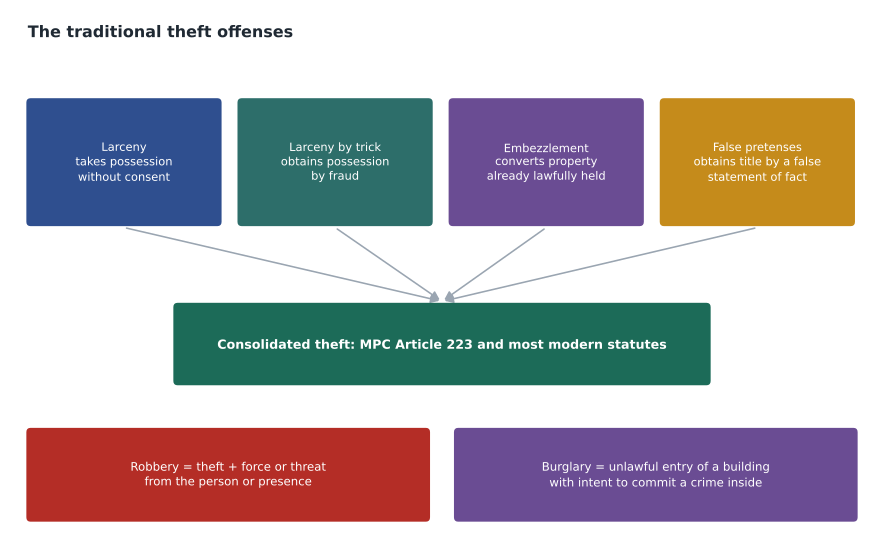
Because larceny required a trespassory taking from possession, it did not reach a person who was lawfully in possession and then decided to steal. Parliament filled the gap in 1799 with the crime of embezzlement, the fraudulent conversion of property by a person in lawful possession of it. Bank tellers, agents, trustees and employees who receive property from third parties for their employers are typical embezzlers. Embezzlement requires conversion, a serious act of interference with the owner's rights, together with intent to defraud.
Larceny by trick also did not reach a person who obtained title, not just possession, by fraud. Parliament created the crime of obtaining property by false pretenses in 1757: knowingly making a false representation of a past or present fact that causes the victim to pass title to the defendant, with intent to defraud. A seller who passes counterfeit money obtains title to goods by false pretenses. Courts divided over whether false promises about future conduct counted; the traditional rule excluded them, but many modern statutes and the Model Penal Code include them.
The line between larceny by trick and false pretenses depends on what the victim intended to transfer. If the victim intended to give only possession, such as by lending a car, it is larceny by trick. If the victim intended to give ownership, such as by selling goods, it is false pretenses. Hannah notes that prosecutors once had to guess correctly in the indictment, and defendants convicted of the wrong one went free. Mendenhall says that is exactly why reformers consolidated the crimes.
Consolidation and the Model Penal Code
The Model Penal Code's Article 223 consolidated larceny, embezzlement, false pretenses, extortion, receiving stolen property and related offenses into a single offense of theft. Section 223.1 provides that conduct denominated theft constitutes a single offense, and that an accusation of theft may be supported by evidence that it was committed in any manner specified in the article, subject to the defendant's right to a continuance if he would be unfairly surprised. The Code defines theft by unlawful taking (section 223.2), theft by deception (section 223.3), theft by extortion (section 223.4), theft of property lost or mislaid (section 223.5), receiving stolen property (section 223.6) and theft of services (section 223.7). Most states have adopted consolidated theft statutes in some form, and they typically grade theft by the value of the property.
The Code also broadened what can be stolen. Property includes anything of value, including real estate, tangible and intangible personal property, contract rights, admission tickets and electricity. Theft of services covers obtaining services such as labor, telecommunications, transportation or hotel accommodation by deception or threat, or by diverting them while having control over them.
Federal fraud statutes
Much modern theft is prosecuted federally as fraud. The mail fraud statute, 18 U.S.C. § 1341, and the wire fraud statute, § 1343, prohibit schemes to defraud or to obtain money or property by false or fraudulent pretenses, using the mail or interstate wires. The Supreme Court has repeatedly limited their reach to schemes aimed at money or property. McNally v. United States, 483 U.S. 350 (1987), held that they did not cover schemes to deprive citizens of honest government; Congress responded with § 1346, which Skilling v. United States, 561 U.S. 358 (2010), confined to bribes and kickbacks. Ciminelli v. United States, 598 U.S. 306 (2023), rejected the theory that depriving a victim of potentially valuable economic information is a deprivation of property. But in Kousisis v. United States (2025), the Court held that a defendant who induces a victim to enter a transaction by material misrepresentations can be convicted of wire fraud even if the victim suffered no net economic loss.
Receiving stolen property
Receiving stolen property requires receiving, retaining or disposing of property that has been stolen, knowing that it has been stolen or believing that it probably has been, with intent to deprive the owner. The Model Penal Code's section 223.6 includes a presumption that a dealer in goods who acquires property for far below its reasonable value, or who has been found in possession of stolen property on other occasions, knows or believes it is stolen.
Wendell Fry's purchase of the copper raises exactly this question. Fry paid well below market price, did not record identification as the state's scrap metal statute requires, and bought from a young man with a pickup truck full of stripped wire. Under the Code's presumption for dealers and the doctrine of willful blindness, a jury could find that Fry believed the copper was probably stolen. Fry will argue that scrap dealers routinely buy from contractors and demolition workers and that he simply forgot the paperwork. Daniel observes that many states have strengthened their scrap metal laws in recent years precisely because copper and catalytic converter thefts became so common.
Robbery
Robbery is larceny from the person or presence of the victim by force or by putting the victim in fear. It is an aggravated form of larceny, requiring all of larceny's elements plus the use of force or threat to take the property or, in most modern statutes, to keep it immediately after taking it. The force must be more than is needed simply to take the property: snatching a purse so quickly that the victim does not resist is usually larceny, but a struggle over the purse is robbery. The property need not be in the victim's hand; it is enough that it is within the victim's presence, meaning close enough that the victim could have prevented the taking but for the force or fear.
The Model Penal Code's section 222.1 defines robbery as, in the course of committing a theft, inflicting serious bodily injury, threatening another with or purposely putting him in fear of immediate serious bodily injury, or committing or threatening to commit a first or second degree felony. The course of committing a theft includes an attempt and flight after the attempt or commission. The Code thus does not require a completed theft, and it grades robbery by the seriousness of the threat or injury. Most states have degrees of robbery, with the most serious involving a deadly weapon or serious injury.
Mendenhall asks Section B whether the Riverside Salvage incident was a robbery. Pike shoved Abbott, but not to take property from Abbott or from his presence; the copper was being taken from the warehouse, and Abbott was a watchman with custody of it. Under the common law, the property of the employer in the watchman's presence and under his protection could be the subject of robbery, so if Pike shoved Abbott to keep the copper or to escape with it, the charge is arguable. Under the Code's definition, the question is whether Pike, in the course of committing the theft, inflicted serious bodily injury or purposely put Abbott in fear of it. The shove that led to Abbott's death likely qualifies, which matters because robbery, like burglary, is a listed felony for the Code's felony murder presumption.
Burglary
Common law burglary was the breaking and entering of the dwelling house of another, in the nighttime, with intent to commit a felony therein. The crime protected the security of the home at night, when residents were most vulnerable. Breaking could be actual (opening a closed door or window, even if unlocked) or constructive (entry by fraud or threat). Entry required only that some part of the body, or an instrument used to commit the felony, cross the threshold. The intent to commit a felony had to exist at the time of entry.
Modern statutes have eliminated most of the technical requirements. Most states define burglary as entering or remaining unlawfully in a building or structure, at any time of day, with intent to commit a crime (not only a felony) inside. Many have graded burglary, with dwellings, nighttime entries, weapons and injuries as aggravating factors. The Model Penal Code's section 221.1 defines burglary as entering a building or occupied structure with purpose to commit a crime therein, unless the premises are at the time open to the public or the actor is licensed or privileged to enter. The Code's drafters were critical of burglary as a separate crime, since it punishes what is essentially an attempt to commit the intended crime, often more severely than the crime itself, but they retained it because of its importance in practice.
The question of remaining unlawfully has produced litigation over shoplifters who enter stores during business hours with intent to steal. Some states treat such a person as entering unlawfully because the store's consent does not extend to entry for a criminal purpose; others, following the Code's exception for premises open to the public, do not treat it as burglary. Breaking into a closed warehouse at night, as Shaw and Pike did, is burglary under any definition: they entered a building, without license, with intent to commit theft.
| Crime | Core elements | MPC section |
|---|---|---|
| Theft by unlawful taking | Takes or exercises unlawful control over property of another with purpose to deprive | 223.2 |
| Theft by deception | Purposely obtains property of another by deception | 223.3 |
| Receiving stolen property | Receives, retains or disposes of property knowing or believing it probably stolen | 223.6 |
| Robbery | In the course of a theft, inflicts or threatens serious bodily injury | 222.1 |
| Burglary | Enters a building or occupied structure with purpose to commit a crime there, without license or privilege | 221.1 |
Grading by value and the running problem
Theft offenses are usually graded by the value of the property. Under the Code, theft is a felony of the third degree if the amount exceeds 500 dollars or the property is a firearm or motor vehicle, a misdemeanor if it is between 50 and 500 dollars, and a petty misdemeanor below 50 dollars. States have raised their felony thresholds substantially over time, and many now set the line at 1,000 dollars or more. Value is generally fair market value at the time and place of the theft, and thefts from a single scheme may be aggregated.
In the Westmarch problem, the copper Shaw sold for 1,100 dollars was worth considerably more, both because Fry underpaid and because the wiring's replacement cost, including labor, was much higher than its scrap value. Courts usually use market value, not replacement cost, so the scrap value is the likely measure. Jordan notes that Riverside Salvage's real loss, the cost of rewiring the building, will matter for restitution at sentencing even if it does not set the grade of the offense.
Worked problem
The borrowed car and the forged check
Two Westmarch defendants are charged under a consolidated theft statute based on MPC Article 223. Defendant A borrows a friend's car, saying he needs it for a job interview, intending all along to sell it, and does so the next day. Defendant B, a bookkeeper, writes a company check to a shell company she controls and records it as a payment to a supplier. Each argues that the prosecution charged the wrong theory. Analyze.
Show solution
- Under the common law, A committed larceny by trick: the friend intended to transfer possession only, and A obtained it by fraud with intent to steal from the start.
- B committed embezzlement at common law: she had lawful access to the company's funds through her position and fraudulently converted them.
- Under MPC section 223.1, theft is a single offense, and an accusation of theft may be supported by evidence that it was committed in any manner specified, so the label in the charge does not matter, subject to a continuance for unfair surprise.
- A's conduct also fits theft by deception (section 223.3), since he obtained the car by creating a false impression of his intention.
- B's conduct fits theft by unlawful taking or control (section 223.2) and may also support federal wire fraud charges if she used interstate wires.
Answer: Both are guilty of theft under the consolidated statute. A's conduct was common law larceny by trick and B's was embezzlement, but under MPC section 223.1 the prosecution need not choose the correct historical label, which is precisely the problem consolidation was designed to solve.
Summary and key terms
- Larceny is the trespassory taking and carrying away of another's personal property with intent to permanently deprive; it protected possession (Topolewski; Olivo).
- Embezzlement covers conversion by one in lawful possession; false pretenses covers obtaining title by a false representation of fact; larceny by trick covers obtaining possession by fraud.
- The MPC consolidates these into a single crime of theft (Article 223), broadens the property covered and grades by value; most states follow.
- Federal mail and wire fraud require a scheme to obtain money or property (McNally; Skilling; Ciminelli), but no net loss is required (Kousisis, 2025).
- Receiving stolen property requires knowing or believing property probably stolen; dealers buying far below value face a presumption.
- Robbery is theft by force or fear from the person or presence; burglary is unlawful entry of a building with intent to commit a crime inside (MPC sections 222.1, 221.1).
Practice problems
Work each problem on paper first, then reveal the answer to check.
Why was Topolewski not guilty of larceny?
Show answer
The meat company, knowing of the plan, effectively consented to his taking the barrels by setting them out for him, so the taking was not trespassory.
How do you distinguish larceny by trick from false pretenses?
Show answer
By what the victim intended to transfer: possession only (larceny by trick) or title (false pretenses).
What did Kousisis v. United States (2025) hold about wire fraud?
Show answer
That inducing a victim to enter a transaction through material misrepresentations can be wire fraud even if the victim suffered no net economic loss.
Why might Pike's shove turn the copper theft into robbery under the MPC?
Show answer
Because robbery includes inflicting or threatening serious bodily injury in the course of committing a theft, including flight, and the shove that led to Abbott's death likely qualifies.
Lesson quiz · 5 questions
Score 60% or more to complete this lesson.
Create a free account to save your progress, take quizzes and earn a certificate.