
LAWU-112 · Lesson 11 of 12 · 26 min
Defenses
▶ Video coming soon A video version of this lesson is on the way.
Mendenhall opens the eleventh class by reading from three police interviews in the Westmarch problem. Devon Pike says Abbott swung his heavy flashlight at him first and he pushed him away to protect himself. Tara Quinn says Pike told her, the morning of the run, that if she backed out he would tell her parole officer about a gun he had seen in her apartment and would "make sure you regret it." Kellan Shaw says he had drunk most of a bottle of whiskey that night and does not remember deciding anything. "Three defendants, three defenses," she says. "Self-defense is a justification. Duress is an excuse. Intoxication is something else again. Today is about the difference."
Justification and excuse
Criminal law defenses fall into two broad families. A justification says that the conduct, though it meets the elements of an offense, was the right thing to do, or at least a permissible thing, under the circumstances: self-defense, defense of others, necessity, law enforcement authority. An excuse says that the conduct was wrong, but the actor is not blameworthy because of some condition: insanity, duress, involuntary intoxication, infancy. The distinction matters in several ways. Others may lawfully assist a justified actor but not an excused one; a person may resist an excused attack but not a justified one; and a justification declares the conduct acceptable in future cases, while an excuse does not.
Most defenses are affirmative defenses, on which the defendant bears at least the burden of producing some evidence. States may also place the burden of persuasion on the defendant for true affirmative defenses, as Martin v. Ohio, 480 U.S. 228 (1987), permitted for self-defense, though most states require the prosecution to disprove self-defense beyond a reasonable doubt once it is raised.
Self-defense
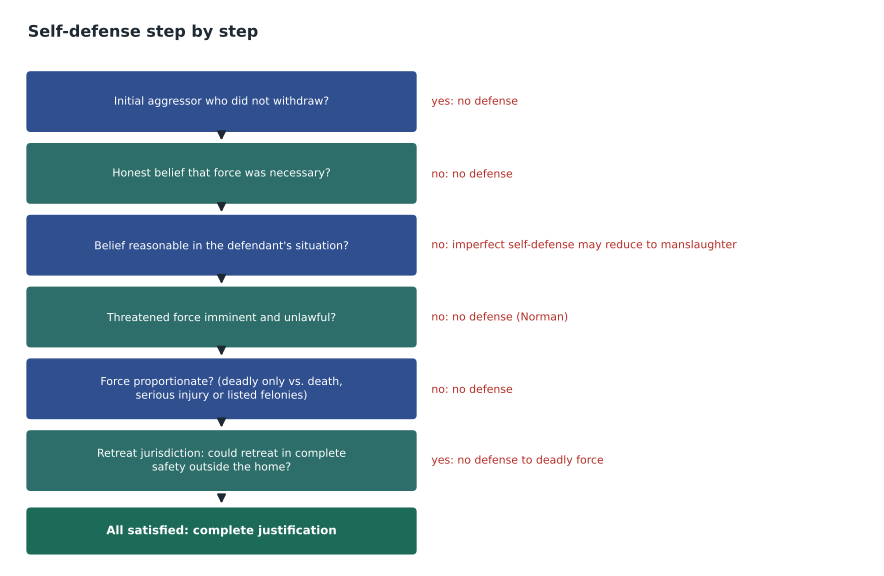
A person is justified in using force against another when she reasonably believes it is necessary to protect herself against the imminent use of unlawful force. Deadly force is justified only against a threat of death, serious bodily injury and, in many states, certain serious felonies such as kidnapping or rape. The elements are: an honest and reasonable belief; that force is necessary; to prevent imminent unlawful force; with force proportionate to the threat. The person must not have been the initial aggressor, and in some states she must retreat before using deadly force if she can do so in complete safety.
The reasonableness requirement has an objective and a subjective side. People v. Goetz, 68 N.Y.2d 96 (1986), arose from Bernhard Goetz's shooting of four young men on a New York subway after one asked him for five dollars. The trial court dismissed attempted murder charges after instructing that the question was whether Goetz's beliefs were reasonable to him. The New York Court of Appeals reversed, holding that the statute's requirement that the defendant "reasonably believes" deadly force is necessary imposes an objective standard: whether a reasonable person in the defendant's situation would have believed it necessary. The defendant's situation includes the physical facts, the attackers' movements, any relevant knowledge about them and the defendant's prior experiences, but not his idiosyncratic beliefs. Goetz was later acquitted of the shooting charges and convicted only of illegal gun possession.
Imminence has produced the most debate in cases involving victims of domestic violence. In State v. Norman, 324 N.C. 250 (1989), Judy Norman shot and killed her sleeping husband after years of brutal abuse, including beatings, threats and forced prostitution, and after he had threatened to kill her. The North Carolina Supreme Court held that she was not entitled to a self-defense instruction because a sleeping man poses no imminent threat. Critics argue that the imminence requirement fails people who cannot safely confront an abuser while he is awake, and many courts now admit expert testimony on the effects of battering to explain why a defendant reasonably perceived danger and did not leave. The Model Penal Code replaces imminence with a requirement that the actor believe force is "immediately necessary for the purpose of protecting himself against the use of unlawful force by such other person on the present occasion" (section 3.04(1)), which is more flexible but still tied to the present occasion.
Retreat and stand your ground
Must a person retreat before using deadly force? The traditional majority American rule is no: a person who is not the aggressor may stand her ground and use deadly force if otherwise justified, even if she could safely retreat. A minority of states impose a duty to retreat before using deadly force if the person knows she can retreat in complete safety, as the Model Penal Code provides (section 3.04(2)(b)(ii)). Even in retreat jurisdictions, the castle doctrine provides that a person need not retreat from her own home, unless she was the initial aggressor. In State v. Abbott, 36 N.J. 63 (1961), the New Jersey Supreme Court explained the retreat rule and its castle exception.
Beginning with Florida in 2005, many states enacted stand your ground statutes that expressly eliminate any duty to retreat in any place where the person has a right to be, and often create presumptions that a person who uses force against an intruder into a home or occupied vehicle reasonably feared death or serious injury. Some also provide immunity from prosecution, decided at a pretrial hearing. Today most states follow a no-retreat rule by statute or case law. Supporters say the laws protect people who face sudden attacks; critics point to research suggesting they are associated with increases in homicides and to concerns about unequal application.
Initial aggressors and mistakes
A person who starts a fight cannot claim self-defense unless she withdraws in good faith and communicates the withdrawal, or unless the other person responds to a nondeadly attack with deadly force, in which case the initial aggressor may defend herself. United States v. Peterson, 483 F.2d 1222 (D.C. Cir. 1973), affirmed a manslaughter conviction of a man who, after an argument with a man taking parts from his car, went into his house, got a pistol and returned, and then shot the other man when he advanced with a lug wrench; by arming himself and returning, the defendant became the aggressor.
Self-defense permits reasonable mistakes. A person who reasonably but wrongly believes she is about to be shot is justified, even if the attacker held a toy gun. An unreasonable mistake defeats a complete defense, but, as the manslaughter lesson explained, many states treat an honest but unreasonable belief as imperfect self-defense, reducing murder to manslaughter. The Model Penal Code reaches a similar result: under section 3.09(2), a person who is reckless or negligent in believing force necessary has no justification defense to an offense for which recklessness or negligence suffices.
Pike's claim fails on several grounds. He was a burglar, the initial aggressor in the broader sense of creating the confrontation, and Abbott, as a watchman protecting property and confronting intruders, was entitled to use reasonable force to stop them. A person cannot claim self-defense against lawful force. Even if Abbott swung the flashlight, the question would be whether Pike withdrew or whether Abbott escalated to deadly force; a single swing of a flashlight at a burglar fleeing past him is unlikely to qualify.
Defense of others, property and law enforcement
A person may use force to defend a third person under the same conditions as self-defense, if she reasonably believes the third person would be entitled to use that force. Under the older alter ego rule, the defender stood in the shoes of the person defended and had no defense if that person was actually the aggressor, even if the defender reasonably believed otherwise. Most states and the Model Penal Code (section 3.05) now follow the reasonable belief approach.
Force may be used to defend property, but deadly force may not be used solely to protect property. In People v. Ceballos, 12 Cal. 3d 470 (1974), a man who rigged a spring gun in his garage, which shot a teenager attempting a burglary, was convicted of assault with a deadly weapon; the California Supreme Court held that deadly mechanical devices are not justified when the defender would not have been justified in using deadly force if present, and that a burglary of an unoccupied garage did not threaten death or serious injury.
Police may use reasonable force to make an arrest. Under Tennessee v. Garner, 471 U.S. 1 (1985), deadly force may not be used to stop a fleeing suspect unless the officer has probable cause to believe the suspect poses a significant threat of death or serious physical injury to the officer or others; Graham v. Connor, 490 U.S. 386 (1989), evaluates force under the Fourth Amendment's objective reasonableness standard. Barnes v. Felix (2025) held that courts must consider the totality of the circumstances, not only the moment when the officer faced danger. These constitutional cases govern civil suits but also inform state justification statutes for officers. Private citizens' arrest powers are narrower and vary by state.
Necessity
Necessity, or choice of evils, justifies conduct that avoids a greater harm. Under the Model Penal Code's section 3.02, conduct the actor believes necessary to avoid a harm or evil to himself or another is justified if the harm avoided is greater than the harm caused, no law provides exceptions or defenses for the situation, and no legislative purpose to exclude the justification plainly appears. Common law courts also required that the harm be imminent, that there be no legal alternative and that the defendant not have created the emergency.
The classic case is Regina v. Dudley and Stephens, (1884) 14 Q.B.D. 273. After a shipwreck, two sailors drifting in a lifeboat for weeks killed and ate a teenage cabin boy, Richard Parker, who was near death; they were rescued four days later. The court held that necessity was no defense to murder and sentenced them to death, though the Crown commuted the sentences to six months' imprisonment. Modern courts have applied necessity to prisoners escaping intolerable conditions (People v. Unger, 66 Ill. 2d 333 (1977), allowing the defense when the prisoner faced imminent sexual assault and promptly surrendered or tried to) but have rejected it for political protests involving indirect civil disobedience. In United States v. Schoon, 971 F.2d 193 (9th Cir. 1991), the court held that protesters who obstructed an IRS office to oppose US policy in El Salvador could never invoke necessity, because breaking a law to protest a different policy cannot directly avoid the harm and lawful political alternatives always exist.
Duress
Duress excuses a defendant who committed a crime because another person threatened her with death or serious bodily injury, if a person of reasonable firmness would have been unable to resist. The common law required a threat of imminent death or serious bodily harm to the defendant or a close family member, a well-grounded belief that the threat would be carried out, and no reasonable opportunity to escape. It was not a defense to murder. Under the Model Penal Code's section 2.09, duress is a defense if the actor was coerced by the use or threat of unlawful force against his person or another's that a person of reasonable firmness in his situation would have been unable to resist; it does not exclude murder, and it is unavailable if the actor recklessly placed himself in a situation where duress was probable.
United States v. Contento-Pachon, 723 F.2d 691 (9th Cir. 1984), allowed the duress defense for a Colombian taxi driver who swallowed cocaine-filled balloons and flew to the United States after a drug trafficker threatened to kill his wife and child, and told him he was being watched. The court held that a jury could find the threats immediate and escape impossible, given that the police in his town were reportedly paid by traffickers. Dixon v. United States, 548 U.S. 1 (2006), held that a federal defendant may be required to prove duress by a preponderance of the evidence.
Quinn's duress claim is weak under both tests. Pike threatened to report a gun to her parole officer and vaguely to make her regret it; a threat to report someone to authorities is not a threat of unlawful force, and "make sure you regret it" may not be a threat of death or serious bodily injury at all. She had hours to escape the threat, by going to the police or simply not showing up. And her own message in the group chat, asking for a share of the copper, suggests she joined willingly. Under the Code, the question would be whether a person of reasonable firmness in her situation would have been unable to resist, a standard these facts are unlikely to meet.
Insanity
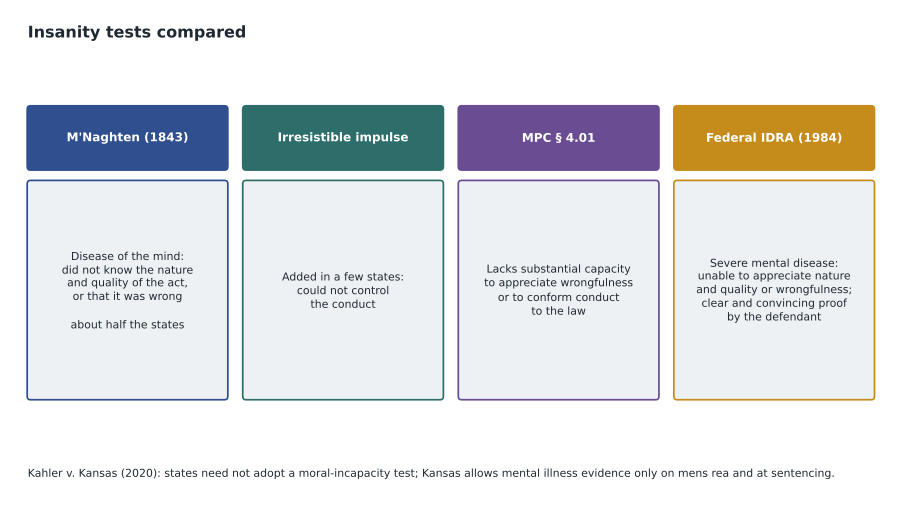
The insanity defense excuses a defendant whose mental disease or defect prevented her from appreciating the wrongfulness of her conduct or, under some tests, from controlling it. The M'Naghten rule, from M'Naghten's Case, (1843) 10 Cl. & F. 200, 8 Eng. Rep. 718, asks whether, at the time of the act, the defendant was laboring under such a defect of reason, from disease of the mind, as not to know the nature and quality of the act, or, if he did know it, not to know that what he was doing was wrong. About half the states use M'Naghten or a close variant. A few add an irresistible impulse test. The Model Penal Code's test, in section 4.01, provides that a person is not responsible if, as a result of mental disease or defect, he lacks substantial capacity either to appreciate the criminality (or wrongfulness) of his conduct or to conform his conduct to the requirements of law. After John Hinckley was acquitted by reason of insanity in 1982 for shooting President Reagan, Congress adopted the Insanity Defense Reform Act of 1984, 18 U.S.C. § 17, which uses a narrower test (severe mental disease or defect making the defendant unable to appreciate the nature and quality or wrongfulness of his acts) and places the burden on the defendant to prove insanity by clear and convincing evidence.
The Constitution does not require any particular test. Clark v. Arizona, 548 U.S. 735 (2006), upheld Arizona's narrow test, which asked only whether the defendant knew his act was wrong, and its rule limiting psychiatric evidence on mens rea. Kahler v. Kansas, 589 U.S. 271 (2020), held that due process does not require a state to adopt an insanity test that turns on the defendant's ability to recognize that his crime was morally wrong; Kansas, which allows mental illness evidence only to negate mens rea and at sentencing, could abolish the moral-incapacity test. Only a few states, including Kansas, Idaho, Montana and Utah, have eliminated a traditional insanity defense. Defendants found not guilty by reason of insanity are typically committed to psychiatric institutions, sometimes for longer than they would have served in prison.
Intoxication
Voluntary intoxication is generally not a defense, but in many states it can negate the specific intent required for some crimes. At common law, a defendant too drunk to form the intent to steal, for example, could not be guilty of larceny, though he could be guilty of general intent crimes such as assault. The Model Penal Code's section 2.08 allows intoxication evidence to negate purpose or knowledge, but provides that when recklessness establishes an element, a person who is unaware of a risk because of voluntary intoxication is treated as if he had been aware. Montana v. Egelhoff, 518 U.S. 37 (1996), upheld a Montana statute barring juries from considering voluntary intoxication in determining mental state, holding that the Constitution does not require states to allow intoxication evidence to negate mens rea. About a dozen states bar voluntary intoxication evidence entirely. Involuntary intoxication, such as being drugged without one's knowledge, is a defense if it produces a condition equivalent to insanity.
Shaw's intoxication claim may help him on crimes requiring purpose, such as burglary's intent to commit theft, in a state that allows intoxication to negate specific intent; but his texts in the group chat, his purchase of the bolt cutters and his cutting of the lock show planning and purpose formed while sober. For manslaughter based on recklessness, the Code treats his drunken unawareness as awareness. Daniel notes that juries tend to be unsympathetic to drunkenness defenses in any event.
| Defense | Type | Core requirement | Authority |
|---|---|---|---|
| Self-defense | Justification | Reasonable belief that proportionate force is necessary against imminent unlawful force | Goetz; Norman; MPC 3.04 |
| Necessity | Justification | Avoiding a greater harm with no legal alternative | Dudley and Stephens; Schoon; MPC 3.02 |
| Duress | Excuse | Threat of unlawful force a person of reasonable firmness could not resist | Contento-Pachon; MPC 2.09 |
| Insanity | Excuse | Mental disease preventing appreciation of wrongfulness (or control, under the MPC) | M'Naghten; MPC 4.01; Clark; Kahler |
| Voluntary intoxication | Failure of proof (limited) | May negate purpose or knowledge in many states; not recklessness | MPC 2.08; Egelhoff |
Worked problem
The warning shot in the parking lot
Late at night in a Brennan Falls parking lot, a man demands a woman's car keys and moves toward her, his hand in his jacket pocket as if holding a gun. She has a licensed handgun, draws it and fires, killing him. He was unarmed. Westmarch follows the MPC on self-defense but has a stand your ground statute eliminating the duty to retreat. She could have run back into the nearby store. Analyze her defense.
Show solution
- Initial aggressor: the man made the demand and advanced; she did not provoke the encounter.
- Honest belief: she believed he had a gun and would use it to take the keys or harm her.
- Reasonable belief: a reasonable person in her situation (alone, at night, a stranger demanding keys while reaching into a pocket as if armed) could believe deadly force was immediately necessary; his being unarmed does not defeat a reasonable mistake.
- Proportionality: deadly force is permitted against a threat of death, serious bodily injury or robbery by force under the MPC's section 3.04(2)(b); a robbery with an apparent gun qualifies.
- Retreat: the MPC would require retreat if she knew she could do so in complete safety, but Westmarch's stand your ground statute eliminates that duty in a place she had a right to be.
- If the jury found her belief honest but unreasonable, the MPC's section 3.09(2) would allow conviction only of a reckless or negligent homicide offense.
Answer: She has a strong self-defense claim: she reasonably believed deadly force was immediately necessary to prevent an armed robbery, the man's being unarmed does not defeat a reasonable mistake, and the stand your ground statute removes any duty to retreat. If the jury found her belief unreasonable, she would face at most manslaughter or negligent homicide rather than murder.
Summary and key terms
- Justifications (self-defense, defense of others, necessity, law enforcement) declare conduct permissible; excuses (insanity, duress, involuntary intoxication) excuse a blameless actor.
- Self-defense requires an honest and reasonable belief that proportionate force is necessary against imminent unlawful force (Goetz's objective standard; Norman on imminence; MPC section 3.04).
- Most states follow a no-retreat rule, many by stand your ground statute; retreat jurisdictions exempt the home (castle doctrine); initial aggressors lose the defense unless they withdraw (Peterson).
- Deadly force may not protect property alone (Ceballos); police force is limited by Garner, Graham and Barnes (2025).
- Necessity requires avoiding a greater harm without a legal alternative (Dudley and Stephens; Unger; Schoon).
- Duress requires a threat of unlawful force a person of reasonable firmness could not resist (Contento-Pachon; MPC 2.09; Dixon).
- Insanity tests include M'Naghten, the MPC's substantial capacity test and the federal IDRA; Clark and Kahler give states wide latitude.
- Voluntary intoxication may negate purpose or knowledge in many states but not recklessness, and states may exclude it entirely (Egelhoff).
Practice problems
Work each problem on paper first, then reveal the answer to check.
What standard of reasonableness did People v. Goetz adopt?
Show answer
An objective standard: whether a reasonable person in the defendant's situation, including the physical circumstances and relevant knowledge, would have believed deadly force necessary.
Why was Judy Norman denied a self-defense instruction?
Show answer
The North Carolina Supreme Court held that her sleeping husband posed no imminent threat, so self-defense was unavailable despite years of abuse.
Why did the court in Schoon hold that the necessity defense is unavailable for indirect civil disobedience?
Show answer
Breaking a law to protest a different policy cannot directly avert the harm, and lawful political alternatives always exist.
What did Kahler v. Kansas hold?
Show answer
That due process does not require a state to adopt an insanity test based on the defendant's ability to recognize that his crime was morally wrong.
Lesson quiz · 5 questions
Score 60% or more to complete this lesson.
Create a free account to save your progress, take quizzes and earn a certificate.