
LAWU-112 · Lesson 5 of 12 · 22 min
Homicide: murder and felony murder
▶ Video coming soon A video version of this lesson is on the way.
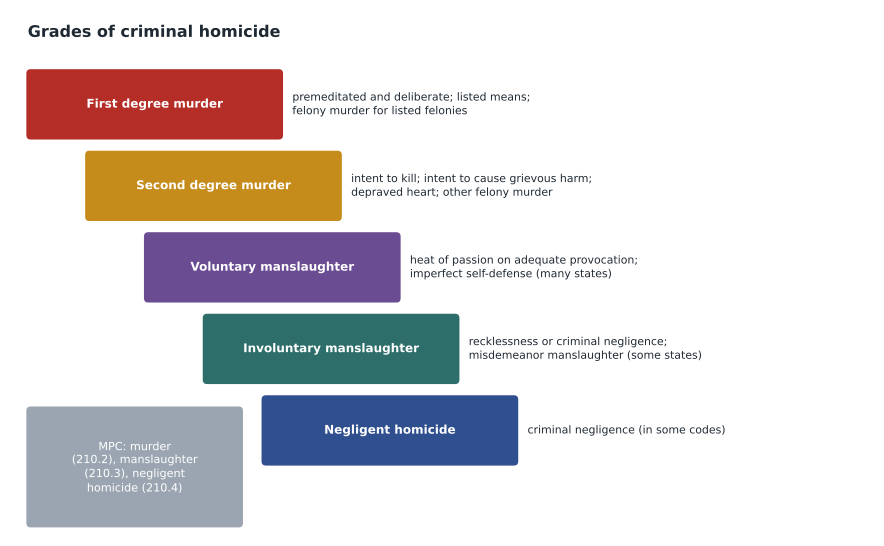
"Homicide is the killing of a human being by another human being," Mendenhall says as the fifth class begins. "Not every homicide is a crime. A soldier in battle, an executioner, a person defending her life: all may kill lawfully. The law of criminal homicide sorts unlawful killings into grades, from first degree murder down to negligent homicide, and the sorting is almost entirely about mental state." She draws a staircase on the board and labels the steps. Today Section B will climb the top steps: murder in its various forms, including the felony murder rule that will decide much of the Riverside Salvage case.
Malice aforethought
At common law, murder was the unlawful killing of a human being with malice aforethought, and manslaughter was an unlawful killing without malice. Despite the words, malice aforethought required neither ill will nor premeditation. Courts recognized four kinds of malice: intent to kill; intent to cause grievous bodily harm; extreme recklessness, often called a depraved heart or abandoned and malignant heart; and the intent to commit a felony, which became the felony murder rule. A killing with any of these mental states was murder.
Most states retain the term malice in their homicide statutes but define it by reference to these categories. The Model Penal Code dropped the term. Under section 210.2, criminal homicide is murder when it is committed purposely or knowingly, or recklessly under circumstances manifesting extreme indifference to the value of human life. The Code provides that such recklessness and indifference are presumed if the actor is engaged in or is an accomplice in the commission of, or an attempt or flight after committing, robbery, rape, arson, burglary, kidnapping or felonious escape. In other words, the Code replaced the felony murder rule with a rebuttable presumption of extreme recklessness.
Degrees of murder
Pennsylvania's 1794 statute introduced the idea of dividing murder into degrees, reserving the most serious punishment for murder that was willful, deliberate and premeditated, or committed by poison or lying in wait, or in the perpetration of certain felonies. Most states followed. First degree murder now usually includes premeditated and deliberate killings, killings by specified means, and felony murder involving listed felonies; second degree murder covers other intentional killings, intent to cause serious injury and depraved heart killings. The Model Penal Code did not divide murder into degrees, though its sentencing provisions distinguished capital cases.
The meaning of premeditation and deliberation has divided courts. Some hold that premeditation requires only enough time for a thought to form, so that a killer who decides to kill an instant before acting has premeditated. Commonwealth v. Carroll, 412 Pa. 525 (1963), illustrates that view: a husband shot his sleeping wife in the head after an argument, and the Pennsylvania Supreme Court affirmed a first degree conviction, saying that no time is too short for a wicked person to form a fully intentional design to kill. Other courts require evidence of actual reflection. In State v. Guthrie, 194 W. Va. 657 (1995), the West Virginia Supreme Court of Appeals rejected instructions that equated premeditation with mere intent, holding that there must be some period between the formation of the intent and the killing that shows the killing was the product of prior consideration. People v. Anderson, 70 Cal. 2d 15 (1968), identified three types of evidence that support premeditation: planning activity, motive and a manner of killing so particular and exacting as to suggest a preconceived design.
Intent to cause grievous bodily harm
A person who intends to inflict serious bodily injury, short of death, and causes death is guilty of murder at common law and in many states. The rationale is that someone who intends grievous harm has accepted a high risk that the victim will die. The Model Penal Code does not have this category; a killing in such circumstances is murder under the Code only if the actor was at least reckless under circumstances of extreme indifference, which will often be true.
Depraved heart murder
Depraved heart murder covers killings that result from extreme recklessness, conduct that shows a wanton disregard for human life. The classic case is Commonwealth v. Malone, 354 Pa. 180 (1946). Malone, a 17-year-old, played a game of Russian poker with a 13-year-old friend, loading one bullet into a five-chamber revolver, putting it to his friend's side and pulling the trigger three times. The friend died. Malone said he did not intend to kill and expected the gun not to fire. The Pennsylvania Supreme Court upheld his second degree murder conviction because he acted in reckless and wanton disregard of the consequences, which supplied the malice.
The line between depraved heart murder and reckless manslaughter is a matter of degree. Both require awareness of a risk of death; murder requires that the risk be extreme and that the defendant's disregard of it show indifference to human life. Courts look at the magnitude of the risk, the defendant's awareness of it, the social utility (if any) of the conduct, and whether the defendant took any precautions. Drunk drivers who kill are usually prosecuted for vehicular manslaughter, but some courts have upheld murder convictions where the driver had prior DUI convictions and warnings, drove at extreme speed or fled the scene. In People v. Watson, 30 Cal. 3d 290 (1981), the California Supreme Court held that a drunk driver who sped through intersections and killed two people could be charged with second degree murder because there was evidence of implied malice. In People v. Feingold, 7 N.Y.3d 288 (2006), New York held that depraved indifference is a culpable mental state, not merely a description of objective circumstances, and the state's courts have since read it narrowly.
The felony murder rule
Under the felony murder rule, a person who causes a death, even accidentally, while committing or attempting a felony is guilty of murder. The rule supplies the malice: the intent to commit the felony substitutes for any mental state toward the death. In its broadest form, it would make a shoplifter who accidentally knocks over an elderly customer, causing a fatal fall, guilty of murder if the shoplifting is a felony.
Supporters argue that the rule deters dangerous felonies and makes felons more careful, reflects the community's sense that a killing during a felony is especially blameworthy, and simplifies prosecutions by removing the need to prove intent. Critics respond that punishing accidental killings as murder violates the principle that punishment should track culpability; that deterrence is doubtful, since people rarely know the rule or expect to kill; and that the rule's harshness falls heavily on young and peripheral participants who did not kill and may not have anticipated violence. England abolished felony murder in 1957, and Michigan's supreme court effectively abolished the common law version in People v. Aaron, 409 Mich. 672 (1980), requiring proof of malice for murder.
Limits on felony murder
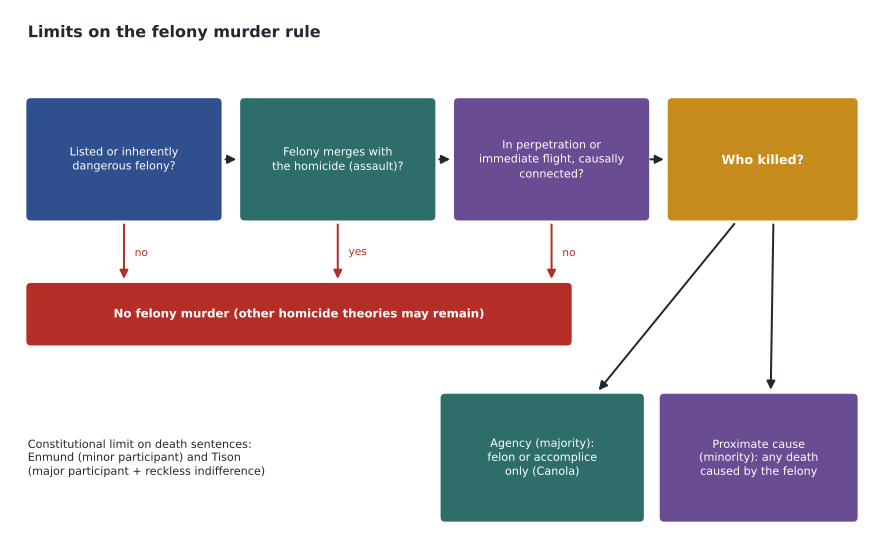
Courts and legislatures have developed several limits. The first is the inherently dangerous felony requirement. Some states limit felony murder to felonies listed in the statute, typically robbery, burglary, rape, arson and kidnapping. For unlisted felonies, many courts require that the felony be inherently dangerous to human life. California assesses danger in the abstract, by looking at the elements of the felony rather than the facts of the case. In People v. Phillips, 64 Cal. 2d 574 (1966), a chiropractor persuaded the parents of a girl with eye cancer to forgo surgery in favor of his treatments, and she died; the court held that grand theft by false pretenses is not inherently dangerous in the abstract, so it could not support felony murder. Other states, such as Wisconsin, look at how the felony was actually committed.
The second limit is the merger doctrine. If the underlying felony is an assault or another crime that is an integral part of the homicide, it merges into the homicide and cannot support felony murder. Otherwise every assault causing death would become murder without any proof of malice, and the rule would swallow the law of manslaughter. In People v. Ireland, 70 Cal. 2d 522 (1969), the California Supreme Court held that assault with a deadly weapon could not serve as the predicate felony. Burglary with intent to assault raises a harder question; courts are divided.
The third limit concerns timing and connection: the killing must occur in the perpetration of the felony. Most courts include the immediate flight from the scene, until the felons reach a place of temporary safety. The death must also be causally connected to the felony, not merely coincidental. A killing during a getaway car chase usually satisfies the rule; a death caused by an unrelated lightning strike during a burglary would not.
Killings by non-felons
The most debated limit involves deaths caused by someone other than the felons, such as a robbery victim or police officer who fires at the robbers and kills a bystander or one of the felons. Under the agency approach, followed by most courts, felony murder applies only when a felon or an accomplice acting in furtherance of the felony does the killing. In State v. Canola, 73 N.J. 206 (1977), a store owner resisting a robbery shot and killed one of the robbers; the New Jersey Supreme Court held that the surviving robbers could not be convicted of felony murder for their co-felon's death, because the killing was not done by them or someone acting in concert with them. Under the minority proximate cause approach, felons can be liable for any death proximately caused by the felony, including killings by resisting victims or police. Some states, such as Pennsylvania in some contexts and Illinois in some cases, have used that approach, though often reserving it for deaths of innocent persons. Many states have also addressed the issue by statute.
Constitutional limits and recent reforms
For capital punishment, the Eighth Amendment limits felony murder liability. Enmund v. Florida, 458 U.S. 782 (1982), held that the death penalty cannot be imposed on a getaway driver who did not kill, attempt to kill or intend that a killing take place. Tison v. Arizona, 481 U.S. 137 (1987), held that it may be imposed on a felony murderer who was a major participant in the felony and acted with reckless indifference to human life.
Several states have recently narrowed felony murder. California's Senate Bill 1437 (2018) limited murder liability for participants in felonies to those who actually killed, aided the killing with intent to kill, or were major participants acting with reckless indifference to human life, and created a process for people convicted under the old rule to seek resentencing. Colorado in 2021 reclassified felony murder from first degree to second degree murder, while keeping an affirmative defense for participants who did not kill, were unarmed and had no reason to think any participant would kill. Minnesota in 2023 limited felony murder liability for people who did not cause the death themselves, again with a resentencing process. Illinois narrowed its rule in 2021 so that a death caused by a non-participant, such as a police officer, no longer supports felony murder.
| Limit | Rule | Leading authority |
|---|---|---|
| Dangerous felony | Listed felonies, or felonies inherently dangerous (in the abstract or as committed) | Phillips |
| Merger | Assault-type felonies integral to the killing cannot be predicates | Ireland |
| In perpetration | Killing during the felony or immediate flight, causally connected | Flight cases |
| Killer's identity | Agency approach: only killings by felons or accomplices (majority) | Canola |
| Death penalty | Not for minor participants without intent; allowed for major participants with reckless indifference | Enmund; Tison |
Felony murder at Riverside Salvage
Mendenhall asks Section B to apply the rule. Westmarch's code follows the Model Penal Code's presumption approach, but she asks them first to analyze the case under a traditional felony murder statute listing burglary. Shaw and Pike entered a building at night with intent to steal copper, which is burglary in most jurisdictions. Abbott died after Pike shoved him during the burglary, while the felons were still at the scene. Under a traditional rule, Pike is guilty of murder regardless of whether he foresaw death, and under accomplice principles, Shaw and Quinn may be guilty too. Burglary is a listed felony, so the inherently dangerous question does not arise; burglary does not merge with the killing, because its purpose (theft) is independent of the assault; and Pike, a felon, did the killing, so the agency approach is satisfied.
Under Westmarch's Model Penal Code version, the burglary raises a presumption that Pike acted with extreme indifference to human life, but Pike may rebut it by showing that he gave a single push to get past a man blocking the door, with no weapon and no intent to injure. If the jury finds the presumption rebutted, Pike is not guilty of murder and the case moves down the staircase to manslaughter, the subject of the next lesson. Jordan observes that this is exactly the culpability-based limit the Code's drafters intended. Daniel adds that, in the real world, the threat of a felony murder charge would give the prosecutor enormous leverage to secure guilty pleas to burglary and manslaughter, which brings the class back to the plea bargaining statistics from the first day.
Worked problem
The arson and the firefighter
To collect insurance money, a store owner in Brennan Falls sets fire to his empty store at 3 a.m. after confirming no one is inside. A firefighter dies when the roof collapses during the response. The state charges the owner with felony murder under a statute listing arson. The owner argues that he took care to make sure no one would be hurt. Analyze the charge.
Show solution
- Predicate felony: arson is a listed felony, so its inherent dangerousness is presumed; under California's abstract test it would also qualify, since setting fire to a building is dangerous to life in the abstract.
- Merger: arson has an independent felonious purpose (destroying property for insurance), so it does not merge with the homicide.
- In perpetration and causation: the death occurred while responding to the fire the owner set; firefighters' response is a foreseeable, dependent consequence of arson, and most courts hold arsonists liable for firefighter deaths.
- Killer's identity: the owner's act of setting the fire caused the death; no third party's deliberate act intervened, so the agency issue does not arise.
- The owner's precautions are irrelevant to felony murder, which does not require a mental state toward death; under an MPC-style presumption, they could help rebut extreme indifference, but the risk to firefighters is obvious.
Answer: Under a traditional statute, the owner is guilty of felony murder: arson is a listed, non-merging felony, and the firefighter's death was caused by the fire he set. His care to clear the building does not matter under the rule, though under the MPC approach he could argue it rebuts the presumption of extreme indifference, a difficult argument given the foreseeable risk to firefighters.
Summary and key terms
- Common law murder required malice aforethought: intent to kill, intent to cause grievous bodily harm, depraved heart recklessness or felony murder.
- Most states divide murder into degrees; first degree typically requires premeditation and deliberation (Carroll's instant view versus Guthrie's requirement of reflection; Anderson's evidence categories).
- Depraved heart murder requires extreme recklessness showing indifference to human life (Malone; Watson; Feingold); the MPC defines murder as purposeful, knowing or extremely indifferent reckless killing (section 210.2).
- Felony murder imposes murder liability for deaths caused in the commission of a felony, limited by dangerous-felony requirements (Phillips), merger (Ireland), the in-perpetration requirement, and, in most states, the agency approach (Canola).
- Enmund and Tison limit the death penalty for felony murderers; California (2018), Colorado (2021), Illinois (2021) and Minnesota (2023) have narrowed felony murder by statute; the MPC replaces it with a rebuttable presumption.
Practice problems
Work each problem on paper first, then reveal the answer to check.
How did the Malone court find malice when the defendant did not intend to kill?
Show answer
Pulling the trigger of a partly loaded revolver pressed against his friend's side three times showed reckless and wanton disregard for human life, which is depraved heart malice.
Why could grand theft not support felony murder in People v. Phillips?
Show answer
California assesses inherent dangerousness in the abstract, and grand theft by false pretenses, considered by its elements, is not inherently dangerous to human life.
What is the merger doctrine and why does it exist?
Show answer
It bars using an assault-type felony integral to the killing as the predicate for felony murder; otherwise every fatal assault would be murder without proof of malice, eliminating manslaughter.
Under the agency approach, are surviving robbers guilty of felony murder when a store owner shoots their accomplice?
Show answer
No. In State v. Canola, the killing was done by the resisting victim, not by a felon or someone acting in furtherance of the felony.
Lesson quiz · 5 questions
Score 60% or more to complete this lesson.
Create a free account to save your progress, take quizzes and earn a certificate.