
LAWU-112 · Lesson 3 of 12 · 23 min
Mens rea and mistake
▶ Video coming soon A video version of this lesson is on the way.
Mendenhall begins the third class by holding up a gray canvas bag. "Suppose I pick up this bag at the airport baggage claim, thinking it's mine, and take it home. It belongs to someone else. Am I a thief?" Section B agrees she is not. "Now suppose I know it's not mine but I take it anyway because I like it." Everyone agrees that is theft. "Same act, same result. The only difference is what was in my head. That is mens rea, and it is the heart of criminal law."
The meaning of mens rea
The maxim actus non facit reum nisi mens sit rea, an act does not make a person guilty unless the mind is guilty, captures the common law's insistence on a culpable mental state. In Morissette v. United States, 342 U.S. 246 (1952), the Supreme Court described the requirement as "no provincial or transient notion" but one "as universal and persistent in mature systems of law as belief in freedom of the human will." Morissette, a junk dealer, took spent bomb casings from a federal bombing range, believing they had been abandoned, and sold them for scrap. He was convicted of knowingly converting government property after the trial judge refused to let the jury consider whether he believed the casings were abandoned. The Court reversed, holding that Congress had incorporated the common law intent requirement of larceny into the statute even though the text did not spell it out.
The common law used a bewildering vocabulary of mental states: malice, willfully, wantonly, fraudulently, corruptly, with a depraved heart. Courts also distinguished general intent crimes, which require only the intent to do the act, from specific intent crimes, which require an additional purpose, such as burglary's intent to commit a felony inside the dwelling or larceny's intent to permanently deprive. The distinction still matters in many states, especially for intoxication and mistake defenses, but it is notoriously slippery.
The Model Penal Code's four levels of culpability
The Model Penal Code replaced the common law vocabulary with four defined mental states in section 2.02, a reform that most states have adopted in some form. In descending order of culpability: a person acts purposely with respect to a result or conduct if it is his conscious object to engage in the conduct or cause the result. He acts knowingly if he is aware that his conduct is of that nature or that a circumstance exists, or, for a result, if he is aware that it is practically certain his conduct will cause the result. He acts recklessly if he consciously disregards a substantial and unjustifiable risk, and the disregard is a gross deviation from the standard of conduct a law-abiding person would observe in his situation. He acts negligently if he should be aware of a substantial and unjustifiable risk, and his failure to perceive it is a gross deviation from the standard of care a reasonable person would observe.
The key line between recklessness and negligence is awareness. The reckless person sees the risk and takes it; the negligent person fails to see a risk he should have seen. Criminal negligence is also more than civil negligence: it requires a gross deviation from reasonable care, not just the ordinary carelessness that supports a tort claim.
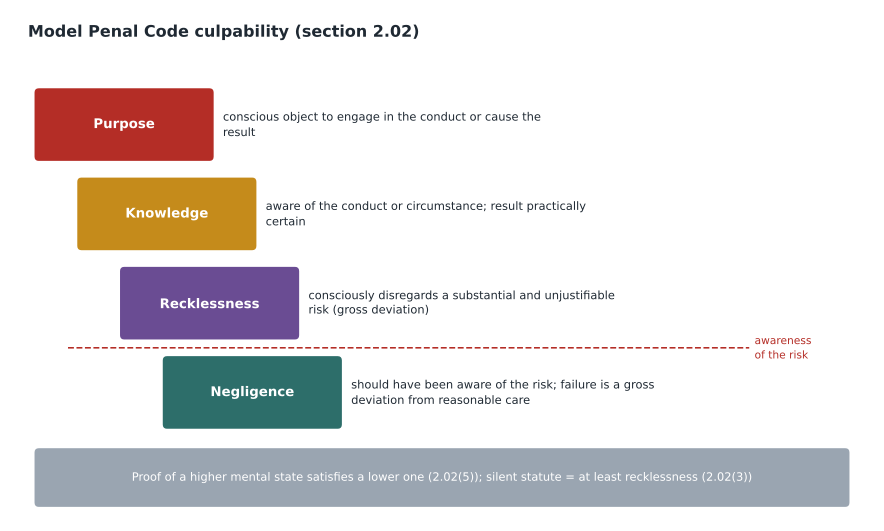
Marcus asks for an example that separates the levels. Mendenhall gives one: a man fires a gun into a crowd. If he wants to kill someone, he acts purposely. If he does not care whether anyone dies but is practically certain someone will, he acts knowingly. If he fires into the air above the crowd, aware that a bullet could come down and hit someone, he acts recklessly. If he fires at what he thinks is an empty field at night without checking, when a reasonable person would have realized people might be there, he acts negligently.
Applying mental states to elements
One of the Code's most important innovations is element analysis. Instead of asking whether a crime requires general or specific intent, the Code asks what mental state applies to each material element: conduct, circumstances and results. The same offense may require purpose as to one element and recklessness as to another. Section 2.02(3) supplies a default: when a statute does not specify the culpability required for an element, it is established if the person acted purposely, knowingly or recklessly. Section 2.02(4) provides that when a statute prescribes a mental state without distinguishing among elements, it applies to all the material elements unless a contrary purpose plainly appears. Section 2.02(5) provides that proof of a higher mental state always satisfies a lower one.
Regina v. Cunningham, [1957] 2 Q.B. 396, an English case American courts often cite, shows why element analysis matters. Cunningham tore a gas meter from the wall of an empty house to steal the coins in it, leaving the gas leaking; it seeped into the house next door and nearly asphyxiated an elderly woman. He was charged under a statute making it a crime to "maliciously" administer a noxious thing. The trial judge told the jury that malicious meant simply wicked. The appellate court quashed the conviction: malice in the statute required that the defendant either intended the harm or foresaw that it might occur and went ahead anyway. Stealing the coins was wicked, but that did not show a culpable mental state toward the poisoning.
Knowledge and willful blindness
Defendants sometimes avoid learning facts that would establish knowledge. Courts address this with the doctrine of willful blindness, sometimes called deliberate ignorance. The Code's section 2.02(7) provides that when knowledge of a fact is required, it is established if a person is aware of a high probability of its existence, unless he actually believes it does not exist. In United States v. Jewell, 532 F.2d 697 (9th Cir. 1976) (en banc), a man drove a car across the Mexican border with marijuana hidden in a secret compartment; he admitted he suspected something illegal was in the car but deliberately did not look. The court upheld a willful blindness instruction. Global-Tech Appliances, Inc. v. SEB S.A., 563 U.S. 754 (2011), a patent case, endorsed the doctrine with two requirements: the defendant must subjectively believe there is a high probability that a fact exists, and must take deliberate actions to avoid learning of it.
Strict liability
Some offenses require no mental state as to at least one element. These strict liability offenses are common among public welfare or regulatory offenses: selling adulterated food, violating traffic laws, selling liquor to minors. In United States v. Balint, 258 U.S. 250 (1922), the Court upheld a conviction for selling narcotics without the required tax forms even though the defendants did not know the drugs were narcotics. In United States v. Park, 421 U.S. 658 (1975), it upheld the conviction of a national grocery chain's president under the Food, Drug, and Cosmetic Act after rats contaminated food in a company warehouse, holding that a corporate officer who had responsibility and authority to prevent the violation could be convicted without proof of personal awareness.
Courts are reluctant to read statutes as imposing strict liability when penalties are serious. In Staples v. United States, 511 U.S. 600 (1994), the Court held that the government had to prove that a defendant knew his rifle had been modified to fire automatically, which brought it within the statutory definition of a machine gun; owning guns was a widespread lawful practice, and the penalty of up to ten years' imprisonment was severe. Elonis v. United States, 575 U.S. 723 (2015), held that a federal threats statute required more than negligence about how the words would be understood.
Statutory rape is the most controversial strict liability crime. Traditionally, a defendant who had sex with a person under the age of consent was guilty even if he reasonably believed the person was older. People v. Hernandez, 61 Cal. 2d 529 (1964), broke from that rule and allowed a reasonable mistake of age defense, and a number of states now allow such a defense in at least some circumstances, especially where the minor is close to the age of consent. Many states, however, still impose strict liability as to age, particularly for younger victims, and courts have generally rejected constitutional challenges.
Recent Supreme Court cases on mens rea
The Court has repeatedly applied a presumption that mental state requirements extend to the elements that separate innocent from wrongful conduct. In Rehaif v. United States, 588 U.S. 225 (2019), a man who had overstayed a student visa was convicted of possessing a firearm as a person unlawfully in the United States. The Court held that the government had to prove not only that he knew he possessed a gun, but also that he knew he belonged to a category of persons barred from possessing one. Ruan v. United States, 597 U.S. 450 (2022), held that a doctor charged with unlawfully dispensing controlled substances could be convicted only if the government proved he knowingly or intentionally acted in an unauthorized manner; it was not enough to show that his prescribing fell outside objective professional standards.
Counterman v. Colorado, 600 U.S. 66 (2023), combined mental state analysis with the First Amendment. Counterman sent hundreds of unwanted Facebook messages to a local musician, some suggesting he was watching her and wished her dead. He was convicted under a stalking statute that used an objective standard: whether a reasonable person would understand the messages as threats. The Court held that the First Amendment requires proof that the defendant had some subjective understanding of the threatening nature of his statements, and that recklessness, consciously disregarding a substantial risk that the communications would be viewed as threatening violence, is enough.
| Case | Statute or issue | Holding |
|---|---|---|
| Rehaif (2019) | Firearm possession by a prohibited person | Must know the facts of one's prohibited status |
| Ruan (2022) | Doctor's unauthorized dispensing | Must knowingly or intentionally act without authorization |
| Counterman (2023) | True threats under the First Amendment | Recklessness as to the threatening nature is required and enough |
| Elonis (2015) | Federal threats statute | Negligence is not enough |
Mistake of fact
A mistake of fact is a defense when it negates the mental state the offense requires. Under Code section 2.04(1), ignorance or mistake is a defense if it negates the purpose, knowledge, belief, recklessness or negligence required to establish a material element. Mendenhall's airport bag illustrates the point: theft requires knowing that the property belongs to another, so an honest belief that the bag was hers negates that knowledge, even if her belief was careless. If the offense required only negligence, by contrast, only a reasonable mistake would help.
The common law approach was more complicated. For specific intent elements, any honest mistake that negated the specific intent was a defense. For general intent crimes, the mistake had to be both honest and reasonable. And for strict liability elements, no mistake was a defense. In People v. Navarro, 99 Cal. App. 3d Supp. 1 (1979), a defendant took four wooden beams from a construction site, believing they had been abandoned. The appellate court held that the jury should have been told that a good faith belief that the beams were abandoned, even if unreasonable, would negate the specific intent to steal.
Mistake of law
The traditional rule is that ignorance of the law is no excuse. People are presumed to know the law, partly because allowing the defense would encourage ignorance and create proof problems. In People v. Marrero, 69 N.Y.2d 382 (1987), a federal corrections officer was arrested for carrying a handgun in a New York social club; he believed, based on his reading of a statute exempting "peace officers," that he was covered. The New York Court of Appeals upheld his conviction even though his reading was plausible: a mistaken interpretation of a statute by the defendant himself is not a defense, even if reasonable.
There are important exceptions. First, a mistake about a different law can negate a mental state element; if theft requires knowing property belongs to another, a mistaken belief about property law can negate that knowledge. Second, the Code's section 2.04(3) recognizes a defense of reasonable reliance on an official statement of the law, later determined to be invalid, contained in a statute, judicial decision, administrative order or official interpretation by a public officer responsible for interpreting the law. Third, due process may bar punishing someone who had no reason to know of a duty. In Lambert v. California, 355 U.S. 225 (1957), the Court reversed the conviction of a woman who failed to register as a convicted felon under a Los Angeles ordinance she had no reason to know about, because the offense punished a wholly passive failure to act. Fourth, some statutes require willfulness in the sense of knowing that one's conduct is unlawful. In Cheek v. United States, 498 U.S. 192 (1991), the Court held that a good faith belief that one is not violating the tax laws, even an unreasonable one, negates willfulness, though disagreement with the law or a belief that it is unconstitutional does not.
The running problem
Mendenhall asks Section B to identify the mental states at Riverside Salvage. Shaw and Pike purposely entered the warehouse and purposely took the copper; their purpose to steal satisfies the intent element of burglary and theft. As to Abbott's death, nobody wanted him to die. Pike shoved him purposely, but whether he was aware of a substantial risk that the shove could kill a 63-year-old man is a question of recklessness. Pike's lawyer will argue it was a single push meant to get past him, at most negligence; the prosecutor will point to the concrete floor and Abbott's age. The felony murder rule, studied later, may make that question irrelevant for murder. Quinn, in the car, will claim she believed the warehouse was abandoned and the copper free for the taking, a mistake of fact that, if believed, negates the knowledge that the property belonged to another.
Worked problem
The hunting guide and the posted land
Westmarch makes it a misdemeanor to "knowingly enter land posted against trespass." A hunting guide leads clients onto land whose posted signs had been torn down by vandals. He had hunted there for years with the previous owner's permission and did not know the land had been sold and posted. A game warden tells him the land is posted. He replies that he does not care and keeps hunting for another hour. Analyze his liability for the time before and after the warden spoke.
Show solution
- Element analysis: the statute requires knowledge, and under the MPC default rule in section 2.02(4) the knowledge requirement applies to every material element, including the circumstance that the land is posted.
- Before the warden spoke, the guide did not know the land was posted; his mistake of fact negates knowledge under section 2.04(1), whether or not a more careful guide would have checked.
- Willful blindness does not apply unless he was aware of a high probability that the land was posted and deliberately avoided confirming it; nothing suggests that.
- After the warden spoke, he knew the land was posted; continuing to hunt there satisfies the knowledge requirement.
- His indifference ("he does not care") is not a defense; motive is irrelevant once the required mental state is present.
Answer: He is not guilty for the period before the warden spoke, because he did not know the land was posted, but he is guilty for the hour after, when he knowingly remained on posted land.
Summary and key terms
- Mens rea is a culpable mental state; Morissette presumed that Congress incorporated the traditional intent requirement into a theft statute.
- The MPC's four mental states are purpose, knowledge, recklessness and negligence; recklessness requires conscious disregard of a substantial and unjustifiable risk, negligence only a failure to perceive it amounting to a gross deviation.
- The MPC applies mental states element by element, defaults to recklessness when a statute is silent, and lets proof of a higher state satisfy a lower one (sections 2.02(3)-(5)); Cunningham shows why.
- Knowledge includes awareness of a high probability (willful blindness: Jewell; Global-Tech).
- Strict liability is common for regulatory offenses (Balint, Park) but disfavored for serious crimes (Staples, Elonis); Rehaif, Ruan and Counterman extend mental state requirements.
- A mistake of fact is a defense if it negates a required mental state; mistake of law is generally no defense (Marrero), with exceptions for mistakes negating an element, official statements, Lambert and willfulness crimes (Cheek).
Practice problems
Work each problem on paper first, then reveal the answer to check.
What separates recklessness from negligence under the MPC?
Show answer
Awareness: the reckless actor consciously disregards a risk he perceives, while the negligent actor fails to perceive a risk he should have perceived.
Why did the Court reverse in Morissette?
Show answer
Because the federal conversion statute incorporated the traditional intent requirement of larceny, so Morissette's belief that the casings were abandoned was relevant and the jury should have considered it.
What did the government have to prove under Rehaif?
Show answer
That the defendant knew he possessed a firearm and also knew he belonged to the category of persons barred from possessing one.
How did Cheek's good faith belief differ from a constitutional objection to the tax laws?
Show answer
A sincere misunderstanding that one owes no tax negates willfulness even if unreasonable, but a belief that the tax laws are unconstitutional is disagreement with the law, not ignorance of it, and does not.
Lesson quiz · 5 questions
Score 60% or more to complete this lesson.
Create a free account to save your progress, take quizzes and earn a certificate.