
LAWU-112 · Lesson 1 of 12 · 23 min
Purposes of punishment and the principle of legality
▶ Video coming soon A video version of this lesson is on the way.
Professor Gloria Mendenhall begins the spring semester of Criminal Law by writing two numbers on the board: 1,800,000 and 95. "Roughly how many people are held in American prisons and jails on a typical day," she says, pointing at the first, "and roughly what share of criminal convictions come from guilty pleas rather than trials." She has spent eight years as a state public defender and five as an assistant United States attorney, and she tells Section B that she will make them argue for both sides of every case. "Criminal law is the only body of law you will study this year that ends with the state locking a human being in a cage. Before we ask whether someone is guilty, we need to ask why we punish at all, and what limits a free society puts on the power to punish."
Jordan Kimura, who served as an Army logistics officer before law school, asks whether those figures are exact. Mendenhall says they are deliberately rounded: incarceration counts change every year and are reported differently by federal and state agencies, but the order of magnitude has been stable for two decades, and the dominance of plea bargaining is well documented. In Missouri v. Frye, 566 U.S. 134 (2012), and Lafler v. Cooper, 566 U.S. 156 (2012), the Supreme Court itself observed that criminal justice today is for the most part a system of pleas, not a system of trials, and held that the Sixth Amendment right to effective counsel extends to plea negotiations. "So most of the doctrine we study," she says, "matters because it shapes bargaining: what the prosecutor can prove, what the defense can argue, and what sentence each side can threaten or offer."
What makes something a crime
A crime is conduct that the law prohibits on pain of criminal punishment, imposed by the state after a criminal prosecution. Three features set criminal law apart from civil law. First, the state, not the injured person, brings the case, which is why cases are captioned People v. or State v. or United States v. Second, a criminal conviction carries moral condemnation: as Henry Hart argued in a famous 1958 article, what distinguishes a criminal from a civil sanction is the judgment of community condemnation that accompanies it. Third, the procedural protections are much stronger. The prosecution must prove every element beyond a reasonable doubt (In re Winship, 397 U.S. 358 (1970)); the defendant has rights to counsel, to a jury for serious offenses, to confront witnesses and against self-incrimination.
The same conduct can lead to both kinds of liability. Daniel Reyes, who worked as a paralegal at a personal-injury firm, recalls a drunk-driving crash his firm handled: the driver was prosecuted for vehicular assault and also sued for damages. The criminal case asked whether the state could prove guilt beyond a reasonable doubt; the civil case asked whether the injured family could prove negligence by a preponderance of the evidence. An acquittal in the criminal case would not have barred the civil suit.
Retribution
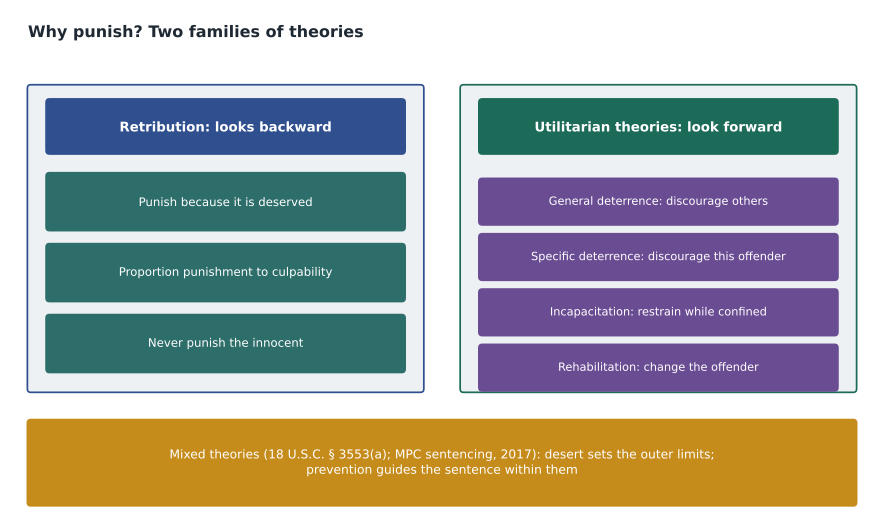
Theories of punishment fall into two broad families. Retributive theories look backward: offenders should be punished because they deserve it, in proportion to the wrong they did. Immanuel Kant offered the most uncompromising version, arguing that punishment must be imposed because the person has committed a crime and never merely as a means to promote some other good. Modern retributivists usually stress proportionality and desert as limits as much as reasons: the state may not punish more than the offender deserves, and it may not punish the innocent even if doing so would deter others.
Retribution is not revenge. Revenge is personal and unlimited; retribution is imposed by a neutral state, according to rules, and measured by culpability. Hannah Lindqvist, a former history teacher, notes that the lex talionis of the ancient world, an eye for an eye, was itself a limit: it capped punishment at the harm done. Mendenhall agrees and adds that desert depends on culpability, not just harm. A driver who kills a pedestrian through a momentary lapse and one who kills deliberately cause the same harm, but retributivists say they deserve very different punishment, which is why the law of homicide grades killings by mental state.
Utilitarian theories: deterrence, incapacitation and rehabilitation
Utilitarian theories look forward: punishment is justified only if it produces more good than harm, chiefly by preventing future crime. Jeremy Bentham argued that punishment is itself an evil, justified only to exclude some greater evil. Utilitarians identify several ways punishment prevents crime. General deterrence discourages other people from committing crimes by showing what happens to offenders. Specific deterrence discourages the offender from offending again. Incapacitation physically prevents the offender from committing crimes against the public while confined. Rehabilitation aims to change the offender so that he no longer wants to offend.
Each mechanism raises empirical questions. Research on deterrence generally finds that the certainty and swiftness of punishment matter more than its severity: potential offenders respond more to the likelihood of being caught than to the length of the sentence they might receive. Incapacitation clearly prevents crimes during confinement, but its benefits shrink as offenders age, because most people commit fewer crimes after their twenties. Rehabilitation fell out of favor in the 1970s after critics argued that nothing worked, then regained support as evidence accumulated that some programs, such as drug treatment and cognitive behavioral therapy, reduce reoffending.
Marcus Webb, the engineer in Section B, asks what happens when the theories conflict. Mendenhall answers with the classic objection to pure utilitarianism: if punishing an innocent person would deter many others and no one would ever find out, utilitarian logic might seem to permit it. Retributivists say this shows that desert must at least limit punishment. Most modern scholars adopt a mixed theory: desert sets the outer limits, and within those limits utilitarian goals guide the choice of sentence.
The theories in court
Courts confront these theories directly at sentencing. In United States v. Bergman, 416 F. Supp. 496 (S.D.N.Y. 1976), Judge Marvin Frankel sentenced a prominent rabbi and nursing-home operator who had defrauded Medicaid. The defendant argued that he needed no rehabilitation and posed no danger, so prison served no purpose. Judge Frankel agreed that rehabilitation and incapacitation did not apply, but imposed a four-month sentence for general deterrence and to mark the seriousness of the crime, reasoning that white-collar offenders are especially likely to be deterred by the prospect of prison.
Statutes often list the purposes explicitly. The federal sentencing statute, 18 U.S.C. § 3553(a), directs courts to impose a sentence sufficient, but not greater than necessary, to reflect the seriousness of the offense, promote respect for the law and provide just punishment, afford adequate deterrence, protect the public, and provide the defendant with needed training, medical care or other treatment. That single provision blends retribution, deterrence, incapacitation and rehabilitation. The Model Penal Code's 2017 revision of its sentencing provisions takes a similar mixed approach, making proportionality the primary limit and allowing utilitarian goals to operate within it.
The Eighth Amendment's ban on cruel and unusual punishments adds a constitutional limit on proportionality. The Court has struck down the death penalty for the rape of an adult woman (Coker v. Georgia, 433 U.S. 584 (1977)) and for the rape of a child where the victim did not die (Kennedy v. Louisiana, 554 U.S. 407 (2008)), mandatory life without parole for juveniles (Miller v. Alabama, 567 U.S. 460 (2012)), and life without parole for juveniles who did not kill (Graham v. Florida, 560 U.S. 48 (2010)). But review of prison terms for adults is highly deferential: Ewing v. California, 538 U.S. 11 (2003), upheld a sentence of 25 years to life under California's three-strikes law for stealing three golf clubs.
The principle of legality
The second half of the class turns to the principle of legality, often expressed by the Latin maxim nullum crimen sine lege, nulla poena sine lege: no crime without law, no punishment without law. The principle has several parts. Crimes must be defined in advance by a legislature, not created by courts after the fact. Criminal statutes must give fair notice of what is prohibited. And ambiguous criminal statutes are construed in favor of the defendant.
The first part means there are no common law crimes in the federal system. United States v. Hudson and Goodwin, 11 U.S. (7 Cranch) 32 (1812), held that federal courts have no power to create crimes; Congress must define them by statute. Most states have also abolished common law crimes by statute, and the Model Penal Code provides that no conduct constitutes an offense unless it is a crime under the Code or another statute. A minority of states still retain common law crimes. In Commonwealth v. Mochan, 177 Pa. Super. 454 (1955), a Pennsylvania court upheld a conviction for making obscene and harassing phone calls to a married woman, conduct no statute then prohibited, on the theory that it openly outraged decency; the dissent protested that it was the legislature's job to define new crimes.
Retroactivity and judicial expansion
The Constitution forbids ex post facto laws, which punish conduct that was innocent when done or increase the punishment after the fact (Article I, sections 9 and 10). The Ex Post Facto Clauses apply to legislatures, but due process imposes a similar limit on courts. In Keeler v. Superior Court, 2 Cal. 3d 619 (1970), the California Supreme Court refused to treat the killing of a viable fetus as murder under a statute defining murder as the unlawful killing of a human being, because extending the statute would have been an unforeseeable judicial enlargement of a criminal law. The legislature then amended the statute to include fetuses. In Bouie v. City of Columbia, 378 U.S. 347 (1964), the Supreme Court reversed trespass convictions of civil rights protesters who had stayed at a lunch counter after being asked to leave, because the state court had retroactively expanded a statute that covered only entering after notice.
Rogers v. Tennessee, 532 U.S. 451 (2001), drew the line differently for the common law. The Tennessee Supreme Court abolished the year-and-a-day rule, under which a death more than a year and a day after the defendant's act could not be murder, and applied the change to Rogers, whose victim died 15 months after a stabbing. The Supreme Court held that judicial changes to common law doctrines violate due process only if they are unexpected and indefensible by reference to the law as it existed; the year-and-a-day rule was widely recognized as outdated, so abolishing it was foreseeable.
Vagueness and lenity
The void-for-vagueness doctrine requires criminal laws to define offenses with enough clarity that ordinary people can understand what is prohibited, and in a way that does not encourage arbitrary and discriminatory enforcement. In Papachristou v. City of Jacksonville, 405 U.S. 156 (1972), the Court struck down a vagrancy ordinance punishing "rogues and vagabonds," "night walkers" and persons "wandering or strolling around from place to place without any lawful purpose." In City of Chicago v. Morales, 527 U.S. 41 (1999), it struck down an anti-gang loitering ordinance that let police order people to disperse when they remained in one place "with no apparent purpose." Johnson v. United States, 576 U.S. 591 (2015), invalidated the residual clause of the Armed Career Criminal Act, and Sessions v. Dimaya, 584 U.S. 148 (2018), and United States v. Davis, 588 U.S. 445 (2019), applied the same reasoning to similar clauses in other statutes.
The rule of lenity provides that when a criminal statute remains genuinely ambiguous after the ordinary tools of interpretation are applied, the ambiguity is resolved in the defendant's favor. In McBoyle v. United States, 283 U.S. 25 (1931), the Court held that a statute prohibiting the interstate transport of a stolen "motor vehicle" did not cover an airplane, with Justice Holmes writing that fair warning should be given in language the common world will understand. The justices continue to debate how ambiguous a statute must be before lenity applies, and recent decisions have often read federal criminal statutes narrowly through ordinary interpretation instead. Fischer v. United States, 603 U.S. 480 (2024), read a federal obstruction statute to require impairing the availability or integrity of evidence; Snyder v. United States, 603 U.S. 1 (2024), held that the federal program bribery statute does not cover gratuities paid after an official act; and Thompson v. United States (2025) held that a statute prohibiting false statements to lenders does not reach statements that are misleading but true.
| Requirement | Source | Example |
|---|---|---|
| Crimes defined by legislatures | Hudson and Goodwin (1812); MPC section 1.05 | No federal common law crimes |
| No retroactive punishment | Ex Post Facto Clauses; due process (Bouie, Rogers) | Keeler refused to extend murder to a fetus |
| Fair notice and no arbitrary enforcement | Void-for-vagueness doctrine | Papachristou; Morales; Johnson |
| Ambiguity favors the defendant | Rule of lenity | McBoyle: an airplane is not a motor vehicle |
Why legality matters
Priya Natarajan asks why courts should let a clearly blameworthy person go free because of a drafting gap. Mendenhall says the answer is about power. Legality protects individuals from punishment they could not have anticipated, keeps the power to define crimes with the most democratic branch, and limits the discretion of police and prosecutors. "The Jacksonville ordinance," she says, "did not tell anyone what was forbidden. It told the police whom they could arrest. That is the danger." The costs of legality, she adds, are real but modest: legislatures can and do close gaps quickly once courts expose them, as California did after Keeler.
She ends by introducing the course's running problem. Throughout the semester, Section B will follow a fictional case in the fictional State of Westmarch, whose penal code is modeled closely on the Model Penal Code. Last summer in the city of Brennan Falls, three young people planned to strip copper wiring from a closed warehouse owned by Riverside Salvage. A night watchman named Lou Abbott confronted them; one of the three shoved him; he collapsed and later died. "Every doctrine we study," she says, "will ask a question about that night: what each of them did, what each of them knew or intended, whether the death was legally caused by anyone, and what defenses they might raise."
Worked problem
A new crime for a new technology
A Westmarch statute enacted in 2010 makes it a misdemeanor to "intercept any wire or oral communication" without consent. In 2026 a defendant secretly reads his former partner's text messages by logging into her cloud account with a password he guessed. No Westmarch court has applied the statute to stored text messages. The prosecutor argues that text messages are wire communications and that the defendant's conduct is plainly wrong. What legality arguments should the defense raise?
Show solution
- Identify the text: the statute covers interception of wire or oral communications; the question is whether reading stored messages counts as interception.
- Ordinary interpretation comes first: interception usually means acquiring a communication during transmission, and federal courts interpreting similar language in the Wiretap Act have generally held that accessing stored messages is not interception.
- Fair notice and Bouie: applying the statute to stored messages for the first time could be an unforeseeable judicial expansion of a criminal law if the words do not reasonably cover the conduct.
- Rule of lenity: if the statute is genuinely ambiguous after ordinary interpretation, the ambiguity should be resolved for the defendant.
- Policy: the conduct may be blameworthy and may violate other statutes (such as unauthorized computer access laws); the remedy for a gap is legislative amendment, not judicial expansion.
Answer: The defense should argue that, read in its ordinary sense, the statute reaches only the interception of communications in transit, and that extending it to stored messages would be an unforeseeable judicial expansion barred by due process, with any remaining ambiguity resolved by lenity. The prosecutor's better path is to charge under a statute that clearly covers unauthorized access to stored data.
Summary and key terms
- A crime is conduct the state prohibits on pain of criminal punishment; criminal cases carry moral condemnation and require proof beyond a reasonable doubt (Winship).
- Retribution justifies punishment by desert and limits it by proportionality to culpability; utilitarian theories justify punishment by preventing future crime through deterrence, incapacitation and rehabilitation.
- Most modern systems, including 18 U.S.C. section 3553(a), blend the theories; Bergman shows general deterrence driving a sentence when other purposes did not apply.
- The Eighth Amendment limits disproportionate punishment, strongly for the death penalty and juveniles (Coker, Kennedy, Graham, Miller) but deferentially for adult prison terms (Ewing).
- The principle of legality requires crimes to be defined in advance by legislatures (Hudson and Goodwin), forbids retroactive punishment and unforeseeable judicial expansion (Keeler, Bouie; but Rogers), requires clear statutes (Papachristou, Morales, Johnson) and resolves genuine ambiguity for the defendant (McBoyle).
- Recent Supreme Court decisions such as Fischer (2024), Snyder (2024) and Thompson (2025) often read federal criminal statutes narrowly.
Practice problems
Work each problem on paper first, then reveal the answer to check.
Why did Judge Frankel impose prison time in Bergman even though he found that the defendant needed no rehabilitation and posed no danger?
Show answer
For general deterrence and to reflect the seriousness of the offense: a meaningful sentence would deter other white-collar offenders, and a sentence of no confinement would depreciate the crime.
What is the difference between Bouie and Rogers v. Tennessee?
Show answer
Bouie barred an unforeseeable judicial expansion of a statute to punish conduct that had been lawful; Rogers allowed retroactive abolition of a common law rule because the change was foreseeable and defensible given the rule's obsolescence.
Why did the Court strike down the Chicago loitering ordinance in Morales?
Show answer
It was vague: "no apparent purpose" gave citizens no clear standard and gave police nearly unlimited discretion to decide whom to order to disperse.
When does the rule of lenity apply?
Show answer
Only when a criminal statute remains genuinely ambiguous after the ordinary tools of statutory interpretation have been applied; then the ambiguity is resolved in the defendant's favor.
Lesson quiz · 5 questions
Score 60% or more to complete this lesson.
Create a free account to save your progress, take quizzes and earn a certificate.