
LAWU-112 · Lesson 6 of 12 · 22 min
Homicide: manslaughter
▶ Video coming soon A video version of this lesson is on the way.
Mendenhall opens the sixth class with two stories. In the first, a man comes home early and finds his wife in bed with his best friend; within seconds he grabs a heavy lamp and strikes the friend, killing him. In the second, a nurse at a nursing home, exhausted after a double shift, gives a patient ten times the prescribed dose of a sedative because she misreads a chart, and the patient dies. "Neither is murder in most states," she says. "Both may be manslaughter. But for very different reasons. The first is an intentional killing that the law partially excuses. The second is an unintentional killing that the law punishes because the nurse should have seen the risk."
Two kinds of manslaughter
Manslaughter is an unlawful killing without malice aforethought. It comes in two forms. Voluntary manslaughter is an intentional killing that would otherwise be murder, mitigated because the defendant acted in the heat of passion on adequate provocation, or, in some states, because of an honest but unreasonable belief in the need to use deadly force. Involuntary manslaughter is an unintentional killing caused by recklessness or criminal negligence, or, in some states, during an unlawful act that is not a felony. Sentences for manslaughter are substantially lower than for murder, so the line matters enormously.
Provocation at common law
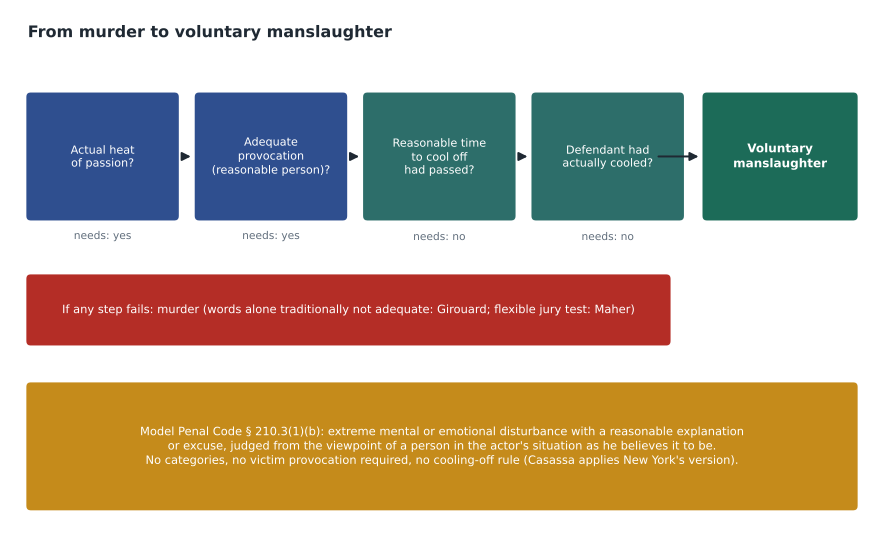
The common law provocation doctrine had four requirements. The defendant must have acted in the heat of passion; the passion must have been provoked by adequate provocation, the kind that would cause a reasonable person to lose self-control; the defendant must not have had a reasonable opportunity to cool off; and the defendant must not in fact have cooled off. The doctrine is a concession to human frailty, not a justification: the law does not approve of the killing, but recognizes that a person whose reason has been overwhelmed by a severe provocation is less blameworthy than one who kills in cold blood.
The old common law recognized only a few categories of adequate provocation: an aggravated assault or battery on the defendant; mutual combat; an illegal arrest; serious injury to a close relative; and discovering one's wife in the act of adultery. Words alone, however insulting, were never adequate. In Girouard v. State, 321 Md. 532 (1991), a husband stabbed his wife to death after she taunted him during an argument, told him she had never wanted to marry him and that she had filed charges against him for abuse. The Maryland Court of Appeals affirmed his murder conviction: words alone were not adequate provocation, however hurtful, and the court declined to extend the categories.
Maher v. People, 10 Mich. 212 (1862), began the shift toward a flexible standard. Maher shot a man he believed had just had sex with his wife, based on information he received from a friend that day. The Michigan Supreme Court held that the jury should have been allowed to decide whether the provocation was adequate, by asking whether it would cause an ordinary person to act rashly and from passion rather than judgment. Most American jurisdictions now leave adequacy to the jury under a reasonable person standard rather than fixed categories, though many retain the rule that words alone are not enough, except perhaps words that inform the defendant of a provoking fact.
The reasonable person and cooling time
Which characteristics of the defendant can the reasonable person share? Courts generally allow the jury to consider the defendant's physical characteristics and the circumstances in which he acted, but not idiosyncratic temperament, such as a quick temper or intoxication. A reasonable person, by definition, does not become more easily provoked by drinking. The harder question is whether traits such as age, sex, sexual orientation or cultural background may be considered. Courts are divided, and the issue has been especially controversial in cases where defendants have claimed that discovering a victim's sexual orientation or gender identity provoked them. More than a dozen states, beginning with California in 2014, have barred so-called gay and trans panic defenses by statute.
Cooling time is measured objectively and subjectively. If enough time passed that a reasonable person would have cooled off, the killing is murder even if the defendant was still enraged. But courts sometimes allow the jury to consider rekindling, where a new event reignites the passion, and long-simmering provocation, especially in cases involving domestic abuse, where a final incident triggers a reaction to years of mistreatment. In People v. Berry, 18 Cal. 3d 509 (1976), the California Supreme Court held that a two-week period of taunting and sexual provocation by the defendant's wife, culminating in a final scream, could support a heat of passion instruction.
Extreme emotional disturbance
The Model Penal Code broadened the doctrine. Under section 210.3(1)(b), a homicide that would otherwise be murder is manslaughter when it is committed under the influence of extreme mental or emotional disturbance for which there is reasonable explanation or excuse. The reasonableness of the explanation is determined from the viewpoint of a person in the actor's situation under the circumstances as he believes them to be. The Code abandons the categories, does not require a provoking act by the victim, does not exclude words, and has no cooling-off rule. New York and several other states adopted versions of it.
People v. Casassa, 49 N.Y.2d 668 (1980), shows how New York applies the standard. Casassa became obsessed with a woman he had dated briefly; after she rejected him, he broke into her apartment repeatedly to eavesdrop, then brought wine to her apartment and, when she refused him again, stabbed her to death. The trial court, sitting without a jury, found that he acted under extreme emotional disturbance but that there was no reasonable explanation for it, because his reaction was so peculiar to him. The Court of Appeals affirmed, holding that the test has a subjective part (did the defendant actually experience extreme disturbance) and an objective part (was there a reasonable explanation, viewed from the defendant's situation but not his idiosyncratic perspective).
Patterson v. New York, 432 U.S. 197 (1977), upheld New York's requirement that the defendant prove extreme emotional disturbance by a preponderance of the evidence, as an affirmative defense. Mullaney v. Wilbur, 421 U.S. 684 (1975), had struck down a Maine law that required the defendant to prove heat of passion to reduce murder to manslaughter, because Maine defined malice as the absence of provocation, making provocation's absence an element the state had to prove. Together the cases teach that the state must prove every element beyond a reasonable doubt, but legislatures can define elements and affirmative defenses as they choose.
Imperfect self-defense
Many states recognize a second form of voluntary manslaughter: imperfect self-defense. A person who kills while honestly but unreasonably believing that deadly force is necessary to defend against an imminent threat is not justified, because self-defense requires a reasonable belief. But she lacks the malice required for murder, so the killing is manslaughter. California calls this unreasonable self-defense. The Model Penal Code reaches a similar result through its general approach to mistaken justification, discussed in the defenses lesson: a person who negligently or recklessly believes force is necessary can be convicted only of an offense requiring negligence or recklessness, such as manslaughter or negligent homicide.
Involuntary manslaughter: recklessness and criminal negligence
Involuntary manslaughter covers unintentional killings caused by a high degree of carelessness. The required degree varies. Under the Model Penal Code, reckless homicide is manslaughter (section 210.3(1)(a)) and negligent homicide is a separate, lesser offense (section 210.4). Many states follow a similar structure. Other states, following common law terminology, use phrases such as gross negligence, culpable negligence or wanton and reckless conduct, and courts differ on whether the defendant must be aware of the risk.
Commonwealth v. Welansky, 316 Mass. 383 (1944), arose from the Cocoanut Grove nightclub fire in Boston in 1942, which killed 492 people. Welansky, the owner, had kept emergency exits locked or hidden to prevent customers from leaving without paying, and the club was overcrowded and decorated with flammable materials. He was hospitalized at the time of the fire. The Massachusetts Supreme Judicial Court upheld his manslaughter convictions under a standard of wanton or reckless conduct, holding that a person can be reckless if an ordinary person in his position would have realized the grave danger, even if he did not, though in Welansky's case actual awareness was strongly supported.
State v. Williams, 4 Wash. App. 908 (1971), set a lower bar. Walter and Bernice Williams, a young Native American couple with limited education, failed to take their 17-month-old son to a doctor for an abscessed tooth, partly because they feared that welfare authorities would take him away if they saw how sick he was. The infection developed into gangrene and the child died. Washington's statute at the time allowed a manslaughter conviction based on ordinary negligence, and the court affirmed. The case is often criticized because it punished parents for a failure that may have reflected fear, poverty and a well-founded distrust of child welfare authorities more than indifference, and because ordinary negligence is a low threshold for a serious crime.
| Offense | Mental state | Example |
|---|---|---|
| Depraved heart murder | Extreme recklessness; indifference to human life | Malone: pulling the trigger of a loaded revolver |
| Manslaughter (MPC 210.3) | Recklessness: conscious disregard of a substantial, unjustifiable risk | Welansky (locked exits, under a wanton or reckless standard) |
| Negligent homicide (MPC 210.4) | Criminal negligence: gross deviation, without awareness | Exhausted nurse misreading a chart (likely) |
| Ordinary negligence | Not criminal under the MPC; Williams under an old statute | Civil liability only in most states |
Misdemeanor manslaughter
The misdemeanor manslaughter rule, sometimes called the unlawful act doctrine, is the little sibling of felony murder: a death caused during the commission of an unlawful act that is not a felony is involuntary manslaughter. In its broadest form, a driver who exceeds the speed limit by a few miles and causes a fatal crash would be guilty of manslaughter without proof of negligence. Most states that retain the rule limit it to unlawful acts that are malum in se (wrong in themselves) rather than malum prohibitum (wrong only because prohibited), or to acts that are dangerous, and require that the unlawful aspect of the act cause the death. The Model Penal Code rejects the rule entirely.
Vehicular homicide
Every state has specific statutes for deaths caused by driving. Many create offenses of vehicular homicide or vehicular manslaughter that require only negligence, sometimes combined with driving while intoxicated, and some make an intoxicated driver who causes a death guilty without proof of any further fault. These statutes reflect the large number of traffic deaths each year and the difficulty of fitting them into the traditional categories. As the previous lesson showed, extreme cases of drunk driving can also support depraved heart murder charges.
Manslaughter at Riverside Salvage
Mendenhall returns to Lou Abbott. If the jury finds that Pike rebutted the presumption of extreme indifference, could he be guilty of manslaughter? Under Westmarch's code, manslaughter requires recklessly causing death. The prosecution will argue that Pike, a strong 27-year-old, shoved a man in his sixties hard enough to throw him onto concrete, and must have been aware of a substantial risk of serious injury and death. Pike will argue that he pushed to get past, did not see Abbott's age in the dark, and was aware at most of a risk of bruises. If the jury concludes that he did not actually perceive a risk of death but should have, the verdict is negligent homicide. Priya notes that this is where the eggshell victim rule and mental state interact: causation is clear, but culpability depends on what Pike perceived about a risk he could not see, Abbott's heart condition.
Provocation offers Pike nothing: being discovered by a watchman during a burglary is not adequate provocation, and in any event a defendant cannot rely on provocation he brought about through his own wrongdoing. Imperfect self-defense also fails because Pike was the aggressor and Abbott carried only a flashlight. Hannah asks whether Shaw's failure to call 911 could be manslaughter as well, if Shaw had a legal duty. Mendenhall says yes, in principle: an omission in breach of a duty can be reckless or negligent, and if a prompt call would have saved Abbott, Shaw's omission could be a cause. The medical evidence on whether earlier treatment would have saved him will matter.
Worked problem
The exhausted nurse
Return to the nurse from the start of class. After a double shift, she reads a chart written in a colleague's hurried handwriting, sees a dose of 50 milligrams instead of 5, and administers it without checking with a pharmacist, although hospital protocol requires a second check for any dose above the usual range. The patient dies. The state charges her with manslaughter (recklessness) and, alternatively, negligent homicide. Analyze both charges.
Show solution
- Causation: the overdose caused the death; the colleague's poor handwriting is a contributing condition but not a superseding cause.
- Recklessness requires conscious disregard: if the nurse noticed the dose was unusual and administered it anyway, skipping the required check, she was reckless.
- If she did not notice that the dose was unusual because she was exhausted, she did not consciously disregard the risk, so recklessness fails.
- Negligent homicide requires a failure to perceive a substantial and unjustifiable risk that is a gross deviation from reasonable care. A tenfold dose, combined with a protocol requiring a second check precisely to catch such errors, makes a gross deviation arguable.
- Mitigating facts (exhaustion, understaffing, poor handwriting) bear on whether her failure was a gross deviation and on sentencing; they may also point to institutional responsibility.
Answer: She is likely not guilty of manslaughter unless the prosecution proves she noticed the unusual dose and consciously skipped the check. She may be guilty of negligent homicide if the jury finds that failing to notice a tenfold overdose and ignoring the mandatory double check was a gross deviation from the standard of care, though her exhaustion and the circumstances give her a real defense argument.
Summary and key terms
- Manslaughter is an unlawful killing without malice: voluntary (intentional but mitigated) or involuntary (unintentional but culpable).
- Common law provocation requires actual heat of passion, adequate provocation measured by a reasonable person, no reasonable cooling time and no actual cooling; words alone were traditionally insufficient (Girouard), but many courts leave adequacy to the jury (Maher; Berry).
- The MPC's extreme emotional disturbance doctrine drops the categories and cooling rule but requires a reasonable explanation from the defendant's situation (section 210.3; Casassa); Patterson allows the defense burden, Mullaney limits it.
- Imperfect self-defense reduces murder to manslaughter when the belief in the need for deadly force is honest but unreasonable.
- Involuntary manslaughter rests on recklessness or criminal negligence (Welansky; Williams); the MPC separates reckless manslaughter from negligent homicide.
- Misdemeanor manslaughter survives in limited form in some states; the MPC rejects it; vehicular homicide statutes cover many traffic deaths.
Practice problems
Work each problem on paper first, then reveal the answer to check.
Why did Girouard's provocation claim fail?
Show answer
Maryland followed the rule that words alone, however insulting or hurtful, are not adequate provocation, and the court declined to expand the recognized categories.
How does the MPC's extreme emotional disturbance standard differ from common law provocation?
Show answer
It does not require a provoking act by the victim or fit within fixed categories, does not exclude words, and has no cooling-off rule; it asks whether there was a reasonable explanation for the disturbance from the viewpoint of a person in the actor's situation.
What made State v. Williams controversial?
Show answer
It upheld a manslaughter conviction based on ordinary negligence for parents who delayed medical care partly out of fear of losing their child, punishing conduct that reflected circumstances more than indifference.
What did the Massachusetts court hold in Welansky about recklessness?
Show answer
That wanton or reckless conduct can be found when an ordinary person in the defendant's position would have realized the grave danger, and the owner's locked and hidden exits supported manslaughter convictions.
Lesson quiz · 5 questions
Score 60% or more to complete this lesson.
Create a free account to save your progress, take quizzes and earn a certificate.