
LAWU-112 · Lesson 12 of 12 · 25 min
Capstone: solving a criminal law problem
▶ Video coming soon A video version of this lesson is on the way.
On the last day of the semester, Mendenhall hands out a three-page fact pattern and tells Section B to treat it as a practice final. "A criminal law exam is a sorting exercise," she says. "For each person, for each event, you ask: what crime might this be, what are its elements, which element is in doubt, and what defenses are available? Then you argue both sides, using the facts, and reach a conclusion that says how likely it is. Do not write an essay about criminal law. Write about these people."
A method for criminal law problems
Mendenhall's method has five steps. First, list the actors and, for each, the events in which they took part; criminal liability is personal, so every defendant is analyzed separately. Second, for each event, identify every plausible crime, starting with the most serious, because lesser included offenses follow from the analysis of greater ones. Third, for each crime, go element by element: conduct (a voluntary act or an omission in breach of a duty), the required circumstances, any result and causation, and the mental state for each element under the jurisdiction's rules. Fourth, consider theories that extend liability to people who did not personally commit the act: accomplice liability, conspiracy and Pinkerton, and felony murder. Fifth, consider defenses, distinguishing justifications from excuses, and failure-of-proof arguments such as mistake and intoxication.
She adds two warnings. Identify the jurisdiction's rules: a problem set in a Model Penal Code state is answered differently from one set in a common law state, and many exams specify the rules or ask for both. And spend your time where the facts are in doubt. If an element is plainly satisfied, say so in one sentence and move on; the points come from analyzing the elements that the facts make debatable.
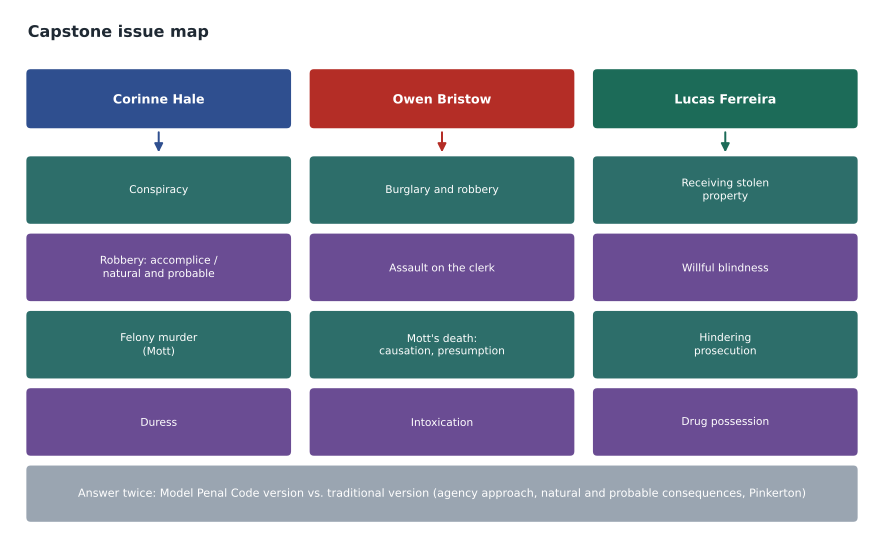
The problem
The State of Westmarch has two versions of its penal code for this problem: a Model Penal Code version (as used all semester) and, for comparison, a traditional version that follows the common law, the felony murder rule with the agency approach, and the natural and probable consequences doctrine. Section B must analyze the problem under both.
Corinne Hale, 23, works as a pharmacy technician at Lakeview Pharmacy in Brennan Falls. Her boyfriend, Owen Bristow, 26, owes 6,000 dollars to a drug dealer known as Rook, who has told Bristow that he will "break both his hands" if the money is not paid by Friday. Bristow asks Hale to help him take prescription painkillers from the pharmacy, which he plans to give Rook in place of the money. Hale at first refuses. On Wednesday, Bristow shows her a photo Rook sent him of her car parked outside her apartment, with the message "nice car, tell your girl hi." Hale agrees to help. She tells Bristow that the pharmacy's back door alarm is turned off between 8:55 and 9:05 p.m. while the night clerk takes out the trash, and that the controlled substances are kept in a locked cabinet whose key hangs on a hook in the office.
On Thursday night, Bristow drinks four beers to steady his nerves, puts on a ski mask, and enters through the back door at 9:00 p.m. carrying a pellet pistol that looks like a real handgun. The night clerk, Amir Saleh, 58, comes back inside, sees Bristow and freezes. Bristow points the pellet pistol at him and says "keys, now." Saleh points to the office. Bristow takes the key, opens the cabinet and fills a duffel bag with bottles of oxycodone. As he leaves, Saleh presses a silent alarm.
Officer Dana Whitlock, responding, arrives as Bristow runs into the alley. She orders him to stop. Bristow turns, raising the pellet pistol toward her. Whitlock fires but misses; the shot passes through a fence and strikes Gabriel Mott, 34, who was walking his dog on the next street, killing him. Bristow escapes. Later that night, Bristow takes the duffel bag to Lucas Ferreira, a friend who owns a used electronics shop, and asks him to keep it in his storage room for a few days. Ferreira asks no questions, though he sees the pharmacy labels on several bottles through the bag's open zipper, and he has heard on the radio that Lakeview Pharmacy was robbed that night. Bristow is arrested two days later.
Issue 1: Hale's liability for the robbery
Hale did not enter the pharmacy. Her liability for the robbery depends on conspiracy and accomplice liability. Conspiracy: she agreed with Bristow to take the painkillers, and his entry into the pharmacy was an overt act. Under either version of the code, she is guilty of conspiracy to commit theft or burglary; whether she agreed to robbery depends on whether the plan included force or threats. She told Bristow when the alarm was off and where the key was, which suggests a plan to take the drugs while the clerk was outside, not a confrontation. The prosecution will argue that a confrontation with the clerk was foreseeable.
Accomplice liability: she aided by giving information about the alarm and the key, which facilitated the crime (Tally), and she acted with purpose to promote the taking of the drugs. Under the MPC, she is an accomplice to the offenses she purposely promoted, theft and burglary, but to the robbery only if she had the purpose to promote the use of force or threat, which the facts do not clearly show. Under the traditional version's natural and probable consequences doctrine, she would be liable for the robbery if an armed confrontation with the clerk was a reasonably foreseeable consequence of the plan, a close question given that she knew the clerk would return within ten minutes and the plan carried a risk of encountering him. Under Pinkerton, followed in the traditional version, she would be liable for robbery as a conspirator on the same foreseeability analysis.
Issue 2: Hale's duress defense
Hale will argue duress. Rook's message, a photo of her car and "tell your girl hi," is a veiled threat, and Rook had threatened serious bodily injury to Bristow. Under the common law, duress requires a threat of imminent death or serious bodily injury, a well-grounded belief, and no reasonable opportunity to escape. The threat to her was implicit and not imminent; she had a day to go to the police. Under the MPC's section 2.09, the question is whether a person of reasonable firmness in her situation would have been unable to resist the threat. A jury might find that an implicit threat from a drug dealer who knew where she lived was coercive, but the opportunity to seek police protection and the time between threat and crime weigh heavily against the defense. Duress is also unavailable under the MPC if she recklessly placed herself in a situation in which coercion was probable; she did not, since the debt was Bristow's. Prediction: the duress defense is likely to fail under the common law and is a jury question, unlikely to succeed, under the MPC.
Issue 3: Bristow's robbery and assault
Bristow entered a building with purpose to commit theft, which is burglary under either version. He took the drugs by pointing what appeared to be a gun at Saleh and demanding the keys, which is robbery: under the MPC's section 222.1, in the course of committing a theft he threatened Saleh with, or purposely put him in fear of, immediate serious bodily injury. That the pistol was a pellet gun does not matter for robbery by threat, because the threat and the fear are what count; it may matter for an aggravated robbery charge requiring a deadly weapon, depending on how the statute defines one, since many statutes include items that appear to be deadly weapons. Pointing the pistol at Saleh is also an assault by attempted battery or by placing him in fear, depending on the statute.
Bristow's intoxication offers little. Four beers are unlikely to negate the purpose to steal, and his conduct (planning with Hale, wearing a mask, using the key) shows purpose. Under the MPC, voluntary intoxication can negate purpose or knowledge but not recklessness; under many traditional codes it can negate specific intent. On these facts, it would not succeed. Bristow has no duress defense of his own on these facts, because Rook's threat (to break his hands, by Friday) left him time to seek help, and a person of reasonable firmness would not commit armed robbery in response; some courts also deny the defense to someone who voluntarily involved himself with a violent criminal, as the MPC does for those who recklessly place themselves in a situation where coercion is probable.
Issue 4: The death of Gabriel Mott
This is the central issue. Officer Whitlock, not Bristow, fired the fatal shot. Under the traditional version's agency approach (Canola), felony murder applies only to killings by a felon or someone acting in furtherance of the felony, so Bristow is not guilty of felony murder for Mott's death. Under a proximate cause approach, followed in some states, Bristow could be liable because his felony and his act of raising the pistol at the officer set in motion the shooting that killed Mott, a foreseeable consequence of armed flight from police.
Under the MPC version, there is no felony murder rule; the question is whether Bristow committed murder (purposely, knowingly or with extreme indifference) or manslaughter (recklessly) by causing Mott's death. Causation: Bristow's act of raising the pistol at the officer is a but-for cause of her firing, and her response is a dependent intervening cause, a normal response to an apparent armed threat, not a free and deliberate act to exploit the situation. Under section 2.03, the result (a bystander killed by police gunfire during an armed confrontation) is within the risk of the kind of harm that pointing an apparent gun at a police officer in a residential area creates, and not too remote or accidental to bear on liability. The presumption of extreme indifference applies because the death occurred during flight after a robbery and burglary. Bristow can attempt to rebut it by arguing that he carried only a pellet gun and did not intend to shoot anyone, but raising an apparent gun toward an armed officer near homes shows a conscious disregard of a grave risk that someone would be killed. Prediction: under the MPC version, a murder conviction is likely sustainable and manslaughter is very likely.
Officer Whitlock herself is not criminally liable if her use of deadly force was justified: she reasonably believed Bristow was raising a gun at her, which threatened death or serious bodily injury, and under Garner and the state's justification statute an officer may use deadly force in that situation. A reasonable mistake about the pistol's nature does not defeat justification. Whether her shot was reckless toward bystanders is a separate question; most justification statutes, including the MPC's section 3.09(3), provide that justification is unavailable for injury to innocent persons if the actor was reckless or negligent toward them, but on these facts, firing at an apparently armed suspect in an alley at night, a prosecutor would be unlikely to charge.
Issue 5: Hale's liability for Mott's death
Under the traditional version with the agency approach, no felony murder applies to anyone for Mott's death. Under the MPC version, Hale is an accomplice to homicide only if she acted with the culpability required for the homicide offense. The presumption of extreme indifference applies to accomplices in a robbery or burglary, but Hale can rebut it powerfully: she planned a quiet theft while the clerk was outside, did not know Bristow would bring anything resembling a gun, and was not present. Without awareness of a substantial risk of death, she is not guilty even of manslaughter. Mendenhall notes that this is the result the Model Penal Code's drafters designed and that reform statutes in California, Colorado, Illinois and Minnesota pursue in different ways.
Issue 6: Ferreira
Ferreira agreed to store the duffel bag after the robbery. He is not an accomplice to the robbery or burglary, because his aid came after the crimes were complete. He may be guilty as an accessory after the fact under a hindering prosecution statute, if he acted with purpose to hinder Bristow's apprehension or prosecution. More directly, he may be guilty of receiving stolen property: he retained property that had been stolen, and the question is whether he knew or believed it was probably stolen. He saw pharmacy labels on the bottles and had heard that Lakeview Pharmacy was robbed that night; under willful blindness (Jewell; MPC section 2.02(7)), awareness of a high probability is knowledge unless he actually believed otherwise. Ferreira's failure to ask questions looks like deliberate avoidance. Possession of the oxycodone may also expose him to drug possession charges, depending on whether he knowingly exercised control over it for long enough to have been able to end his possession (MPC section 2.01(4)).
| Defendant and issue | MPC version | Traditional version |
|---|---|---|
| Hale: theft and burglary | Guilty as accomplice and conspirator | Guilty |
| Hale: robbery | Not guilty unless she purposely promoted force | Likely guilty under natural and probable consequences and Pinkerton |
| Hale: duress | Jury question, unlikely to succeed | Likely fails (no imminence, chance to go to police) |
| Bristow: robbery and burglary | Guilty | Guilty |
| Bristow: Mott's death | Murder likely sustainable under the presumption; manslaughter very likely | No felony murder under the agency approach; other homicide theories possible |
| Hale: Mott's death | Not guilty if presumption rebutted | No felony murder under the agency approach |
| Ferreira | Receiving stolen property likely; hindering prosecution possible | Same |
Writing the answer
Mendenhall shows Section B what strong answers do. They use headings for each defendant and issue. They state each rule precisely, with its source, and then apply it to specific facts, quoting the fact pattern where it helps. They argue both sides of every debatable element, because exams are written to have debatable elements. They distinguish the jurisdictions where the problem asks for both. And they reach calibrated conclusions, using words such as likely, probably and a jury could find, rather than declaring outcomes certain. Weak answers recite rules without applying them, skip the defenses, merge defendants together and spend pages on elements that are not in doubt.
Jordan asks how to manage time on a three-hour exam with this many issues. Mendenhall suggests spending the first fifteen or twenty minutes outlining: a grid of defendants and events, with crimes and defenses in each cell. Then allocate time by the number and difficulty of issues, and leave ten minutes at the end to check that every defendant has been addressed. "The grid," she says, "is your issue-spotting insurance."
Worked problem
Writing one issue in exam form
Write a short exam answer to the question whether Bristow is guilty of murder for the death of Gabriel Mott under the MPC version of the Westmarch code.
Show solution
- Issue: whether Bristow committed murder by causing Mott's death when the fatal shot was fired by a police officer during his flight from a robbery.
- Rule: under MPC section 210.2, homicide is murder if committed purposely, knowingly or recklessly under circumstances manifesting extreme indifference to human life, and such recklessness and indifference are presumed if the actor is engaged in flight after committing robbery or burglary; causation requires but-for cause and that the result be within the risk created and not too remote or accidental (section 2.03).
- Application, causation: Bristow's act of raising the pellet pistol toward Officer Whitlock is a but-for cause of her shot; her response was a normal, dependent reaction to an apparent armed threat, not a superseding act, and a bystander killed by gunfire is within the risk of pointing an apparent gun at an armed officer near homes.
- Application, mental state: the presumption applies because the death occurred during flight after a robbery; Bristow will argue the gun was a pellet pistol and he meant only to scare her, but raising it at an armed officer shows conscious disregard of an extreme risk to life.
- Conclusion: a jury could likely find murder; at minimum, the facts strongly support reckless manslaughter.
Answer: Bristow is likely guilty of murder under the MPC version. His raising of an apparent gun at Officer Whitlock was a factual and legal cause of Mott's death, the officer's shot being a foreseeable dependent response, and the statutory presumption of extreme indifference, arising from flight after robbery, is difficult to rebut on these facts. Even if the jury found the presumption rebutted, he would very likely be guilty of manslaughter.
Closing
Mendenhall ends the course by returning to the two numbers she wrote on the board on the first day. "Most of you will never try a criminal case," she says. "But all of you will be citizens and voters in a country that incarcerates more people than almost any other, and many of you will advise clients, sit on boards, run for office or become judges. Every doctrine we studied this semester, from the voluntary act to felony murder to the insanity defense, is a choice about whom to blame and how much. Learn the doctrines well enough to apply them, and then keep asking whether they are the right choices."
Summary and key terms
- Analyze each defendant separately: list actors and events, identify crimes from most serious down, and go element by element (conduct, circumstances, result and causation, mental state).
- Extend liability where appropriate through accomplice liability, conspiracy and Pinkerton, and felony murder, applying the jurisdiction's rules (agency versus proximate cause; natural and probable consequences versus MPC purpose).
- Consider defenses carefully: justifications such as self-defense and police use of force, excuses such as duress, and failure-of-proof arguments such as mistake and intoxication.
- Killings by police or victims during a felony are the classic test of felony murder's limits (Canola) and of causation and the MPC presumption.
- Spend time on debatable elements, argue both sides with specific facts, and give calibrated conclusions; outline with a defendant-by-event grid before writing.
Practice problems
Work each problem on paper first, then reveal the answer to check.
Why is Bristow not guilty of felony murder for Mott's death under the traditional version?
Show answer
The traditional version follows the agency approach, which limits felony murder to killings by a felon or someone acting in furtherance of the felony; Officer Whitlock fired the fatal shot.
Why is Hale's duress defense weak?
Show answer
The threat to her was implicit and not imminent, and she had a day to seek police protection; under the common law there was a reasonable opportunity to escape, and under the MPC a person of reasonable firmness would likely have resisted.
On what basis could Ferreira be guilty of receiving stolen property?
Show answer
He retained stolen property while aware of a high probability that it was stolen, having seen pharmacy labels and heard about the robbery, which is knowledge under the willful blindness doctrine.
How does the choice between the MPC and the natural and probable consequences doctrine affect Hale's liability for robbery?
Show answer
Under the MPC she is an accomplice only to crimes she purposely promoted, likely theft and burglary but not robbery; under natural and probable consequences she may be liable for robbery if an armed confrontation was foreseeable.
Lesson quiz · 5 questions
Score 60% or more to complete this lesson.
Create a free account to save your progress, take quizzes and earn a certificate.