
LAWU-112 · Lesson 2 of 12 · 23 min
Actus reus
▶ Video coming soon A video version of this lesson is on the way.
Mendenhall opens the second class by asking Section B to imagine a man who, while asleep, gets up, walks to his kitchen and stabs a houseguest. "Has he committed a crime?" Most students say no. Then she changes the facts: the man knows he sleepwalks violently, has been warned by his doctor, and keeps a knife on his nightstand anyway. The answers split. "That split," she says, "is the subject of today. Criminal liability requires conduct, and the conduct has to be the right kind: a voluntary act, or a failure to act when the law imposes a duty to act."
Why criminal law requires an act
Every crime has two basic components: the actus reus, or guilty act, and the mens rea, or guilty mind. The actus reus includes the defendant's conduct, any required circumstances, and, for result crimes, a prohibited result. Murder, for example, requires conduct (an act), a circumstance (the victim is a human being) and a result (death). This lesson concentrates on the conduct element: the requirement of a voluntary act or a legally recognized omission.
The act requirement serves several purposes. It keeps the state from punishing thoughts alone, which would be impossible to prove and dangerous to allow; a person who fantasizes about harming a rival but does nothing has committed no crime. It provides evidence that the defendant's intentions were real and firm. And it limits criminal law to conduct that people can control, so that punishment is deserved and can deter. As the Model Penal Code commentary puts it, the law cannot hope to deter involuntary movement.
The act requirement also has a constitutional dimension. In Robinson v. California, 370 U.S. 660 (1962), the Supreme Court held that a law making it a crime to "be addicted to the use of narcotics" inflicted cruel and unusual punishment, because it punished a status rather than any act. In Powell v. Texas, 392 U.S. 514 (1968), however, a plurality upheld the conviction of a man with alcoholism for being drunk in public, because the law punished the act of appearing in public while intoxicated, not the condition itself. More recently, City of Grants Pass v. Johnson, 603 U.S. 520 (2024), held that enforcing public camping bans against people experiencing homelessness does not violate the Eighth Amendment, reading Robinson narrowly as a limit on punishing status alone, not conduct that a person's status may make hard to avoid.
The voluntary act
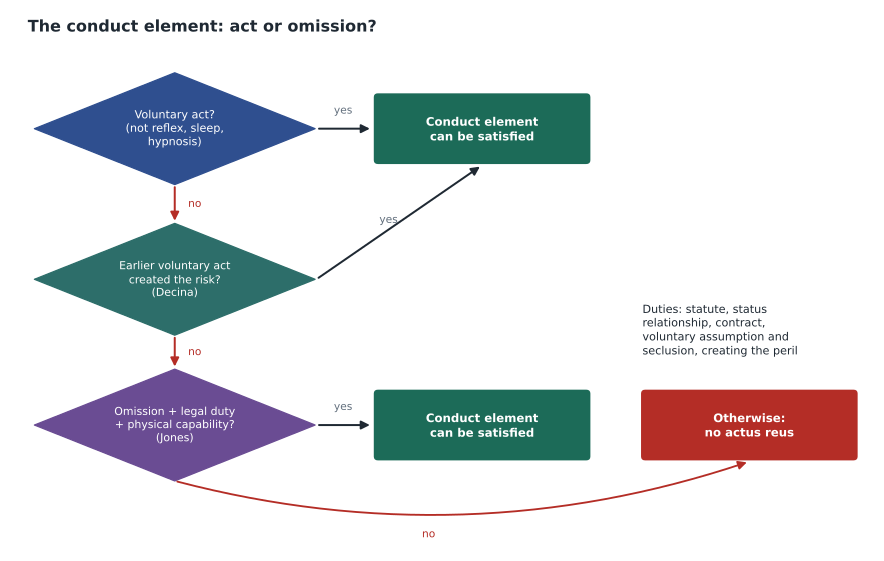
Model Penal Code section 2.01(1) provides that a person is not guilty of an offense unless his liability is based on conduct that includes a voluntary act or the omission to perform an act of which he is physically capable. Section 2.01(2) lists movements that are not voluntary acts: a reflex or convulsion; a bodily movement during unconsciousness or sleep; conduct during hypnosis or resulting from hypnotic suggestion; and, as a catch-all, a bodily movement that otherwise is not a product of the effort or determination of the actor, either conscious or habitual.
The classic case for the reflex category is a seizure. In People v. Decina, 2 N.Y.2d 133 (1956), the defendant, who knew he was subject to epileptic seizures, suffered one while driving and struck and killed four children. He argued that he had not acted voluntarily. The New York Court of Appeals upheld the indictment for criminal negligence because his voluntary act was choosing to drive, knowing that a seizure could happen at any moment. The relevant act need not be the final movement that caused the harm; it can be an earlier voluntary act, such as getting behind the wheel, that created the risk.
Martin v. State, 31 Ala. App. 334 (1944), illustrates a different problem. Police arrested Martin at his home and carried him onto a public highway, where he used loud and profane language. He was convicted of being drunk on a public highway and manifesting a drunken condition. The appellate court reversed: the statute presupposed a voluntary appearance in public, and Martin had been involuntarily and forcibly carried there by the arresting officers. The voluntary act requirement applies to each act the offense requires, and the state cannot supply it by creating the circumstance itself.
Sleepwalking and unconsciousness raise the most dramatic cases. Courts and commentators generally agree that a person who acts while truly unconscious, as in some cases of sleepwalking or a concussion, does not act voluntarily. This is often called the defense of automatism, though strictly it is a denial of the actus reus rather than an affirmative defense. Some jurisdictions treat unconsciousness caused by a mental disease as a matter for the insanity defense instead, because a successful insanity plea can lead to civil commitment, whereas a complete acquittal for involuntariness cannot.
Hannah asks about habits. The Code's catch-all treats habitual conduct as voluntary: a driver who absentmindedly drifts through a stop sign while thinking about something else has acted voluntarily, because driving is a product of habitual effort even when not consciously directed. Involuntariness is reserved for movements that are not the product of the person's will at all.
Possession as an act
Many of the most commonly charged crimes, such as possession of drugs, firearms or stolen property, punish possession. Possession is not a bodily movement, so the Code treats it specially. Section 2.01(4) provides that possession is an act if the possessor knowingly procured or received the thing possessed or was aware of his control of it for a sufficient period to have been able to terminate his possession. A person who discovers a package of drugs in her car and throws it away immediately has not possessed it; one who discovers it and keeps driving with it for a week has.
Possession can be actual (on the person) or constructive (within the person's dominion and control, such as in a car he drives or a dresser in his bedroom), and it can be joint. Constructive and joint possession cases are fact-intensive: courts look for evidence connecting the defendant to the item beyond mere proximity, such as fingerprints, statements, personal papers near the drugs or control of the premises.
Omissions
The general rule in American law is that there is no criminal liability for failing to act, even to prevent serious harm, unless the law imposes a duty to act. A stranger who watches a child drown in a shallow pool and does nothing has committed no crime in most states, however morally monstrous the failure. Daniel says he remembers the same rule from tort law, and Mendenhall says the criminal law is if anything stricter, because criminal duties must be clear enough to satisfy the principle of legality.
The leading statement of the duty categories comes from Jones v. United States, 308 F.2d 307 (D.C. Cir. 1962). Jones took in the infant son of an acquaintance, and the child died of malnutrition while in her home. Her conviction for involuntary manslaughter was reversed because the trial judge failed to instruct the jury that it had to find a legal duty of care. The court identified four situations in which a failure to act may be a breach of legal duty: where a statute imposes a duty to care for another; where one stands in a certain status relationship to another (such as parent and child or spouses); where one has assumed a contractual duty to care for another; and where one has voluntarily assumed the care of another and so secluded the helpless person as to prevent others from rendering aid.
Courts have added a fifth category: a person who creates the peril, even innocently, may have a duty to help. A driver who accidentally hits a pedestrian has a duty, reinforced in every state by hit-and-run statutes, to stop and render aid. Some cases also impose duties on landowners toward invitees or on employers toward employees, but these are narrower.
Pope v. State, 284 Md. 309 (1979), shows how strictly courts police the categories. Joyce Pope took in a mother and her infant son. The mother, in the grip of a religious delusion, beat the child to death in Pope's home over a period of hours while Pope did nothing and failed to seek help. The Maryland Court of Appeals reversed Pope's conviction for child abuse: she was not a parent, had not assumed responsibility for supervising the child within the meaning of the statute, and the mother was present throughout. The court acknowledged that Pope's failure was morally indefensible but held that a moral duty was not enough.
People v. Beardsley, 150 Mich. 206 (1907), is an older and widely criticized example. Beardsley spent a weekend drinking with a woman who was not his wife; she took a fatal dose of morphine tablets, and he left her in a room in the care of someone else, where she died. The Michigan Supreme Court reversed his manslaughter conviction because he owed her no legal duty: they were not married, and the relationship was not one the law recognized. Modern commentators often question whether a court today would reach the same result, particularly under the voluntary-assumption category.
| Source of duty | Example | Leading authority |
|---|---|---|
| Statute | Duty to file a tax return; hit-and-run duty to stop and aid | Jones v. United States |
| Status relationship | Parent and minor child; spouses | Jones; state child-neglect statutes |
| Contract | Paid caregiver; lifeguard; nursing home | Jones |
| Voluntary assumption and seclusion | Taking in a helpless person so others cannot help | Jones; compare Pope |
| Creating the peril | Driver who causes a crash | State statutes and case law |
Omission or act?
Sometimes it is unclear whether conduct is an act or an omission, and the label matters. The classic example is a doctor who turns off a life-support machine. In Barber v. Superior Court, 147 Cal. App. 3d 1006 (1983), two physicians were charged with murder after removing life support and then intravenous nutrition from a patient in a persistent vegetative state at the family's request. The California Court of Appeal treated the withdrawal of treatment as an omission, not an affirmative act of killing, and held that the doctors had no duty to continue treatment that had become futile once the family, as surrogates, requested its withdrawal. The case is now part of a broader body of law, including Cruzan v. Director, Missouri Department of Health, 497 U.S. 261 (1990), recognizing that competent patients may refuse life-sustaining treatment.
Physical capability is a further limit. The Code requires that the person be physically capable of performing the omitted act. A parent who cannot swim is not criminally liable for failing to dive in after a drowning child, though she may be liable for failing to call for help, throw a flotation device or take other steps within her ability.
Good Samaritan laws
A handful of states impose a general duty to assist. Vermont's statute, Vt. Stat. Ann. tit. 12, § 519, requires a person who knows that another is exposed to grave physical harm to give reasonable assistance if it can be rendered without danger or peril to the rescuer, unless others are already providing assistance, and makes a willful violation punishable by a small fine. Minnesota and Rhode Island have similar laws. Other states require people to report certain crimes, such as child abuse, or to report violent crimes they witness. These statutes are rarely prosecuted, and critics argue that general duties to rescue are hard to define and enforce, while supporters say they express a basic social obligation.
Most states also have Good Samaritan statutes of a different kind, which protect rescuers from civil liability, and many have overdose Good Samaritan laws that give people who call for help during a drug overdose immunity from prosecution for simple possession. These encourage action without creating a duty.
The running problem: actus reus at Riverside Salvage
Mendenhall returns to the Westmarch problem. Kellan Shaw and Devon Pike planned the copper theft in a group chat, and Tara Quinn, Pike's cousin, agreed to drive. On the night in question, Shaw cut the padlock on the warehouse door with bolt cutters; Pike went inside and began cutting wire; Quinn waited in the car. When the watchman, Lou Abbott, came around the corner with a flashlight, Pike shoved him, and Abbott fell to the concrete. Shaw saw Abbott lying on the ground clutching his chest, said "he'll be fine," and ran to the car. No one called 911. A passing truck driver found Abbott about forty minutes later.
Each person's conduct must be analyzed separately. Pike's shove is a voluntary act. Shaw's cutting of the lock is a voluntary act that may support liability for burglary and theft, and possibly for Abbott's death under doctrines studied later, but his failure to call for help raises an omission question. Did Shaw have a duty? He did not create the peril himself (Pike shoved Abbott), but as Pike's co-venturer in the burglary, he may be treated as having helped create it, and some courts recognize a duty for those who participate in creating a dangerous situation. Quinn's waiting in the car is an act of driving and waiting, relevant to accomplice liability; her failure to call for help raises the same duty question as Shaw's, with an even weaker argument that she created the peril.
Worked problem
The caretaker and the elderly neighbor
Renee, a Westmarch resident, agrees with her elderly neighbor's adult son, who lives out of state, to look in on the neighbor twice a day and bring him meals in exchange for 300 dollars a week. After two months, Renee stops visiting without telling anyone because she is busy with a new job. She keeps accepting the payments. The neighbor, who cannot walk without help, is found ten days later severely dehydrated and dies in the hospital. Westmarch's manslaughter statute requires recklessly causing death; its code follows MPC section 2.01. Did Renee commit an actus reus?
Show solution
- Identify the relevant conduct: Renee did not do anything that directly injured the neighbor; her liability, if any, rests on a failure to act.
- Omission liability requires a legal duty. Under MPC section 2.01(3), an omission suffices if a duty to perform the omitted act is otherwise imposed by law, which includes duties arising from contract.
- Renee had a contractual duty: she agreed, for pay, to provide care, and kept accepting payment. This fits the contract category from Jones.
- Voluntary assumption also applies: by undertaking his care she may have caused others (the son) to rely on her and not arrange other help, which echoes the seclusion idea.
- Physical capability: nothing suggests she was unable to visit or call for help.
- Conclusion on the act element; mental state (whether she consciously disregarded a substantial risk) and causation are separate questions.
Answer: Yes. Renee's failure to provide the care she had contracted and been paid to provide is an omission in breach of a legal duty, which satisfies the conduct element. Whether she is guilty of manslaughter depends on mental state and causation, discussed in the next lessons.
Summary and key terms
- Every crime requires an actus reus: conduct, plus any required circumstances and results.
- The act requirement prevents punishing thoughts or status (Robinson), though punishing conduct linked to a condition is allowed (Powell; Grants Pass, 2024).
- MPC section 2.01 requires a voluntary act; reflexes, convulsions, movements during unconsciousness or sleep, and hypnotic conduct are not voluntary, but habitual conduct is.
- Liability can rest on an earlier voluntary act that created the risk (Decina), but the state cannot supply a required act by forcing the defendant into it (Martin).
- Possession is an act if the person knowingly obtained the item or was aware of control long enough to end it.
- Omissions are criminal only if the law imposes a duty: statute, status relationship, contract, voluntary assumption and seclusion, or creating the peril (Jones; Pope; Beardsley).
- Withdrawing futile life support has been treated as an omission (Barber); a few states, such as Vermont, impose limited general duties to rescue.
Practice problems
Work each problem on paper first, then reveal the answer to check.
Why did the court uphold the indictment in People v. Decina even though Decina was unconscious when the crash occurred?
Show answer
Because his voluntary act was choosing to drive while knowing he was subject to seizures, and that earlier act created the risk that caused the deaths.
How does Martin v. State show the limits of the voluntary act requirement?
Show answer
Martin was carried onto the highway by police, so his presence in public was not voluntary, and the state could not convict him of being drunk in public based on a circumstance it created.
What are the four duty categories identified in Jones v. United States?
Show answer
A statutory duty, a status relationship, a contractual duty, and the voluntary assumption of care that secludes a helpless person from others' aid.
Why was Joyce Pope's conviction reversed?
Show answer
She had no legal duty: she was not a parent, had not assumed the responsibility for the child that the statute required, and the child's mother was present; a moral duty was not enough.
Lesson quiz · 5 questions
Score 60% or more to complete this lesson.
Create a free account to save your progress, take quizzes and earn a certificate.