
LAWU-111 · Lesson 9 of 12 · 21 min
Procedural due process
▶ Video coming soon A video version of this lesson is on the way.
Whitford opens the ninth class with a letter she has written for the occasion. It is addressed to a fictional bus driver for the Larkhaven public schools, and it says: "Your employment is terminated effective immediately for falsifying your timecard. You may appeal within thirty days." She asks whether the letter is constitutional. Hannah says the driver should have been told about the charge and given a chance to respond before being fired. Daniel says it depends on whether the driver had a contract. Marcus asks what the appeal involves. "All three of you are asking the right questions," Whitford says, "in the order the Court asks them. First: does the driver have a protected interest? Second: what process is due?"
Two clauses, two kinds of due process
The Fifth Amendment forbids the federal government, and the Fourteenth Amendment forbids the states, to deprive any person "of life, liberty, or property, without due process of law." Procedural due process asks whether the government used fair procedures before depriving someone of a protected interest. Substantive due process, the subject of the next lesson, asks whether the government may take certain actions at all, however fair the procedure. Procedural due process applies only to government action (lesson 8) and protects "persons," including noncitizens and corporations.
The analysis has two steps. First, is there a deprivation of life, liberty or property? Second, if so, what process is due, and was it provided? A third, threshold question is whether the government deprived the person intentionally: Daniels v. Williams, 474 U.S. 327 (1986), held that a negligent act of a government official, such as leaving a pillow on a jail staircase, does not "deprive" anyone of liberty or property in the constitutional sense.
Property interests
Property in due process law includes much more than land and possessions, but it is not every benefit a person would like to keep. Board of Regents of State Colleges v. Roth, 408 U.S. 564 (1972), held that a person has a property interest in a benefit only if he has a "legitimate claim of entitlement" to it, defined by an independent source such as state law, a contract or clear rules, not a mere "unilateral expectation." David Roth, hired by a state university under a one-year contract that said nothing about renewal, had no property interest in being rehired and so no right to a hearing when the university declined to renew. In the companion case, Perry v. Sindermann, 408 U.S. 593 (1972), a junior college teacher with ten years of service could show a property interest through an informal "de facto tenure" system established by the college's guidelines and practice.
Government benefits defined by statute can be property. Goldberg v. Kelly, 397 U.S. 254 (1970), treated welfare benefits for eligible recipients as entitlements. Public employees who can be fired only for cause have a property interest in continued employment. Licenses, public education under state compulsory education laws (Goss v. Lopez, 419 U.S. 565 (1975)), and utility service from a public utility can all qualify. Town of Castle Rock v. Gonzales, 545 U.S. 748 (2005), limited the concept: a woman whose estranged husband murdered their three children after police failed to enforce a restraining order had no property interest in enforcement, because Colorado law, read against the tradition of police discretion, did not make enforcement truly mandatory.
Whitford returns to the bus driver. If Westmarch's civil service law or the union contract allows termination only for cause, the driver has a property interest. If the driver is an at-will employee, there is no property interest in the job, though there may still be a liberty interest if the termination stigmatizes her.
Liberty interests
Liberty includes freedom from bodily restraint and also, as Meyer v. Nebraska, 262 U.S. 390 (1923), put it, the right "to contract, to engage in any of the common occupations of life, to acquire useful knowledge, to marry, establish a home and bring up children" and other privileges long recognized as essential. Physical confinement, civil commitment, corporal punishment in schools (Ingraham v. Wright, 430 U.S. 651 (1977)), and parental rights all involve liberty interests. Prisoners retain some liberty interests, but under Sandin v. Conner, 515 U.S. 472 (1995), changes in prison conditions trigger due process protection only if they impose an "atypical and significant hardship" relative to ordinary prison life.
Reputation alone is not a protected interest. In Paul v. Davis, 424 U.S. 693 (1976), police distributed a flyer to merchants listing "active shoplifters" that included a man whose shoplifting charge had been dismissed; the Court held that injury to reputation, without a change in some other legal status, does not implicate due process. This is the "stigma-plus" test: government defamation plus the loss of a job, license or other legal right triggers a right to a hearing to clear one's name.
In Department of State v. Muñoz, 602 U.S. 899 (2024), an American citizen claimed that the denial of her noncitizen husband's visa deprived her of the fundamental right to live with her spouse in the United States, entitling her to an explanation. Justice Barrett's opinion for the Court held that a citizen has no fundamental liberty interest in her spouse's admission to the country, reflecting the long tradition of political-branch control over immigration. Justice Sotomayor dissented for three Justices.
What process is due: Mathews v. Eldridge
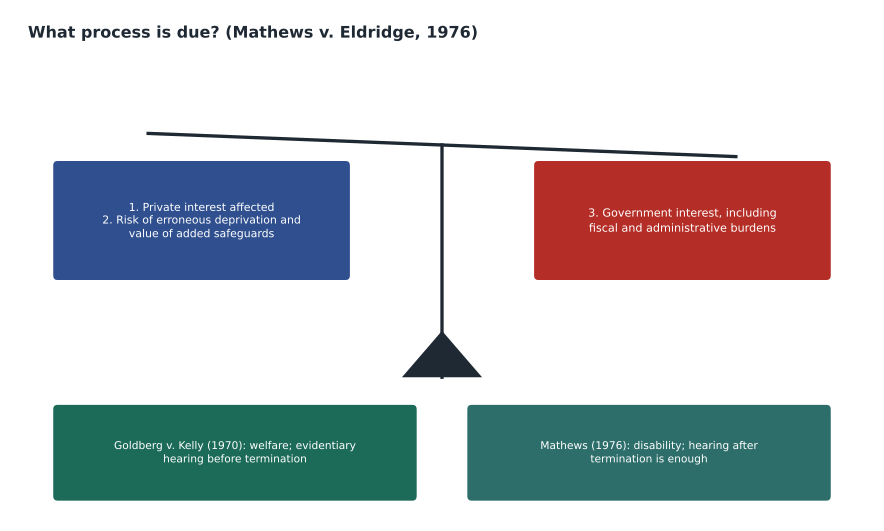
Due process is "flexible and calls for such procedural protections as the particular situation demands" (Morrissey v. Brewer, 408 U.S. 471 (1972)). The core is notice and an opportunity to be heard "at a meaningful time and in a meaningful manner" (Armstrong v. Manzo, 380 U.S. 545 (1965)). The modern test comes from Mathews v. Eldridge, 424 U.S. 319 (1976), which weighs three factors: (1) the private interest affected by the official action; (2) the risk of an erroneous deprivation through the procedures used, and the probable value, if any, of additional or substitute procedural safeguards; and (3) the government's interest, including the function involved and the fiscal and administrative burdens of additional procedures.
Goldberg v. Kelly had held that welfare recipients were entitled to an evidentiary hearing before benefits were terminated, with the right to appear, present evidence and cross-examine witnesses, because recipients depend on benefits for subsistence. In Mathews, George Eldridge's Social Security disability benefits were terminated after a written review, with a full evidentiary hearing available afterward and retroactive payments if he won. The Court held no pre-termination evidentiary hearing was required: disability recipients are not necessarily needy, disability decisions rest largely on written medical reports that make error less likely, and pre-termination hearings for every case would be costly.
Timing and form of the hearing
The general rule is that a hearing must come before the deprivation, but its form can be minimal if a fuller hearing follows. In Cleveland Board of Education v. Loudermill, 470 U.S. 532 (1985), a school security guard was fired for failing to disclose a felony conviction on his job application. The Court held that a public employee with a property interest in his job is entitled before termination to "oral or written notice of the charges against him, an explanation of the employer's evidence, and an opportunity to present his side of the story," followed by a full post-termination hearing. The pre-termination hearing need not be elaborate; it is "an initial check against mistaken decisions." Loudermill also rejected the "bitter with the sweet" theory that a legislature creating a property interest can define the procedures for taking it away: once a property interest exists, the Constitution, not the statute, determines what process is due.
Goss v. Lopez held that students facing suspensions of ten days or less must receive oral or written notice of the charges, an explanation of the evidence if they deny them, and a chance to tell their side, ordinarily before removal unless they pose a continuing danger. Ingraham v. Wright held that no prior hearing was required before paddling a student, because state tort and criminal law provided adequate remedies for excessive punishment.
Post-deprivation remedies suffice when pre-deprivation process is impractical. Parratt v. Taylor, 451 U.S. 527 (1981), and Hudson v. Palmer, 468 U.S. 517 (1984), held that when a state employee's random, unauthorized act causes a deprivation the state could not foresee, an adequate state tort remedy satisfies due process. Emergencies also justify immediate action, such as seizing contaminated food or suspending a dangerous driver's license, with a prompt hearing afterward. In Culley v. Marshall, 601 U.S. 377 (2024), owners whose cars were seized for civil forfeiture after others used them to transport drugs argued they were entitled to a separate preliminary hearing on interim possession. The Court held that due process requires a timely forfeiture hearing but not a separate preliminary hearing.
An impartial decision maker
Due process requires a neutral decision maker. Tumey v. Ohio, 273 U.S. 510 (1927), struck down a system in which a village mayor who judged liquor cases received fees only if he convicted. In Caperton v. A.T. Massey Coal Co., 556 U.S. 868 (2009), the chief executive of a coal company facing a 50 million dollar verdict spent about 3 million dollars supporting the election of a candidate to the West Virginia Supreme Court of Appeals, who then cast the deciding vote to reverse the verdict. The Court held that due process required recusal because there was a "serious risk of actual bias" based on objective and reasonable perceptions. Williams v. Pennsylvania, 579 U.S. 1 (2016), held that a justice who had approved a death penalty request as district attorney could not later sit on the defendant's appeal.
Counsel, vagueness and national security
Due process does not always require appointed counsel outside criminal cases. In Lassiter v. Department of Social Services, 452 U.S. 18 (1981), the Court held that the need for counsel in a parental rights termination proceeding must be decided case by case under Mathews, and in Turner v. Rogers, 564 U.S. 431 (2011), that a parent facing jail for civil contempt for unpaid child support was not automatically entitled to counsel where the opposing party was also unrepresented and alternative safeguards were provided.
The void-for-vagueness doctrine is also grounded in due process: a law is void if it fails to give ordinary people fair notice of what is prohibited or invites arbitrary enforcement. Johnson v. United States, 576 U.S. 591 (2015), struck down the residual clause of the Armed Career Criminal Act, which defined a violent felony as any crime that "otherwise involves conduct that presents a serious potential risk of physical injury to another," and Sessions v. Dimaya, 584 U.S. 148 (2018), applied the same reasoning to a similar clause in immigration law.
Even in wartime and national security cases, due process applies. In Hamdi v. Rumsfeld, 542 U.S. 507 (2004), a plurality applied Mathews to an American citizen detained as an enemy combatant and held he was entitled to notice of the factual basis for his classification and a fair opportunity to rebut it before a neutral decision maker. In 2025, in emergency orders arising from the government's use of the Alien Enemies Act of 1798 to remove alleged members of a foreign gang, the Court held that the detainees were entitled to notice and an opportunity to seek habeas review before removal, and that notice given roughly a day before removal, without information on how to contest it, was inadequate. The underlying questions about the Act's scope continued in the lower courts.
| Interest | Case | Process required |
|---|---|---|
| Welfare benefits | Goldberg v. Kelly (1970) | Evidentiary hearing before termination |
| Disability benefits | Mathews v. Eldridge (1976) | Written review before, full hearing after |
| Public employment (for cause) | Loudermill (1985) | Advance notice, explanation and chance to respond before; full hearing after |
| Short school suspension | Goss v. Lopez (1975) | Informal notice and chance to explain |
| Paddling in school | Ingraham v. Wright (1977) | No prior hearing; tort remedies suffice |
| Citizen detained as enemy combatant | Hamdi (2004) | Fair notice and opportunity to rebut before a neutral decision maker |
Worked problem
The Larkhaven bus driver
Return to the bus driver. Westmarch's civil service law provides that public school employees who have completed a probationary year "may be discharged only for just cause" and are entitled to a hearing before the civil service board within 60 days after discharge. The driver has worked for six years. She was handed the termination letter and escorted from the depot without any chance to respond. Her board hearing is set for day 58. Was she denied due process?
Show solution
- Protected interest: the just-cause provision gives her a legitimate claim of entitlement to continued employment, a property interest under Roth and Loudermill.
- Deprivation: termination is an intentional deprivation by a government employer.
- Process due under Mathews: her interest in her livelihood is weighty; the risk of error without any chance to respond is real (timecard disputes often have explanations); the government's burden of a brief pre-termination meeting is small.
- Loudermill requires notice of the charges, an explanation of the evidence, and an opportunity to respond before termination; the letter gave notice of the charge but no explanation and no chance to respond.
- The statute's post-termination hearing does not cure the absence of pre-termination process, and under Loudermill the legislature cannot define away the constitutional requirement. A suspension with pay pending a prompt hearing would have been a permissible alternative.
Answer: Yes. Because the driver had a property interest in her job, Loudermill required at least an informal pre-termination opportunity to respond to the charges and evidence. The post-termination hearing, standing alone, was not enough; the district could have suspended her with pay while it gave her that opportunity.
Summary and key terms
- Procedural due process asks whether the government provided fair procedures before an intentional deprivation of life, liberty or property (negligence is not enough: Daniels).
- Property interests require a legitimate claim of entitlement from an independent source such as state law or contract (Roth; Sindermann; Castle Rock).
- Liberty includes freedom from restraint and fundamental personal choices; reputation alone is not protected (Paul v. Davis), but stigma plus loss of a legal status is; Muñoz (2024) found no liberty interest in a spouse's visa.
- Mathews v. Eldridge balances the private interest, the risk of error and value of added safeguards, and the government's interest.
- Pre-deprivation hearings are the norm but may be informal (Loudermill; Goss); post-deprivation remedies suffice for random, unauthorized acts or emergencies (Parratt; Hudson; Culley).
- Due process requires an impartial decision maker (Tumey; Caperton), forbids vague laws (Johnson; Dimaya), and applies in national security cases (Hamdi; the 2025 Alien Enemies Act orders).
- Procedural due process
- The constitutional requirement of fair procedures before government deprives a person of life, liberty or property.
- Legitimate claim of entitlement
- A property interest grounded in an independent source such as law or contract.
- Stigma-plus
- The rule that government defamation implicates due process only when combined with the loss of another legal right or status.
- Mathews v. Eldridge test
- The three-factor balancing test for determining what process is due.
- Pre-termination hearing
- An opportunity to respond before a deprivation, which may be informal if fuller process follows.
- Void for vagueness
- The due process doctrine invalidating laws that give no fair notice or invite arbitrary enforcement.
Practice problems
Work each problem on paper first, then reveal the answer to check.
Why did David Roth have no right to a hearing?
Show answer
His one-year contract gave him no legitimate claim of entitlement to renewal, so he had no property interest, and the nonrenewal did not impose a stigma affecting a liberty interest.
How did the Court distinguish Goldberg in Mathews v. Eldridge?
Show answer
Disability recipients are not necessarily destitute, disability decisions rest largely on objective medical evidence, and the cost of pre-termination evidentiary hearings outweighed their limited value.
A state statute says a public employee may be fired only for cause but that no hearing is required. Is that statute decisive?
Show answer
No. Under Loudermill, once the statute creates a property interest, the Constitution determines what process is due, and the legislature cannot define away the right to a hearing.
What is the stigma-plus test?
Show answer
Government defamation triggers due process protection only when accompanied by the loss of some other legal right or status, such as a job or license.
Lesson quiz · 5 questions
Score 60% or more to complete this lesson.
Create a free account to save your progress, take quizzes and earn a certificate.