
LAWU-111 · Lesson 5 of 12 · 23 min
The dormant Commerce Clause and preemption
▶ Video coming soon A video version of this lesson is on the way.
Whitford starts the fifth class with a hypothetical from the fictional state of Westmarch. Its legislature, worried about battery fires, has passed two laws. The first bans the sale in Westmarch of any lithium-ion battery that was not recycled at a Westmarch-licensed facility. The second requires every e-bike sold in Westmarch to carry a battery made with at least a quarter recycled content, wherever the battery is made. Congress has passed no law on either subject. "Does the Commerce Clause say anything about state laws," she asks, "when Congress has said nothing at all?" Daniel reads the clause aloud and points out that it is a grant of power to Congress, not a limit on states. "Exactly," Whitford says. "And yet for two centuries the Court has read a limit into its silence."
The idea of a dormant commerce power
The Commerce Clause gives Congress power to regulate interstate commerce. It does not expressly forbid states to do anything. But one of the central reasons for the Constitution was to end the trade wars among the states under the Articles of Confederation, when states taxed and blocked each other's goods. From that history and the structure of a national common market, the Court has inferred a negative or "dormant" Commerce Clause: even when Congress has not acted, states may not discriminate against interstate commerce or unduly burden it.
Early cases groped for the line. Marshall suggested in Gibbons that the commerce power might be exclusive, but in Willson v. Black Bird Creek Marsh Co., 27 U.S. (2 Pet.) 245 (1829), he upheld a state's dam across a navigable creek. Cooley v. Board of Wardens, 53 U.S. (12 How.) 299 (1852), upheld a Pennsylvania law requiring ships in the port of Philadelphia to hire local pilots, reasoning that subjects needing a single national rule are for Congress alone, while local matters admit diverse state rules. Modern doctrine replaced these categories with a focus on discrimination and burden.
Justices Scalia and Thomas long criticized the doctrine as having no basis in the text, and Justice Thomas would abandon it. Justice Gorsuch's majority opinion in National Pork Producers Council v. Ross, 598 U.S. 356 (2023), described the doctrine's "antidiscrimination principle" as its core and refused to expand it. Defenders answer that the doctrine protects the national market that the Commerce Clause was meant to create, and that Congress remains free to override any ruling by authorizing state regulation.
Discrimination: the virtually per se rule
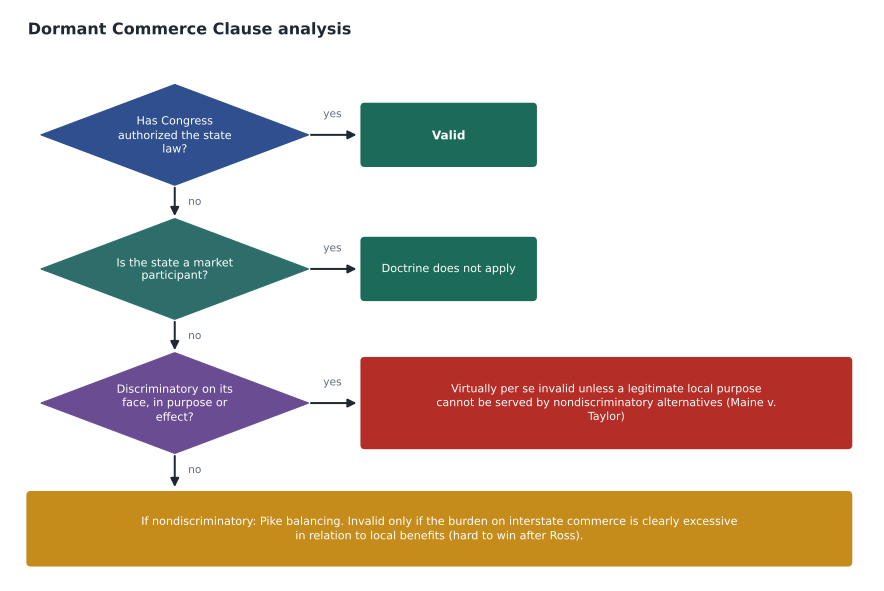
A state law that discriminates against interstate commerce, on its face, in purpose or in effect, is "virtually per se invalid." It survives only if the state shows that it serves a legitimate local purpose that cannot be adequately served by reasonable nondiscriminatory alternatives, a test close to strict scrutiny. In Philadelphia v. New Jersey, 437 U.S. 617 (1978), New Jersey banned the import of most solid waste collected outside the state. The Court struck it down: whatever New Jersey's environmental purpose, it could not achieve it by isolating itself from the national economy and placing the whole burden on out-of-state waste, which was no more harmful than New Jersey's own.
Discrimination can be facial, as in Philadelphia, or arise from a law's effect. In Hunt v. Washington State Apple Advertising Commission, 432 U.S. 333 (1977), North Carolina required apples sold in closed containers to carry only the federal grade or no grade, which barred Washington's own respected grading system. The law stripped Washington growers of a competitive advantage they had earned, while costing North Carolina growers nothing, and the state's consumer-protection justification was weak. In Dean Milk Co. v. City of Madison, 340 U.S. 349 (1951), a city required milk sold there to be pasteurized within five miles of the city; even though it also excluded milk from most of Wisconsin, it discriminated against interstate commerce, and nondiscriminatory health inspections were available.
A state can sometimes justify discrimination. In Maine v. Taylor, 477 U.S. 131 (1986), the Court upheld Maine's ban on importing live baitfish because the state showed that out-of-state baitfish carried parasites and nonnative species that could harm its fisheries, and no satisfactory way to inspect them existed. Whitford stresses that this is rare: the state bears the burden and must show that it had no reasonable alternative.
Nondiscriminatory laws: Pike balancing
Laws that regulate evenhandedly, treating in-state and out-of-state interests alike, are judged under Pike v. Bruce Church, Inc., 397 U.S. 137 (1970): they will be upheld "unless the burden imposed on such commerce is clearly excessive in relation to the putative local benefits." In Pike itself, Arizona required cantaloupes grown in Arizona to be packed there before shipment, so they would carry Arizona labels; applying the rule to a grower whose melons were packed nearby in California would have required building a packing shed costing about 200,000 dollars, a burden clearly excessive for the slight state interest in labeling. Kassel v. Consolidated Freightways Corp., 450 U.S. 662 (1981), struck down Iowa's ban on 65-foot double trailers, permitted in neighboring states, because the safety benefit was illusory while the burden on interstate trucking was substantial.
Most laws survive Pike balancing. In Exxon Corp. v. Governor of Maryland, 437 U.S. 117 (1978), Maryland barred oil producers and refiners from operating retail gas stations. All the affected producers were out of state, but the Court held the law did not discriminate, because it treated interstate retailers that were not producers the same as in-state retailers, and the Commerce Clause "protects the interstate market, not particular interstate firms." Shifting business from one set of interstate firms to another is not a burden on interstate commerce as such.
National Pork Producers Council v. Ross
In 2018 California voters approved Proposition 12, which bans the sale in California of whole pork meat from pigs confined in spaces that do not meet minimum size requirements, wherever the pigs were raised. Nearly all pork eaten in California comes from other states. Pork producers argued that the law had an impermissible extraterritorial effect because it controlled how farmers in other states raised pigs, and that its burden on the national pork market was clearly excessive compared with its benefits.
The Court rejected both arguments. Justice Gorsuch's opinion held that there is no freestanding rule against state laws with extraterritorial effects: earlier cases that seemed to say so, such as Baldwin v. G.A.F. Seelig and Healy v. Beer Institute, were really about discrimination or price control. Almost every state law affects out-of-state commerce in some way. On Pike, the Justices fractured. A majority affirmed the dismissal of the complaint, but for different reasons: some Justices said courts cannot weigh incommensurable moral and economic interests; others said the complaint had not plausibly alleged a substantial burden on interstate commerce. A different majority, the four Justices who joined Chief Justice Roberts's partial dissent plus Justice Barrett, concluded that the complaint did allege a substantial burden, and at least six Justices made clear that Pike balancing survives. The result is that Pike remains available but is hard to win, and the claim that a law is invalid simply because it regulates out-of-state production failed.
Whitford returns to Westmarch's second law, the recycled-content requirement. Like Proposition 12, it applies equally to batteries made in Westmarch and elsewhere, so it does not discriminate. A challenger would have to show a substantial burden on interstate commerce clearly excessive compared with the local benefits, and after Ross, a court would likely uphold it. The first law, requiring recycling at a Westmarch-licensed facility, is different: it is facial discrimination in favor of local businesses, like the local processing requirements in Dean Milk and Pike.
The market participant exception
When a state acts as a buyer or seller in a market, rather than as a regulator, it may favor its own residents. In Reeves, Inc. v. Stake, 447 U.S. 429 (1980), South Dakota could sell cement from its state-owned plant only to in-state customers during a shortage. In White v. Massachusetts Council of Construction Employers, Inc., 460 U.S. 204 (1983), Boston could require contractors on city-funded projects to hire city residents for half their workforce. The exception has limits: in South-Central Timber Development, Inc. v. Wunnicke, 467 U.S. 82 (1984), a plurality held Alaska could not require buyers of state timber to process it in Alaska, because the state was using its role as seller to regulate a downstream market.
Related cases treat government functions favorably. In United Haulers Association v. Oneida-Herkimer Solid Waste Management Authority, 550 U.S. 330 (2007), the Court upheld county ordinances requiring all local trash to go to a public processing facility, distinguishing an earlier case that struck down a similar requirement benefiting a private facility. Laws favoring a public entity performing a traditional government function are treated as nondiscriminatory.
Taxes, alcohol and congressional consent
State taxes on interstate commerce face a four-part test from Complete Auto Transit, Inc. v. Brady, 430 U.S. 274 (1977): the tax must apply to an activity with a substantial nexus to the state, be fairly apportioned, not discriminate against interstate commerce, and be fairly related to services the state provides. South Dakota v. Wayfair, Inc., 585 U.S. 162 (2018), overruled the rule that a state could require a seller to collect sales tax only if the seller had a physical presence in the state; economic and virtual contacts can establish substantial nexus, which is why online purchases are now taxed almost everywhere. Comptroller of the Treasury v. Wynne, 575 U.S. 542 (2015), struck down Maryland's income tax scheme because it failed to give residents full credit for income taxes paid to other states, which taxed interstate income more heavily than intrastate income.
The Twenty-first Amendment gives states power over the importation of alcohol, but it does not permit protectionism. Tennessee Wine and Spirits Retailers Association v. Thomas, 588 U.S. 504 (2019), struck down a two-year residency requirement for liquor store licenses as discrimination unsupported by any public health or safety purpose. Finally, because the dormant Commerce Clause protects Congress's power, Congress may authorize states to regulate commerce in ways that would otherwise be forbidden, as it did for state insurance regulation in the McCarran-Ferguson Act (Prudential Insurance Co. v. Benjamin, 328 U.S. 408 (1946)).
The Privileges and Immunities Clause of Article IV
A second limit on state discrimination appears in Article IV, section 2: "The Citizens of each State shall be entitled to all Privileges and Immunities of Citizens in the several States." It protects individuals (not corporations, which are not citizens for this purpose) from discrimination based on state citizenship or residence regarding fundamental rights, especially the right to pursue a livelihood. In Supreme Court of New Hampshire v. Piper, 470 U.S. 274 (1985), the Court struck down a rule limiting bar admission to state residents. Toomer v. Witsell, 334 U.S. 385 (1948), invalidated a South Carolina license fee for out-of-state shrimpers a hundred times the fee for residents.
Discrimination is permitted if the state has a substantial reason and the discrimination bears a substantial relationship to it. Not every interest is fundamental: Baldwin v. Montana Fish and Game Commission, 436 U.S. 371 (1978), allowed higher elk hunting license fees for nonresidents because recreational hunting is not fundamental to the nation's unity, and McBurney v. Young, 569 U.S. 221 (2013), allowed Virginia to limit its public records law to citizens. The Fourteenth Amendment has its own Privileges or Immunities Clause, largely emptied by the Slaughter-House Cases of 1873 but revived in Saenz v. Roe, 526 U.S. 489 (1999), to protect the right of new residents to be treated equally with longer-term residents.
Preemption
When Congress does act within its powers, valid federal law displaces conflicting state law under the Supremacy Clause. Courts recognize three kinds of preemption. Express preemption occurs when a statute says so; the question is the scope of the preemption clause. Field preemption occurs when federal regulation is so pervasive, or the federal interest so dominant, that Congress left no room for state law in the field, as with alien registration in Hines v. Davidowitz, 312 U.S. 52 (1941), and Arizona v. United States, 567 U.S. 387 (2012). Conflict preemption occurs when it is impossible to comply with both federal and state law, or when state law "stands as an obstacle to the accomplishment and execution of the full purposes and objectives of Congress."
In Arizona v. United States, the Court held that federal law preempted three provisions of Arizona's 2010 immigration law: a state crime for failing to carry federal registration papers (field preemption), a state crime for unauthorized aliens seeking work (obstacle preemption, because Congress chose to penalize employers rather than workers), and warrantless arrests based on probable cause of removability. It declined to block the provision requiring officers to check immigration status during lawful stops. Impossibility preemption divided the Court in drug labeling cases: Wyeth v. Levine, 555 U.S. 555 (2009), held that brand-name manufacturers can strengthen warnings and so can be sued under state failure-to-warn law, while PLIVA, Inc. v. Mensing, 564 U.S. 604 (2011), held that generic manufacturers, who must copy the brand-name label, cannot.
Courts often begin with a presumption against preemption in fields of traditional state regulation, such as health and safety (Rice v. Santa Fe Elevator Corp., 331 U.S. 218 (1947)), although the Court has said it does not apply that presumption when interpreting an express preemption clause. Several Justices have criticized broad obstacle preemption as an invitation to enforce purposes Congress never enacted. In Kansas v. Garcia, 589 U.S. 191 (2020), the Court held that federal immigration law did not preempt state identity-theft prosecutions of workers who used other people's Social Security numbers on tax forms, emphasizing the text of the statute over general purposes.
Worked problem
Analyzing Westmarch's battery laws
Return to Westmarch's two laws: (1) a ban on selling batteries not recycled at a Westmarch-licensed facility, and (2) a recycled-content requirement for all batteries sold in Westmarch. Suppose Congress later enacts a statute setting national battery safety standards with a clause preempting "any state requirement relating to battery safety that is different from or in addition to" the federal standards. Analyze the laws before and after the federal statute.
Show solution
- Law 1, before Congress acts: requiring recycling at an in-state facility discriminates on its face in favor of local processors (Dean Milk; Pike). It is virtually per se invalid unless Westmarch shows no nondiscriminatory alternative, such as certifying out-of-state recyclers that meet the same standards.
- Law 2, before Congress acts: it applies evenhandedly to all batteries, so Pike balancing applies; after Ross, a challenger must show a substantial burden clearly excessive in relation to benefits, which is hard.
- Market participant: neither law involves Westmarch buying or selling batteries, so the exception does not apply.
- After Congress acts: the express preemption clause covers requirements relating to battery safety. Whether a recycled-content rule relates to safety or to environmental policy is a question of the clause's scope.
- If the recycled-content rule is environmental, it may survive express preemption; it would still be preempted if compliance with both laws were impossible or it obstructed federal objectives.
Answer: Law 1 is likely invalid as facial discrimination. Law 2 likely survives the dormant Commerce Clause under Ross. After the federal statute, Law 2 survives unless a court reads "relating to battery safety" to include recycled-content rules or finds a conflict with federal requirements.
Summary and key terms
- The dormant Commerce Clause bars states from discriminating against or unduly burdening interstate commerce even when Congress is silent; Congress may authorize what the doctrine would forbid.
- Discriminatory laws (facial, purposeful or in effect) are virtually per se invalid unless no nondiscriminatory alternative can serve a legitimate local purpose (Philadelphia v. New Jersey; Hunt; Dean Milk; Maine v. Taylor).
- Evenhanded laws are upheld unless burdens are clearly excessive relative to benefits (Pike; Kassel; Exxon).
- National Pork Producers v. Ross (2023) rejected a freestanding extraterritoriality rule and left Pike balancing in place but hard to win.
- Market participants may favor residents (Reeves; White), but not regulate downstream markets (South-Central Timber); Wayfair abolished the physical presence rule for sales tax collection.
- Article IV's Privileges and Immunities Clause protects individuals' fundamental interests, such as earning a living, against discrimination by citizenship absent a substantial justification (Piper; Toomer).
- Federal law preempts state law expressly, by occupying a field, or by conflict (impossibility or obstacle); Arizona v. United States, Wyeth, PLIVA and Kansas v. Garcia illustrate each.
- Dormant Commerce Clause
- The implied limit on state laws that discriminate against or unduly burden interstate commerce.
- Virtually per se invalid
- The near-automatic invalidity of state laws that discriminate against interstate commerce.
- Pike balancing
- The test asking whether a nondiscriminatory law's burden on interstate commerce is clearly excessive relative to local benefits.
- Market participant exception
- The rule that a state acting as buyer or seller may favor its residents.
- Express preemption
- Displacement of state law by a federal statute's explicit preemption clause.
- Field preemption
- Displacement of state law where federal law occupies an entire field.
- Obstacle preemption
- Displacement of state law that stands as an obstacle to the purposes of federal law.
- Privileges and Immunities Clause
- Article IV's protection of citizens of other states against discrimination in fundamental matters.
Practice problems
Work each problem on paper first, then reveal the answer to check.
A state requires all chicken sold in the state to be processed at plants within 50 miles of the point of sale. Analyze.
Show answer
Like Dean Milk, it discriminates in effect against out-of-state processors and is virtually per se invalid unless the state shows that nondiscriminatory alternatives, such as inspecting distant plants, cannot protect health.
Why did the pork producers lose their extraterritoriality argument in Ross?
Show answer
The Court held there is no rule against state laws merely because they have practical effects on out-of-state commerce; the dormant Commerce Clause's core is discrimination, and Proposition 12 applied equally to in-state and out-of-state pork.
A state university gives in-state students a lower tuition rate. Why is that permissible?
Show answer
The state acts as a market participant providing education, and the Court has accepted residency-based tuition; Article IV also allows reasonable residency distinctions where substantial reasons exist.
Name the three types of preemption.
Show answer
Express preemption, field preemption and conflict preemption (impossibility and obstacle).
Lesson quiz · 5 questions
Score 60% or more to complete this lesson.
Create a free account to save your progress, take quizzes and earn a certificate.