
LAWU-111 · Lesson 4 of 12 · 22 min
Taxing, spending and the Tenth Amendment
▶ Video coming soon A video version of this lesson is on the way.
Jordan Kimura spent six years in the Army, and he begins the fourth class with a story. When he was stationed in a western state, the state legislature debated raising its drinking age from 18 to 21, not because legislators wanted to, he says, but because the federal government would otherwise withhold highway money. "Was that a law or a bribe?" he asks. Whitford answers that it was South Dakota v. Dole, and that Jordan has just found the most important power Congress has to influence the states without commanding them. "Today we look at Congress's money powers," she says, "and at the one thing Congress may never do to a state: take over its government."
The taxing power
Article I, section 8, clause 1 gives Congress power "to lay and collect Taxes, Duties, Imposts and Excises, to pay the Debts and provide for the common Defense and general Welfare of the United States." Taxes need not be tied to another enumerated power; the taxing power is independent. Several constitutional rules shape it. Duties, imposts and excises must be uniform throughout the United States. Direct taxes must be apportioned among the states by population (Article I, sections 2 and 9), a rule that led the Court in Pollock v. Farmers' Loan and Trust Co., 157 U.S. 429 (1895), to strike down the federal income tax and prompted the Sixteenth Amendment of 1913, which permits taxes on incomes "from whatever source derived, without apportionment." Article I, section 9 forbids taxes on exports from any state.
In Moore v. United States, 602 U.S. 572 (2024), taxpayers challenged the Mandatory Repatriation Tax, a one-time tax under the 2017 tax law on American shareholders' share of foreign corporations' accumulated, undistributed earnings. They argued that the Sixteenth Amendment covers only realized income, and that a tax on unrealized gains must be apportioned. Justice Kavanaugh's opinion for the Court upheld the tax on a narrower ground: Congress may attribute a corporation's realized income to its shareholders and tax them on it, as it has long done with partnerships and S corporations. The Court expressly left open whether realization is a constitutional requirement, a question relevant to proposals for wealth taxes.
Tax or penalty?
Congress sometimes uses taxes to discourage conduct, and the Court has struggled to decide when a so-called tax is really a penalty that must be justified under some other power. In Bailey v. Drexel Furniture Co. (the Child Labor Tax Case), 259 U.S. 20 (1922), the Court struck down a 10 percent tax on the net profits of employers who knowingly used child labor, reasoning that its high rate, its scienter requirement and its enforcement by the Department of Labor showed it was a penalty to regulate production. Later cases became more deferential, upholding taxes on firearms dealers and gamblers even when their main purpose was regulatory.
NFIB v. Sebelius, 567 U.S. 519 (2012), revived the question. The Affordable Care Act called its payment for going without insurance a "penalty," but Chief Justice Roberts, writing for five Justices on this point, held that the label did not control. The payment was a tax for constitutional purposes because, functionally, it was paid to the IRS with ordinary tax returns, was calculated by income and filing status, was usually far less than the price of insurance, had no scienter requirement and was not punished as a crime. It left individuals a lawful choice between buying insurance and paying more tax. Under the canon of constitutional avoidance, the Court adopted that fairly possible reading. The same opinion held that the payment was not a "direct tax" requiring apportionment.
Whitford gives Section B the functional factors from Bailey and NFIB as a checklist: the size of the exaction compared with the conduct; whether it requires knowing or willful conduct; who collects it; whether it carries criminal or other punitive consequences; and whether it raises at least some revenue. Hannah notes that in a separate statutory part of NFIB, the Court held the payment was not a "tax" for purposes of the Anti-Injunction Act, which bars suits to restrain the collection of taxes. The same word can have different meanings in a statute and in the Constitution.
The spending power
The same clause authorizes Congress to spend for "the general Welfare." Madison argued that this phrase only summarized the other enumerated powers, so Congress could spend only to carry them out; Hamilton argued it was an independent power to spend for any purpose that serves the general welfare. United States v. Butler, 297 U.S. 1 (1936), adopted Hamilton's view, although it struck down an agricultural program on other grounds, and Helvering v. Davis, 301 U.S. 619 (1937), upheld the old-age benefits of the Social Security Act, leaving the definition of the general welfare largely to Congress.
Because Congress may spend on matters it could not directly regulate, the main questions concern conditions attached to federal grants. Federal money funds a large share of state budgets for highways, Medicaid, education and public safety, and nearly every grant comes with conditions.
South Dakota v. Dole
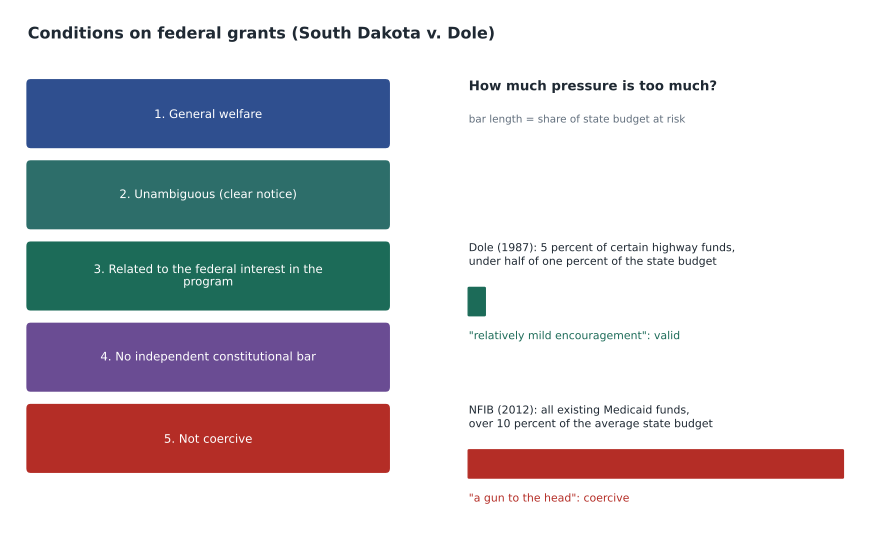
In 1984 Congress directed the Secretary of Transportation to withhold 5 percent of certain federal highway funds from any state that allowed people under 21 to buy alcohol. South Dakota, which allowed 19-year-olds to buy beer with low alcohol content, challenged the condition. In South Dakota v. Dole, 483 U.S. 203 (1987), Chief Justice Rehnquist's opinion upheld it and set out the governing test. Conditions on federal grants must (1) serve the general welfare; (2) be stated unambiguously, so states can make an informed choice; (3) relate to the federal interest in the particular program (germaneness); (4) not violate an independent constitutional bar, such as inducing states to engage in unconstitutional conduct; and (5) not be so coercive that "pressure turns into compulsion."
The drinking age condition passed every test. Safe interstate travel was a federal interest related to highway funding, because young drivers crossed state lines to drink where it was legal. And the stakes were modest: South Dakota stood to lose less than half of one percent of its budget, which Rehnquist called "relatively mild encouragement." Justice O'Connor dissented, arguing the condition regulated drinking rather than highways and failed the germaneness test.
Coercion and the Medicaid expansion
For 25 years after Dole, no condition was held coercive. Then NFIB v. Sebelius held that the Affordable Care Act's Medicaid expansion crossed the line. The act required states to cover nearly all adults with incomes up to 133 percent of the federal poverty level, with the federal government paying most of the cost, and provided that a state that refused could lose not only the new funds but all of its existing Medicaid funding. Chief Justice Roberts, joined by Justices Breyer and Kagan, with four dissenters reaching the same conclusion, held that threatening the loss of over 10 percent of a state's overall budget was "a gun to the head," not mild encouragement, and that the expansion was a shift in kind, not degree, to a new program rather than a modification of the old one. The remedy was to bar the federal government from withdrawing existing Medicaid funds from states that declined the expansion, which turned the expansion into a genuine option. As of 2026, most states have adopted it, several of them by ballot measure.
Clear notice and enforcement of conditions
The clear-statement rule from Pennhurst State School and Hospital v. Halderman, 451 U.S. 1 (1981), treats spending legislation as "much in the nature of a contract": a state is bound only by conditions it knowingly accepted, so Congress must state them unambiguously. The Court has applied this rule to limit remedies against grant recipients. In Cummings v. Premier Rehab Keller, P.L.L.C., 596 U.S. 212 (2022), it held that damages for emotional distress are not available in private suits under the Rehabilitation Act and the Affordable Care Act's antidiscrimination provision, because funding recipients would not have been clearly on notice of that liability. In Medina v. Planned Parenthood South Atlantic (2025), the Court held that the Medicaid act's "any-qualified-provider" provision does not clearly create individual rights that patients may enforce through 42 U.S.C. section 1983, so a patient could not sue to stop South Carolina from excluding Planned Parenthood from its program.
The Tenth Amendment and anti-commandeering
The Tenth Amendment provides: "The powers not delegated to the United States by the Constitution, nor prohibited by it to the States, are reserved to the States respectively, or to the people." Darby described it as a truism, and the Court's first effort to use it to shield states from generally applicable federal laws failed. National League of Cities v. Usery, 426 U.S. 833 (1976), held that federal wage and hour rules could not be applied to traditional state governmental functions, but Garcia v. San Antonio Metropolitan Transit Authority, 469 U.S. 528 (1985), overruled it, reasoning that states are protected mainly through the political process, their representation in Congress, rather than by judicially defined spheres of immunity. Federal laws that apply to private parties and states alike, such as minimum wage laws, are valid.
What Congress may not do is commandeer the states' legislative or executive machinery. In New York v. United States, 505 U.S. 144 (1992), a federal statute required states either to arrange for disposal of low-level radioactive waste generated within their borders or to "take title" to the waste and become liable for it. Justice O'Connor's opinion upheld the statute's monetary and access incentives, which used the spending and commerce powers to encourage states, but struck down the take-title provision: offering states a choice between two forms of federally compelled legislation is no choice at all. Congress may regulate individuals directly, or encourage states with money or with the option of federal regulation, but it may not "commandeer the legislative processes of the States by directly compelling them to enact and enforce a federal regulatory program." Commandeering also blurs political accountability: voters cannot tell which government to blame.
Printz v. United States, 521 U.S. 898 (1997), extended the rule to state executive officers. The Brady Handgun Violence Prevention Act required local chief law enforcement officers to conduct background checks on handgun buyers until a national system was ready. Justice Scalia's opinion held that Congress cannot "command the States' officers, or those of their political subdivisions, to administer or enforce a federal regulatory program," drawing on history, the structure of dual sovereignty and the President's power to execute federal laws. Reno v. Condon, 528 U.S. 141 (2000), clarified that Congress may regulate states as owners of databases, by restricting their sale of drivers' personal information, because the law regulated state activities rather than requiring states to regulate their citizens.
Murphy v. NCAA
In Murphy v. National Collegiate Athletic Association, 584 U.S. 453 (2018), a federal statute made it unlawful for states to "authorize" sports gambling. New Jersey partially repealed its own prohibitions to permit betting at casinos and racetracks, and the sports leagues sued. Justice Alito's opinion held that a prohibition on state authorization violates the anti-commandeering rule just as a command to enact a law would: "The distinction between compelling a State to enact legislation and prohibiting a State from enacting new laws is an empty one." Preemption is different, the Court explained, because a valid preemption provision regulates private actors and confers rights or imposes duties on them, while this statute regulated only states. Within a few years, most states had legalized sports betting in some form.
Whitford explains why the anti-commandeering doctrine appears in the news so often. It is the legal basis for so-called sanctuary jurisdictions: the federal government may enforce immigration law with federal officers, and may offer funding with clear conditions, but it may not require state and local police to enforce federal immigration law or hold people for federal agents. Courts continue to hear disputes over federal efforts to condition grants on cooperation, where the questions are usually whether Congress clearly authorized the condition and whether it is germane, rather than commandeering itself.
Worked problem
Conditions on a federal grant
Congress creates a 2 billion dollar grant program for states to improve fire safety in public housing. Section 4 provides that a state receiving any funds must (a) adopt the federal residential battery charging standards as state law for all buildings, public or private, and (b) assign state fire marshals to inspect garages for compliance and report violations to a federal agency. A state that declines loses the new grant and 50 percent of all its existing federal disaster relief funds. Analyze the conditions.
Show solution
- General welfare and clear notice: fire safety serves the general welfare, and the conditions are stated unambiguously.
- Germaneness: battery charging standards in public housing relate to the grant's fire-safety purpose; extending them to private buildings is less related but still about fire safety (compare O'Connor's Dole dissent).
- Coercion: threatening half of existing disaster relief funds, an established and separate program, resembles the Medicaid threat in NFIB more than the 5 percent highway cut in Dole.
- Commandeering: section 4(b) requires state officers to inspect and report for a federal program. Imposed directly, it would violate Printz. Offered as a voluntary grant condition with a real choice, it is generally permissible.
- Remedy: as in NFIB, a court could sever the coercive threat to existing funds and leave the conditions attached only to the new grant.
Answer: The conditions on the new money are likely valid as clear, related conditions on a voluntary grant. The threat to cut existing disaster relief funds is likely unconstitutionally coercive under NFIB, and the remedy would bar that penalty, leaving states free to decline the new grant alone.
The big picture
Whitford summarizes the lesson in three sentences on the board. Congress may tax and spend broadly, so long as a tax is functionally a tax and spending conditions are clear, related and not coercive. Congress may regulate private conduct, and states acting like private parties, under its enumerated powers. Congress may not order state legislatures to legislate or state officers to administer federal programs. Jordan copies them down and adds a fourth line of his own: "Money talks, but it cannot give orders."
Summary and key terms
- The taxing power is independent of other enumerated powers; direct taxes must be apportioned except income taxes under the Sixteenth Amendment; Moore (2024) upheld attribution of a foreign corporation's realized income to shareholders and left the realization question open.
- Whether an exaction is a tax or a penalty depends on function, not label (Bailey; NFIB); the individual mandate was upheld as a tax.
- Congress may spend for the general welfare (Butler; Helvering v. Davis) and attach conditions that meet the five Dole requirements.
- NFIB held the threat to withdraw all existing Medicaid funds unconstitutionally coercive; the remedy made the expansion optional.
- Spending conditions must be stated unambiguously (Pennhurst); recent cases limit private enforcement and remedies (Cummings; Medina).
- The Tenth Amendment does not exempt states from generally applicable laws (Garcia), but Congress may not commandeer state legislatures (New York), executive officers (Printz) or forbid states to repeal their laws (Murphy).
- Direct tax
- A tax that must be apportioned among the states by population; historically capitation and land taxes.
- Spending power
- Congress's power to spend for the general welfare, including on matters it could not regulate directly.
- Germaneness
- The requirement that a grant condition relate to the federal interest in the funded program.
- Coercion
- Financial pressure so great that a state has no real choice, invalid under NFIB.
- Pennhurst clear-statement rule
- A state is bound only by grant conditions Congress stated unambiguously.
- Anti-commandeering doctrine
- The rule that Congress may not compel states to enact or administer federal regulatory programs.
- Preemption
- Displacement of state law by valid federal law that regulates private actors.
Practice problems
Work each problem on paper first, then reveal the answer to check.
Why was the individual mandate a tax for constitutional purposes despite being called a penalty?
Show answer
Functionally it was collected by the IRS with tax returns, calculated by income, usually cheaper than insurance, required no knowing violation and carried no criminal consequence, leaving a lawful choice to pay more tax.
What distinguished the Medicaid threat in NFIB from the highway condition in Dole?
Show answer
Scale and kind: states risked losing all existing Medicaid funds, over a tenth of their budgets, for declining a new program, while South Dakota risked a small share of highway money tied to a related federal interest.
Congress requires county sheriffs to report the immigration status of everyone they arrest to a federal agency. Constitutional?
Show answer
Likely not if imposed as a direct command to state officers to administer a federal program (Printz), though the federal government may collect information through its own officers or offer clear, voluntary grant conditions.
How did Murphy distinguish anti-commandeering from preemption?
Show answer
Valid preemption provisions regulate private actors, conferring rights or duties on them; the statute in Murphy regulated only states by forbidding them to authorize gambling.
Lesson quiz · 5 questions
Score 60% or more to complete this lesson.
Create a free account to save your progress, take quizzes and earn a certificate.