
LAWU-111 · Lesson 6 of 12 · 22 min
Separation of powers
▶ Video coming soon A video version of this lesson is on the way.
Whitford begins the sixth class by reading two sentences side by side. The first is from Article I: "All legislative Powers herein granted shall be vested in a Congress of the United States." The second is from Article II: "The executive Power shall be vested in a President of the United States of America." She asks Section B to spot the difference. Hannah sees it first: Article I says "herein granted" and Article II does not. "That missing phrase," Whitford says, "has launched a century of arguments about whether the President has powers beyond those the Constitution lists. Last term the Court decided two of the biggest of those arguments. Today we learn the framework the Justices still use."
Why separate powers?
The framers divided power among three branches to protect liberty. Madison wrote in Federalist No. 47 that "the accumulation of all powers, legislative, executive, and judiciary, in the same hands" is "the very definition of tyranny," and in Federalist No. 51 that "ambition must be made to counteract ambition": each branch would have the means and the motive to resist encroachment by the others. The Constitution does not separate powers perfectly. It blends them through checks and balances: the President's veto, the Senate's role in appointments and treaties, impeachment, judicial review, and Congress's control of money.
Two styles of reasoning run through the cases. Formalist opinions ask which branch a power belongs to and insist that each branch exercise only its own type of power through the procedures the Constitution prescribes. Functionalist opinions ask whether an arrangement threatens the core functions of a branch or concentrates power dangerously, and tolerate flexible arrangements that do not. The current Court leans formalist in many separation of powers cases, but every Justice uses both styles.
Youngstown and the three zones
In April 1952, during the Korean War, steelworkers announced a nationwide strike. President Truman, believing a strike would endanger the war effort, issued an executive order directing the Secretary of Commerce to seize and operate most of the nation's steel mills. No statute authorized the seizure; indeed, Congress had considered and rejected giving the President seizure power when it passed the Taft-Hartley Act in 1947. The steel companies sued. In Youngstown Sheet and Tube Co. v. Sawyer, 343 U.S. 579 (1952), the Court held the seizure unconstitutional, 6 to 3.
Justice Black's opinion for the Court was formalist: the President's power must come from a statute or the Constitution, and neither authorized the seizure. The power to seize private property to settle a labor dispute is lawmaking, which belongs to Congress, and the Commander in Chief power does not reach domestic industry far from the theater of war. But the most influential opinion was Justice Robert Jackson's concurrence, which described three zones of presidential power.
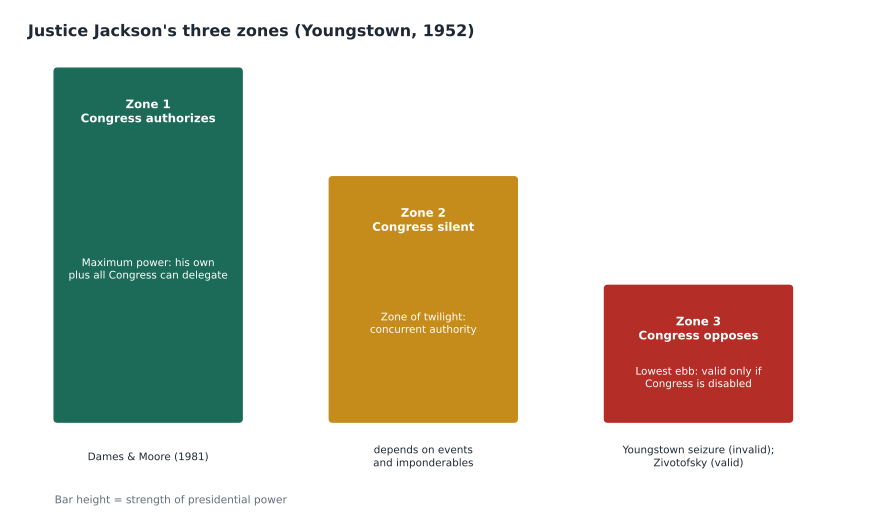
In the first zone, the President acts with the express or implied authorization of Congress; his authority is at its maximum, including all that he possesses in his own right plus all that Congress can delegate. In the second, the President acts in the absence of a congressional grant or denial; he relies on his own independent powers, but there is "a zone of twilight" in which he and Congress may have concurrent authority, and the outcome depends on "the imperatives of events and contemporary imponderables." In the third, the President takes measures incompatible with the expressed or implied will of Congress; his power is "at its lowest ebb," and courts can sustain his action only by disabling Congress from acting on the subject. Jackson placed the steel seizure in the third zone because Congress had rejected seizure as a tool for labor disputes.
Foreign affairs
The President's foreign affairs powers rest on specific clauses (Commander in Chief, receiving ambassadors, making treaties with Senate consent) and on structural arguments about the need for a single voice in foreign relations. United States v. Curtiss-Wright Export Corp., 299 U.S. 304 (1936), contains famous language about the President as "the sole organ of the federal government in the field of international relations," though the case actually involved a power Congress had delegated. Later cases treat that language cautiously.
Dames and Moore v. Regan, 453 U.S. 654 (1981), applied Jackson's framework to the agreements ending the Iran hostage crisis, which suspended American claims against Iran and moved them to an international tribunal. The Court found express statutory authority for nullifying attachments of Iranian assets, and for the claims suspension relied on Congress's long acquiescence in presidential claims settlements, treating it as a form of implicit approval. Zivotofsky v. Kerry, 576 U.S. 1 (2015), went the other way on the merits: it held that the power to recognize foreign governments belongs exclusively to the President, so Congress could not require the State Department to list "Israel" as the birthplace on passports of Americans born in Jerusalem. That is a rare case in which the President prevailed in Jackson's third zone. Medellín v. Texas, 552 U.S. 491 (2008), held that the President could not unilaterally make a non-self-executing treaty obligation binding on state courts: the power to make domestic law belongs to Congress.
Trump v. Hawaii, 585 U.S. 667 (2018), upheld a presidential proclamation restricting entry by nationals of several countries, relying on the broad delegation in the Immigration and Nationality Act and on deference to the executive in national security and immigration. War powers remain contested. Congress declares war; the President commands the armed forces and may repel sudden attacks. The War Powers Resolution of 1973 requires the President to report to Congress within 48 hours of introducing forces into hostilities and to withdraw them within 60 days (with a 30-day extension) unless Congress authorizes the action. Presidents of both parties have questioned its constitutionality, and courts have generally treated disputes over it as nonjusticiable.
Congress's lawmaking procedures
Article I, section 7 prescribes how laws are made: passage by both houses (bicameralism) and presentment to the President for signature or veto. INS v. Chadha, 462 U.S. 919 (1983), enforced these steps. The Immigration and Nationality Act let either house of Congress, by resolution, overturn the Attorney General's decision to suspend a noncitizen's deportation. The House vetoed the suspension for Jagdish Chadha. The Court held this "legislative veto" unconstitutional: the House's action altered legal rights and duties, so it was legislative, and legislation requires bicameralism and presentment. The decision invalidated legislative veto provisions in more than 200 statutes. Congress responded with the Congressional Review Act of 1996, under which Congress can overturn agency rules by joint resolution, which must be passed by both houses and presented to the President.
Clinton v. City of New York, 524 U.S. 417 (1998), struck down the Line Item Veto Act, which let the President cancel individual spending items after signing a bill. The Court held that canceling parts of a statute amounts to amending or repealing it without following Article I, section 7, which allows the President to approve or reject a bill only in its entirety.
Nondelegation
If Congress holds the legislative power, may it hand that power to agencies? Formally, the Court says no: Congress may not delegate legislative power. Functionally, the Court has allowed broad grants of discretion so long as Congress supplies an "intelligible principle" to guide the agency, a test from J.W. Hampton, Jr. and Co. v. United States, 276 U.S. 394 (1928). The Court has struck down statutes on nondelegation grounds only twice, both in 1935: Panama Refining Co. v. Ryan, 293 U.S. 388, and A.L.A. Schechter Poultry Corp. v. United States, 295 U.S. 495, which involved codes of "fair competition" written largely by industry groups. Whitman v. American Trucking Associations, Inc., 531 U.S. 457 (2001), upheld the Clean Air Act's direction to set air quality standards "requisite to protect the public health" with an adequate margin of safety.
Several Justices have called for reviving the doctrine. In Gundy v. United States, 588 U.S. 128 (2019), a plurality upheld a delegation to the Attorney General to decide how the federal sex offender registration law applied to people convicted before it took effect, but Justice Gorsuch's dissent, joined by the Chief Justice and Justice Thomas, proposed a stricter test, and Justice Alito said he would consider it in a future case. In FCC v. Consumers' Research (2025), however, the Court, in an opinion by Justice Kagan, rejected a nondelegation challenge to the universal service fund, which subsidizes telephone and internet service in rural areas and schools. The statute's direction that contributions be "sufficient" to fund the programs supplied an intelligible principle, and the FCC's reliance on a private administrator was permissible because the agency retained final authority. Justice Gorsuch, joined by Justices Thomas and Alito, dissented.
The major questions doctrine
If the nondelegation doctrine remains weak, the major questions doctrine has become strong. It is a rule of statutory interpretation: when an agency claims the power to decide a question of vast economic and political significance, it must point to clear congressional authorization, not a vague or ancillary provision. West Virginia v. EPA, 597 U.S. 697 (2022), applied the doctrine to the Clean Power Plan, which would have required power plants to shift generation from coal to natural gas and renewables. Chief Justice Roberts's opinion held that a rarely used provision of the Clean Air Act did not clearly authorize such a sweeping restructuring of the electricity sector. Biden v. Nebraska, 600 U.S. 477 (2023), applied it to the Secretary of Education's plan to cancel roughly 430 billion dollars in student loans under a statute allowing him to "waive or modify" loan provisions in a national emergency. Justice Barrett, concurring, described the doctrine as an ordinary interpretive tool reflecting how a reasonable person would read a delegation; Justice Kagan's dissents argued it lets the Court substitute its policy judgments for Congress's.
Last February, in Learning Resources, Inc. v. Trump (2026), decided together with Trump v. V.O.S. Selections, Inc., the Court held that the International Emergency Economic Powers Act of 1977 does not authorize the President to impose tariffs. The statute lets the President, after declaring a national emergency, "regulate" the "importation" of property, but Chief Justice Roberts's opinion, joined on the statutory reasoning by Justices Sotomayor, Kagan, Gorsuch, Barrett and Jackson, noted that the statute never mentions tariffs or duties and that the power to impose them belongs to Congress's taxing power under Article I. A plurality of three Justices also relied on the major questions doctrine and declined to recognize a foreign affairs exception to it; Justice Kagan's concurrence, joined by Justices Sotomayor and Jackson, reached the same result using ordinary statutory interpretation. Justice Kavanaugh, joined by Justices Thomas and Alito, dissented, arguing that "regulate" importation includes tariffs and that the major questions doctrine should not apply to foreign affairs statutes. Whitford notes that the case fits Jackson's framework: the President claimed zone-one authority, and the Court held Congress had not given it.
Agencies and courts after Loper Bright
For forty years, Chevron U.S.A. Inc. v. Natural Resources Defense Council, Inc., 467 U.S. 837 (1984), told courts to defer to an agency's reasonable interpretation of an ambiguous statute it administers. Loper Bright Enterprises v. Raimondo, 603 U.S. 369 (2024), overruled Chevron. Chief Justice Roberts's opinion held that the Administrative Procedure Act requires courts to exercise their independent judgment in deciding whether an agency has acted within its statutory authority. Courts may give respectful consideration to an agency's views under Skidmore v. Swift and Co., 323 U.S. 134 (1944), weighing their thoroughness and consistency, and Congress may expressly delegate discretion to an agency within limits. The Court said earlier decisions relying on Chevron remain good law under statutory stare decisis. Justice Kagan's dissent argued that agencies have expertise courts lack and that the decision transfers power from agencies to judges. The case is administrative law (LAWU-211), but Whitford includes it because it reshapes the balance among the three branches.
| Issue | Case | Result |
|---|---|---|
| Presidential seizure of steel mills | Youngstown (1952) | Invalid: no statutory or constitutional authority; Jackson's three zones |
| One-house legislative veto | INS v. Chadha (1983) | Invalid: violates bicameralism and presentment |
| Line item veto | Clinton v. City of New York (1998) | Invalid: unilateral amendment of statutes |
| Recognition of foreign governments | Zivotofsky v. Kerry (2015) | President's power is exclusive; statute invalid |
| Clean Power Plan | West Virginia v. EPA (2022) | No clear authorization for a major question |
| Universal service fund | FCC v. Consumers' Research (2025) | Intelligible principle satisfied |
| Emergency tariffs | Learning Resources v. Trump (2026) | IEEPA does not authorize tariffs |
Worked problem
An emergency order on battery imports
Suppose the President declares a national emergency over battery fires and, citing the International Emergency Economic Powers Act, (1) bans imports of lithium-ion cells from a named foreign manufacturer whose cells caused several fires, and (2) imposes a 40 percent duty on all imported cells. Congress has separately passed a statute directing the Consumer Product Safety Commission to set battery safety standards and expressly declining to authorize import bans. Analyze under Youngstown and Learning Resources.
Show solution
- Classify each action under Jackson's framework by asking what Congress has authorized or forbidden.
- The ban: IEEPA lets the President "regulate" or "prohibit" importation of property in which a foreign national has an interest after declaring an emergency, so a targeted ban looks like zone one, unless the later safety statute's express refusal to authorize import bans moves it toward zone three.
- The duty: under Learning Resources, IEEPA does not authorize tariffs; tariffs belong to Congress's taxing power. Without other statutory authority, the duty falls in zone three or simply lacks any source of power.
- Major questions: a 40 percent duty on a whole category of imports has vast economic significance and would require clear authorization.
- Independent constitutional power: the President has no inherent power to impose taxes, so the duty cannot be saved by Article II.
Answer: The targeted ban has a strong statutory basis in IEEPA, subject to an argument that Congress's later refusal to authorize import bans in the safety statute limits it. The across-the-board duty is invalid under Learning Resources: IEEPA does not authorize tariffs, and the President has no independent power to tax.
Summary and key terms
- The Constitution separates powers and blends them through checks and balances; cases use formalist and functionalist reasoning.
- Youngstown (1952) invalidated Truman's steel seizure; Jackson's concurrence describes three zones of presidential power depending on congressional authorization, silence or opposition.
- Foreign affairs: Curtiss-Wright's "sole organ" language is read narrowly; Dames and Moore relied on congressional acquiescence; Zivotofsky held the recognition power exclusive; Medellín denied unilateral presidential lawmaking.
- Chadha struck down the legislative veto and Clinton v. City of New York the line item veto for bypassing bicameralism and presentment.
- Delegations are valid with an intelligible principle (Whitman; FCC v. Consumers' Research, 2025), though several Justices favor a stricter test (Gundy dissent).
- The major questions doctrine requires clear authorization for agency or presidential claims of vast significance (West Virginia v. EPA; Biden v. Nebraska); Learning Resources (2026) held IEEPA does not authorize tariffs.
- Loper Bright (2024) overruled Chevron: courts decide the meaning of statutes independently, giving agency views respect under Skidmore.
- Separation of powers
- The division of governmental power among the legislative, executive and judicial branches.
- Checks and balances
- Constitutional mechanisms by which each branch limits the others.
- Zone of twilight
- Jackson's term for presidential action where Congress has neither authorized nor forbidden it.
- Bicameralism and presentment
- The requirement that legislation pass both houses and be presented to the President.
- Legislative veto
- A mechanism, invalid after Chadha, letting one or both houses override executive action without presentment.
- Intelligible principle
- The guidance Congress must give when delegating discretion to an agency.
- Major questions doctrine
- The rule that agencies need clear congressional authorization to decide questions of vast economic and political significance.
Practice problems
Work each problem on paper first, then reveal the answer to check.
Which Youngstown zone did Jackson assign to the steel seizure, and why?
Show answer
Zone three, because Congress had considered and rejected seizure as a means of resolving labor disputes in the Taft-Hartley Act, so the President acted against the implied will of Congress.
Why was the House's veto in Chadha unconstitutional?
Show answer
It was legislative action that altered legal rights, yet it was taken by one house alone without passage by the Senate or presentment to the President, as Article I, section 7 requires.
How do the nondelegation doctrine and the major questions doctrine differ?
Show answer
Nondelegation is a constitutional limit on what Congress may delegate (requiring an intelligible principle); major questions is a rule of statutory interpretation requiring clear authorization before reading a statute to grant power over issues of vast significance.
What did Loper Bright change?
Show answer
It overruled Chevron deference; courts must now independently decide what a statute means, giving agency interpretations respect only to the extent they are persuasive under Skidmore.
Lesson quiz · 5 questions
Score 60% or more to complete this lesson.
Create a free account to save your progress, take quizzes and earn a certificate.