
LAWU-111 · Lesson 1 of 12 · 25 min
Judicial review
▶ Video coming soon A video version of this lesson is on the way.
Professor Adele Whitford begins the spring semester by setting a pocket copy of the Constitution on the lectern and asking Section B a question that sounds simple. "Where in this document," she says, holding it up, "does it say that the Supreme Court can strike down an Act of Congress?" Priya Natarajan flips to Article III and reads the description of the judicial power. Daniel Reyes tries the Supremacy Clause in Article VI. Hannah Lindqvist, the former history teacher, finally says what Whitford wants to hear: "It doesn't say it in so many words. The Court said it." Whitford nods. "Then our first job," she says, "is to understand why the Court said it, why the country accepted it, and what limits come with it. Everything else in this course depends on the answer."
The Constitution as law
The Constitution of 1787 created a national government of three branches and limited powers. Article I vests "all legislative Powers herein granted" in Congress and lists them, most importantly in section 8. Article II vests "the executive Power" in a President. Article III vests "the judicial Power of the United States" in "one supreme Court" and whatever lower federal courts Congress creates, and extends that power to nine categories of "Cases" and "Controversies." Article IV governs relations among the states, Article V sets out the amendment process, and Article VI declares that the Constitution, federal laws made "in Pursuance thereof" and treaties are "the supreme Law of the Land," binding on state judges. The first ten amendments, the Bill of Rights, were ratified in 1791, and the Reconstruction Amendments (the Thirteenth, Fourteenth and Fifteenth) after the Civil War transformed the relationship between the national government and the states.
Whitford stresses two features that shape the whole course. First, the national government has only enumerated powers: when Congress acts, someone may ask which grant of power authorizes it, and the Tenth Amendment confirms that powers not delegated are reserved to the states or the people. Second, the Constitution is written law that binds government officials. If it is law, someone must decide what it means when officials disagree, and in a legal system that someone is ordinarily a court deciding a case.
Marbury v. Madison
Marbury v. Madison, 5 U.S. (1 Cranch) 137 (1803), arose from the bitter transition between President John Adams's Federalists and Thomas Jefferson's Republicans. In the last days of his term, Adams appointed William Marbury as a justice of the peace for the District of Columbia. The Senate confirmed him and the commission was signed and sealed, but Secretary of State John Marshall (who was also, by then, the new Chief Justice) did not deliver it before Adams left office. Jefferson's Secretary of State, James Madison, refused to deliver it. Marbury filed suit directly in the Supreme Court, asking for a writ of mandamus ordering Madison to hand over the commission.
Chief Justice Marshall's opinion answered three questions. Did Marbury have a right to the commission? Yes: the appointment was complete when the commission was signed and sealed. Did the laws afford him a remedy? Yes: "The very essence of civil liberty certainly consists in the right of every individual to claim the protection of the laws, whenever he receives an injury." Could the Supreme Court issue the remedy? No. Section 13 of the Judiciary Act of 1789, as Marshall read it, gave the Supreme Court original jurisdiction to issue mandamus to federal officers, but Article III limits the Court's original jurisdiction to cases affecting ambassadors, other public ministers and consuls, and those in which a state is a party. Congress could not enlarge it. Faced with a conflict between a statute and the Constitution, the Court had to follow the Constitution and refuse to apply the statute.
The famous passages explain why. The Constitution is "the fundamental and paramount law of the nation," so "an act of the legislature, repugnant to the constitution, is void." And "it is emphatically the province and duty of the judicial department to say what the law is." A court deciding a case must apply the law; if two laws conflict, it must decide which governs; and the higher law prevails. Marshall pointed to textual clues: judges take an oath to support the Constitution, Article III extends the judicial power to cases "arising under this Constitution," and the Supremacy Clause ranks the Constitution first, with federal statutes supreme only when made "in Pursuance thereof."
Whitford asks Section B to notice the strategy. Marshall lectured the Jefferson administration that it had violated Marbury's rights, yet gave it nothing to defy: the Court ruled for Madison. By denying itself a power Congress had tried to give it, the Court claimed a far greater one. Jordan Kimura, the Army veteran, calls it "winning the war by losing the battle." Historians add that the idea of judicial review was not new in 1803. It appears in Alexander Hamilton's Federalist No. 78, which argued that the courts are "the least dangerous" branch, having "neither force nor will, but merely judgment," and that judges must prefer the Constitution to a statute that conflicts with it. Several state courts had already refused to enforce statutes that violated their state constitutions.
Review of state courts and state laws
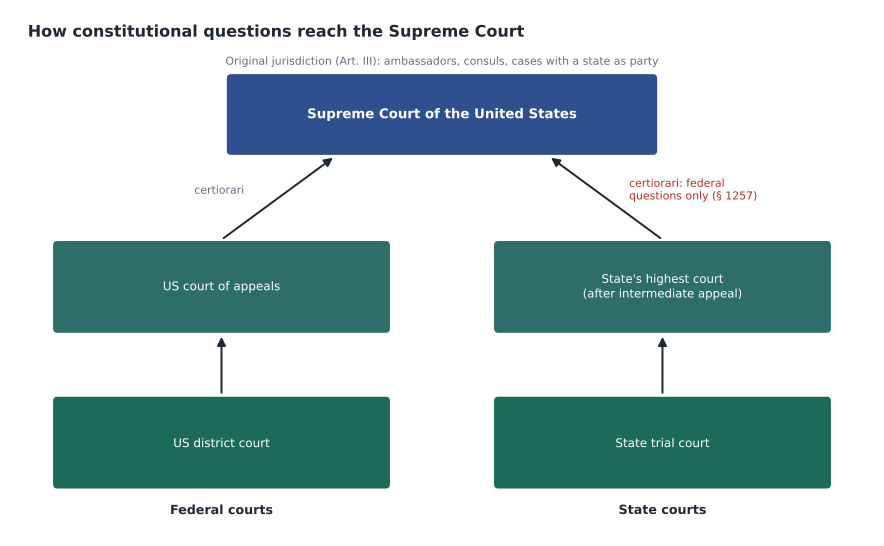
Marbury involved a federal statute. Judicial review of state action was established soon after and has arguably mattered more. In Fletcher v. Peck, 10 U.S. (6 Cranch) 87 (1810), the Court held a Georgia statute invalid under the Contracts Clause. In Martin v. Hunter's Lessee, 14 U.S. (1 Wheat.) 304 (1816), the Virginia Court of Appeals had declared that the US Supreme Court could not review its judgments. Justice Joseph Story's opinion rejected that claim: Article III extends the judicial power to all cases arising under federal law, and uniform interpretation of federal law requires a single court with the final word, even over the highest court of a state. Cohens v. Virginia, 19 U.S. (6 Wheat.) 264 (1821), extended the point to criminal cases in which a state is a party.
The modern statute is 28 U.S.C. section 1257, which allows the Supreme Court to review, by writ of certiorari, final judgments of a state's highest court where a federal statute or treaty is challenged, a state law is challenged as contrary to federal law, or a federal right is claimed. Two limits follow. The Court reviews only questions of federal law; a state court is the final word on the meaning of its own state's law. And under the adequate and independent state ground doctrine, the Court will not review a federal question if the state judgment rests on a state-law ground that is adequate to support it and independent of federal law. Michigan v. Long, 463 U.S. 1032 (1983), adopted a presumption: if a state court's opinion appears to rest primarily on federal law, or is interwoven with it, the Court assumes there is no independent state ground unless the state court clearly says otherwise.
Judicial supremacy
Marbury said the courts must interpret the Constitution when deciding cases. It did not clearly say that other branches must treat the Court's interpretations as binding in all future situations. Presidents have sometimes resisted that idea: Jefferson argued each branch could interpret the Constitution for itself, and Andrew Jackson, vetoing the bill to recharter the Bank of the United States, insisted he was not bound by the Court's view in McCulloch v. Maryland. Abraham Lincoln, in his first inaugural address, accepted that Dred Scott bound the parties but denied that it settled national policy for all time.
The modern Court has claimed a stronger role. In Cooper v. Aaron, 358 U.S. 1 (1958), Arkansas officials argued that they were not bound by Brown v. Board of Education because they had not been parties to it. All nine Justices signed an opinion declaring that Marbury "declared the basic principle that the federal judiciary is supreme in the exposition of the law of the Constitution," and that the interpretation in Brown was "the supreme law of the land" binding on state officials. City of Boerne v. Flores, 521 U.S. 507 (1997), relied on the same idea when it held that Congress cannot use its enforcement power under section 5 of the Fourteenth Amendment to redefine the substance of constitutional rights; Congress may enforce rights as the Court defines them, through legislation with "congruence and proportionality" between the injury and the remedy.
Whitford asks whether judicial supremacy is a problem for democracy. Hannah raises what scholars call the countermajoritarian difficulty, Alexander Bickel's phrase for the fact that unelected judges with life tenure can override decisions of elected officials. Marcus Webb answers with the other side: the Constitution itself is the people's higher law, adopted by supermajorities, and judicial review enforces their choices against temporary majorities. Whitford tells them that both arguments are right in part, and that the long debate about how judges should interpret the Constitution is, in large measure, an effort to answer the difficulty.
Checks on the courts
The judiciary is not unchecked. The President nominates and the Senate confirms federal judges. Congress sets the number of Justices (nine since 1869), creates or abolishes lower federal courts, funds the courts, and can propose constitutional amendments to overturn decisions, as the Eleventh, Fourteenth, Sixteenth and Twenty-Sixth Amendments did. Congress may also pass new statutes when the Court's decision rests on statutory interpretation rather than the Constitution.
Congress also has some control over jurisdiction. Article III gives the Supreme Court appellate jurisdiction "with such Exceptions, and under such Regulations as the Congress shall make." In Ex parte McCardle, 74 U.S. (7 Wall.) 506 (1869), Congress repealed the statute under which a Mississippi newspaper editor held by military authorities had appealed, while the case was pending, and the Court dismissed for want of jurisdiction, noting that other routes to the Court remained open. How far Congress may go in stripping jurisdiction to prevent courts from hearing constitutional claims remains debated. United States v. Klein, 80 U.S. (13 Wall.) 128 (1872), held that Congress cannot prescribe a rule of decision in a pending case, but later cases such as Bank Markazi v. Peterson, 578 U.S. 212 (2016), and Patchak v. Zinke, 583 U.S. 244 (2018), upheld statutes that changed the law applicable to particular pending cases.
Self-restraint: avoidance and severability
The Court also limits itself. Justice Brandeis's concurrence in Ashwander v. TVA, 297 U.S. 288 (1936), collected rules of restraint: the Court will not decide constitutional questions unnecessarily, will not formulate a rule broader than the facts require, and, where a statute is fairly open to two readings, will choose the one that avoids serious constitutional doubts. This canon of constitutional avoidance appears constantly in modern cases. In NFIB v. Sebelius, 567 U.S. 519 (2012), Chief Justice Roberts read the Affordable Care Act's individual mandate as a tax because that reading was fairly possible and saved the statute.
When a court does find part of a statute unconstitutional, it must decide what remains. Under the severability doctrine, a court strikes the invalid provision and keeps the rest unless Congress would not have enacted the remainder on its own or the remainder cannot function. Seila Law LLC v. CFPB, 591 U.S. 197 (2020), severed the removal protection for the director of the Consumer Financial Protection Bureau and left the agency standing. Severability matters for remedies throughout this course, including the removal cases in lesson 7.
How judges interpret the Constitution
Because so much depends on the Court's interpretations, the method of interpretation matters. Whitford gives Section B a checklist she calls the five modalities, drawing on Philip Bobbitt's classic list: text, history, structure, precedent and consequences (Bobbitt also lists ethical arguments about national values). Every Justice uses all of them; they differ in emphasis and in which they treat as decisive.
Textualists begin, and often end, with the words. Originalists ask what the words meant to the public when they were adopted. Original public meaning originalism, associated with Justice Scalia and now central to the Court's majority, looks to dictionaries, usage and practice at the time of ratification. The Court's recent "history and tradition" tests, in New York State Rifle and Pistol Association v. Bruen, 597 U.S. 1 (2022), for the Second Amendment and Dobbs v. Jackson Women's Health Organization, 597 U.S. 215 (2022), for unenumerated rights under the Due Process Clause, apply this approach. Living constitutionalists emphasize that broad phrases such as "equal protection" and "due process" state principles whose application can evolve, and that precedent, developed through common-law reasoning, deserves weight of its own.
Structural arguments draw inferences from the relationships the Constitution creates: separation of powers, federalism, and the place of the people. McCulloch v. Maryland, 17 U.S. (4 Wheat.) 316 (1819), is the great example, inferring that a state cannot tax a federal bank because "the power to tax involves the power to destroy" and the people of one state cannot control the government of all. Consequentialist or prudential arguments ask what effects a reading would have, and Justices disagree about how much weight they deserve.
| Mode | Question it asks | Classic example |
|---|---|---|
| Text | What do the words say? | Marbury on the limits of original jurisdiction |
| History and original meaning | What did the words mean when adopted, and what traditions shaped them? | Bruen and Dobbs |
| Structure | What follows from the relationships the Constitution sets up? | McCulloch on state taxation of the national bank |
| Precedent | What have courts already decided, and should it stand? | Planned Parenthood v. Casey; Dobbs; Loper Bright |
| Consequences | What would each reading do in practice? | NFIB's avoidance reading of the mandate |
Stare decisis in constitutional cases
Precedent is the second great source of constitutional law, and the Court regularly debates when to overrule it. Stare decisis is said to be at its weakest in constitutional cases, because Congress cannot fix a constitutional error by statute. In Dobbs, the majority overruled Roe v. Wade and Planned Parenthood v. Casey after weighing five factors: the nature of the earlier court's error, the quality of its reasoning, the workability of its rules, its effect on other areas of law, and the absence of concrete reliance interests. In Loper Bright Enterprises v. Raimondo, 603 U.S. 369 (2024), the Court overruled Chevron's rule of deference to agencies' statutory interpretations, and last June, in Trump v. Slaughter (2026), it overruled Humphrey's Executor v. United States, the 1935 decision upholding removal protection for members of the Federal Trade Commission. Dissenters in each case argued that the majority had given too little weight to precedent and to the stability of the law.
Whitford gives Section B a warning that will matter on every exam: when the Court overrules a case, read both the majority and the dissent's account of the precedent, because the next case will be argued in the language of both. And always check whether a precedent you rely on is still good law; this Court has overruled more major constitutional precedents in the last five years than in many earlier decades.
Worked problem
Applying Marbury to a modern statute
Congress passes a statute providing that "in any action challenging a federal agency rule, the Supreme Court shall have original jurisdiction and shall decide the case within 90 days." A trade association files suit directly in the Supreme Court, challenging an agency rule. The government argues the Court lacks jurisdiction. How should the Court rule?
Show solution
- Identify the constitutional text: Article III, section 2 defines the Supreme Court's original jurisdiction as cases affecting ambassadors, other public ministers and consuls, and cases in which a state is a party.
- Ask whether the case fits: a trade association against a federal agency is neither a case affecting an ambassador nor one in which a state is a party.
- Apply Marbury: Congress cannot add to the Supreme Court's original jurisdiction, so the grant is unconstitutional as applied to this case.
- Consider severability: the statute's other provisions (for example, the 90-day deadline) may fall with the grant, depending on whether they can operate alone.
- Note the alternative: the association may sue in a federal district court and reach the Supreme Court by appeal and certiorari.
Answer: The Court should dismiss for want of jurisdiction. As in Marbury, Congress cannot enlarge the Supreme Court's original jurisdiction beyond the categories listed in Article III, and the Court must follow the Constitution rather than the conflicting statute.
Why this matters for the rest of the course
Every lesson that follows asks a version of Marbury's question: what does the Constitution permit, who decides, and how? The next lesson asks when a federal court can decide a constitutional question at all, through the doctrines of standing, ripeness, mootness and political questions. Lessons 3 to 7 ask what the national government may do and how its power is divided. Lessons 8 to 11 turn to individual rights. Whitford closes the class by returning the pocket Constitution to her jacket. "Read it twice before every class," she says. "You will be surprised how often the answer begins with the words."
Summary and key terms
- The Constitution is written law that grants limited powers to three branches and binds officials; the Supremacy Clause makes it supreme over federal statutes and state law.
- Marbury v. Madison (1803) held that the Court must refuse to apply a statute that conflicts with the Constitution, because it is "the province and duty of the judicial department to say what the law is."
- Martin v. Hunter's Lessee (1816) and Cohens v. Virginia (1821) established Supreme Court review of state court judgments on federal questions; 28 U.S.C. section 1257 governs today, subject to the adequate and independent state ground doctrine.
- Cooper v. Aaron (1958) asserted judicial supremacy in interpreting the Constitution; City of Boerne (1997) limits Congress's power to redefine rights under section 5 of the Fourteenth Amendment.
- Courts are checked by appointments, amendments, jurisdiction statutes (Ex parte McCardle) and their own restraint (avoidance, severability).
- Interpretation draws on text, history and original meaning, structure, precedent and consequences; stare decisis is weakest in constitutional cases, as Dobbs, Loper Bright and Trump v. Slaughter show.
- Judicial review
- The power of courts to refuse to apply laws or official acts that conflict with the Constitution.
- Original jurisdiction
- The power to hear a case first, rather than on appeal; the Supreme Court's is fixed by Article III.
- Adequate and independent state ground
- A state-law basis for a state court judgment that prevents Supreme Court review of the federal question.
- Judicial supremacy
- The view that the Supreme Court's constitutional interpretations bind the other branches and the states.
- Constitutional avoidance
- The canon that a court should adopt a fairly possible reading of a statute that avoids serious constitutional doubts.
- Severability
- The doctrine that a court strikes only the unconstitutional part of a statute when the rest can stand alone.
- Original public meaning
- What the words of a constitutional provision meant to the public when it was adopted.
- Stare decisis
- The doctrine that courts should generally follow precedent.
Practice problems
Work each problem on paper first, then reveal the answer to check.
Why did the Court in Marbury hold that it could not issue the writ Marbury requested?
Show answer
Because section 13 of the Judiciary Act, as the Court read it, gave the Supreme Court original jurisdiction over a case that Article III did not include in its original jurisdiction, and the Court must follow the Constitution over a conflicting statute.
A state supreme court holds that a search violated both the Fourth Amendment and the state constitution, and says expressly that the state constitution independently requires suppression. Can the US Supreme Court review the Fourth Amendment ruling?
Show answer
No. The judgment rests on an adequate and independent state ground, which the state court clearly stated, so reversing the federal ruling would not change the result.
What did Cooper v. Aaron add to Marbury?
Show answer
It asserted that the Court's interpretation of the Constitution binds state officials who were not parties to the case, describing the federal judiciary as supreme in the exposition of constitutional law.
Give one way Congress can respond to a constitutional decision it dislikes and one way it cannot.
Show answer
It can propose a constitutional amendment (or adjust jurisdiction or the number of Justices); it cannot simply pass a statute redefining the constitutional right, as City of Boerne holds, or dictate a rule of decision in a pending case, as Klein holds.
Lesson quiz · 5 questions
Score 60% or more to complete this lesson.
Create a free account to save your progress, take quizzes and earn a certificate.