
LAWU-111 · Lesson 3 of 12 · 22 min
Federalism and the Commerce Clause
▶ Video coming soon A video version of this lesson is on the way.
Marcus Webb arrives at the third class with a question from his old job. Before law school he worked at a startup that built home battery systems, and he wants to know whether Congress could pass a national safety standard for lithium-ion batteries charged in people's garages, the kind of battery at the center of the Delgado e-bike case from Civil Procedure. "Of course it can," says Priya. "Batteries cross state lines." Hannah is less sure. "What about a battery that someone builds at home from parts and never sells?" Whitford writes both questions on the board. "That," she says, "is the history of the Commerce Clause in two sentences."
Enumerated powers and McCulloch
Congress has only the powers the Constitution grants. Article I, section 8 lists them: to lay and collect taxes, to borrow money, to regulate commerce, to establish rules of naturalization and bankruptcy, to coin money, to establish post offices, to grant patents and copyrights, to declare war and raise armies, and others. The last clause gives Congress power "to make all Laws which shall be necessary and proper for carrying into Execution the foregoing Powers, and all other Powers vested by this Constitution in the Government of the United States."
McCulloch v. Maryland, 17 U.S. (4 Wheat.) 316 (1819), set the frame for reading these powers. The question was whether Congress could charter the Second Bank of the United States, though no clause mentions banks or corporations. Chief Justice Marshall reasoned that the Constitution, unlike a legal code, marks only "its great outlines" because "it is a constitution we are expounding." The Necessary and Proper Clause does not mean "absolutely necessary"; it permits means that are convenient or useful to carry out enumerated powers: "Let the end be legitimate, let it be within the scope of the constitution, and all means which are appropriate, which are plainly adapted to that end, which are not prohibited, but consist with the letter and spirit of the constitution, are constitutional." A bank was a reasonable means of exercising the powers to tax, borrow and support armies. Maryland's tax on the bank was invalid because a state cannot burden the instruments of the national government.
Whitford asks why federalism matters at all. The answers in the cases are familiar: dividing power between two levels of government protects liberty by preventing concentration of power, allows states to experiment with policies (Justice Brandeis called a state a "laboratory"), keeps government closer to the people, and lets citizens choose among states. Critics answer that states have also used their power to protect slavery and segregation, which is why the Reconstruction Amendments shifted power to the national government.
Gibbons v. Ogden and the early understanding
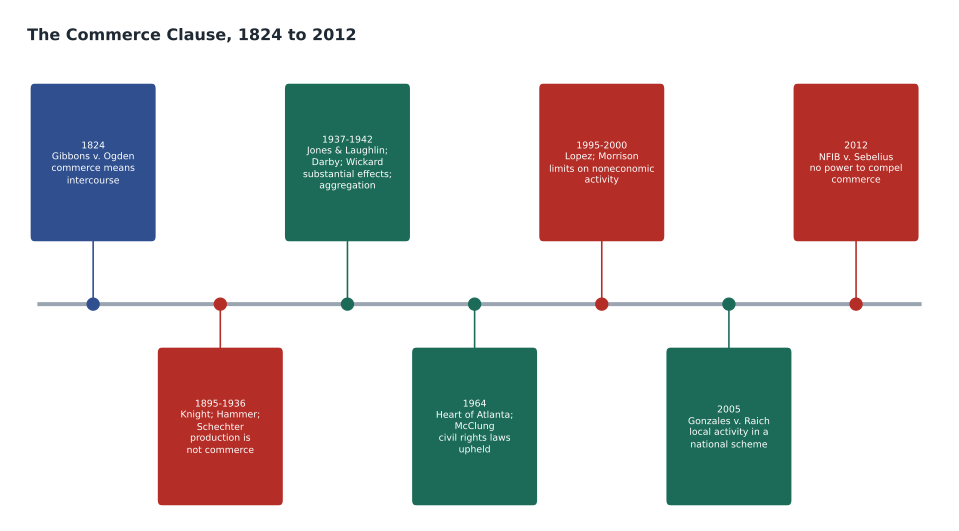
Article I, section 8, clause 3 gives Congress power "to regulate Commerce with foreign Nations, and among the several States, and with the Indian Tribes." In Gibbons v. Ogden, 22 U.S. (9 Wheat.) 1 (1824), New York had given a monopoly on steamboat traffic in its waters, and Aaron Ogden, holding a license under the monopoly, sued Thomas Gibbons, who ran competing boats between New Jersey and New York under a federal coasting license. Marshall read "commerce" broadly as "intercourse," including navigation, not merely buying and selling, and "among the several States" as commerce "which concerns more States than one." Commerce that is completely internal to a state and does not affect other states was left to the states. Because the federal license conflicted with New York's monopoly, the federal law prevailed under the Supremacy Clause.
The restrictive era
From the 1890s to 1937, the Court drew formal lines limiting the commerce power. In United States v. E. C. Knight Co., 156 U.S. 1 (1895), it held that the Sherman Antitrust Act could not reach a sugar refining monopoly because manufacturing was not commerce; it affected commerce only "indirectly." In Hammer v. Dagenhart, 247 U.S. 251 (1918), it struck down a federal ban on interstate shipment of goods made with child labor, reasoning that the law really regulated production, which was reserved to the states under the Tenth Amendment. The Court did uphold some laws, such as the ban on interstate shipment of lottery tickets in Champion v. Ames (the Lottery Case), 188 U.S. 321 (1903), and regulation of local railroad rates that affected interstate rates in the Shreveport Rate Case, 234 U.S. 342 (1914).
The conflict peaked during the New Deal. In A.L.A. Schechter Poultry Corp. v. United States, 295 U.S. 495 (1935), the Court invalidated wage and hour codes applied to a Brooklyn poultry slaughterhouse, because the poultry had come to rest in the state and the effect on interstate commerce was indirect. In Carter v. Carter Coal Co., 298 U.S. 238 (1936), it struck down regulation of coal mining labor. President Franklin Roosevelt responded in 1937 with his plan to add Justices, the "court-packing" plan, which Congress did not pass. That spring, the Court changed course.
The modern expansion
In NLRB v. Jones and Laughlin Steel Corp., 301 U.S. 1 (1937), the Court upheld the National Labor Relations Act as applied to a steel manufacturer, reasoning that labor strife at a huge integrated enterprise had a "close and substantial relation" to interstate commerce. United States v. Darby, 312 U.S. 100 (1941), upheld the Fair Labor Standards Act, overruled Hammer v. Dagenhart, and described the Tenth Amendment as "but a truism that all is retained which has not been surrendered."
Wickard v. Filburn, 317 U.S. 111 (1942), marked the outer edge. Roscoe Filburn, an Ohio farmer, grew 23 acres of wheat when his federal quota under the Agricultural Adjustment Act allowed about 11. Much of the excess was fed to his own animals or used on his farm, never sold. The Court upheld the penalty: even if one farmer's home-consumed wheat is trivial, taken together with that of many similarly situated farmers it substantially affects interstate prices, because home-grown wheat reduces the demand for purchased wheat. This aggregation principle remains central.
The commerce power also became the basis for the civil rights laws. In Heart of Atlanta Motel, Inc. v. United States, 379 U.S. 241 (1964), the Court upheld Title II of the Civil Rights Act of 1964 as applied to a motel that served interstate travelers, relying on evidence that discrimination discouraged Black Americans from traveling. In Katzenbach v. McClung, 379 U.S. 294 (1964), it upheld Title II as applied to Ollie's Barbecue in Birmingham, Alabama, which served mostly local customers but bought much of its food from out of state. Congress used the commerce power because the Civil Rights Cases, 109 U.S. 3 (1883), had held that the Fourteenth Amendment reaches only state action, not private discrimination (lesson 8).
Lopez and Morrison: limits return
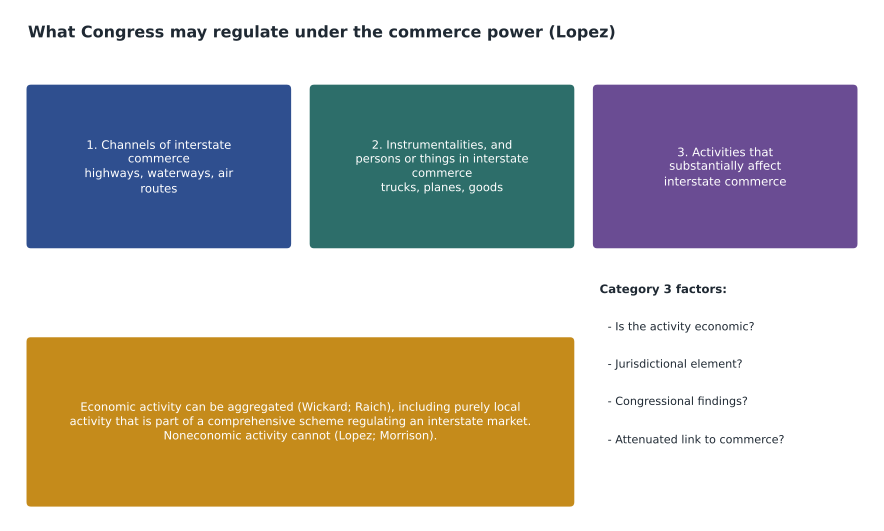
For nearly sixty years after 1937, the Court did not strike down a federal statute as exceeding the commerce power. Then came United States v. Lopez, 514 U.S. 549 (1995). Alfonso Lopez, a twelfth grader in San Antonio, brought a handgun to school and was charged under the federal Gun-Free School Zones Act of 1990. Chief Justice Rehnquist's opinion identified three categories of activity Congress may regulate under the commerce power: (1) the use of the channels of interstate commerce, such as highways, waterways and air routes; (2) the instrumentalities of interstate commerce, and persons or things in interstate commerce, even if the threat comes only from intrastate activities; and (3) activities that substantially affect interstate commerce.
The statute fit only the third category, if any. The Court held it did not, for several reasons: possessing a gun near a school is not economic activity; the statute had no jurisdictional element requiring a connection to interstate commerce in each case; Congress made no findings about the effect on commerce; and the government's theory (guns near schools cause violence, which affects national productivity and the willingness to travel) had no stopping point and would let Congress regulate anything, including family law and education. Justice Breyer's dissent argued that the effect of school violence on the national economy was real and that Congress was entitled to a rational basis for its judgment.
United States v. Morrison, 529 U.S. 598 (2000), applied Lopez to the civil remedy provision of the Violence Against Women Act, which let victims of gender-motivated violence sue their attackers in federal court. Congress had made extensive findings about the economic costs of such violence, but the Court held that gender-motivated violence is not economic activity and that Congress cannot aggregate noneconomic intrastate conduct to reach it. The Court also held the provision could not rest on section 5 of the Fourteenth Amendment, because it regulated private actors rather than states. Congress later amended the act's grants and criminal provisions, which remain in force; the civil remedy struck down in Morrison has not been restored in that form.
Gonzales v. Raich and comprehensive schemes
Gonzales v. Raich, 545 U.S. 1 (2005), showed that Lopez did not overturn Wickard. Angel Raich and Diane Monson, California residents, used marijuana grown at home for medical purposes, legal under California law. They argued that the federal Controlled Substances Act could not constitutionally reach their purely local, noncommercial cultivation and use. The Court disagreed. Justice Stevens's opinion relied on Wickard: Congress may regulate purely intrastate activity that is economic in nature, here the production of a fungible commodity with an established interstate market, if it rationally concludes that failing to do so would undercut the regulation of the interstate market. Exempting home-grown marijuana would leave a gap in a comprehensive regulatory scheme. Justice Scalia concurred on Necessary and Proper Clause grounds. Justice O'Connor dissented, and Justice Thomas's dissent argued that the original meaning of "commerce" covered trade and exchange, not production for personal use.
Whitford points out that Raich and Lopez can be reconciled by the line between economic and noneconomic activity and by the presence of a broad regulatory scheme. Hannah's home-built battery, never sold, looks like Filburn's wheat or Raich's marijuana if Congress regulates the national battery market comprehensively. A free-standing ban on possessing batteries near schools would look more like Lopez.
NFIB v. Sebelius: activity and inactivity
National Federation of Independent Business v. Sebelius, 567 U.S. 519 (2012), tested whether Congress could require individuals to buy health insurance. The Affordable Care Act's individual mandate required most Americans to maintain minimum coverage or pay a "shared responsibility payment" to the IRS. Five Justices, in Chief Justice Roberts's opinion and the joint dissent, concluded that the Commerce Clause did not authorize the mandate: the power to regulate commerce presupposes existing commercial activity, and the mandate compelled individuals to become active in commerce by purchasing a product. The Necessary and Proper Clause could not save it either, because it was not a "proper" means: it would expand federal power into a new domain. The four other Justices, in Justice Ginsburg's opinion, would have upheld the mandate under the Commerce Clause, noting that nearly everyone eventually consumes health care.
The mandate nonetheless survived, because Roberts, joined on this point by the four liberal Justices, held it could be read as a tax (lesson 4). Lawyers still debate the precedential weight of the commerce discussion, since it was not necessary to the judgment, but lower courts and later litigants treat the activity and inactivity distinction seriously. In 2017 Congress reduced the payment to zero, and in California v. Texas, 593 U.S. 659 (2021), the Court held that states and individuals challenging the now-penalty-free mandate lacked standing.
The Necessary and Proper Clause today
United States v. Comstock, 560 U.S. 126 (2010), upheld a federal statute authorizing civil commitment of sexually dangerous federal prisoners after their sentences end. Justice Breyer's opinion relied on McCulloch: the statute was a rational means of implementing Congress's power to operate a federal prison system, itself necessary and proper to enforce federal criminal laws enacted under enumerated powers. The chain of inferences troubled Justice Thomas, who dissented, and Justices Kennedy and Alito, who concurred narrowly. Whitford tells Section B that most federal laws today rest on some combination of the commerce power, the taxing and spending powers, and the Necessary and Proper Clause, so a challenger must usually defeat all three.
Worked problem
A federal battery safety statute
Congress enacts the Residential Battery Safety Act. Section 2 sets fire-safety standards for lithium-ion batteries "sold or offered for sale in or affecting interstate commerce." Section 3 makes it a federal crime to charge any lithium-ion battery over a certain size in a residential garage without an approved fire-resistant enclosure. Congress finds that battery fires cost insurers and homeowners hundreds of millions of dollars a year and that nearly all cells are imported or shipped interstate. Analyze both sections under the Commerce Clause.
Show solution
- Section 2: regulating goods sold in interstate commerce falls within Lopez categories two and three; the jurisdictional element ties each application to commerce. This is plainly valid.
- Section 3, category two: the batteries themselves are things that have moved in interstate commerce, and Congress may protect against harms they cause; the government will argue the garage rule regulates their safe use.
- Section 3, category three: charging a battery is arguably noneconomic conduct, like gun possession in Lopez, but it is closely tied to the use of a commercial product and part of a comprehensive regulatory scheme for the battery market, like Raich.
- Aggregation: millions of home charging sessions, taken together, plausibly affect the interstate markets for batteries and insurance (Wickard).
- Limits: the challenger will cite Lopez and Morrison (no jurisdictional element in section 3; traditional state police power over home safety), and NFIB if the provision is framed as compelling purchase of an enclosure.
Answer: Section 2 is valid. Section 3 is closer but likely valid as part of a comprehensive scheme regulating an interstate commodity and its safe use, especially if Congress adds a jurisdictional element limiting it to batteries that have moved in interstate commerce. The strongest challenge invokes Lopez and the traditional state power over home safety.
Looking ahead
Whitford closes by connecting the commerce power to the next two lessons. Even where Congress has power to regulate, other principles limit how it does so: it may not commandeer state governments, it may not coerce states with conditions on funds, and the states themselves may not discriminate against interstate commerce even when Congress is silent. "The commerce power is vast," she says, "but federalism lives in its edges."
Summary and key terms
- Congress has only enumerated powers; McCulloch (1819) reads the Necessary and Proper Clause to permit any appropriate means plainly adapted to a legitimate end.
- Gibbons (1824) defined commerce broadly as intercourse among states; from 1895 to 1937 the Court drew formal lines (E. C. Knight, Hammer v. Dagenhart, Schechter, Carter Coal).
- After 1937, the Court upheld regulation of activities with substantial effects on commerce (Jones and Laughlin; Darby) and allowed aggregation of trivial effects (Wickard v. Filburn).
- Lopez (1995) identified three categories (channels, instrumentalities and things in commerce, and activities substantially affecting commerce) and struck down a noneconomic criminal statute without a jurisdictional element; Morrison (2000) followed.
- Raich (2005) upheld regulation of purely local economic activity that is part of a comprehensive scheme regulating an interstate market.
- NFIB (2012): five Justices concluded Congress cannot compel individuals to enter commerce, but the mandate survived as a tax; Comstock (2010) shows the reach of the Necessary and Proper Clause.
- Enumerated powers
- The powers granted to Congress by the Constitution, mainly in Article I, section 8.
- Necessary and Proper Clause
- Clause giving Congress power to make laws that are appropriate means of carrying out its enumerated powers.
- Aggregation principle
- The rule from Wickard that Congress may consider the total effect of a class of activity on interstate commerce.
- Jurisdictional element
- A statutory requirement that each case have a specific connection to interstate commerce.
- Substantial effects test
- The third Lopez category: activities that, in the aggregate, substantially affect interstate commerce.
- Police power
- The general power of states to regulate for health, safety, welfare and morals, which Congress lacks.
Practice problems
Work each problem on paper first, then reveal the answer to check.
Why did the Court in Lopez reject the government's argument that guns near schools affect the national economy?
Show answer
Because accepting it would leave no limit on federal power: by the same reasoning Congress could regulate family law, education or any activity, and gun possession was not economic activity and lacked a jurisdictional element.
How did Raich distinguish Lopez?
Show answer
The Controlled Substances Act regulated economic activity (production of a commodity with an interstate market) as part of a comprehensive scheme, whereas the Gun-Free School Zones Act was a single criminal statute aimed at noneconomic conduct.
What was the activity and inactivity distinction in NFIB?
Show answer
Five Justices reasoned that the commerce power regulates existing commercial activity and cannot be used to compel people who are not in a market to enter it by buying a product.
Congress bans possession of any firearm "that has moved in interstate commerce" by a person subject to a domestic violence restraining order. Does Lopez doom it?
Show answer
Probably not. The jurisdictional element ties each application to things that have moved in interstate commerce, a feature the Lopez statute lacked; courts have upheld such statutes under the second category.
Lesson quiz · 5 questions
Score 60% or more to complete this lesson.
Create a free account to save your progress, take quizzes and earn a certificate.