
LAWU-111 · Lesson 2 of 12 · 23 min
Justiciability: standing, ripeness, mootness and political questions
▶ Video coming soon A video version of this lesson is on the way.
Whitford opens the second class with a newspaper headline she has invented for the occasion: "Westmarch Professor Sues to Stop Federal Rule She Calls Unconstitutional." (Westmarch is the fictional state Section B met in legal writing.) The professor in the story is a political scientist who believes a new federal rule on campus speech violates the First Amendment. She is not covered by the rule, has never been punished under it, and teaches at a private college that has not adopted it. "She may be right about the First Amendment," Whitford says. "Will a federal court tell her so?" Daniel Reyes, who spent three years as a paralegal, answers immediately. "No. She has no injury." Whitford smiles. "Then let us find out why a lawyer's first question in any constitutional case is not 'Is this constitutional?' but 'Can a court decide it?'"
Cases and controversies
Article III extends the federal judicial power only to "Cases" and "Controversies." From those words the Court has derived a set of justiciability doctrines that keep federal courts from issuing advisory opinions and confine them to resolving concrete disputes between adverse parties. The refusal to give advisory opinions goes back to 1793, when the Justices politely declined President Washington's request, through Secretary of State Jefferson, for answers to legal questions about neutrality in the war between Britain and France. The Justices replied that the separation of powers and their role as a court of last resort made it improper to answer questions outside a case.
The doctrines fall into four groups. Standing asks whether this plaintiff is the right party to bring the suit. Ripeness asks whether the dispute has developed enough to decide. Mootness asks whether it is still alive. The political question doctrine asks whether the issue is one the Constitution commits to the political branches or that courts lack standards to resolve. State courts are not bound by Article III and many issue advisory opinions or have looser standing rules, but federal courts, including the Supreme Court reviewing a state judgment, must satisfy Article III.
Standing: the three elements
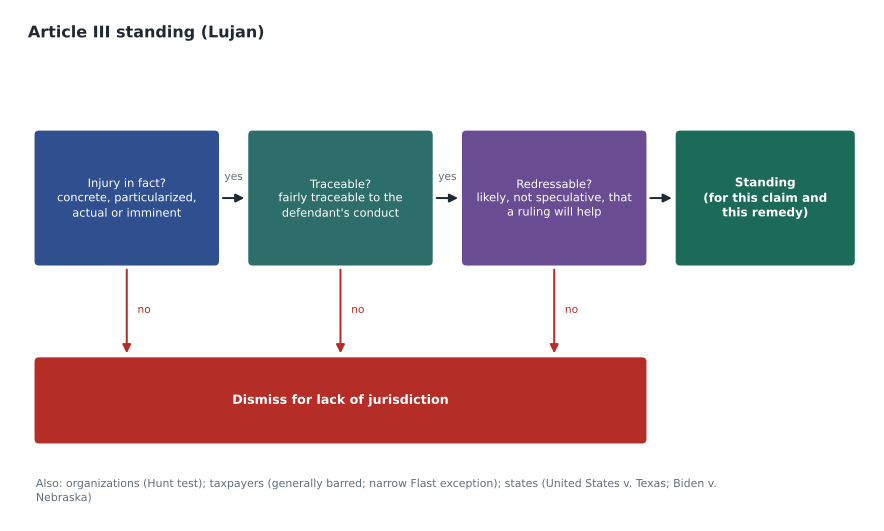
The classic statement comes from Lujan v. Defenders of Wildlife, 504 U.S. 555 (1992). To have standing, a plaintiff must show (1) an injury in fact, meaning an invasion of a legally protected interest that is concrete and particularized and actual or imminent, not conjectural or hypothetical; (2) causation, meaning the injury is fairly traceable to the challenged conduct of the defendant, not the result of the independent action of a third party not before the court; and (3) redressability, meaning it is likely, not merely speculative, that a favorable decision will redress the injury. The plaintiff bears the burden on each element, and the required proof grows as the case advances: allegations suffice at the pleading stage, but evidence is required at summary judgment and trial.
In Lujan, environmental groups challenged a rule that limited the Endangered Species Act's consultation requirement to federal projects in the United States, not abroad. Members of the groups had visited Egypt and Sri Lanka to observe endangered species and said they intended to return. Justice Scalia's opinion held this was not enough: "some day" intentions, without concrete plans, do not show imminent injury. A plurality also found redressability lacking because the agencies funding the projects abroad were not parties and might not follow the rule even if it changed. And the Court held that Congress's grant of a right to "any person" to sue did not by itself create standing for those without a concrete injury.
Concrete injury
TransUnion LLC v. Ramirez, 594 U.S. 413 (2021), sharpened the concreteness requirement. The credit reporting agency TransUnion had placed alerts in the files of about 8,000 people falsely suggesting they matched names on a government list of terrorists and drug traffickers. For about 1,800 of them, TransUnion actually sent the misleading reports to businesses. The Court, in an opinion by Justice Kavanaugh, held that only those 1,800 had standing to seek damages: the dissemination of false, damaging information resembled the traditional harm of defamation, but an inaccurate file that no one saw was not a concrete harm. Congress may "elevate" harms to legally cognizable status, but it cannot transform a bare statutory violation into an Article III injury. "No concrete harm, no standing."
Spokeo, Inc. v. Robins, 578 U.S. 330 (2016), had already said that intangible harms can be concrete, especially those with a close relationship to harms traditionally recognized at common law, and that a risk of real harm can sometimes suffice. TransUnion narrowed the risk point: a mere risk of future harm can support a claim for forward-looking relief such as an injunction, if the risk is sufficiently imminent and substantial, but not a claim for damages unless the risk itself caused a separate concrete harm.
Imminence is a recurring problem in challenges to government surveillance and future enforcement. In Clapper v. Amnesty International USA, 568 U.S. 398 (2013), lawyers and journalists who communicated with people abroad challenged a federal surveillance statute. The Court held that their fear of interception rested on a speculative chain of possibilities and that costs they incurred to avoid surveillance could not manufacture standing. Pre-enforcement challenges are possible, however: under Susan B. Anthony List v. Driehaus, 573 U.S. 149 (2014), a plaintiff may sue before being prosecuted if she intends to engage in conduct arguably affected with a constitutional interest, the conduct is arguably proscribed by the law, and there is a credible threat of enforcement.
Causation and redressability
The Court has recently decided several major cases on traceability, often where plaintiffs sue the government over its regulation, or failure to regulate, someone else. In FDA v. Alliance for Hippocratic Medicine, 602 U.S. 367 (2024), doctors and medical associations opposed to abortion challenged the FDA's 2016 and 2021 changes relaxing the conditions for prescribing mifepristone. A unanimous Court, in an opinion by Justice Kavanaugh, held they lacked standing. They did not prescribe the drug, and their claim that they might someday have to treat a patient with complications, possibly against their conscience, was too speculative; federal conscience laws already protected them. The Court also rejected the associations' claim that diverting resources to oppose the policy was an injury: an organization "cannot spend its way into standing."
In Murthy v. Missouri, 603 U.S. 43 (2024), states and social media users argued that federal officials had coerced platforms into removing their posts. The Court held they had not shown that their particular restrictions were traceable to government pressure rather than the platforms' own decisions, or that an injunction against the officials would likely prevent future restrictions. By contrast, in Department of Commerce v. New York, 588 U.S. 752 (2019), states had standing to challenge a citizenship question on the census because evidence showed it would predictably reduce responses and cost them federal funds and representation: a third party's reaction can satisfy causation when it is predictable.
Redressability asks whether a court order would help. In Haaland v. Brackeen, 599 U.S. 255 (2023), Texas and individual plaintiffs challenged the Indian Child Welfare Act's placement preferences. The Court held that the individual plaintiffs lacked standing for their equal protection claim because an injunction against the federal defendants would not bind the state officials who actually applied the preferences in custody proceedings. The case is a reminder to ask who would have to obey the judgment.
Special kinds of plaintiffs
Organizations may sue on their own behalf, if they suffer injury as organizations, or on behalf of members. Under Hunt v. Washington State Apple Advertising Commission, 432 U.S. 333 (1977), associational standing requires that at least one member would have standing to sue individually, the interests at stake are germane to the organization's purpose, and neither the claim nor the relief requires individual members' participation. In SFFA v. Harvard, 600 U.S. 181 (2023), the Court held that Students for Fair Admissions, a membership organization of applicants, met this test.
Taxpayer standing is generally barred: a taxpayer's interest in how the Treasury spends money is shared by millions and too remote. Frothingham v. Mellon, 262 U.S. 447 (1923), established the rule. The narrow exception from Flast v. Cohen, 392 U.S. 83 (1968), allows taxpayers to challenge congressional appropriations alleged to violate the Establishment Clause, but Hein v. Freedom From Religion Foundation, 551 U.S. 587 (2007), refused to extend it to discretionary executive spending, and Arizona Christian School Tuition Organization v. Winn, 563 U.S. 125 (2011), refused to extend it to tax credits. Legislators generally lack standing to assert institutional injuries to their chamber (Raines v. Byrd, 521 U.S. 811 (1997)), though a legislature as a whole may sometimes sue.
States are frequent constitutional litigants, and Massachusetts v. EPA, 549 U.S. 497 (2007), spoke of "special solicitude" for states asserting quasi-sovereign interests. More recent cases have been more demanding. In United States v. Texas, 599 U.S. 670 (2023), the Court held that Texas and Louisiana lacked standing to challenge federal immigration enforcement priorities, explaining that a state's indirect costs from federal enforcement choices do not ordinarily give standing to demand more arrests or prosecutions. In Biden v. Nebraska, 600 U.S. 477 (2023), by contrast, Missouri had standing to challenge the student loan forgiveness program because a state-created corporation that serviced loans would lose fees.
Third-party standing and prudential limits
As a prudential matter, a litigant ordinarily must assert her own rights, not those of others. Exceptions exist where the litigant has a close relationship with the third party and some hindrance prevents the third party from suing, as with doctors asserting patients' rights or vendors asserting customers' rights (Craig v. Boren, 429 U.S. 190 (1976), allowed a beer vendor to challenge an age limit that applied differently to men and women). In Lexmark International, Inc. v. Static Control Components, Inc., 572 U.S. 118 (2014), the Court reclassified the "zone of interests" requirement as a question of statutory interpretation rather than prudential standing, and suggested that other prudential limits sit uneasily with a court's obligation to decide cases within its jurisdiction.
Ripeness
Ripeness prevents courts from deciding disputes prematurely. Under Abbott Laboratories v. Gardner, 387 U.S. 136 (1967), a court considers the fitness of the issues for judicial decision and the hardship to the parties of withholding consideration. A purely legal challenge to a final regulation that requires immediate and costly compliance is ripe; a challenge that depends on contingent future events, or on how an agency will apply a rule in circumstances not yet arisen, may not be. Ripeness overlaps heavily with the imminence prong of standing, and in Susan B. Anthony List the Court treated them together.
Mootness
A case must remain live at every stage. If the plaintiff's injury ends, the case is moot, and a federal court must dismiss. In DeFunis v. Odegaard, 416 U.S. 312 (1974), a law student challenging his rejection under an affirmative action program had been admitted under a lower court order and was about to graduate, so the Court dismissed. Several exceptions keep cases alive. A dispute "capable of repetition, yet evading review" may be decided if the challenged action is too short to be fully litigated and there is a reasonable expectation the same plaintiff will face it again; Roe v. Wade invoked this because pregnancy ends before an appeal can be heard. Voluntary cessation by a defendant does not moot a case unless it is absolutely clear the conduct cannot reasonably be expected to recur (Friends of the Earth v. Laidlaw, 528 U.S. 167 (2000)); in FBI v. Fikre, 601 U.S. 234 (2024), the Court held that the government's removal of a man from the No Fly List, with a declaration that he would not be relisted based on currently available information, did not moot his challenge. Class actions can continue after the named plaintiff's claim ends if the class has been certified.
Political questions
Some issues, even if presented by injured plaintiffs, are not for courts to decide. Baker v. Carr, 369 U.S. 186 (1962), held that a challenge to malapportioned state legislative districts was justiciable under the Equal Protection Clause and set out six factors indicating a political question, chief among them "a textually demonstrable constitutional commitment of the issue to a coordinate political department" and "a lack of judicially discoverable and manageable standards for resolving it." Nixon v. United States, 506 U.S. 224 (1993), applied the first factor: the Constitution gives the Senate "the sole Power to try all Impeachments," so a federal judge could not challenge the Senate's use of a committee to hear evidence.
Rucho v. Common Cause, 588 U.S. 684 (2019), applied the second factor to partisan gerrymandering. Chief Justice Roberts's opinion held that claims of excessive partisanship in drawing districts present political questions beyond federal courts' reach, because there is no manageable standard for deciding how much partisanship is too much. Racial gerrymandering claims under the Equal Protection Clause and vote-dilution claims under the Voting Rights Act remain justiciable, and state courts may enforce state constitutional limits. By contrast, Zivotofsky v. Clinton, 566 U.S. 189 (2012), held that a challenge to a statute letting Americans born in Jerusalem list Israel as their birthplace on passports was justiciable: deciding whether a statute is constitutional is a familiar judicial task, even when it touches foreign affairs.
Worked problem
Applying standing to the Westmarch professor
Return to the opening story. Professor Gaines teaches at a private college in Westmarch that has not adopted the federal Department of Education rule on campus speech, which applies only to colleges that accept certain federal grants and choose to opt in. She sues the Department, claiming the rule is unconstitutional and that it makes her worry her college might adopt it someday. Does she have standing? What facts would change the answer?
Show solution
- Injury in fact: her worry is not concrete or imminent. The rule does not apply to her college, and adoption is speculative (Clapper; Lujan's "some day" intentions).
- Traceability: any future restriction would come from the college's independent choice to opt in, a third party not before the court (Murthy).
- Redressability: an injunction against the Department would not necessarily stop the college from adopting its own speech code.
- Changing the facts: if her college had opted in, she had been warned that a planned lecture violated the rule, and the college had announced enforcement, she would face a credible threat of enforcement and could bring a pre-enforcement challenge (Susan B. Anthony List).
- Organizational route: a professors' association could sue if at least one member had individual standing and the other Hunt factors were met.
Answer: On the original facts, she lacks standing: her injury is speculative, depends on a third party's choices, and would not be redressed by relief against the Department. With an opt-in by her college and a concrete threat of enforcement against her planned speech, she could bring a pre-enforcement challenge.
Why justiciability matters strategically
Whitford ends with practice advice. Government lawyers raise standing first because it can end a case without any ruling on the merits. Challengers choose plaintiffs carefully, gather declarations showing concrete injuries, and frame relief that a court can actually order. And since Trump v. CASA, Inc. (2025), which held that federal courts likely lack equitable authority to issue "universal" injunctions protecting people who are not parties, the choice of plaintiffs and of procedural vehicle, such as a class action under Rule 23, matters more than ever. Priya, who wants to be an appellate lawyer, writes in her notes: "Merits second. Jurisdiction first. Always."
Summary and key terms
- Article III limits federal courts to cases and controversies; they may not issue advisory opinions.
- Standing requires injury in fact (concrete, particularized, actual or imminent), traceability and redressability (Lujan); TransUnion requires a concrete harm for each plaintiff and each form of relief.
- Speculative chains of harm fail (Clapper; FDA v. Alliance for Hippocratic Medicine; Murthy); predictable third-party reactions can satisfy causation (Department of Commerce v. New York).
- Organizations may sue for members under Hunt; taxpayer standing is barred except the narrow Flast exception; state standing has been narrowed (United States v. Texas) but remains where a state suffers a direct financial injury (Biden v. Nebraska).
- Ripeness weighs fitness and hardship (Abbott Labs); mootness has exceptions for disputes capable of repetition yet evading review and for voluntary cessation (Laidlaw; Fikre).
- Political questions include issues textually committed elsewhere (Nixon v. United States) or lacking manageable standards (Rucho on partisan gerrymandering); Baker v. Carr lists the factors.
- Justiciability
- Whether a dispute is appropriate for decision by a federal court under Article III and related doctrines.
- Injury in fact
- A concrete and particularized harm that is actual or imminent.
- Redressability
- The likelihood that a favorable decision will remedy the plaintiff's injury.
- Associational standing
- An organization's standing to sue on behalf of its members under the Hunt test.
- Ripeness
- Whether a dispute has matured enough for judicial decision, judged by fitness and hardship.
- Mootness
- The end of a live controversy, requiring dismissal unless an exception applies.
- Capable of repetition, yet evading review
- A mootness exception for short-lived disputes likely to recur for the same plaintiff.
- Political question
- An issue committed to the political branches or lacking judicially manageable standards.
Practice problems
Work each problem on paper first, then reveal the answer to check.
A statute lets any consumer sue a company for listing an incorrect zip code in an internal file. A consumer whose file contains the wrong zip code, never shared with anyone, sues for statutory damages. Standing?
Show answer
No. Under TransUnion, a bare statutory violation without a concrete harm, such as dissemination or other real-world effect, does not satisfy Article III.
Why did the doctors in FDA v. Alliance for Hippocratic Medicine lack standing?
Show answer
They did not prescribe or use mifepristone, their claimed future injuries depended on a speculative chain of events, and an organization cannot create standing by spending money to oppose a policy.
A city repeals an ordinance two days before the Supreme Court argument, but says it may enact a similar one later. Is the case moot?
Show answer
Likely not. Voluntary cessation moots a case only if it is absolutely clear the conduct cannot reasonably be expected to recur, and the city's statement suggests it could.
Name the two Baker v. Carr factors the Court has relied on most.
Show answer
A textually demonstrable constitutional commitment of the issue to another branch, and a lack of judicially discoverable and manageable standards.
Lesson quiz · 5 questions
Score 60% or more to complete this lesson.
Create a free account to save your progress, take quizzes and earn a certificate.