
LAWU-111 · Lesson 8 of 12 · 22 min
Incorporation, state action and the Second Amendment
▶ Video coming soon A video version of this lesson is on the way.
The second half of the course turns to individual rights, and Whitford begins it with a puzzle. She projects the First Amendment: "Congress shall make no law respecting an establishment of religion, or prohibiting the free exercise thereof; or abridging the freedom of speech." "Congress," she says. "Not Westmarch, not the city of Larkhaven, not your employer. So why can a city be sued for censoring a speaker?" Daniel answers that the Fourteenth Amendment changed things. "And why," Whitford continues, "can't you sue your employer for firing you over a political post?" Jordan answers that private employers are not the government. "Two answers, two doctrines," she says. "Incorporation and state action. Together they decide whose conduct the Constitution governs."
The Bill of Rights and the states
As originally ratified, the Bill of Rights limited only the federal government. Barron v. Mayor and City Council of Baltimore, 32 U.S. (7 Pet.) 243 (1833), held that the Takings Clause did not apply to a city that had ruined a wharf owner's business by diverting streams: the amendments were adopted to protect against the new national government, and if the framers had meant to limit the states, they would have said so, as they did in Article I, section 10.
The Fourteenth Amendment, ratified in 1868, provides in section 1 that no state shall "make or enforce any law which shall abridge the privileges or immunities of citizens of the United States; nor shall any State deprive any person of life, liberty, or property, without due process of law; nor deny to any person within its jurisdiction the equal protection of the laws." Many of its framers expected the Privileges or Immunities Clause to apply the Bill of Rights to the states. But in the Slaughter-House Cases, 83 U.S. (16 Wall.) 36 (1873), the Court read that clause narrowly to protect only rights of national citizenship, such as access to ports and federal offices, leaving the great body of civil rights to the states.
Selective incorporation through due process
Instead, the Court used the Due Process Clause. Beginning with Chicago, Burlington and Quincy Railroad Co. v. Chicago, 166 U.S. 226 (1897), which applied the requirement of just compensation for takings, and Gitlow v. New York, 268 U.S. 652 (1925), which assumed that freedom of speech is among the liberties protected against the states, the Court gradually held that most provisions of the Bill of Rights are "incorporated" against the states through the Fourteenth Amendment's guarantee of liberty. Justice Black argued for total incorporation of all the first eight amendments; Justice Frankfurter argued that due process protects only rights "implicit in the concept of ordered liberty" (Palko v. Connecticut, 302 U.S. 319 (1937)). The Court took a middle path: selective incorporation, applying particular rights one at a time if they are "fundamental to our scheme of ordered liberty" or "deeply rooted in this Nation's history and tradition" (Duncan v. Louisiana, 391 U.S. 145 (1968); McDonald v. City of Chicago, 561 U.S. 742 (2010)).
Once incorporated, a right applies against the states with the same content as against the federal government. In Ramos v. Louisiana, 590 U.S. 83 (2020), the Court held that the Sixth Amendment right to a jury trial requires a unanimous verdict to convict of a serious offense in state as well as federal court, overruling a 1972 decision that had allowed Louisiana and Oregon to convict by 10-to-2 votes. Timbs v. Indiana, 586 U.S. 146 (2019), incorporated the Excessive Fines Clause. Today nearly all of the Bill of Rights applies to the states. The main exceptions are the Third Amendment's ban on quartering soldiers (never squarely decided by the Supreme Court), the Fifth Amendment right to grand jury indictment, and the Seventh Amendment right to a civil jury.
The state action requirement
The Fourteenth Amendment says "no State shall"; most of the Constitution's rights provisions restrict government. In the Civil Rights Cases, 109 U.S. 3 (1883), the Court held that Congress could not use section 5 of the Fourteenth Amendment to ban racial discrimination by private inns, theaters and railroads, because the amendment reaches only state action. Justice Harlan's lone dissent argued that public accommodations performed public functions and that the Thirteenth Amendment authorized Congress to abolish the "badges and incidents of slavery." (The Thirteenth Amendment, which bans slavery and involuntary servitude, is the exception: it applies directly to private conduct.) As lesson 3 explained, Congress later reached private discrimination through the Commerce Clause in the Civil Rights Act of 1964.
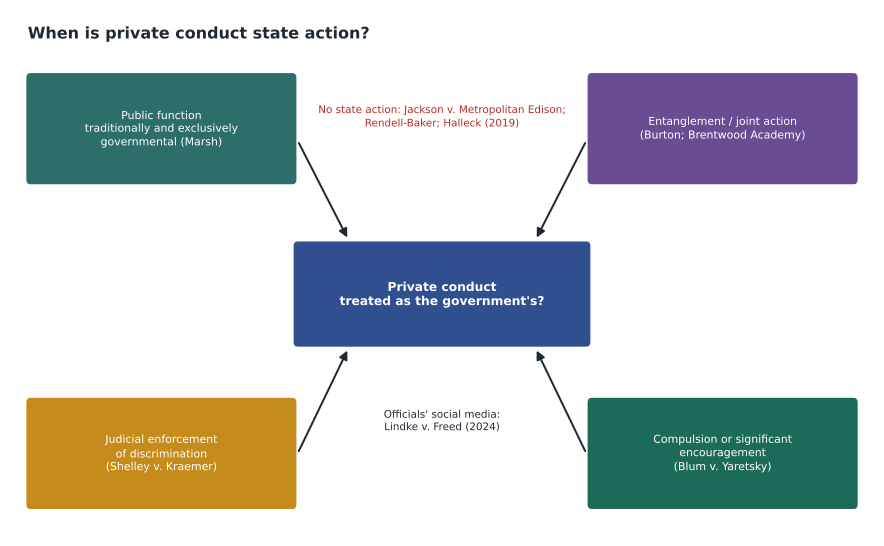
The state action requirement preserves a sphere of private freedom from constitutional rules: a private club may choose its members, a private newspaper may refuse to print an advertisement, and a private university may discipline students for speech that a public university could not punish. It also forces courts to decide when private conduct is so connected to the government that it should be treated as the government's. The Court has used several overlapping tests.
Public functions
A private party performing a function that has been "traditionally the exclusive prerogative of the State" is a state actor. In Marsh v. Alabama, 326 U.S. 501 (1946), a company town owned by a shipbuilding firm, with streets, sidewalks and a business district, could not bar a Jehovah's Witness from distributing literature; it had taken on all the attributes of a municipality. The Court has applied the public function test to running elections, as in the "white primary" cases such as Terry v. Adams, 345 U.S. 461 (1953), but has refused to extend it beyond functions that are both traditional and exclusive.
In Jackson v. Metropolitan Edison Co., 419 U.S. 345 (1974), a heavily regulated private utility with a monopoly was not a state actor when it cut off a customer's service, because supplying electricity is not exclusively governmental. Rendell-Baker v. Kohn, 457 U.S. 830 (1982), held that a private school funded almost entirely by public money was not a state actor when it fired teachers. Manhattan Community Access Corp. v. Halleck, 587 U.S. 802 (2019), held that a private nonprofit operating public access television channels under a city designation was not a state actor: operating a forum for speech is not a traditional, exclusive public function. Justice Kavanaugh's opinion warned that a broader test would subject private property owners and businesses that open their property to speech, including social media platforms, to First Amendment constraints.
Entanglement, encouragement and enforcement
Private conduct is also state action when the government is so entwined with it that the two are effectively joint actors, or when the government compels or significantly encourages it. In Burton v. Wilmington Parking Authority, 365 U.S. 715 (1961), a private restaurant leasing space in a city-owned parking garage, whose profits helped fund the garage, could not refuse to serve Black customers: the state had "so far insinuated itself into a position of interdependence" that it was a joint participant. In Brentwood Academy v. Tennessee Secondary School Athletic Association, 531 U.S. 288 (2001), a nominally private association regulating high school sports was a state actor because public schools made up most of its members, public officials ran it, and its employees were eligible for the state retirement system.
By contrast, in Blum v. Yaretsky, 457 U.S. 991 (1982), private nursing homes' decisions to transfer Medicaid patients were not state action despite state funding and regulation, because the decisions reflected the homes' own medical judgment rather than state compulsion. Shelley v. Kraemer, 334 U.S. 1 (1948), held that judicial enforcement of racially restrictive covenants in private deeds was state action that violated equal protection. Shelley has never been extended to treat every court enforcement of a private agreement as state action; it is usually confined to its facts.
Government officials using social media present a modern variant. In Lindke v. Freed, 601 U.S. 187 (2024), a city manager blocked a critic from his Facebook page, where he posted about both family life and city business. Justice Barrett's unanimous opinion held that an official's speech on social media is state action only if the official (1) possessed actual authority to speak on the government's behalf on the particular matter and (2) purported to exercise that authority in the relevant posts. Labels and appearance matter, but the key is whether the official was exercising the state's power. O'Connor-Ratcliff v. Garnier, 601 U.S. 205 (2024), a companion case, was sent back for application of the test.
The Second Amendment
The Second Amendment provides: "A well regulated Militia, being necessary to the security of a free State, the right of the people to keep and bear Arms, shall not be infringed." For most of the twentieth century, courts read it to protect only the arming of state militias. District of Columbia v. Heller, 554 U.S. 570 (2008), rejected that view. Justice Scalia's 5 to 4 opinion, relying on the amendment's original public meaning, held that it protects an individual right to keep and bear arms for self-defense, unconnected to militia service; the prefatory clause announces a purpose but does not limit the operative clause. The Court struck down the District of Columbia's ban on handguns in the home, the "quintessential self-defense weapon," and its requirement that other guns be kept inoperable. Heller added that "longstanding prohibitions" on possession by felons and the mentally ill, bans in sensitive places such as schools and government buildings, and conditions on commercial sale remain presumptively lawful. McDonald v. City of Chicago (2010) incorporated the right against the states.
Bruen and Rahimi
After Heller, lower courts used a two-step approach combining history with means-end scrutiny. New York State Rifle and Pistol Association v. Bruen, 597 U.S. 1 (2022), rejected the means-end step. Justice Thomas's 6 to 3 opinion held that when the Second Amendment's plain text covers an individual's conduct, the Constitution presumptively protects it, and the government must justify its regulation by demonstrating that it is consistent with the nation's historical tradition of firearm regulation. New York's requirement that applicants for a license to carry a handgun in public show "proper cause," a special need for self-defense, failed because no historical tradition supported such broad discretion to deny carrying for ordinary self-defense. The Court said modern laws need not have a historical "twin," only a "well-established and representative historical analog," judged by how and why the laws burden the right.
United States v. Rahimi, 602 U.S. 680 (2024), clarified the test. Zackey Rahimi was subject to a domestic violence restraining order after assaulting his girlfriend and was later charged under 18 U.S.C. section 922(g)(8), which bars possession of firearms by a person subject to such an order who has been found to pose a credible threat to an intimate partner or child. The Fifth Circuit had held the statute unconstitutional under Bruen. Chief Justice Roberts's 8 to 1 opinion reversed: the Second Amendment permits more than laws "trapped in amber," and the relevant question is whether a challenged law is consistent with the principles underlying the historical tradition. Founding-era surety laws and "going armed" laws showed a principle that individuals found to threaten physical violence to others may be disarmed. Justice Thomas dissented. Several Justices wrote separately about how much weight to give history after the founding.
Last June, in Wolford v. Lopez (2026), the Court applied Bruen to a 2023 Hawaii law that made it a crime for a licensed carrier to bring a gun onto private property open to the public, such as a store or parking lot, without the owner's express consent. Justice Alito's 6 to 3 opinion held the law unconstitutional: carrying in such places falls within the amendment's text, and Hawaii's historical analogues, including colonial laws against hunting on others' land without permission, addressed different harms. The default rule in most states, that carriers may enter property open to the public unless the owner says otherwise, leaves property owners free to exclude guns. Justice Jackson, joined by Justice Sotomayor, dissented, arguing there is no constitutional right to bring arms onto another's property without permission, and Justice Kagan dissented separately. Similar laws in California, Maryland, New Jersey and New York are now vulnerable.
| Case | Holding | Method |
|---|---|---|
| Heller (2008) | Individual right to keep arms for self-defense; D.C. handgun ban invalid | Original public meaning |
| McDonald (2010) | Right incorporated against the states | Selective incorporation through due process |
| Bruen (2022) | Proper-cause licensing invalid; means-end scrutiny rejected | Text, then historical tradition |
| Rahimi (2024) | Disarming people found to be credible threats to others is valid | Principles underlying historical tradition |
| Wolford (2026) | Ban on carrying onto private property open to the public without express consent invalid | Bruen's historical test |
Worked problem
A private security guard and a public stadium
The city of Larkhaven owns a stadium and leases it to a private company, Arena Partners, which keeps most of the revenue but must pay the city a share of ticket sales. Arena Partners' security guards, who are licensed by the state and have authority to detain people for trespass, eject a fan for holding a sign criticizing the mayor. The fan sues Arena Partners and the city for violating the First Amendment. Is there state action?
Show solution
- Public function: running a stadium is not a traditional, exclusive government function (Halleck; Jackson v. Metropolitan Edison), though detaining people for trespass draws on police power.
- Entanglement: the city owns the stadium and shares in revenue, as in Burton, which supports joint participation; but leasing public property does not by itself make a private tenant a state actor.
- Encouragement or compulsion: did the city direct or encourage removal of signs critical of the mayor? Evidence of a city instruction would make the ejection state action (Blum).
- Who is liable: if the guards were state actors, both they and possibly the city (if it had a policy) could be sued under 42 U.S.C. section 1983.
- Merits: if there is state action, ejecting a fan for a political sign in a stadium open to the public raises serious First Amendment concerns, depending on the forum.
Answer: State action is uncertain and turns on the facts. The strongest arguments are Burton-style interdependence (city ownership and revenue sharing) and any evidence that the city encouraged the removal. Without city involvement in the decision, a court following Halleck and Jackson would likely find no state action.
Summary and key terms
- Barron (1833) held the Bill of Rights originally bound only the federal government; the Slaughter-House Cases (1873) narrowed the Fourteenth Amendment's Privileges or Immunities Clause.
- Through selective incorporation under the Due Process Clause, nearly all Bill of Rights guarantees now apply to the states with the same content (Duncan; McDonald; Timbs; Ramos).
- Constitutional rights generally restrict only state action (Civil Rights Cases, 1883); the Thirteenth Amendment is an exception.
- Private conduct is state action when it performs a traditional, exclusive public function (Marsh), is entwined with or compelled by government (Burton; Brentwood; Blum), or involves judicial enforcement of discrimination (Shelley).
- Halleck (2019) refused to treat a private operator of a speech forum as a state actor; Lindke v. Freed (2024) set the test for officials' social media.
- The Second Amendment protects an individual right (Heller), incorporated against the states (McDonald); Bruen requires historical justification for regulations, Rahimi applies principles underlying tradition, and Wolford (2026) struck Hawaii's private-property default rule.
- Incorporation
- The application of Bill of Rights guarantees to the states through the Fourteenth Amendment's Due Process Clause.
- Selective incorporation
- The Court's approach of incorporating rights one at a time if fundamental to ordered liberty and deeply rooted in history.
- State action
- Conduct by the government, or private conduct attributable to it, which the Constitution's rights provisions restrict.
- Public function test
- The rule that private parties performing traditionally exclusive government functions are state actors.
- Entanglement
- Interdependence between government and private actors that makes private conduct state action.
- Historical tradition test
- Bruen's requirement that firearm regulations be consistent with the nation's historical tradition of regulation.
Practice problems
Work each problem on paper first, then reveal the answer to check.
Why did the Court in Halleck find no state action?
Show answer
Operating public access channels is not a function traditionally and exclusively performed by government, and the city's designation and regulation did not make the private nonprofit a state actor.
What does Lindke v. Freed require for an official's social media post to be state action?
Show answer
The official must have actual authority to speak for the government on the matter and must purport to exercise that authority in the posts at issue.
How did Rahimi refine Bruen?
Show answer
It explained that a modern law need not have a historical twin; it must be consistent with the principles underlying the historical tradition, here that people found to threaten violence may be disarmed.
Which Bill of Rights protections have not been incorporated against the states?
Show answer
Grand jury indictment (Fifth Amendment), civil jury trial (Seventh Amendment), and the Third Amendment, which the Court has not squarely addressed.
Lesson quiz · 5 questions
Score 60% or more to complete this lesson.
Create a free account to save your progress, take quizzes and earn a certificate.