
LAWU-111 · Lesson 12 of 12 · 23 min
Capstone: solving a constitutional law problem
▶ Video coming soon A video version of this lesson is on the way.
For the last class, Whitford distributes a four-page fact pattern and tells Section B to treat it as a practice exam. "A constitutional law exam is not a test of whether you remember Marbury," she says. "It is a test of whether you can see every constitutional question in a messy set of facts, put each one in the right framework, and argue both sides honestly. Today we do it together." She reminds them of the five-step checklist she has used all semester for each issue: identify the government actor and the power or right at stake; find the governing framework; state the test; apply it to the facts, arguing both sides; and conclude, with the strength of your prediction.
A method for constitutional problems
Whitford's method begins with two threshold questions. First, who is acting? Federal action raises questions of enumerated powers and separation of powers; state action raises questions of federalism limits (the dormant Commerce Clause and preemption) and of the Fourteenth Amendment; private action raises the state action question. Second, can a court hear the claim? Check standing, ripeness and mootness for each plaintiff and each form of relief before reaching the merits.
For federal laws, ask whether Congress had power (commerce, taxing, spending, Necessary and Proper, section 5 of the Fourteenth Amendment), then whether the law violates a structural limit (commandeering, coercive conditions, separation of powers, appointments and removal), then whether it violates an individual right. For state laws, ask whether federal law preempts them, whether they discriminate against or unduly burden interstate commerce, and whether they violate individual rights. For each individual rights claim, identify the right or classification, choose the level of scrutiny, and apply it.
The problem
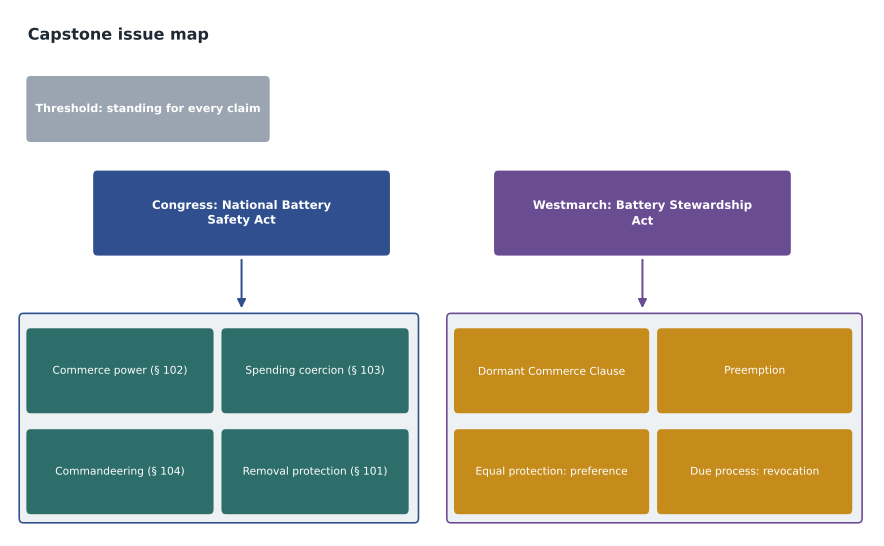
After a wave of garage fires caused by e-bike batteries, Congress enacts the National Battery Safety Act. Section 101 creates the National Battery Safety Commission, five members appointed by the President with Senate consent for staggered five-year terms, removable "only for neglect of duty or malfeasance in office." The Commission may issue binding safety rules for lithium-ion batteries, bring civil enforcement actions in federal court, and impose penalties after hearings before administrative law judges appointed by the Commission.
Section 102 makes it a federal crime to "charge, store, or possess" any lithium-ion battery of more than 500 watt-hours that does not meet the Commission's standards. Section 103 offers states grants for fire department training, but provides that any state that does not adopt the Commission's standards as state law within one year will lose all of its existing federal fire-assistance grants, which average about 3 percent of state budgets. Section 104 requires every county fire marshal to inspect battery retailers annually and to report violations to the Commission.
Meanwhile, the State of Westmarch enacts the Battery Stewardship Act. It requires every battery sold in Westmarch to be collected for recycling at the end of its life by a "Westmarch stewardship organization," defined as a nonprofit incorporated in Westmarch with a majority of its directors residing in the state. It gives a preference in state battery retailer licenses to applicants who are veterans of the armed forces and residents of Westmarch for at least five years. And it allows the state fire commissioner to revoke a retailer's license "immediately upon a finding of a safety violation," with a hearing available within 90 days.
Three plaintiffs sue. Kestrel North America LLC, the e-bike importer from the Delgado case, challenges sections 101 to 104 and the stewardship requirement. Rosa Delgado, who stores a 750 watt-hour e-bike battery in her garage, challenges section 102. Ridgeline Cycle Supply, an Ohio-based retailer with stores in Westmarch, challenges the licensing preference and the revocation procedure after its Westmarch license was revoked the day an inspector found an improperly stored battery.
Issue 1: Standing
Each plaintiff must show standing for each claim and each form of relief (TransUnion). Kestrel, as an importer whose batteries must meet the Commission's rules and who faces penalties, has standing to challenge the Commission's structure and rules: it is directly regulated, and in Seila Law and Collins regulated parties could challenge removal protections, though Collins limits retrospective relief to cases where the defect caused harm. Kestrel's standing to challenge section 103's grant conditions is weak: the conditions bind states, not importers, and any injury depends on states' choices (FDA v. Alliance for Hippocratic Medicine; Murthy). A state would be the proper plaintiff. Kestrel has standing to challenge the stewardship requirement if it must pay for or arrange end-of-life collection through Westmarch organizations.
Delgado faces possible prosecution under section 102 for storing a battery that does not meet the new standards. If her battery does not comply and the government has not disavowed enforcement, she can bring a pre-enforcement challenge (Susan B. Anthony List): her conduct is arguably proscribed and the threat of prosecution is credible. Ridgeline has standing to challenge the revocation procedure, having lost its license, and to challenge the licensing preference if it is ready and able to apply for licenses and is disadvantaged by the preference (Northeastern Florida Chapter of Associated General Contractors v. Jacksonville, 508 U.S. 656 (1993), recognized that the inability to compete on an equal footing is an injury).
Issue 2: The commerce power and section 102
Section 102 regulates charging, storing and possessing batteries, conduct that occurs in the home. The government will argue that the batteries are things in interstate commerce (Lopez category two), and that home charging is part of a comprehensive scheme regulating a national market in batteries, aggregable under Wickard and Raich: millions of noncompliant batteries in homes undermine the safety standards for the interstate market and affect the interstate markets for insurance and housing. Delgado will argue that possessing an item in one's home is noneconomic activity like gun possession in Lopez, that the statute has no jurisdictional element, and that home fire safety is a traditional state police power. She may also invoke NFIB's activity and inactivity distinction if the law effectively requires owners to buy new batteries.
Prediction: Raich is the closest precedent. Like marijuana, batteries are a fungible commodity with an established interstate market, and Congress could rationally conclude that exempting home possession would leave a gap in the regulatory scheme. Section 102 is likely valid, though the challenge is not frivolous, and adding a jurisdictional element would strengthen the statute. A separate due process argument (vagueness, if the standards are unclear) could also be raised.
Issue 3: Section 103's spending condition
The grant condition requires states to adopt federal standards as state law or lose existing fire-assistance funds. Under Dole, the condition must serve the general welfare, be unambiguous, relate to the federal interest in the program, not induce unconstitutional action, and not be coercive. Battery fire safety relates to fire-assistance grants, and the condition is clearly stated. The coercion question is closer than in Dole and less extreme than in NFIB: the threatened loss, about 3 percent of state budgets, is far more than the half of one percent in Dole and far less than the over 10 percent in NFIB. The state will argue that threatening an existing program to force acceptance of a new regulatory mandate is the kind of shift NFIB condemned; the government will argue that fire assistance and fire safety are one program and that 3 percent leaves a real choice.
A further problem: the condition requires states to adopt federal standards as state law, which looks like commandeering of the legislative process. But conditions on voluntary grants are generally permitted precisely because states may decline, as New York v. United States recognized. Prediction: probably valid, with coercion the main risk; a court finding coercion would follow NFIB's remedy and bar withdrawal of existing funds.
Issue 4: Section 104 and commandeering
Section 104 directly requires county fire marshals, who are local officers, to inspect retailers and report to the Commission, with no option to decline. Under Printz, Congress cannot command state or local executive officers to administer a federal regulatory program, and political subdivisions are covered. The government might argue that reporting is a minimal ministerial duty (some Justices in Printz left open reporting requirements), but inspections are core administration. Prediction: section 104 is unconstitutional and would be severed; Congress could instead fund federal inspectors or offer grants for voluntary state inspections.
Issue 5: The Commission's structure
The Commission is a multimember agency exercising substantial executive power: binding rules, enforcement litigation and penalties. After Trump v. Slaughter (2026), for-cause removal protection for such an agency is unconstitutional, because Article II vests the executive power in the President, who must be able to remove those who exercise it. Kestrel will seek invalidation of the Commission's actions; under Seila Law and Collins, the remedy is to sever the removal protection, leaving commissioners removable at will, and retrospective relief requires a showing that the protection caused harm, such as a President's stated wish to remove commissioners who adopted the challenged rule.
The administrative law judges are officers under Lucia and are properly appointed by the Commission as a head of department. If their decisions are final without Commission review, Arthrex requires a mechanism for review by a presidentially appointed officer. Kestrel could also argue that imposing civil penalties through agency adjudication violates its Seventh Amendment right to a jury, under SEC v. Jarkesy, 603 U.S. 109 (2024), which held that the SEC must bring fraud claims seeking civil penalties in court before a jury when they resemble common-law claims. Here the Commission may also sue in federal court, which avoids the problem for those actions. Prediction: the removal protection falls and is severed; the Commission survives.
Issue 6: Westmarch's stewardship requirement and the dormant Commerce Clause
Requiring collection by nonprofits incorporated in Westmarch with resident-majority boards discriminates on its face in favor of in-state organizations, much like the local processing requirements in Dean Milk and Pike and unlike the evenhanded law in Ross. It is virtually per se invalid unless Westmarch shows a legitimate local purpose that nondiscriminatory alternatives cannot serve. Westmarch will argue that local organizations are easier to supervise and more accountable; Kestrel will answer that licensing and auditing standards could ensure accountability for any qualified organization, wherever incorporated. The state might invoke the market participant exception or United Haulers, but the law regulates private sellers and private stewardship groups, not a public facility or the state's own purchases. Prediction: the residency and incorporation requirements are invalid.
Issue 7: Preemption
If the National Battery Safety Act contains an express preemption clause, or if the Commission's standards occupy the field of battery safety, Westmarch's laws may also be preempted to the extent they regulate battery safety. A stewardship law about recycling and end-of-life collection may be framed as environmental rather than safety regulation, so it might survive express preemption depending on the clause's wording. Conflict preemption would apply only if compliance with both laws were impossible or Westmarch's law obstructed federal objectives. Without more facts about the statute's text, the best answer identifies the question and explains how the clause's scope would decide it (lesson 5).
Issue 8: The licensing preference
The license preference has two parts. The veterans' preference, standing alone, is not a suspect classification and receives rational basis review; Feeney upheld a lifetime veterans' preference in state civil service despite its heavy impact on women, because the state acted to reward veterans, not to exclude women. The five-year residency requirement is different. Durational residency requirements that penalize new residents in obtaining important benefits implicate the right to travel (Saenz v. Roe) and receive heightened scrutiny, and Attorney General of New York v. Soto-Lopez, 476 U.S. 898 (1986), struck down a civil service preference limited to veterans who lived in New York when they entered the service. For an out-of-state retailer such as Ridgeline, a corporation, the Article IV Privileges and Immunities Clause does not apply, but the dormant Commerce Clause does, and a residency preference for licenses to sell goods discriminates against interstate commerce. Prediction: the veterans' preference alone is valid; the residency component is likely invalid.
Issue 9: Procedural due process for license revocation
Ridgeline's license, which can be revoked only on a finding of a safety violation, is a property interest under Roth: state law defines the conditions for keeping it. Under Mathews, the private interest is significant (a business's ability to operate); the risk of error from revocation on an inspector's finding without any opportunity to respond is real; and the state's interest in preventing fires is strong. Emergencies can justify immediate action with a prompt post-deprivation hearing, as with seizing contaminated food. The question is whether immediate revocation in every case, followed by a hearing up to 90 days later, is justified, or whether a temporary suspension limited to the dangerous condition, with a prompt hearing, would serve the state's interest. Ridgeline will cite Loudermill's requirement of at least an informal pre-deprivation opportunity to respond where feasible and argue that 90 days is not prompt. Prediction: a court would likely require either a pre-revocation opportunity to respond in non-emergency cases or a much prompter post-revocation hearing.
Writing the answer
Whitford reviews what separates strong exam answers from weak ones. Strong answers organize by issue with headings, address threshold questions first, state each test precisely with its source case, use the facts to argue both sides, and give calibrated conclusions ("likely," "probably," "a close question"). Weak answers recite every case they know, skip standing, and announce conclusions without analysis. She also reminds Section B that recent decisions such as Slaughter, Learning Resources, Skrmetti and B.P.J. change the frameworks, so answers should use the current law and mention when a question remains open, such as the status of the Federal Reserve after Trump v. Cook.
| Issue | Framework | Likely result |
|---|---|---|
| Standing | Lujan; TransUnion; Susan B. Anthony List | Kestrel, Delgado and Ridgeline have standing for their main claims; Kestrel lacks standing on the grant condition |
| Section 102 | Lopez; Wickard; Raich | Valid as part of a comprehensive scheme |
| Section 103 | Dole; NFIB | Probably valid; coercion is the risk |
| Section 104 | Printz | Invalid commandeering; severed |
| Removal protection | Seila Law; Trump v. Slaughter | Invalid; severed |
| Stewardship requirement | Dean Milk; Philadelphia v. New Jersey | Invalid facial discrimination |
| Licensing preference | Feeney; Saenz; Soto-Lopez; dormant Commerce Clause | Veterans' preference valid; residency component invalid |
| License revocation | Roth; Mathews; Loudermill | Process likely inadequate as written |
Worked problem
Writing one issue in exam form
Write a short exam answer to Issue 4: whether section 104's requirement that county fire marshals inspect battery retailers and report violations to the Commission is constitutional.
Show solution
- Issue: whether Congress may require local fire marshals to inspect and report under a federal program.
- Rule: Congress may not commandeer state legislatures (New York) or command state and local executive officers to administer or enforce a federal regulatory program (Printz); it may regulate private parties directly, use its own officers, or offer voluntary grants.
- Application: section 104 imposes mandatory inspection and reporting duties on local officers with no option to decline, which is administration of the federal program. The government's best argument is that reporting is ministerial, but annual inspections require local officers to devote time and judgment to federal enforcement, as the background checks did in Printz.
- Counterargument: if section 104 applied to fire marshals only as a condition of section 103 grants, it would be a permissible voluntary condition.
- Conclusion: section 104 is likely unconstitutional and severable, leaving the rest of the Act in force.
Answer: Section 104 likely violates the anti-commandeering doctrine under Printz because it compels local executive officers to administer a federal regulatory program. A court would sever it; Congress could achieve the same goal through federal inspectors or voluntary grant conditions.
Closing
Whitford ends the course where she began, with the pocket Constitution. "Every issue in this problem," she says, "started with words in this document and with a question about who decides what they mean. You now know the frameworks the Court uses, and you know that several of them changed in the last few years. They will change again. Read the text, read the cases, and argue both sides as if you might have to argue the other one tomorrow, because you might."
Summary and key terms
- Start every constitutional problem by identifying the government actor and checking justiciability for each plaintiff and remedy.
- For federal laws: power (commerce, taxing, spending, Necessary and Proper), structural limits (commandeering, coercion, separation of powers, removal), then individual rights.
- For state laws: preemption, the dormant Commerce Clause, then individual rights under the Fourteenth Amendment.
- For rights claims: identify the right or classification, choose the tier of scrutiny, and apply it to the facts.
- Use current law: Trump v. Slaughter, Learning Resources, Skrmetti, B.P.J. and Wolford reshaped key frameworks in 2025 and 2026; flag open questions such as the Federal Reserve's status.
- Write by issue, with precise rules, two-sided application and calibrated conclusions.
- Threshold issue
- A question, such as standing, that must be resolved before reaching the merits.
- Severability
- The remedy of striking only the unconstitutional provision and keeping the rest of a statute.
- Durational residency requirement
- A rule conditioning benefits on living in a state for a minimum period, scrutinized under the right to travel.
- Calibrated conclusion
- A prediction that states how strong the analysis is, such as likely or a close question.
Practice problems
Work each problem on paper first, then reveal the answer to check.
Why should standing be analyzed separately for each plaintiff and claim in the capstone?
Show answer
Because standing is not dispensed in gross; each plaintiff must show injury, traceability and redressability for each claim and form of relief, and Kestrel, for example, may have standing to challenge the Commission but not the grant conditions that bind states.
What is the remedy for an unconstitutional removal protection, and when can a challenger undo past agency action?
Show answer
The court severs the protection, leaving the officers removable at will; under Collins, past actions are set aside only if the challenger shows the protection actually caused harm.
Why does Ridgeline's challenge to the residency preference proceed under the dormant Commerce Clause rather than Article IV?
Show answer
Corporations are not citizens for purposes of the Article IV Privileges and Immunities Clause, but a residency preference for retail licenses discriminates against interstate commerce.
Name two recent decisions that changed frameworks used in the capstone.
Show answer
Trump v. Slaughter (2026) on removal of multimember agency members, and SEC v. Jarkesy (2024) on jury rights in agency penalty proceedings; others include Learning Resources and B.P.J.
Lesson quiz · 5 questions
Score 60% or more to complete this lesson.
Create a free account to save your progress, take quizzes and earn a certificate.