
LAWU-111 · Lesson 10 of 12 · 21 min
Substantive due process and unenumerated rights
▶ Video coming soon A video version of this lesson is on the way.
Whitford tells Section B at the start of the tenth class that this is the lesson where she will work hardest to keep her own views out of the room. "Every one of you will meet clients, judges and voters who feel strongly about these cases," she says. "Your job as lawyers is to understand the arguments well enough to make either side's best case." She writes the Ninth Amendment on the board: "The enumeration in the Constitution, of certain rights, shall not be construed to deny or disparage others retained by the people." Then she writes the Fourteenth Amendment's guarantee that no state shall deprive any person of "liberty" without due process of law. "The question for today," she says, "is whether courts may protect rights the Constitution does not name, and if so, which ones and how."
What is substantive due process?
On its face, the Due Process Clause guarantees procedure: no deprivation of liberty "without due process of law." But since the nineteenth century the Court has also read it to protect certain liberties against government interference regardless of the procedures used. Critics call the phrase "substantive due process" an oxymoron; Justice Thomas has urged the Court to abandon the doctrine and consider whether some of the same rights belong under the Privileges or Immunities Clause instead. Defenders answer that the word "liberty" has substantive content, that the doctrine has deep roots in Anglo-American ideas of law that binds even legislatures, and that it has been used to protect rights almost everyone now accepts, such as the right to marry a person of another race and parents' rights to direct their children's education.
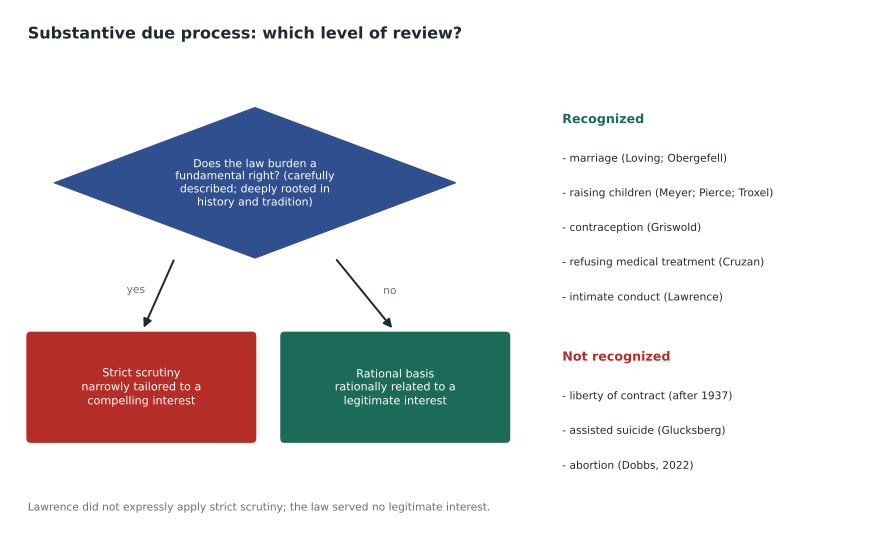
The doctrine has two strands. When a law burdens a fundamental right, courts apply strict scrutiny: the law must be narrowly tailored to serve a compelling government interest. When no fundamental right is involved, courts apply rational basis review: the law must be rationally related to a legitimate government interest, a test almost always satisfied. The decisive question is therefore which rights are fundamental.
The Lochner era and its end
In Lochner v. New York, 198 U.S. 45 (1905), the Court struck down a New York law limiting bakery employees to 10 hours a day and 60 hours a week, holding that it interfered with the liberty of contract protected by the Due Process Clause and was not a reasonable health measure. Justice Holmes's dissent became more famous than the majority: "The Fourteenth Amendment does not enact Mr. Herbert Spencer's Social Statics," he wrote, and a constitution "is not intended to embody a particular economic theory." For three decades the Court struck down minimum wage, maximum hours and other economic regulations, while upholding many others.
The era ended in 1937. West Coast Hotel Co. v. Parrish, 300 U.S. 379 (1937), upheld Washington's minimum wage law for women and overruled an earlier decision striking down a similar law. United States v. Carolene Products Co., 304 U.S. 144 (1938), announced that economic regulations would be presumed constitutional and upheld if any rational basis could support them, but its footnote 4 suggested more searching review for laws that violate specific constitutional prohibitions, restrict the political process, or target "discrete and insular minorities." Williamson v. Lee Optical of Oklahoma, Inc., 348 U.S. 483 (1955), showed how deferential rational basis became: the Court upheld a law forbidding opticians to fit old lenses into new frames without a prescription, imagining reasons the legislature might have had. "Lochnerizing" is now an accusation that judges are substituting their policy preferences for the legislature's.
Family, procreation and privacy
Even during and after the Lochner era, the Court protected certain personal liberties. Meyer v. Nebraska, 262 U.S. 390 (1923), struck down a law forbidding the teaching of foreign languages to young children, and Pierce v. Society of Sisters, 268 U.S. 510 (1925), struck down an Oregon law requiring children to attend public schools: "The child is not the mere creature of the State." Skinner v. Oklahoma, 316 U.S. 535 (1942), invalidated a law authorizing sterilization of some repeat offenders but not others, describing procreation as "one of the basic civil rights of man" (the case rested on equal protection).
Griswold v. Connecticut, 381 U.S. 479 (1965), struck down a Connecticut law forbidding the use of contraceptives, as applied to married couples. Justice Douglas's opinion found a right of privacy in the "penumbras" of several Bill of Rights guarantees; concurring Justices relied on the Ninth Amendment or on liberty under the Due Process Clause. Eisenstadt v. Baird, 405 U.S. 438 (1972), extended access to contraceptives to unmarried people. Loving v. Virginia, 388 U.S. 1 (1967), struck down Virginia's ban on interracial marriage under both the Equal Protection Clause and the Due Process Clause, calling marriage "one of the vital personal rights essential to the orderly pursuit of happiness." Moore v. City of East Cleveland, 431 U.S. 494 (1977), struck down a zoning ordinance that prevented a grandmother from living with her grandsons, protecting the extended family as "deeply rooted in this Nation's history and tradition." Troxel v. Granville, 530 U.S. 57 (2000), protected a fit parent's right to decide who may visit her children.
Roe, Casey and Dobbs
Roe v. Wade, 410 U.S. 113 (1973), held that the right of privacy encompasses a woman's decision whether to terminate a pregnancy, and set out a trimester framework: states could not regulate abortion in the first trimester except to require that a physician perform it, could regulate it to protect maternal health in the second, and could prohibit it after viability except where necessary to preserve the woman's life or health. Planned Parenthood of Southeastern Pennsylvania v. Casey, 505 U.S. 833 (1992), reaffirmed Roe's "central holding" on the basis of stare decisis and the liberty protected by the Due Process Clause, but replaced the trimester framework with an "undue burden" test: before viability, a state could not impose a substantial obstacle in the path of a woman seeking an abortion.
Dobbs v. Jackson Women's Health Organization, 597 U.S. 215 (2022), overruled both. Mississippi had banned most abortions after 15 weeks of pregnancy, well before viability. Justice Alito's opinion for five Justices held that the Constitution makes no reference to abortion and that no such right is implicitly protected by any constitutional provision, because the right is not "deeply rooted in this Nation's history and tradition" or "implicit in the concept of ordered liberty." The opinion surveyed laws criminalizing abortion at various stages in most states when the Fourteenth Amendment was adopted. Applying the stare decisis factors (lesson 1), the majority concluded that Roe was "egregiously wrong" and that Casey's undue burden test was unworkable. Abortion laws are now reviewed for a rational basis, and the issue was "returned to the people and their elected representatives." Chief Justice Roberts concurred in the judgment, preferring to uphold Mississippi's law without overruling Roe entirely.
The majority stressed that its decision concerned abortion alone, because abortion uniquely involves what it called "potential life," and that nothing in the opinion should cast doubt on precedents that do not concern abortion. Justice Kavanaugh's concurrence emphasized the Constitution's neutrality on abortion and said the decision does not threaten Griswold, Loving or Obergefell. Justice Thomas's concurrence urged the Court to reconsider all of its substantive due process precedents, naming Griswold, Lawrence and Obergefell. The joint dissent of Justices Breyer, Sotomayor and Kagan argued that the majority's history test would have excluded women and freed slaves from the original understanding of liberty, that the decision threatened other rights resting on the same foundation, and that it abandoned stare decisis.
Since Dobbs, abortion law has varied widely by state. Many states ban or sharply restrict abortion, while others protect it by statute, and voters in several states have approved state constitutional amendments protecting abortion rights. Litigation has shifted to state constitutions, federal statutes such as the Emergency Medical Treatment and Labor Act (the Court dismissed Moyle v. United States, 603 U.S. 324 (2024), without deciding whether it preempts Idaho's ban in medical emergencies), and FDA regulation of medication abortion (lesson 2).
Defining rights: Glucksberg
How should courts decide whether an unenumerated right is fundamental? Washington v. Glucksberg, 521 U.S. 702 (1997), upheld Washington's ban on assisting suicide against a challenge by physicians and terminally ill patients. Chief Justice Rehnquist's opinion required (1) a "careful description" of the asserted liberty interest, framed specifically, and (2) proof that the interest is "deeply rooted in this Nation's history and tradition" and "implicit in the concept of ordered liberty." Framed carefully, the right at issue was a right to commit suicide with another's assistance, which the nation's long tradition of prohibiting assisted suicide did not support. Cruzan v. Director, Missouri Department of Health, 497 U.S. 261 (1990), had assumed that a competent person has a liberty interest in refusing unwanted medical treatment, including nutrition and hydration, while allowing a state to require clear and convincing evidence of an incompetent patient's wishes.
The level of generality at which a right is described often decides the case. Described generally, as a right to make intimate decisions about one's own life, many claims succeed; described specifically, as a right to engage in a particular act, many fail. Justice Kennedy's opinions took a broader view, and Dobbs reaffirmed Glucksberg's approach.
Lawrence and Obergefell
Bowers v. Hardwick, 478 U.S. 186 (1986), had upheld a Georgia law criminalizing sodomy as applied to two men, framing the question as whether there is a fundamental right to engage in homosexual sodomy. Lawrence v. Texas, 539 U.S. 558 (2003), overruled Bowers. Justice Kennedy's opinion held that Texas's law criminalizing intimate sexual conduct between people of the same sex violated the liberty protected by the Due Process Clause: "The State cannot demean their existence or control their destiny by making their private sexual conduct a crime." Notably, the Court did not expressly call the right fundamental or apply strict scrutiny; it held the law furthered no legitimate state interest that could justify its intrusion. Justice O'Connor concurred on equal protection grounds.
Obergefell v. Hodges, 576 U.S. 644 (2015), held 5 to 4 that the Fourteenth Amendment requires states to license marriages between two people of the same sex and to recognize such marriages lawfully performed elsewhere. Justice Kennedy relied on both due process and equal protection, describing four principles: the right to personal choice regarding marriage is inherent in individual autonomy; marriage supports a two-person union unlike any other; it safeguards children and families; and it is a keystone of the social order. Chief Justice Roberts's dissent argued that the Constitution had "nothing to do with" the decision and that the issue belonged to voters. Congress later enacted the Respect for Marriage Act of 2022, which requires federal recognition of valid same-sex and interracial marriages and requires states to recognize marriages validly performed in other states, though it does not require any state to issue licenses. The Court has not revisited Obergefell since Dobbs.
Economic liberty and property today
Economic regulations still receive only rational basis review under the Due Process Clause, but property owners have other protections. The Takings Clause of the Fifth Amendment, incorporated against the states, requires just compensation when government takes private property for public use. Tyler v. Hennepin County, 598 U.S. 631 (2023), held that a county that seized a woman's condominium for about 15,000 dollars in unpaid taxes and sold it for 40,000 dollars could not keep the surplus. Sheetz v. County of El Dorado, 601 U.S. 267 (2024), held that conditions on building permits imposed by legislatures, not just those imposed by administrators, must satisfy the "essential nexus" and "rough proportionality" tests. Due process also limits grossly excessive punitive damages (BMW of North America, Inc. v. Gore, 517 U.S. 559 (1996); State Farm Mutual Automobile Insurance Co. v. Campbell, 538 U.S. 408 (2003)), as Torts explained.
| Right claimed | Leading case | Status in 2026 |
|---|---|---|
| Liberty of contract | Lochner (1905); West Coast Hotel (1937) | Rejected; economic laws get rational basis review |
| Parental direction of education | Meyer (1923); Pierce (1925) | Protected |
| Contraception | Griswold (1965); Eisenstadt (1972) | Protected |
| Marriage | Loving (1967); Obergefell (2015) | Protected |
| Abortion | Roe (1973); Casey (1992); Dobbs (2022) | Not a federal constitutional right after Dobbs |
| Intimate conduct | Lawrence (2003) | Protected |
| Physician-assisted suicide | Glucksberg (1997) | Not a fundamental right |
Worked problem
A state ban on lab-grown meat
Westmarch bans the sale of meat grown from animal cells in laboratories, citing uncertainty about long-term health effects and the importance of the state's cattle industry. A restaurant owner who wants to serve cultivated chicken and a diner who wants to eat it sue, claiming the ban violates substantive due process by infringing their liberty to pursue a lawful occupation and to choose what to eat. Analyze.
Show solution
- Characterize the right carefully (Glucksberg): the right to sell or eat a particular novel food product.
- History and tradition: no deeply rooted tradition protects a right to sell or consume any specific food free from regulation; food has long been regulated for safety and other reasons.
- Level of review: absent a fundamental right, rational basis applies (Carolene Products; Lee Optical).
- Rational basis: health uncertainty is a legitimate interest, and a ban is a rational means even if overinclusive; protecting a local industry is more doubtful as a legitimate interest by itself, but the court will uphold the law if any legitimate rationale is conceivable.
- Other claims: the dormant Commerce Clause (lesson 5) is the more promising route if the ban discriminates against out-of-state producers in purpose or effect.
Answer: The substantive due process claim almost certainly fails: there is no fundamental right to sell or eat a particular food, and the ban is rationally related to the legitimate interest in food safety. A dormant Commerce Clause claim alleging protectionist purpose would be the stronger challenge.
Summary and key terms
- Substantive due process protects certain liberties against government interference regardless of procedure; laws burdening fundamental rights get strict scrutiny, others rational basis.
- Lochner (1905) protected liberty of contract; West Coast Hotel (1937) and Carolene Products (1938) ended that era, and economic laws now get deferential review (Lee Optical).
- The Court has protected family and personal autonomy: Meyer, Pierce, Griswold, Eisenstadt, Loving, Moore, Troxel.
- Roe (1973) and Casey (1992) protected a right to abortion; Dobbs (2022) overruled them, holding the right is not deeply rooted in history and tradition.
- Glucksberg (1997) requires a careful description of the right and proof that it is deeply rooted; Dobbs reaffirmed that approach.
- Lawrence (2003) protected intimate conduct; Obergefell (2015) required states to license and recognize same-sex marriages; the Respect for Marriage Act (2022) adds federal and interstate recognition.
- Property owners rely mainly on the Takings Clause (Tyler, 2023; Sheetz, 2024) and limits on punitive damages.
- Substantive due process
- The doctrine that the Due Process Clause protects certain liberties from government interference regardless of procedure.
- Fundamental right
- A right, enumerated or deeply rooted in history and tradition, whose burdening triggers strict scrutiny.
- Strict scrutiny
- Review requiring a law to be narrowly tailored to serve a compelling government interest.
- Rational basis review
- Deferential review asking whether a law is rationally related to a legitimate government interest.
- Lochnerizing
- Pejorative term for judges striking down economic regulation based on their own policy views.
- Careful description
- Glucksberg's requirement that an asserted right be framed specifically before asking whether it is deeply rooted.
Practice problems
Work each problem on paper first, then reveal the answer to check.
What test did Dobbs apply to decide whether abortion is a fundamental right?
Show answer
Whether the right is deeply rooted in the nation's history and tradition and implicit in the concept of ordered liberty, as described in Glucksberg; the majority found that abortion was not.
Why does the level of generality matter in substantive due process cases?
Show answer
A broadly described right, such as personal autonomy in intimate matters, is easier to find in tradition than a narrowly described one, such as assisted suicide; framing often decides the outcome.
Did Lawrence v. Texas apply strict scrutiny?
Show answer
Not expressly. The Court held that the law furthered no legitimate state interest that could justify its intrusion into personal liberty, without formally declaring a fundamental right.
What does the Respect for Marriage Act require, and what does it not require?
Show answer
It requires federal recognition of valid same-sex and interracial marriages and requires states to recognize marriages validly performed elsewhere; it does not require states to issue marriage licenses to same-sex couples.
Lesson quiz · 5 questions
Score 60% or more to complete this lesson.
Create a free account to save your progress, take quizzes and earn a certificate.