
LAWU-111 · Lesson 11 of 12 · 22 min
Equal protection
▶ Video coming soon A video version of this lesson is on the way.
On the morning of the eleventh class, Whitford hands each student a card with a single classification written on it: "race," "sex," "age over 65," "noncitizen," "income," "children of unmarried parents," "people with intellectual disabilities," "opticians." She asks them to line up across the front of the room from the classification courts trust least to the one they trust most. Jordan, holding "race," goes to one end without hesitation. Marcus, holding "opticians," goes to the other. The middle is crowded and contested. "That line," Whitford says, "is the tiers of scrutiny. The Equal Protection Clause applies to every law that draws a line between people, which is almost every law. The question is how hard a court will look."
The clause and the tiers
Section 1 of the Fourteenth Amendment forbids any state to "deny to any person within its jurisdiction the equal protection of the laws." The clause does not mention the federal government, but Bolling v. Sharpe, 347 U.S. 497 (1954), decided the same day as Brown v. Board of Education, held that the Fifth Amendment's Due Process Clause includes an equivalent guarantee against the federal government, and the Court applies the same standards to both. Equal protection forbids treating similarly situated people differently without adequate justification. Because all laws classify, the Court calibrates review according to the classification.
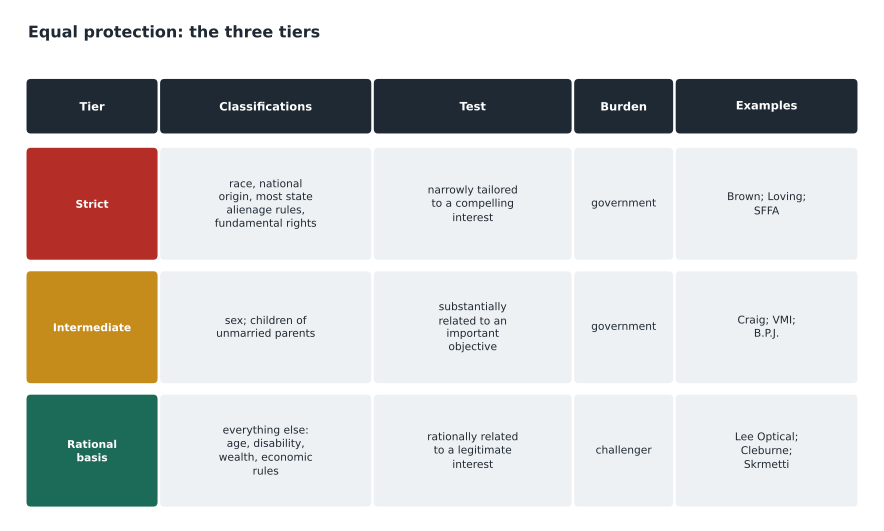
Strict scrutiny applies to classifications based on race, ethnicity, national origin and, with exceptions, alienage, and to classifications that burden fundamental rights. The government must show that the classification is narrowly tailored to achieve a compelling interest. Intermediate scrutiny applies to classifications based on sex and on the marital status of a child's parents; the government must show the classification is substantially related to an important government objective, and for sex, that it has an "exceedingly persuasive justification." Rational basis review applies to everything else, including classifications based on age, disability, wealth and economic activity; the challenger must show the classification is not rationally related to any legitimate government interest. Whitford stresses that the tier usually decides the case: strict scrutiny is "strict in theory, fatal in fact" in most cases, and rational basis almost always upholds the law.
Race: from Plessy to Brown
The Fourteenth Amendment was adopted to secure equality for formerly enslaved people, and Strauder v. West Virginia, 100 U.S. 303 (1880), struck down a law limiting jury service to white men. But Plessy v. Ferguson, 163 U.S. 537 (1896), upheld a Louisiana law requiring separate railway cars for white and Black passengers, reasoning that separate facilities did not imply inferiority. Justice Harlan's dissent declared that "our Constitution is color-blind, and neither knows nor tolerates classes among citizens." In Korematsu v. United States, 323 U.S. 214 (1944), the Court upheld the wartime exclusion of Japanese Americans from the West Coast, while announcing that racial classifications are "immediately suspect" and subject to "the most rigid scrutiny." The Court formally repudiated Korematsu in Trump v. Hawaii (2018): "Korematsu was gravely wrong the day it was decided."
Brown v. Board of Education, 347 U.S. 483 (1954), held that segregated public schools violate equal protection: "in the field of public education the doctrine of 'separate but equal' has no place. Separate educational facilities are inherently unequal." Chief Justice Warren's unanimous opinion relied on the importance of education and on the harm segregation inflicts on Black children's sense of their status. Brown II, 349 U.S. 294 (1955), ordered desegregation "with all deliberate speed," an ambiguous mandate that Southern states exploited for years. Loving v. Virginia (1967) struck down bans on interracial marriage, rejecting the argument that such laws were equal because they applied to both races.
Discriminatory purpose
A law that classifies by race on its face triggers strict scrutiny. A facially neutral law triggers strict scrutiny only if it was adopted with a discriminatory purpose; disparate impact alone is not enough. In Washington v. Davis, 426 U.S. 229 (1976), a written test for police recruits that more Black applicants than white applicants failed was upheld because there was no evidence of a purpose to discriminate. (Title VII of the Civil Rights Act of 1964 reaches some disparate impacts in employment, but the Constitution does not.) Village of Arlington Heights v. Metropolitan Housing Development Corp., 429 U.S. 252 (1977), listed evidence that can show purpose: a stark pattern of impact unexplainable on other grounds, the historical background of the decision, departures from normal procedures, and legislative or administrative history. Personnel Administrator of Massachusetts v. Feeney, 442 U.S. 256 (1979), held that purpose means the decision maker acted "because of," not merely "in spite of," the law's adverse effects on a group.
Discriminatory administration of a neutral law also violates equal protection. In Yick Wo v. Hopkins, 118 U.S. 356 (1886), San Francisco officials denied laundry permits to all of about two hundred Chinese applicants while granting them to nearly all non-Chinese applicants under an ordinance neutral on its face. In redistricting, racial gerrymanders that use race as the predominant factor in drawing districts trigger strict scrutiny (Shaw v. Reno, 509 U.S. 630 (1993)). Alexander v. South Carolina State Conference of the NAACP, 602 U.S. 1 (2024), emphasized that courts must presume legislatures act in good faith and that challengers must disentangle race from partisanship, which is a permissible consideration after Rucho.
Affirmative action and SFFA
Race-conscious government action intended to benefit minority groups is also subject to strict scrutiny. Richmond v. J.A. Croson Co., 488 U.S. 469 (1989), applied strict scrutiny to a city's set-aside of construction contracts for minority-owned businesses, and Adarand Constructors, Inc. v. Peña, 515 U.S. 200 (1995), extended it to federal programs. Remedying specific, identified past discrimination by the government itself can be a compelling interest; remedying general societal discrimination is not.
In higher education, Regents of the University of California v. Bakke, 438 U.S. 265 (1978), struck down a medical school's quota, but Justice Powell's controlling opinion accepted student body diversity as a compelling interest that could justify considering race as one factor. Grutter v. Bollinger, 539 U.S. 306 (2003), upheld the University of Michigan Law School's holistic consideration of race, while Gratz v. Bollinger, 539 U.S. 244 (2003), struck down the undergraduate program's automatic points.
Students for Fair Admissions, Inc. v. President and Fellows of Harvard College, 600 U.S. 181 (2023), ended that line of cases. Chief Justice Roberts's opinion held that Harvard's and the University of North Carolina's race-conscious admissions programs violated the Equal Protection Clause (and, for Harvard, Title VI of the Civil Rights Act, which applies the same standard to private institutions receiving federal funds). The universities' interests, such as training future leaders and promoting a robust exchange of ideas, were not sufficiently measurable to permit judicial review; the programs used race negatively, since admissions are zero-sum; they relied on racial stereotypes and crude categories; and they had no logical end point. The opinion added that applicants may still discuss how race has affected their lives, through discrimination, inspiration or otherwise, so long as an applicant is treated as an individual and not on the basis of race. The Court noted that military academies were not before it. Justice Thomas, concurring, defended a color-blind Constitution; Justice Sotomayor's dissent argued that the Equal Protection Clause permits race-conscious efforts to achieve integration and that the decision would entrench inequality; Justice Jackson's dissent focused on the persistence of racial disparities.
Sex
For most of American history, the Court upheld laws treating women differently, often on paternalistic grounds. Reed v. Reed, 404 U.S. 71 (1971), was the first decision to strike down a sex-based law, an Idaho preference for men as estate administrators. In Frontiero v. Richardson, 411 U.S. 677 (1973), a plurality would have applied strict scrutiny to sex classifications. Craig v. Boren, 429 U.S. 190 (1976), settled on intermediate scrutiny, striking down an Oklahoma law allowing women to buy 3.2 percent beer at 18 but men only at 21, because the statistical link between sex and drunk driving was too weak.
United States v. Virginia, 518 U.S. 515 (1996), held that the Virginia Military Institute could not exclude women. Justice Ginsburg's opinion required an "exceedingly persuasive justification" and held that the justification must be genuine, not invented after the fact, and must not rely on overbroad generalizations about the different talents, capacities or preferences of men and women. Virginia's separate leadership program for women at another college was not equal. Laws based on real biological differences have been upheld, as in Nguyen v. INS, 533 U.S. 53 (2001), which sustained different citizenship rules for children born abroad to unmarried citizen fathers and mothers, but Sessions v. Morales-Santana, 582 U.S. 47 (2017), struck down a residency requirement that favored unwed citizen mothers, finding it rested on stereotypes.
Transgender status: Skrmetti and B.P.J.
United States v. Skrmetti (2025) addressed Tennessee's law prohibiting puberty blockers and hormones for minors when used to treat gender dysphoria, while permitting them for other purposes. Chief Justice Roberts's 6 to 3 opinion held that the law classified on the basis of age and medical use, not sex or transgender status, and therefore received only rational basis review, which it easily passed given the ongoing scientific and policy debate. The Court did not decide whether transgender status is a quasi-suspect class or whether the reasoning of Bostock v. Clayton County (2020), which held that firing someone for being transgender is sex discrimination under Title VII, applies to the Equal Protection Clause. Justices Thomas, Alito and Barrett wrote that transgender status is not a suspect class. Justice Sotomayor, joined by Justice Jackson and in part by Justice Kagan, dissented, arguing that the law classifies by sex and warranted intermediate scrutiny.
Last June, in West Virginia v. B.P.J. and Little v. Hecox (2026), the Court upheld West Virginia and Idaho laws limiting girls' and women's school sports teams to biological females. Justice Kavanaugh's opinion applied intermediate scrutiny, because the laws expressly classify by sex, and held that the states' interests in safety and competitive fairness justified the classification, including as applied to athletes who had not gone through male puberty. The Court also held, unanimously, that the laws do not violate Title IX, reading "sex" in that statute to mean biological sex. Justice Sotomayor, joined by Justices Kagan and Jackson, dissented on the constitutional question, arguing that the case should have been remanded for fact-finding on whether athletes like B.P.J. are similarly situated to other girls.
Other classifications
Classifications of noncitizens by states generally receive strict scrutiny (Graham v. Richardson, 403 U.S. 365 (1971), invalidating welfare restrictions), except for positions involving the exercise of political functions, such as police officers and public school teachers, where rational basis applies. Federal immigration classifications receive great deference. Plyler v. Doe, 457 U.S. 202 (1982), struck down a Texas law denying free public education to undocumented children, applying a heightened form of rational basis review because the law punished children for their parents' conduct and denied them education's foundational benefits. Classifications based on whether a child's parents were married receive intermediate scrutiny (Clark v. Jeter, 486 U.S. 456 (1988)).
Age, disability and wealth receive rational basis review. Massachusetts Board of Retirement v. Murgia, 427 U.S. 307 (1976), upheld mandatory retirement of state police at 50, and San Antonio Independent School District v. Rodriguez, 411 U.S. 1 (1973), upheld Texas's school funding system based on local property taxes, holding that wealth is not a suspect class and education is not a fundamental right under the federal Constitution. Many state courts have since struck down school finance systems under their own constitutions.
Sometimes rational basis has bite. When a law appears to rest on animus toward an unpopular group, the Court has struck it down: in USDA v. Moreno, 413 U.S. 528 (1973), a food stamp rule aimed at "hippie communes"; in City of Cleburne v. Cleburne Living Center, Inc., 473 U.S. 432 (1985), a permit requirement for a group home for people with intellectual disabilities; in Romer v. Evans, 517 U.S. 620 (1996), a Colorado constitutional amendment barring any protection of gay people from discrimination; and in United States v. Windsor, 570 U.S. 744 (2013), the federal Defense of Marriage Act's refusal to recognize valid same-sex marriages. "A bare desire to harm a politically unpopular group cannot constitute a legitimate governmental interest."
Fundamental rights under equal protection
Equal protection also protects certain fundamental rights from unequal distribution. Reynolds v. Sims, 377 U.S. 533 (1964), required state legislative districts of substantially equal population, the principle of "one person, one vote." Harper v. Virginia State Board of Elections, 383 U.S. 663 (1966), struck down a poll tax in state elections. Bush v. Gore, 531 U.S. 98 (2000), held that Florida's recount, using varying standards from county to county for determining a voter's intent, violated equal protection, a holding the Court said was "limited to the present circumstances." The right to travel between states, protected by Saenz v. Roe (lesson 5), and access to the courts in some contexts also receive protection.
Worked problem
A scholarship program and an age limit
Westmarch creates two programs. Program A offers full scholarships at the state university to graduates of high schools in counties where the average household income is in the lowest fifth of the state; because of residential patterns, about 70 percent of recipients are members of one racial minority group. The legislature's reports discuss economic need and never mention race. Program B limits eligibility for a state-funded job retraining program to workers under 55. Analyze both under equal protection.
Show solution
- Program A, classification: facially it classifies by county income, not race, so strict scrutiny applies only if there is a discriminatory purpose (Washington v. Davis; Arlington Heights).
- Program A, evidence: the reports discuss only economic need; a disparate racial impact, even a large one, is not enough without evidence that the legislature acted because of race (Feeney). After SFFA, challengers will look for evidence that income was used as a proxy for race.
- Program A, review: absent purpose, rational basis applies, and expanding opportunity for low-income students is plainly legitimate.
- Program B, classification: age receives rational basis review (Murgia).
- Program B, review: the state could rationally conclude that retraining younger workers yields more years of employment per dollar; the law will be upheld even if imperfect.
Answer: Both programs likely survive. Program A is facially neutral and, without evidence of a racial purpose, receives rational basis review; its disparate impact alone does not trigger strict scrutiny. Program B's age limit is rationally related to the legitimate goal of maximizing the return on retraining funds.
Summary and key terms
- Equal protection applies to states through the Fourteenth Amendment and to the federal government through the Fifth Amendment (Bolling v. Sharpe); review depends on the classification.
- Strict scrutiny (race, national origin, most state alienage classifications, fundamental rights): narrowly tailored to a compelling interest. Intermediate (sex, nonmarital children): substantially related to an important objective. Rational basis (everything else).
- Brown (1954) rejected separate but equal; Korematsu has been repudiated; facially neutral laws need discriminatory purpose, not just impact (Washington v. Davis; Arlington Heights; Feeney).
- SFFA (2023) held race-conscious university admissions unconstitutional; all government racial classifications, including remedial ones, get strict scrutiny (Croson; Adarand).
- Sex classifications require an exceedingly persuasive justification (United States v. Virginia); Skrmetti (2025) applied rational basis to Tennessee's law on treatments for minors; B.P.J. (2026) upheld sex-based school sports teams under intermediate scrutiny.
- Rational basis can have bite against animus (Moreno; Cleburne; Romer; Windsor); fundamental rights strand covers voting (Reynolds; Harper; Bush v. Gore).
- Suspect classification
- A classification, such as race, that triggers strict scrutiny.
- Intermediate scrutiny
- Review requiring a classification to be substantially related to an important government objective.
- Exceedingly persuasive justification
- The standard from United States v. Virginia for sex classifications.
- Discriminatory purpose
- Acting because of, not merely in spite of, a law's adverse effect on a group; required for neutral laws.
- Disparate impact
- A disproportionate effect on a group, insufficient alone to establish an equal protection violation.
- Animus
- A bare desire to harm a politically unpopular group, which is not a legitimate government interest.
- One person, one vote
- The requirement that legislative districts have substantially equal population.
Practice problems
Work each problem on paper first, then reveal the answer to check.
Why was the police test in Washington v. Davis upheld despite its disparate racial impact?
Show answer
Equal protection requires proof of discriminatory purpose; disparate impact alone does not trigger strict scrutiny, and the test was rationally related to the legitimate goal of measuring verbal skills.
Give three reasons the Court in SFFA found Harvard's and UNC's programs unconstitutional.
Show answer
Their interests were not measurable enough for judicial review; race operated as a negative for some applicants in a zero-sum process; the programs relied on racial stereotypes; and they had no logical end point.
Why did Skrmetti apply rational basis review rather than intermediate scrutiny?
Show answer
The majority held that Tennessee's law classified by age and medical use, not by sex or transgender status, so no heightened scrutiny applied.
What do Moreno, Cleburne, Romer and Windsor have in common?
Show answer
Each struck down a law under rational basis review because it appeared to rest on animus toward an unpopular group, which is not a legitimate government interest.
Lesson quiz · 5 questions
Score 60% or more to complete this lesson.
Create a free account to save your progress, take quizzes and earn a certificate.