
LAWU-111 · Lesson 7 of 12 · 22 min
Appointments, removal and presidential immunity
▶ Video coming soon A video version of this lesson is on the way.
Priya Natarajan has been waiting for this class. Last June, the day the Supreme Court decided Trump v. Slaughter, she read all three opinions on her phone between shifts at her summer job. Whitford asks her to summarize the case in one sentence. "The President can fire a member of the Federal Trade Commission for any reason," Priya says, "and Humphrey's Executor is gone." Whitford asks for a second sentence. Priya hesitates. "But not a governor of the Federal Reserve. At least not yet." Whitford smiles. "Then you understand why this is the most unsettled area in the course. Let us see how we got here."
The Appointments Clause
Article II, section 2, clause 2 provides that the President "shall nominate, and by and with the Advice and Consent of the Senate, shall appoint" ambassadors, Supreme Court Justices and "all other Officers of the United States," but that "Congress may by Law vest the Appointment of such inferior Officers, as they think proper, in the President alone, in the Courts of Law, or in the Heads of Departments." The clause creates three categories: principal officers, who must be appointed by the President with Senate consent; inferior officers, whose appointment Congress may vest in the President, the courts or department heads; and employees, who are not officers at all and may be hired however Congress provides.
An officer is someone who holds a continuing position established by law and exercises "significant authority pursuant to the laws of the United States" (Buckley v. Valeo, 424 U.S. 1 (1976)). In Buckley, the Court struck down the original structure of the Federal Election Commission, whose voting members were partly appointed by the Speaker of the House and the President pro tempore of the Senate: Congress cannot appoint officers who enforce the law. Lucia v. SEC, 585 U.S. 237 (2018), held that the Securities and Exchange Commission's administrative law judges were officers, because they conducted adversarial hearings and issued decisions, so they had to be appointed by the Commission itself rather than by staff.
The line between principal and inferior officers turns on supervision. Edmond v. United States, 520 U.S. 651 (1997), held that inferior officers are those "whose work is directed and supervised at some level by others who were appointed by Presidential nomination with the advice and consent of the Senate." In United States v. Arthrex, Inc., 594 U.S. 1 (2021), administrative patent judges could issue final decisions invalidating patents that no presidentially appointed officer could review; the Court held that this unreviewable authority was incompatible with their status as inferior officers and fixed the problem by allowing the Director of the Patent and Trademark Office to review their decisions. In Kennedy v. Braidwood Management, Inc. (2025), the Court held that members of the Preventive Services Task Force, whose recommendations determine which preventive care insurers must cover without cost sharing, are inferior officers because the Secretary of Health and Human Services can remove them at will and review their recommendations, so the Secretary could validly appoint them.
The Recess Appointments Clause lets the President fill vacancies "that may happen during the Recess of the Senate" with commissions expiring at the end of the next session. NLRB v. Noel Canning, 573 U.S. 513 (2014), held that the Senate is in session when it says it is, provided it retains the capacity to conduct business, and that a recess of fewer than ten days is presumptively too short. The Senate has since used brief pro forma sessions to block recess appointments.
Removal: the text is silent
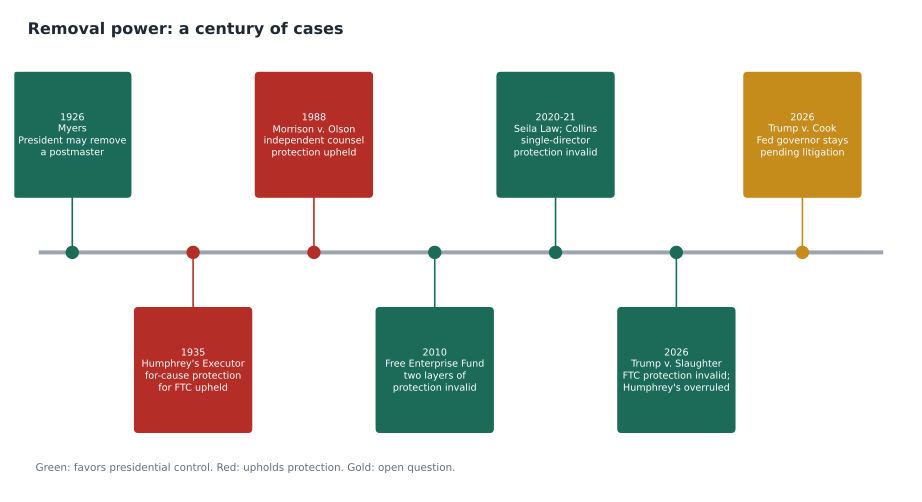
The Constitution says nothing about removing executive officers other than by impeachment. In the "Decision of 1789," the First Congress debated whether the Secretary of Foreign Affairs could be removed by the President alone and drafted the statute on the assumption that he could. In Myers v. United States, 272 U.S. 52 (1926), Chief Justice (and former President) Taft wrote that the President's duty to "take Care that the Laws be faithfully executed" and the vesting of the executive power in him require that he be able to remove the officers who help him, so a statute requiring Senate consent to remove a postmaster was unconstitutional.
Nine years later, Humphrey's Executor v. United States, 295 U.S. 602 (1935), limited Myers. President Roosevelt had removed William Humphrey, a Federal Trade Commissioner, over policy disagreements, though the statute allowed removal only for "inefficiency, neglect of duty, or malfeasance in office." The Court unanimously upheld the restriction, describing the FTC as a body of experts exercising "quasi-legislative" and "quasi-judicial" functions rather than purely executive power, which Congress could insulate from presidential control. Humphrey's Executor became the constitutional foundation of the independent agencies: multimember commissions, often with members of both parties serving fixed staggered terms, removable only for cause. Wiener v. United States, 357 U.S. 349 (1958), extended the principle to a war claims commission, implying protection from removal where an officer's duties were adjudicatory.
Morrison v. Olson, 487 U.S. 654 (1988), upheld the independent counsel created after Watergate, who could be removed by the Attorney General only for "good cause." The Court abandoned the purely-executive label and asked instead whether the removal restriction impeded the President's ability to perform his constitutional duty. Because the independent counsel was an inferior officer with limited jurisdiction and tenure, it did not. Justice Scalia's solitary dissent argued that prosecution is quintessentially executive and that the decision would enable politically motivated investigations; Congress let the independent counsel statute lapse in 1999. Bowsher v. Synar, 478 U.S. 714 (1986), held that Congress cannot reserve a role for itself in removing an officer who executes the laws, invalidating a budget-cutting role given to the Comptroller General, who was removable by joint resolution of Congress.
The modern turn
In the 21st century, the Court has steadily narrowed the room for removal protections. Free Enterprise Fund v. Public Company Accounting Oversight Board, 561 U.S. 477 (2010), struck down two layers of for-cause protection: members of the accounting oversight board could be removed only for cause by SEC commissioners, who were themselves assumed to be removable only for cause. Such dual protection left the President unable to hold anyone accountable. Seila Law LLC v. Consumer Financial Protection Bureau, 591 U.S. 197 (2020), held that the CFPB's single director, removable only for cause, violated the separation of powers. Chief Justice Roberts described the President's removal power as the general rule and recognized only two exceptions: multimember expert agencies that do not wield substantial executive power (Humphrey's) and inferior officers with limited duties and no policymaking or administrative authority (Morrison). Collins v. Yellen, 594 U.S. 220 (2021), applied Seila Law to the single director of the Federal Housing Finance Agency, while holding that shareholders were not entitled to unwind past agency actions unless the unconstitutional removal protection actually caused them harm.
In early 2025, the President removed members of several multimember agencies, including the National Labor Relations Board, the Merit Systems Protection Board and the FTC, without the cause their statutes required. In May 2025, in Trump v. Wilcox, the Court stayed lower court orders reinstating NLRB and MSPB members pending appeal, noting that the government was likely to show that those agencies exercise considerable executive power, and adding that the Federal Reserve is a "uniquely structured, quasi-private entity" with a distinct historical tradition.
Trump v. Slaughter and Trump v. Cook
Rebecca Kelly Slaughter, an FTC commissioner, sued after the President removed her in March 2025 without alleging any of the statutory causes. Last June, in Trump v. Slaughter (2026), the Court held 6 to 3 that the FTC's for-cause removal protection is unconstitutional, and it overruled Humphrey's Executor. Chief Justice Roberts's opinion, joined by Justices Thomas, Alito, Gorsuch, Kavanaugh and Barrett, reasoned that the modern FTC exercises substantial executive power, including rulemaking, investigation and litigation, and that Article II vests all of the executive power in the President, who must be able to remove those who wield it on his behalf. Humphrey's, the Chief Justice wrote, "has for decades been a result in search of a rationale." Justice Gorsuch concurred, urging that legislative and adjudicative powers exercised by agencies be returned to Congress and the courts. Justice Sotomayor, joined by Justices Kagan and Jackson, dissented, arguing that the decision discards ninety years of precedent and gives the President unchecked control over agencies Congress designed to be independent.
The same day, in Trump v. Cook (2026), the Court refused 5 to 4 to lift an injunction keeping Federal Reserve Governor Lisa Cook in office while her challenge to her removal proceeds. The Federal Reserve Act allows removal of governors only "for cause," and the President had cited allegations of mortgage fraud before her appointment. Chief Justice Roberts, joined by Justices Sotomayor, Kagan, Kavanaugh and Jackson, concluded that the government had not shown it was likely to succeed under the statute, because its reading would turn for-cause protection into removal at will; the Court did not reach Cook's due process arguments. The majority pointed to the Federal Reserve's distinctive structure and the long tradition of insulating monetary policy from political control; Justice Kavanaugh, concurring, said any change must come from Congress. Justices Thomas, Alito, Gorsuch and Barrett dissented in separate opinions. Because Cook was decided on an emergency application, the merits remain open.
Whitford asks Section B what remains of independent agencies. Jordan suggests that multimember structure may still matter for political balance requirements and staggered terms, even if commissioners can now be removed. Marcus wonders about agencies that mainly adjudicate, like the Wiener commission. Hannah asks about the Federal Reserve's monetary policy committee, whose members include regional bank presidents chosen by private boards. Whitford says each question will be litigated, and that a good lawyer will start with Seila Law's two exceptions and ask whether either survives Slaughter.
Presidential immunity and privilege
The President is not above the law, but the office carries special protections. United States v. Nixon, 418 U.S. 683 (1974), recognized a constitutionally based executive privilege for presidential communications but held it must yield to a specific, demonstrated need for evidence in a criminal trial; the decision forced release of the Watergate tapes. Nixon v. Fitzgerald, 457 U.S. 731 (1982), held that a former President has absolute immunity from civil damages suits for acts within the "outer perimeter" of his official duties. Clinton v. Jones, 520 U.S. 681 (1997), held that a sitting President has no immunity from civil suits over conduct before taking office. Trump v. Vance, 591 U.S. 786 (2020), held that a sitting President has no absolute immunity from a state grand jury subpoena for personal records, and Trump v. Mazars USA, LLP, 591 U.S. 848 (2020), set a four-factor test for congressional subpoenas of a President's personal information.
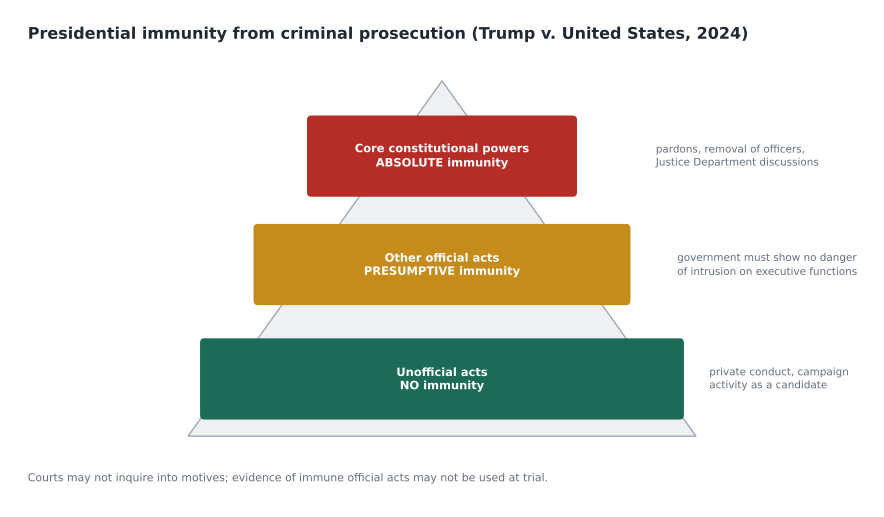
Trump v. United States, 603 U.S. 593 (2024), addressed criminal immunity for the first time. A federal grand jury had indicted the former President on charges related to efforts to overturn the 2020 election. Chief Justice Roberts's 6 to 3 opinion held that a former President has (1) absolute immunity from criminal prosecution for actions within his "conclusive and preclusive" constitutional authority, such as the pardon power, the removal of executive officers and discussions with the Justice Department about investigations; (2) at least presumptive immunity for other official acts, which the government can overcome only by showing that prosecution would pose no danger of intrusion on the authority and functions of the executive branch; and (3) no immunity for unofficial acts. Courts may not inquire into the President's motives in classifying acts, and evidence of immune official conduct may not be introduced even to prove a charge based on unofficial acts. Justice Sotomayor's dissent warned that the President is now "a king above the law" for official acts; Justice Barrett concurred in part, disagreeing with the evidentiary rule. On remand the case ended without trial: after the 2024 election, the special counsel moved to dismiss, consistent with the Justice Department's long-standing view that a sitting President cannot be prosecuted.
Impeachment, pardons and Section 3
Article II, section 4 provides for removal of the President, Vice President and civil officers on impeachment by the House and conviction by two-thirds of the Senate for "Treason, Bribery, or other high Crimes and Misdemeanors." Nixon v. United States (1993) held that the Senate's procedures are not reviewable (lesson 2). The pardon power extends to "Offenses against the United States," meaning federal crimes, "except in Cases of Impeachment"; it does not reach state crimes. Finally, in Trump v. Anderson, 601 U.S. 100 (2024), the Court unanimously reversed the Colorado Supreme Court's decision removing the former President from the state's primary ballot under Section 3 of the Fourteenth Amendment, which disqualifies certain officials who engaged in insurrection. The Court held that states may not enforce Section 3 against federal officeholders and candidates; responsibility rests with Congress under section 5. Four Justices, in separate writings, would have decided the case more narrowly.
Worked problem
A new national battery safety commission
Congress creates the National Battery Safety Commission, five members appointed by the President with Senate consent for staggered seven-year terms, no more than three from one party, removable "only for inefficiency, neglect of duty, or malfeasance in office." The Commission issues binding safety rules, sues manufacturers for civil penalties, and adjudicates enforcement actions through hearing officers whose decisions are final unless a party appeals to a federal court of appeals. The commission chair hires the hearing officers. Identify the constitutional problems.
Show solution
- Removal of commissioners: under Trump v. Slaughter, for-cause protection for members of a multimember agency exercising substantial executive power (rulemaking and enforcement litigation) is unconstitutional. A court would likely sever the protection, leaving commissioners removable at will.
- Appointment of hearing officers: if they conduct adversarial hearings and issue decisions, they are officers under Lucia and must be appointed by the President, a court or a head of department; a full commission can be a department head, but the chair alone may not be, depending on the statute.
- Finality: if hearing officers issue final decisions no presidentially appointed officer can review, Arthrex suggests they act as principal officers without proper appointment; the fix is review by the Commission.
- Party balance: Slaughter does not clearly address party-balance requirements, which limit appointment rather than removal; their validity is debated.
- Severability: Seila Law and Arthrex show the Court's preference for severing the defective provision rather than invalidating the agency.
Answer: The commissioners' for-cause removal protection is likely unconstitutional after Slaughter and would be severed. The hearing officers must be appointed by the Commission (not the chair alone, unless the chair is a department head), and their decisions must be reviewable by the Commission to satisfy Arthrex. The agency itself survives.
Summary and key terms
- Principal officers require presidential nomination and Senate consent; Congress may vest appointment of inferior officers in the President, courts or department heads (Buckley; Edmond; Lucia; Arthrex; Braidwood, 2025).
- Myers (1926) recognized broad presidential removal power; Humphrey's Executor (1935) upheld for-cause protection for FTC commissioners; Morrison (1988) upheld protection for the independent counsel.
- Free Enterprise Fund (2010) struck down double for-cause protection; Seila Law (2020) and Collins (2021) struck down protection for single agency heads.
- Trump v. Slaughter (2026) held the FTC's removal protection unconstitutional and overruled Humphrey's Executor; Trump v. Cook (2026) left a Federal Reserve governor in office pending litigation, emphasizing the Fed's distinct tradition.
- United States v. Nixon recognized a qualified executive privilege; Nixon v. Fitzgerald gave absolute civil immunity for official acts; Clinton v. Jones denied immunity for unofficial pre-office conduct.
- Trump v. United States (2024): absolute criminal immunity for core constitutional powers, presumptive immunity for other official acts, none for unofficial acts.
- Trump v. Anderson (2024): states may not enforce Section 3 of the Fourteenth Amendment against federal candidates.
- Principal officer
- An officer not directed and supervised by another presidentially appointed, Senate-confirmed officer; must be appointed with Senate consent.
- Inferior officer
- An officer directed and supervised by a principal officer; appointment may be vested in the President, courts or department heads.
- For-cause removal
- A statutory limit allowing removal only for reasons such as inefficiency, neglect of duty or malfeasance.
- Independent agency
- An agency whose leaders were traditionally protected from removal at will, such as the FTC before 2026.
- Executive privilege
- The President's qualified privilege to protect confidential communications.
- Presumptive immunity
- Immunity for a former President's official acts that the prosecution may overcome only by showing no danger of intrusion on executive authority.
Practice problems
Work each problem on paper first, then reveal the answer to check.
What two exceptions to the President's removal power did Seila Law recognize, and what happened to the first one in 2026?
Show answer
Multimember expert agencies not wielding substantial executive power (Humphrey's) and inferior officers with limited duties (Morrison). Trump v. Slaughter overruled Humphrey's Executor, holding the FTC's protection unconstitutional.
Why were the SEC's administrative law judges officers in Lucia?
Show answer
They held continuing positions established by law and exercised significant authority, conducting adversarial hearings, ruling on evidence and issuing decisions.
Under Trump v. United States, how would a court treat a former President's private financial dealings before taking office?
Show answer
As unofficial acts, with no immunity from prosecution.
Why did Trump v. Anderson reverse the Colorado decision?
Show answer
Because states have no power to enforce Section 3 of the Fourteenth Amendment against federal officeholders and candidates; that power belongs to Congress under section 5.
Lesson quiz · 5 questions
Score 60% or more to complete this lesson.
Create a free account to save your progress, take quizzes and earn a certificate.