
LAWU-104 · Lesson 9 of 12 · 20 min
Statutory interpretation
▶ Video coming soon A video version of this lesson is on the way.
Professor Kinsella begins the ninth class with a sign she says she saw at a public park: "No vehicles in the park." She asks Section B whether the rule bars an ambulance answering a call, a child's tricycle, a war memorial made from a decommissioned tank, and a drone. The debate lasts twenty minutes. Daniel Reyes says the ambulance obviously gets in, whatever the sign says. Priya Natarajan says the sign means what it says and the city can write exceptions if it wants them. Hannah Lindqvist asks what problem the city was trying to solve. Kinsella tells them they have just reenacted a famous debate between the legal philosophers H.L.A. Hart and Lon Fuller in the 1950s, and that they will hear versions of it in every statutory case they read. "Interpretation is not a side issue," she says. "It is how statutes become law in particular cases."
The starting point: text
Every modern approach to statutory interpretation starts with the text. Courts ask what the words mean, read in context, to an ordinary reader at the time of enactment, or to a specialist where the words are technical. The Supreme Court has repeatedly said that when the text is clear, the inquiry ends there. In Bostock v. Clayton County, 590 U.S. 644 (2020), for example, the Court held that an employer who fires an employee for being gay or transgender discriminates "because of sex" under Title VII, reasoning from the ordinary meaning of the statute's words even though the Congress that enacted Title VII in 1964 may not have anticipated that application.
Context matters as much as dictionary definitions. Words take meaning from the sentence, the section, the whole statute and related statutes. In Yates v. United States, 574 U.S. 528 (2015), a commercial fisherman threw undersized red grouper overboard to avoid an inspection and was charged under a provision of the Sarbanes-Oxley Act that punished destroying "any record, document, or tangible object" to obstruct an investigation. A plurality of the Court held that a fish is not a "tangible object" in that provision, which was aimed at records and documents in a statute about corporate fraud, even though a fish is a tangible object in ordinary speech.
Textualism and purposivism
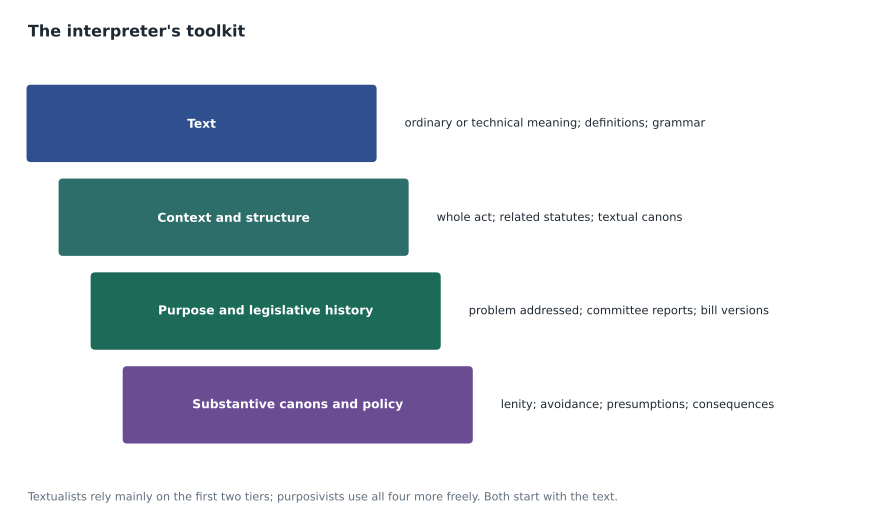
Judges and scholars divide roughly into two schools. Textualists, associated most with Justice Antonin Scalia, focus on the ordinary meaning of the enacted words in context and are skeptical of legislative history, because only the text went through bicameral passage and presentment to the President. Purposivists, associated with the legal process scholars Henry Hart and Albert Sacks and with judges such as Justice Stephen Breyer, read the text in light of the problem the legislature was trying to solve and are more willing to use legislative history to identify that purpose.
The two schools overlap more than their labels suggest. Textualists consider context and structure, which often reveal purpose. Purposivists start with text and rarely ignore it. The differences show most in hard cases, where the text is open to more than one reading or its literal meaning produces a strange result. Kinsella tells Section B that the current Supreme Court is predominantly textualist in its methods, so briefs to it, and to many lower courts, lead with text and structure and use purpose and legislative history as support.
The classic purposivist case is Church of the Holy Trinity v. United States, 143 U.S. 457 (1892). A federal statute made it unlawful to pay the transportation of any foreigner to perform "labor or service of any kind" in the United States. A New York church paid for an English minister to come to be its rector. The Court held that the statute did not apply, reasoning that although the work of a minister fell within the letter of the statute, it was not within its spirit, which was aimed at cheap manual labor. Textualists regard the decision as a cautionary tale; purposivists cite it for the principle that literal readings should yield when they produce results the legislature could not have intended.
Textual canons
Canons of construction are rules of thumb courts use to interpret statutes. Textual or linguistic canons describe how language is ordinarily used. They are not binding rules, and they sometimes point in opposite directions, but courts invoke them constantly.
- Ordinary meaning: words are given their ordinary meaning unless defined or used as terms of art.
- Expressio unius est exclusio alterius (the expression of one thing implies the exclusion of others): if a statute lists specific items, unlisted items are probably excluded.
- Ejusdem generis (of the same kind): general words following a list of specific items are read to cover only things similar to the listed items. In Fischer v. United States, 603 U.S. 480 (2024), the Court read a catch-all clause in an obstruction statute in light of the specific clause before it, which concerned impairing the availability or integrity of records and other evidence.
- Noscitur a sociis (a word is known by its companions): ambiguous words take meaning from the words around them, the reasoning behind Yates.
- Surplusage: every word should be given effect, so a reading that makes words redundant is disfavored.
- Whole act and consistent usage: the same word is presumed to mean the same thing throughout a statute, and different words different things.
- Grammatical canons, such as the rule of the last antecedent, under which a limiting phrase usually modifies only the item immediately before it.
Kinsella shows how canons can conflict. In the memo problem, the Westmarch statute's exception applies when an owner "charges the person" for recreational use, and the definition of charge refers to the "admission price or fee asked in return for invitation or permission to enter or go upon the land." Ordinary meaning and the surrounding words ("price," "fee," "in return for") suggest a required payment. But the purpose of the statute, encouraging free access, might support reading charge broadly to include payments that are expected in practice. Section B will have to decide how the Westmarch courts would resolve that tension.
Substantive canons
Substantive canons reflect policy judgments rather than linguistic habits. The rule of lenity resolves genuine ambiguity in a criminal statute in the defendant's favor, a principle visible in McBoyle and Yates. The canon of constitutional avoidance says that if one reasonable reading of a statute would raise serious constitutional doubts and another would not, courts choose the latter. The presumption against retroactivity says statutes do not apply to past conduct unless the legislature clearly says so. The presumption against extraterritoriality says federal statutes apply only within the United States unless Congress indicates otherwise. The presumption against preemption, in areas traditionally regulated by states, says federal law does not displace state law unless that was Congress's clear purpose.
In administrative cases, the major questions doctrine, discussed in Lesson 8, operates like a substantive canon: courts expect Congress to speak clearly if it wishes to give an agency power over questions of vast economic and political significance. Some states have their own interpretive statutes and canons. Many state codes include a general construction act that defines common terms and sets interpretive rules, and some state courts are more willing than federal courts to consult legislative history.
| Canon | Type | In plain words |
|---|---|---|
| Ordinary meaning | Textual | Read words as ordinary people would, unless defined or technical |
| Expressio unius | Textual | Listing some things implies excluding others |
| Ejusdem generis | Textual | General words after a list cover only similar things |
| Noscitur a sociis | Textual | A word is known by the company it keeps |
| Surplusage | Textual | Give effect to every word |
| Rule of lenity | Substantive | Resolve real ambiguity in criminal statutes for the defendant |
| Constitutional avoidance | Substantive | Prefer a reading that avoids serious constitutional doubt |
| Presumption against retroactivity | Substantive | Statutes apply prospectively unless clearly stated otherwise |
Purpose and legislative history in practice
When text and context leave genuine ambiguity, many courts look at the statute's purpose and legislative history. Purpose may appear in a statement of findings or purpose in the statute itself, in its structure, or in the history of the problem it addressed. Legislative history, as Lesson 7 explained, includes committee reports, conference reports and changes in the bill's text. The Supreme Court used purpose and structure in King v. Burwell, 576 U.S. 473 (2015), holding that tax credits under the Affordable Care Act were available on exchanges established by the federal government, even though a provision referred to an "Exchange established by the State," because reading it literally would have destroyed the insurance markets the Act was designed to create.
Critics of legislative history make several arguments: it was not enacted; it can be manipulated by staff or lobbyists who insert favorable statements; and, in Judge Harold Leventhal's well-known image, using it is like looking over a crowd and picking out your friends. Defenders respond that committee reports reflect the considered understanding of the members who wrote and voted for the bill, and that ignoring them makes courts less faithful to Congress. A researcher's job is not to settle the debate but to know which approach the relevant court uses and to present both text-based and history-based arguments where available.
Interpretation and precedent
Once a court of last resort interprets a statute, its interpretation becomes part of the statute's meaning for lower courts, and courts apply statutory stare decisis with special force, because the legislature can correct an interpretation it dislikes by amending the statute. When a legislature reenacts a statute without change after courts have interpreted it, courts sometimes infer that the legislature accepted the interpretation. When a legislature amends a statute in response to a decision, the amendment supersedes the decision for future cases, which is why a researcher must check the history of both the statute and the cases.
Worked problem
Interpreting 'charge' in the Westmarch statute
The fictional Westmarch Recreational Use Act removes immunity when the owner 'charges the person' for recreational use, and defines charge as 'the admission price or fee asked in return for invitation or permission to enter or go upon the land.' Coldbrook Orchard offered free hayrides, with a sign reading 'Hayrides free. Donations to Westmarch 4-H welcome, suggested 5 dollars,' and a volunteer holding a donation bucket at the wagon steps. Outline the interpretive arguments.
Show solution
- Text: 'price or fee asked in return for' permission suggests a payment required as a condition of entry; a suggested donation to a third party is arguably not a price asked by the owner.
- Context: 'admission price' and 'fee' are words of required payment (noscitur a sociis); the sign said 'free.'
- Precedent: Pell held that a mandatory parking fee is a charge, looking at substance over labels; Quill held a truly voluntary donation box is not a charge, but suggested the result would differ if payment were required in practice.
- Purpose: the Act encourages landowners to open land free of charge; reading charge to include a voluntary donation for charity could discourage exactly the generosity the statute rewards. Against that, if the orchard benefited commercially from the hayrides, which drew customers to buy apples, a court might find the arrangement was not truly free.
- Facts to develop: whether riders were turned away or pressured if they did not pay, who received the money, and whether the hayride was tied to apple sales.
Answer: Text, context and Quill favor the orchard on the charge exception, unless the facts show that payment was effectively required. The memo should present this as the likely result while flagging the factual questions that could change it.
A method for interpretation questions
Kinsella gives Section B a sequence for any interpretation problem. Quote the exact statutory language. Identify the precise word or phrase in dispute and the competing readings. Check for a statutory definition. Analyze ordinary meaning and context, including the rest of the statute. Find controlling cases interpreting the language. Apply relevant canons, noting where they conflict. Consider purpose and legislative history, according to the approach the relevant court follows. Finally, predict how the court will resolve it and explain why, acknowledging the strongest argument on the other side.
Marcus Webb says that in engineering, specifications are written to remove ambiguity, and he finds it frustrating that statutes are not. Kinsella says legislators try, but language is finite and the future is not. "No drafter imagined a drone when the park sign went up," she says. "Interpretation is how the law meets the world it did not foresee."
Interpretation in state courts
State courts interpret their own statutes, and their methods do not always match the federal courts'. Some state supreme courts are firmly textualist; others regularly consult legislative history, bill analyses and the purposes stated in a statute. Many states have general construction statutes that tell courts how to read words such as "shall" and "may," whether the singular includes the plural, and how to compute time periods. Before writing about the meaning of a state statute, find out how that state's highest court describes its own interpretive approach and whether a construction statute applies.
Summary and key terms
- Interpretation starts with the text: ordinary or technical meaning, read in context.
- Textualists emphasize enacted text and structure; purposivists also weigh the statute's purpose and legislative history; both start with text.
- Textual canons include expressio unius, ejusdem generis, noscitur a sociis, surplusage and consistent usage; they can conflict.
- Substantive canons include lenity, constitutional avoidance and presumptions against retroactivity, extraterritoriality and preemption.
- Key cases: Holy Trinity (spirit over letter), McBoyle and Yates (context and lenity), King v. Burwell (purpose and structure), Bostock (ordinary meaning), Fischer (catch-all read with specific clause).
- Statutory stare decisis is strong; legislative amendments can supersede judicial interpretations.
- Textualism
- An approach that interprets statutes by the ordinary meaning of their enacted text in context.
- Purposivism
- An approach that interprets statutes in light of the problem the legislature sought to address.
- Canon of construction
- A rule of thumb courts use to interpret statutory language.
- Ejusdem generis
- General words following specific ones are read to cover only similar things.
- Expressio unius
- Listing some items implies the exclusion of unlisted items.
- Constitutional avoidance
- Choosing a reasonable interpretation that avoids serious constitutional problems.
Practice problems
Work each problem on paper first, then reveal the answer to check.
A statute imposes a fee on 'cars, trucks, buses and other vehicles.' Does it cover a horse-drawn carriage?
Show answer
Under ejusdem generis, 'other vehicles' would likely be read to cover motorized road vehicles like those listed, so a horse-drawn carriage is probably not covered, though context and purpose could change the answer.
A criminal statute is genuinely ambiguous after a court has used text, structure and history. Which canon applies?
Show answer
The rule of lenity, which resolves the ambiguity in the defendant's favor.
Why do textualists distrust legislative history?
Show answer
Because it was not enacted through bicameral passage and presentment, it may reflect the views of a few members or staff, and it can be selectively used to support almost any reading.
After a state supreme court interprets a statute, the legislature amends the statute to adopt the opposite rule. What happens to the decision?
Show answer
It is superseded by statute for conduct governed by the amended version. It may still govern events that occurred before the amendment took effect.
Lesson quiz · 5 questions
Score 60% or more to complete this lesson.
Create a free account to save your progress, take quizzes and earn a certificate.