
LAWU-104 · Lesson 6 of 12 · 21 min
Reading and briefing cases
▶ Video coming soon A video version of this lesson is on the way.
By the sixth class, Section B has read dozens of cases for their doctrinal courses, and most of them are tired. Jordan Kimura admits that his study group spends hours on each night's reading and still freezes when a professor asks what a case held. Professor Kinsella says that reading cases is a skill like any other, and that the problem is usually not effort but method. She hands out a short opinion, a real Supreme Court case of only a few pages, and gives the class twenty minutes to read it with a pencil. Then she asks five questions: who sued whom for what; what happened in the lower courts; what question the Court answered; what the answer was; and why. Most students can answer the first and fourth. Few can answer the third and fifth precisely. "That," she says, "is what a case brief is for."
Why read actively
Judicial opinions are not written for students. They assume knowledge of procedure and doctrine, they mix facts, history and law, and they often answer questions the reader did not know were being asked. Reading them passively, from top to bottom like a novel, wastes time. Active reading means reading with questions in mind, marking the text, and stopping to restate what each part does. Researchers who read actively understand more, remember more, and spot the passages that matter for their problem.
Kinsella recommends reading each important case at least twice. The first read is fast: identify the parties, the outcome and the general shape of the reasoning. The second read is slow: work through the facts that mattered, the precise question, the rule the court applied, and how it applied the rule to the facts. Margin notes help. Many students use a few consistent marks: F for key facts, PH for procedural history, I for the issue, H for the holding, R for reasoning, and a question mark for anything they do not understand.
Context before content
Before reading the opinion itself, look at the information that frames it. Which court decided the case, and when? What was the procedural posture: was the court reviewing a dismissal, a summary judgment, a jury verdict or a criminal conviction? Posture matters because it determines the standard of review and what facts the court must accept. A court reviewing a motion to dismiss, for example, accepts the complaint's factual allegations as true, so its statements about the facts are not findings that those facts actually happened.
Look also at who wrote the opinion and whether it was unanimous. An opinion for a divided court, especially with several concurrences, may have a narrower holding than its broad language suggests. And look at the date: a case decided before a statute was amended, or before a key Supreme Court decision, may be stale even if no citator flag appears.
The elements of a case brief
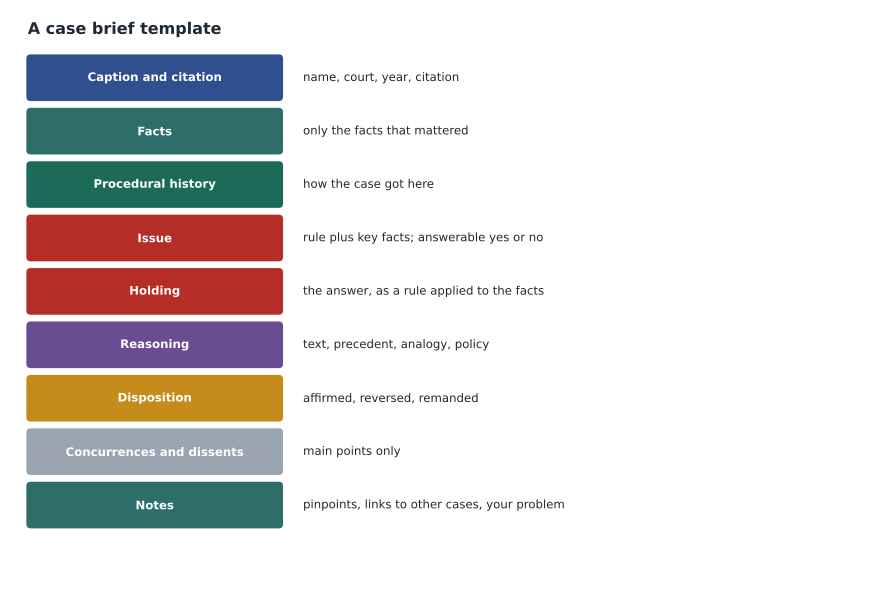
A case brief is a short written summary of an opinion, prepared for your own use. It is not a document for a court, which confusingly is also called a brief. Formats vary, but most include the same elements.
- Caption and citation: the case name, court, year and citation, so you can find and cite it.
- Facts: the facts the court treated as legally significant, in a few sentences. Leave out the rest.
- Procedural history: what happened in the lower courts and how the case reached this court.
- Issue: the legal question the court decided, phrased as a question that combines the rule and the key facts. A good issue statement can usually be answered yes or no.
- Holding: the court's answer to the issue, stated as a rule applied to the key facts.
- Reasoning: why the court reached that answer: the authorities it relied on, the policies it invoked, and how it dealt with counterarguments.
- Disposition: what the court did: affirmed, reversed, vacated, remanded.
- Concurrences and dissents: briefly, the main points of any separate opinions.
- Notes: your own observations: how the case relates to others, questions it leaves open, and why it matters for your problem.
Framing issues and holdings
The hardest parts of a brief are the issue and the holding, because they require deciding how broadly to read the case. An issue phrased too broadly ("Is the defendant liable?") says nothing. An issue phrased too narrowly, with every fact included, cannot be applied to any other case. The right level combines the legal rule with the facts that the court treated as decisive.
Kinsella uses a well-known example to show the difference. In McBoyle v. United States, 283 U.S. 25 (1931), the defendant was convicted under the National Motor Vehicle Theft Act for transporting a stolen airplane across state lines. The statute defined "motor vehicle" to include "an automobile, automobile truck, automobile wagon, motor cycle, or any other self-propelled vehicle not designed for running on rails." Too broad: "Did the defendant commit a crime?" Too narrow: "Is a 1931 airplane stolen in Illinois and flown to Oklahoma a motor vehicle?" About right: "Does a statute prohibiting interstate transport of stolen 'motor vehicles,' defined by reference to vehicles that run on land, cover aircraft?" The Court held that it does not, reasoning that the words evoke a picture of vehicles moving on land and that a criminal statute should give fair warning in language the common world will understand.
Priya Natarajan points out that the holding could also be stated more broadly, as a rule about fair warning in criminal statutes. Kinsella agrees and says that is exactly the point: the reasoning supports a broader principle, later known as part of the rule of lenity, while the holding itself concerns the statute's definition. Lawyers on different sides of a later case will argue for different readings, and the brief should note both.
Reasoning: the part that persuades
Students often skim the reasoning to get to the holding, but for a researcher the reasoning is often the most useful part. It tells you which facts mattered and why, which authorities the court found persuasive, which policies drove the result, and what limits the court placed on its ruling. When you apply a case to new facts, the reasoning is what tells you whether the new facts call for the same result.
Courts reason in recognizable patterns: from the text of a statute or constitution; from precedent, by following, extending or distinguishing earlier cases; by analogy to similar situations; from policy, by considering the consequences of a rule; and from principles such as fairness or institutional competence. Labeling the type of reasoning in your brief helps you use the case later. A case decided on the plain text of a statute will be hard to distinguish if your statute has the same text; a case decided on policy may be distinguishable if the policy does not apply to your facts.
Synthesizing several cases
One case rarely answers a research question. More often, a researcher must read several cases and synthesize them into a single statement of the rule, including its elements, exceptions and the factors courts weigh. Synthesis is different from summary. A summary describes each case in turn; a synthesis states what the cases add up to, then uses each case to illustrate part of the rule.
A useful technique is a synthesis chart. List the cases in rows, and in columns record the court and year, the key facts, the outcome, and the reasoning or factor that drove the outcome. Patterns appear: cases with fact A came out one way, cases with fact B came out the other way, and the court's language explains why. From the chart you can write a rule statement that covers all the cases, and an explanation that shows how each case fits.
| Case | Payment involved | Result | Why |
|---|---|---|---|
| Stavros v. Kettering Timber Co. (Westm. 2009) | None; free hunting access | Immune | Statute protects landowners who open land for free recreation |
| Pell v. City of Brennan Falls (Westm. Ct. App. 2015) | Mandatory parking fee to enter the park | Not immune | A fee required as a condition of entry is a charge |
| Ibarra v. Westmarch Department of Natural Resources (Westm. 2018) | None; trail user injured | Immune; willful exception not met | Willful means knowing of danger and consciously disregarding it |
| Quill v. Fenwick Farms (Westm. Ct. App. 2021) | Voluntary donation box at a corn maze | Immune | A truly voluntary donation is not a charge; it would be if payment were required in practice |
The cases in the chart are fictional. They are part of the closed universe of Westmarch authorities that Section B will receive with the memo assignment in October. Kinsella previews them now so the class can see how a chart turns four separate cases into a rule: under the Westmarch statute, a landowner loses immunity if it charges for entry or use, and a payment is a charge if it is required as a condition of entry or use, whether formally or in practice; truly voluntary donations are not charges.
Briefing for research, not just class
Class briefs and research briefs differ in emphasis. For class, a brief prepares you to answer a professor's questions about the case as a whole. For research, a brief focuses on the parts of the case relevant to your client's problem: the facts that resemble or differ from your client's, the rule as it applies to your issue, and the language you might quote. A research brief should always record the pinpoint pages for any passage you might cite, which saves time when you write.
Hannah Lindqvist asks whether briefing every case is realistic in practice. Kinsella says no; experienced lawyers rarely write full briefs. But they still ask the same questions of every important case, and they record the answers in notes or in their research log. First-year students brief fully because it builds the habit of asking those questions automatically.
Worked problem
Briefing Pell v. City of Brennan Falls
Brief the fictional Westmarch Court of Appeals decision in Pell, which Section B has seen in preview: a park visitor paid a mandatory eight-dollar parking fee to enter a city park, was injured on a broken boardwalk, and sued. The trial court granted summary judgment for the city under the recreational use statute; the court of appeals reversed.
Show solution
- Facts: visitor paid a mandatory parking fee; there was no other practical way to enter the park; injured on a boardwalk while walking for recreation.
- Procedural history: summary judgment for the city in the trial court; plaintiff appealed.
- Issue: Under the Westmarch Recreational Use Act, is a mandatory parking fee that visitors must pay to enter a park a 'charge' that removes the landowner's immunity?
- Holding: Yes. A fee that must be paid as a practical condition of entry is a charge, whatever it is called.
- Reasoning: the statute defines charge as the price asked in return for permission to enter; substance controls over labels; the statute's purpose is to encourage free access, which a required fee defeats.
- Disposition: reversed and remanded for trial on negligence.
Answer: The brief captures what matters for the memo: the court looks at whether payment is required in practice, not at what it is called. That point will matter when Section B analyzes a donation bucket at a hayride.
Reading critically
Finally, Kinsella asks Section B to read every case critically, not just to extract rules but to evaluate them. Is the reasoning sound? Does the court address the strongest counterarguments? Are its statements about precedent accurate? Does the holding fit the facts, or did the court reach beyond them? A lawyer who reads critically can argue that a harmful case should be read narrowly or distinguished, and can anticipate how an opponent will use a favorable case. The habit begins with the case brief and continues for an entire career.
Reading opinions with an eye to writing
Kinsella adds one more reason to read cases closely: they are models of legal writing, good and bad. A strong opinion states the question early, lays out the facts the reader needs before the law, organizes its analysis around the issues, and explains why the losing side's best arguments fail. A weak one buries the holding, wanders through history, and leaves the reader to guess which reasoning was decisive. As Section B reads cases this year, she asks them to notice how judges use headings, topic sentences and transitions, how they introduce and quote authority, and how they handle counterarguments. Those are exactly the skills the memo assignment will test.
She also asks them to notice how judges characterize precedent. When a court wants to follow an earlier case, it emphasizes the similarities and quotes the earlier court's general language. When it wants to avoid an earlier case, it emphasizes the differences, describes the earlier holding narrowly, or calls broad language dicta. Learning to recognize those moves makes a reader better at predicting how a court will treat the cases in a memo.
Summary and key terms
- Read important cases at least twice: fast for shape, slow for facts, issue, holding and reasoning.
- Check context first: court, date, procedural posture and standard of review, author and any separate opinions.
- A case brief records caption, facts, procedural history, issue, holding, reasoning, disposition, separate opinions and notes.
- Frame issues and holdings at the right level: the legal rule plus the decisive facts.
- Reasoning tells you which facts mattered and why; label its type (text, precedent, analogy, policy, principle).
- Synthesize multiple cases into a single rule using a synthesis chart, then explain how each case fits.
- Research briefs focus on your client's issue and record pinpoint pages for citation.
- Case brief
- A short personal summary of an opinion's facts, procedural history, issue, holding and reasoning.
- Procedural posture
- The stage of the case and the ruling under review, which determines the standard of review.
- Issue
- The legal question the court decided, combining the rule and the decisive facts.
- Disposition
- The court's action on the judgment below: affirmed, reversed, vacated or remanded.
- Synthesis
- Combining several cases into one statement of the rule and showing how each case fits.
- Rule of lenity
- The principle that ambiguity in a criminal statute is resolved in the defendant's favor.
Practice problems
Work each problem on paper first, then reveal the answer to check.
Rewrite this issue statement at the right level: 'Did the plaintiff win?'
Show answer
Identify the rule and the decisive facts, for example: 'Under the state recreational use statute, does a landowner who requires a parking fee to enter its land lose immunity from negligence claims by visitors?'
An appellate court reviewing a dismissal for failure to state a claim describes the defendant's conduct as reckless. Can you cite the case for the fact that the defendant was reckless?
Show answer
No. At the dismissal stage the court accepts the complaint's allegations as true; it made no finding about what actually happened.
What is the difference between summarizing cases and synthesizing them?
Show answer
A summary describes each case separately. A synthesis states the rule that the cases together establish, including elements and factors, and uses each case to illustrate part of that rule.
Why should a research brief record pinpoint pages?
Show answer
Because any passage you might cite or quote needs a pinpoint citation, and recording it while reading saves time and prevents errors when writing.
Lesson quiz · 5 questions
Score 60% or more to complete this lesson.
Create a free account to save your progress, take quizzes and earn a certificate.