
LAWU-104 · Lesson 7 of 12 · 20 min
Statutes and legislative history
▶ Video coming soon A video version of this lesson is on the way.
Professor Kinsella starts the seventh class by asking Section B a question that sounds like a trick: where would you find the federal law that Congress passed last week? Marcus Webb says the United States Code. Kinsella shakes her head. Not yet, she explains. A new law takes time to work its way from the floor of Congress into the Code, and in between it lives in several other places. Knowing those places, and knowing how to make sure the version you are reading is current, is the core of statutory research. "In most practice areas today," she says, "the answer begins with a statute. If you get the statute wrong, nothing else you find will save you."
How a federal statute is born
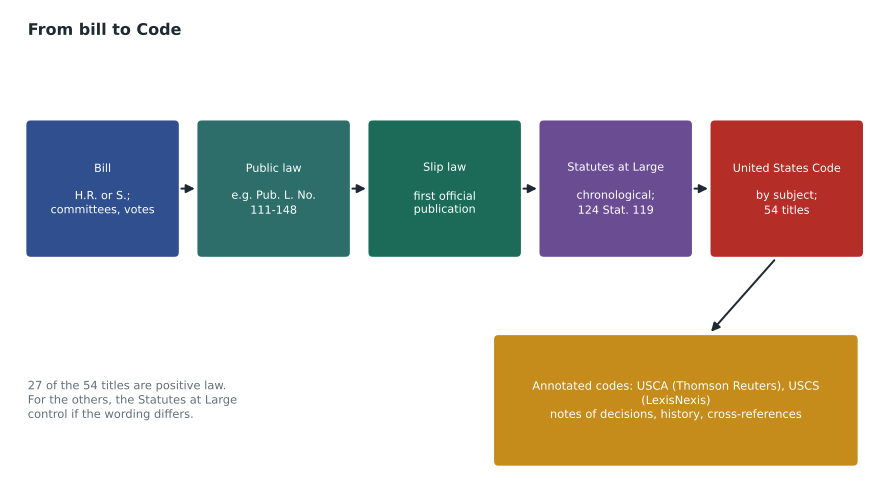
A bill introduced in Congress is numbered by chamber: H.R. for House bills, S. for Senate bills. After committee consideration, floor debate and passage by both chambers in identical form, the bill goes to the President, who may sign it, veto it, or let it become law without signature. Once enacted, it receives a public law number showing the Congress and the order of enactment, such as Pub. L. No. 111-148, the Patient Protection and Affordable Care Act, the 148th public law of the 111th Congress.
The new law is first published as a slip law, a separate pamphlet or electronic document. At the end of each session, slip laws are compiled in chronological order in the United States Statutes at Large, the official record of every law Congress enacts; the Affordable Care Act appears at 124 Stat. 119. Finally, the Office of the Law Revision Counsel of the House of Representatives integrates the new law's provisions into the United States Code, which arranges the general and permanent laws of the United States by subject in 54 titles.
The United States Code and positive law
The United States Code is a codification, not a separate enactment, with an important qualification. Some titles of the Code have themselves been enacted by Congress as positive law, which makes the Code's text legal evidence of the law. Other titles are only prima facie evidence of the law; if the Code's wording differs from the Statutes at Large, the Statutes at Large control for those titles. According to the Office of the Law Revision Counsel, 27 of the Code's titles are currently positive law. The difference rarely matters, but when the precise wording of a non-positive-law title is in dispute, check the Statutes at Large.
Not everything Congress enacts goes into the Code. Appropriations, private laws and temporary provisions are often left out or appear only in notes. And some laws are scattered across many titles: a single act may amend dozens of sections. To find a law by its name, use the popular name table, available at uscode.house.gov and in the annotated codes, which lists where each act is codified.
Annotated codes
For research, the most useful version of the Code is an annotated one. Thomson Reuters publishes the United States Code Annotated (USCA) and LexisNexis publishes the United States Code Service (USCS). Both reproduce the Code's text and add, for each section, historical notes on amendments, cross-references to regulations, references to secondary sources, and notes of decisions: brief summaries of cases interpreting the section, organized by topic. Notes of decisions are often the fastest route to the controlling cases on a statute.
Annotated codes exist for every state, published by Thomson Reuters, LexisNexis or both. State codes vary in organization: some are divided into titles and sections, some into named codes such as a Penal Code or Civil Code, and some use chapter numbering that changes over time. State legislatures also publish their codes online, though many state that the online version is unofficial.
Reading a statute
Statutes reward slow, careful reading. Kinsella gives Section B a method. First, read the whole act or at least the whole section, not just the sentence you care about, because definitions, exceptions and cross-references can change its meaning. Second, find the definitions section, usually near the beginning of the act or chapter; a word you think you understand may have a special statutory definition. Third, identify the structure: who must do what, under what conditions, with what exceptions, and what consequences follow. Fourth, note the effective date and any applicability provisions, which tell you whether the statute governs your client's facts.
Breaking a statute into elements helps. A statute that says a landowner "owes no duty of care to keep the premises safe for entry or use by others for recreational purposes" except for "willful or malicious failure to guard or warn against a dangerous condition" or where the owner "charges the person" for the use contains several separate requirements: an owner of land; entry or use by another; for recreational purposes; and the absence of either exception. Each element becomes a question for research and analysis. Charts or outlines of statutory elements are among the most useful notes a researcher can make.
Words such as "shall," "may," "and," "or," "includes" and "means" carry weight. "Shall" usually imposes a duty and "may" usually grants discretion. "Means" usually introduces an exhaustive definition, while "includes" usually introduces examples that do not exhaust the term. Lesson 9 covers the canons of construction courts use to interpret such words.
Updating: is this the current version?
A statute you find may have been amended, repealed or renumbered, and the version in force when your client acted may differ from today's. Updating is therefore essential. On the commercial platforms, annotated codes show the currency of each section (for example, "current through Pub. L. No. 119-xx") and flag pending legislation and recent amendments. KeyCite and Shepard's work on statutes too, showing amendments, proposed legislation and cases that have held a section unconstitutional or preempted.
The official Code at uscode.house.gov shows the most recent public law incorporated. For laws enacted after that point, check the list of recent public laws on Congress.gov. For historical versions, the commercial platforms offer prior versions of code sections, and govinfo has past editions of the Code. Determining which version applies on a particular date is a common and important task: a contract signed in 2022 may be governed by a statute as it read in 2022, not as amended in 2025.
| Material | Official source | Annotated or research version |
|---|---|---|
| Text of a new law | Slip law (govinfo, Congress.gov) | USCCAN advance sheets; commercial platforms |
| Chronological session laws | Statutes at Large (govinfo) | United States Code Congressional and Administrative News (USCCAN) |
| Subject codification | United States Code (uscode.house.gov, govinfo) | USCA (Thomson Reuters), USCS (LexisNexis) |
| Cases interpreting a section | None | Notes of decisions in USCA and USCS; citators |
| Bill status and history | Congress.gov | Commercial legislative history collections |
Legislative history
Legislative history is the record of a statute's progress through the legislature: the bill as introduced and its amended versions, committee hearings and reports, floor debates, conference committee reports, and presidential signing statements. Lawyers use it to understand what problem the statute addressed, what its sponsors intended, and how its language evolved. Courts use it to resolve ambiguity, though the weight they give it is contested, as Lesson 9 explains.
Not all legislative history counts equally. Committee reports are generally considered the most authoritative, because they explain the bill as reported by the committee that studied it; the Supreme Court has called them the authoritative source for finding legislative intent in Garcia v. United States, 469 U.S. 70 (1984). Conference reports, which explain the final compromise between the House and Senate versions, also carry weight. Statements by a bill's sponsors receive some weight. Floor statements by other members, testimony at hearings and post-enactment statements usually receive little.
Changes in a bill's text can be powerful evidence. If an earlier version contained a broad provision that was narrowed before enactment, a court may infer that Congress rejected the broader reading. Comparing versions of the bill is therefore one of the most useful forms of legislative history research.
Finding legislative history
For federal statutes, start with the public law number. Congress.gov links each enacted law to its bill, all versions of the bill, its actions, the committee reports and the Congressional Record debates, for laws from the mid-1990s on and in summary form for earlier ones. govinfo publishes congressional reports, hearings and the Congressional Record. Compiled legislative histories, which gather all the documents for a major act in one place, exist for many important statutes and are available on the commercial platforms and in HeinOnline's US Federal Legislative History Library. Reports of the Congressional Research Service, which analyze legislation for members of Congress, have been published on Congress.gov since 2018 and are excellent background sources.
State legislative history is much harder to find. Many states publish little beyond bill texts and journals of each chamber, and committee reports may not exist. Some states have legislative service agencies, bill analyses or law revision commission reports that serve similar purposes; California's committee analyses are a well-known example. A law librarian's help is often essential.
Worked problem
Researching a federal statute
Jordan Kimura wants to understand the federal Uniformed Services Employment and Reemployment Rights Act (USERRA), which protects the civilian jobs of service members. He knows only the name. Outline his statutory research.
Show solution
- Use the popular name table at uscode.house.gov or in USCA to find where USERRA is codified: chapter 43 of title 38.
- Read the whole chapter's table of contents, then the definitions section and the provisions on reemployment rights and discrimination.
- Check currency: confirm the sections are current through the latest public law and look for recent amendments in the annotated code and on Congress.gov.
- Use the notes of decisions in USCA or USCS to find leading cases on the provisions that matter, and run those cases through a citator.
- Check for regulations: the annotated code cross-references the Department of Labor's USERRA regulations in the Code of Federal Regulations.
- If a provision is ambiguous, find the enacting public law, then its committee reports on Congress.gov or govinfo, and compare versions of the bill.
Answer: Within a few steps Jordan has the current text, its structure, the cases interpreting it, the regulations implementing it, and the legislative history to consult if ambiguity remains. The same routine works for any statute.
Uniform and model acts
Many state statutes are based on uniform acts drafted by the Uniform Law Commission or model acts drafted by groups such as the American Law Institute and the American Bar Association. The Uniform Commercial Code, adopted in some form in every state, is the most famous example. When a state statute is based on a uniform act, the official comments to the uniform act and decisions from other states interpreting the same language can be persuasive, because the goal of uniform laws is uniform interpretation. Always check how the state's version differs from the uniform text, since states often modify provisions.
Kinsella closes by connecting the lesson to the memo problem. The fictional Westmarch Recreational Use Act that Section B will analyze is modeled on the recreational use statutes that nearly every state has adopted, many of them based on a model act circulated in the 1960s. In real research, cases from other states interpreting similar language would be persuasive. In the closed-universe memo, Section B will be limited to the Westmarch materials, so the analysis can focus on careful reading of one statute and four cases.
Effective dates and retroactivity
A statute's effective date is not always its enactment date. Many statutes take effect on a specified later date, or a fixed number of days after enactment, and different sections of the same act may take effect at different times. State statutes often take effect on a default date, such as the first day of a fiscal year, unless they say otherwise. Courts generally presume that statutes apply only prospectively, so a statute that changed the law after your client acted may not govern the client's case. When a statute is amended while litigation is pending, the effective-date and applicability provisions of the amending act often decide which version applies, and researchers should look for them in the session law, because they are frequently left out of the code or placed in a note.
Sunset provisions work in the other direction: some statutes expire on a specified date unless the legislature extends them. Annotated codes and the notes at uscode.house.gov usually flag effective dates, applicability provisions and sunsets, but the session law is the authoritative source.
Summary and key terms
- A federal bill becomes a public law, appears as a slip law, is compiled chronologically in the Statutes at Large and is codified by subject in the 54-title United States Code.
- 27 Code titles are positive law; for the rest, the Statutes at Large control if the wording differs.
- Annotated codes (USCA, USCS and state equivalents) add historical notes, cross-references and notes of decisions.
- Read the whole section, find the definitions, break the statute into elements and note effective dates.
- Always update: confirm the current version and the version in force on the relevant date.
- Legislative history includes bill versions, committee and conference reports and floor debates; committee reports carry the most weight; Congress.gov and govinfo are the main free sources.
- State statutes based on uniform or model acts can be interpreted with the official comments and other states' decisions.
- Public law
- A law enacted by Congress, numbered by Congress and order of enactment.
- Statutes at Large
- The official chronological compilation of laws enacted by Congress.
- United States Code
- The subject arrangement of the general and permanent federal laws, in 54 titles.
- Positive law title
- A Code title enacted by Congress itself, making the Code text legal evidence of the law.
- Notes of decisions
- Annotations summarizing cases that interpret a statutory section.
- Legislative history
- Documents produced as a bill moves through the legislature, such as committee reports and debates.
- Popular name table
- A table listing statutes by their common names and showing where they are codified.
Practice problems
Work each problem on paper first, then reveal the answer to check.
What does Pub. L. No. 117-58 tell you?
Show answer
It is the 58th public law enacted by the 117th Congress.
The wording of a section in a non-positive-law title of the US Code differs from the Statutes at Large. Which controls?
Show answer
The Statutes at Large. For titles not enacted as positive law, the Code is only prima facie evidence of the law.
A statute defines 'vehicle' as 'includes a car, truck or motorcycle.' Is a bicycle excluded?
Show answer
Not necessarily. 'Includes' usually introduces examples rather than an exhaustive list, so a court might find bicycles covered depending on context, purpose and other canons.
Which type of legislative history usually carries the most weight?
Show answer
Committee reports, and conference reports explaining the final version of a bill.
Lesson quiz · 5 questions
Score 60% or more to complete this lesson.
Create a free account to save your progress, take quizzes and earn a certificate.