
LAWU-104 · Lesson 5 of 12 · 20 min
Case law research
▶ Video coming soon A video version of this lesson is on the way.
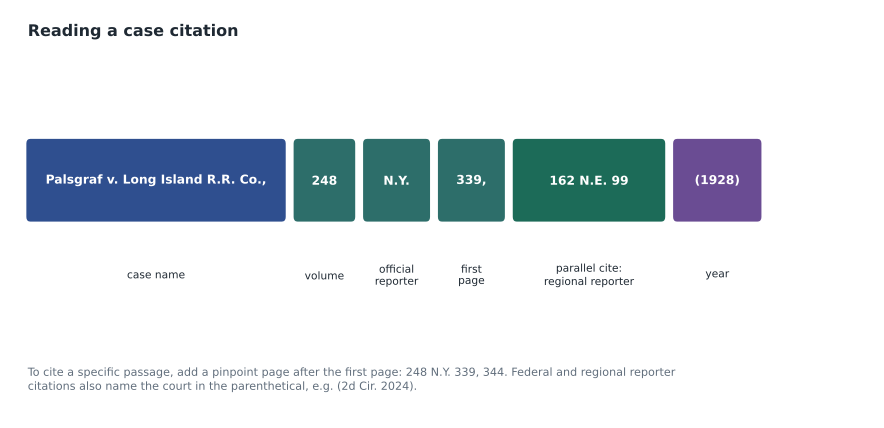
Professor Kinsella starts the fifth class by writing a citation on the board: Palsgraf v. Long Island R.R. Co., 248 N.Y. 339, 162 N.E. 99 (1928). Section B knows the case from Torts, where Professor Brenneman has been teaching proximate cause. Kinsella asks what each part of the citation means. Hannah Lindqvist explains the case name. Priya Natarajan explains that 248 N.Y. 339 means volume 248 of the official New York Reports, page 339. Nobody is sure about 162 N.E. 99. Samuel Tate, standing at the back, explains that it is the same opinion in volume 162 of the North Eastern Reporter, a regional reporter published by West. "Two citations, one case," Kinsella says. "Today you will learn why, and how to find every case that matters to your problem."
How cases are published
When an appellate court decides a case, it usually issues a written opinion. The opinion first appears as a slip opinion on the court's website and is quickly added to the commercial databases. Later, opinions designated for publication are collected in bound volumes called reporters, arranged roughly in chronological order. A citation to a reporter gives the volume number, the abbreviated reporter name and the first page of the opinion, followed in a full citation by the court and year in parentheses.
Some reporters are official, published by or under the authority of the government; others are unofficial, published commercially. Supreme Court decisions appear officially in the United States Reports (U.S.) and unofficially in West's Supreme Court Reporter (S. Ct.) and LexisNexis's Lawyers' Edition (L. Ed.). Because the official volumes appear years after decision, recent Supreme Court cases are often cited to S. Ct. or with blank volume and page numbers until U.S. pagination is available.
Federal court of appeals decisions are published in the Federal Reporter, now in its fourth series (F.4th), and unpublished ones in the Federal Appendix (F. App'x), which West stopped publishing in 2021, though unpublished opinions remain available online. Federal district court opinions selected for publication appear in the Federal Supplement (F. Supp., now F. Supp. 3d). Specialized reporters cover bankruptcy (B.R.), federal rules decisions (F.R.D.) and other fields.
State appellate decisions appear in official state reporters in some states and, in every state, in West's National Reporter System, which groups states into seven regional reporters: Atlantic, North Eastern, North Western, Pacific, South Eastern, South Western and Southern, plus separate reporters for California and New York. Many states have stopped publishing official reporters and designated the West regional reporter or their own website as official, and many have adopted public-domain or vendor-neutral citation formats that cite cases by year, court and sequential number rather than by book and page.
The parts of a published case
A case on a commercial platform contains material from two sources: the court and the publisher. The court supplies the caption (the parties' names and the docket number), the date, the names of the judges and counsel, and the opinion or opinions themselves: the majority, any concurrences and any dissents. The publisher adds a synopsis summarizing the case, headnotes that state individual points of law, and classification codes linking each headnote to a subject system.
Headnotes are written by the publisher's attorney editors, not by the court. They are invaluable for finding cases and for spotting the points a case decides, but they are not part of the opinion and must never be cited or quoted as if they were. Headnotes sometimes oversimplify or even misstate what the court said. Kinsella tells Section B that she once watched an appellate judge ask a lawyer at oral argument which page of the opinion contained the quoted language; it was in the headnote, and the court had not said it. "Read the opinion," she says. "Always."
Digests and the Key Number System
Before full-text searching, the main tool for finding cases by subject was the digest: a set of volumes that arranged every headnote by topic, so that a researcher could look up a legal point and find every case that addressed it. West's American Digest System divides the law into more than four hundred topics, such as Negligence, Contracts and Landlord and Tenant, and each topic into numbered subdivisions called key numbers. Every West headnote is assigned a topic and key number, so all cases on the same point share the same classification.
The Key Number System lives on in Westlaw, where clicking a key number in a headnote retrieves every case classified under it, filtered to the jurisdiction you choose. Lexis has its own classification of headnotes by topic, and Bloomberg Law uses points of law extracted from opinions. Classification searching is powerful because it finds cases that discuss a concept even when they use different words, which full-text searching misses.
The one-good-case method
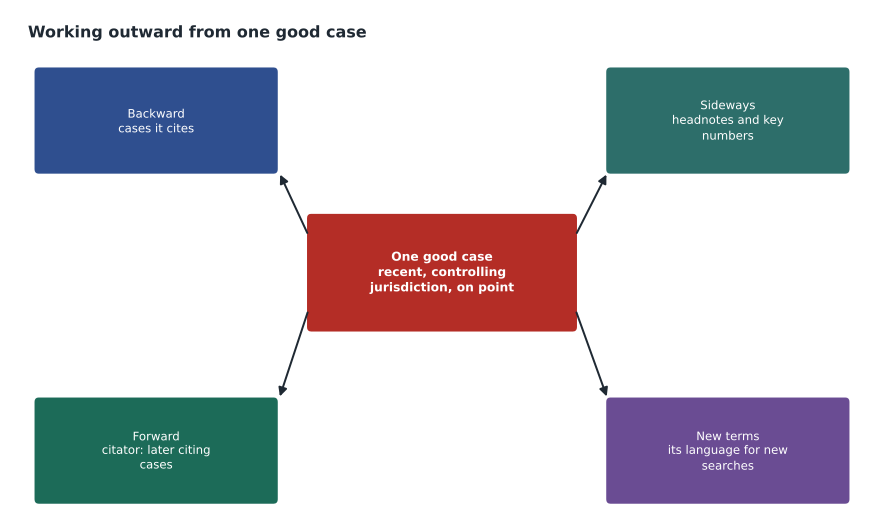
The most efficient way to research case law, Tate tells the class, is to find one good case and work outward from it. A good case is recent, from the controlling jurisdiction, and squarely on point. You may find it in a secondary source, an annotated code, or a search. Once you have it, mine it in four directions: read the cases it cites (backward), use its headnotes and classification codes to find cases on the same points (sideways), use a citator to find later cases that cite it (forward), and read its discussion for terms and concepts to use in new searches.
Citators: KeyCite, Shepard's and BCite
A citator lists every later source that cites a given authority and shows how the later sources treated it. The original citator was Shepard's Citations, first published in 1873 as gummed stickers lawyers attached to their reports; "Shepardizing" became a verb. Today Shepard's is part of Lexis, KeyCite is part of Westlaw, and BCite is part of Bloomberg Law. Each serves two purposes: validation, confirming that an authority is still good law, and expansion, finding later authorities on the same issue.
Each citator uses visual signals. In KeyCite, a red flag warns that a case is no longer good law for at least one point; a yellow flag warns of negative treatment that falls short of overruling, such as being distinguished or criticized; and a blue-striped flag indicates that the case has been appealed to a higher court or is the subject of pending litigation. Shepard's uses a red stop sign for strong negative treatment, an orange square for questioned validity, a yellow triangle for possible negative treatment, and a green diamond for positive treatment. BCite uses its own colored indicators. Citators also show depth of treatment and let you limit citing references to a particular headnote, jurisdiction, date range or treatment.
Flags are warnings, not conclusions. A red flag may mean the case was overruled on one issue but remains good law on the issue you care about. A case with no flag may still be weakened by a later decision that did not cite it directly, or by a statutory amendment. Kinsella's rule is simple: if a flag appears, read the negative case and decide for yourself what it means for your point. And validate every authority you cite, on the day you file, because law changes.
| Meaning | KeyCite (Westlaw) | Shepard's (Lexis) |
|---|---|---|
| No longer good law for at least one point | Red flag | Red stop sign (warning) |
| Validity questioned | Yellow flag | Orange square (questioned) |
| Some negative treatment, not overruled | Yellow flag | Yellow triangle (caution) |
| Positive treatment | No flag (citing references show positive treatment) | Green diamond |
| Appealed or related pending litigation | Blue-striped flag | Shown in history |
| What to do | Read the negative case; check whether it affects your point | Read the negative case; check whether it affects your point |
Reading the citing references
A citator report for an important case may list thousands of citing references. To use it efficiently, narrow the list. Limit by jurisdiction to find the cases that matter in your court. Limit by headnote to find cases citing the case for your specific point. Limit by date to find the newest cases. Look at depth-of-treatment indicators, which show whether a citing case discussed the cited case at length or merely mentioned it. And look at secondary sources citing the case, which may analyze the issue for you.
Kinsella also wants Section B to check the history of each case: what happened to it on appeal. A decision of an intermediate court may have been affirmed, reversed or vacated by a higher court, or review may still be pending. Direct history appears at the top of a citator report. Citing a lower court decision that was later reversed, without noting the reversal, is a serious error.
Reading cases efficiently
Researchers cannot read every case in full, so they read in stages. First, skim the synopsis and headnotes to decide whether the case is relevant. Second, if it seems relevant, jump to the part of the opinion that addresses your issue, using the headnote links. Third, if it is important, read the whole opinion, including the facts, procedural posture, holding and reasoning, and any concurrence or dissent. Lesson 6 covers careful reading and case briefing.
Priya asks how to know when a case is important enough to read in full. Kinsella answers: any case you plan to cite, any binding case on your issue, and any case that other courts keep citing for your point. Those are the cases the reader of your memo will expect you to know thoroughly.
Worked problem
Researching the recreational use question
Daniel Reyes is preparing for the memo assignment by practicing on a real jurisdiction. He wants to know how courts in one state have treated the question whether a landowner who asks for donations has "charged" visitors under the state's recreational use statute. Outline his case research.
Show solution
- Start with the annotated statute: the notes of decisions under the definition of "charge" list cases interpreting it.
- Pick the most recent case from the state's highest court or intermediate court that addresses donations or similar payments. That is his one good case.
- Read its headnotes and click the key number for the definition of charge, limited to the state, to find other cases on the same point.
- Run the case through KeyCite or Shepard's: check its history and flags, then filter citing references to the headnote about "charge" and to the state's courts.
- Read the newest citing cases first, and note any secondary sources that discuss the issue.
- Record each step in his research log.
Answer: Within an hour he has the leading cases, knows whether they remain good law, and has a list of the terms courts use. He has also found a later decision that distinguished his one good case on the ground that the donations there were effectively required, which is exactly the kind of nuance a memo must address.
Common case research mistakes
Kinsella lists the mistakes she sees most often in new lawyers' work. Citing a case for something it does not say, usually because the researcher relied on a headnote or a quotation in another case. Missing the controlling case because the search was not limited to the right jurisdiction. Citing a case that has been reversed, overruled or superseded by statute. Relying on an unpublished decision without checking the court's rules. Treating dicta as a holding. And stopping too early, after finding one favorable case, without looking for authority on the other side.
Every one of those mistakes, she says, is avoided by the same habits: limit to the right jurisdiction, read the opinion, validate with a citator, check history, and keep searching until the results repeat.
Dockets and briefs
Opinions are not the only court documents worth finding. A docket lists every filing in a case, and the filings themselves (complaints, motions, briefs and orders) show how experienced lawyers framed an issue, which authorities they relied on, and how a particular judge ruled on similar motions. Federal dockets are available through PACER and, for many cases, free through CourtListener's RECAP archive; the commercial platforms collect dockets and briefs as well. Kinsella tells Section B that reading the briefs in a leading case is one of the best ways to learn both the law and the craft of legal writing, but she reminds them that briefs are advocacy, not authority, and should never be cited as a statement of the law.
State court dockets are less uniform. Some states offer statewide online access, others only county-by-county systems, and some restrict online access to case information for privacy reasons. Trial court orders that never appear in a reporter can sometimes be found only through dockets, which matters when a researcher needs to know how a local judge handles a recurring question.
Summary and key terms
- Cases are published as slip opinions, then in official and unofficial reporters; a citation gives volume, reporter, first page, court and year.
- Federal cases appear in U.S., S. Ct. and L. Ed. (Supreme Court), F.4th (courts of appeals) and F. Supp. 3d (district courts); state cases appear in state and West regional reporters, and many states use public-domain citations.
- Headnotes and synopses are written by publishers, not courts; never cite them.
- The West Key Number System classifies headnotes by topic so that cases on the same point can be found together.
- Work outward from one good case: backward, sideways, forward and to new search terms.
- Citators (KeyCite, Shepard's, BCite) validate authority and expand research; read the negative cases behind any flag and check each case's history.
- Reporter
- A series of volumes publishing court opinions, roughly in chronological order.
- Parallel citation
- A citation to the same opinion in a second reporter.
- Headnote
- A publisher's summary of a point of law decided in a case; not part of the opinion.
- Key number
- A numbered subdivision of a West topic used to classify headnotes.
- Citator
- A tool listing later authorities citing a source and indicating how they treated it.
- Shepardizing
- Checking an authority's validity and citing references, originally with Shepard's Citations.
Practice problems
Work each problem on paper first, then reveal the answer to check.
What does the citation 91 F.4th 610 (2d Cir. 2024) tell you?
Show answer
The opinion begins on page 610 of volume 91 of the Federal Reporter, Fourth Series, and was decided by the US Court of Appeals for the Second Circuit in 2024.
A headnote states the exact rule you need. May you quote it in your memo?
Show answer
No. Headnotes are written by the publisher, not the court. Find the passage in the opinion that supports the point and quote or cite that.
Your key case has a red KeyCite flag. Does that mean you cannot use it?
Show answer
Not necessarily. Read the negative treatment. The case may have been overruled on a different point and remain good law on yours. If it was overruled on your point, you cannot rely on it as current law.
How do you narrow a citator report for a case cited thousands of times?
Show answer
Filter by jurisdiction, by the headnote that matches your issue, by date, by depth of treatment and by document type, and read the newest relevant citing cases first.
Lesson quiz · 5 questions
Score 60% or more to complete this lesson.
Create a free account to save your progress, take quizzes and earn a certificate.