
LAWU-104 · Lesson 4 of 12 · 21 min
Research platforms, free sources and AI tools
▶ Video coming soon A video version of this lesson is on the way.
On the Tuesday after the library session, Section B meets in a computer lab. Every student has logins for the three major commercial research services, which law schools provide free to students. Samuel Tate starts by asking how many of them have already used one of the services' artificial intelligence features to answer a question from another class. Most hands go up. He then puts a slide on the screen with a single sentence from a federal judge's 2023 sanctions order and asks Section B to guess what happened. Priya Natarajan guesses correctly: a lawyer filed a brief citing cases that did not exist.
"Today," Tate says, "you will learn what these platforms do well, what the free alternatives can and cannot do, and how to use the new AI tools without becoming the next sanctions order."
The commercial platforms
Three commercial services dominate American legal research. Westlaw, published by Thomson Reuters, is built on the West reporters, the West Key Number System and KeyCite. Lexis, published by LexisNexis, offers its own case collections, headnotes and Shepard's Citations. Bloomberg Law, from Bloomberg Industry Group, combines legal research with dockets, news and business information and has its own citator, BCite. Each service contains federal and state cases, statutes, regulations, court rules, dockets and a large library of secondary sources, although each has exclusive content: some treatises and practice guides are available on only one platform.
All three now build generative AI into their research tools. Thomson Reuters offers its CoCounsel assistant across Westlaw, LexisNexis offers Lexis+ with its Protégé assistant, and Bloomberg Law has added its own AI features. These tools answer research questions in natural language, summarize cases, draft documents and compare authorities, and they draw on the publisher's own collection rather than the open internet. Tate warns that product names and features change constantly, so Section B should learn the underlying skills rather than any one interface.
Other services fill particular niches. vLex, which merged with Fastcase in 2023, offers a large global collection and its Vincent AI assistant, and many state bar associations give members free access to it as a member benefit. In November 2025 the practice-management company Clio completed its acquisition of vLex. HeinOnline holds scanned law reviews, historical statutes, the Federal Register back to 1936 and many government documents. Specialized services cover tax, securities, labor and other practice areas.
Commercial platforms are expensive outside law school, and firms negotiate contracts that may limit which databases their lawyers can use without extra charges. Daniel Reyes says his old firm had a plan that charged extra for content outside the firm's subscription, which made the partners nervous whenever a paralegal clicked on a treatise. Tate tells the class to learn what their employer's plan covers in their first week on any job.
Free and low-cost sources
A remarkable amount of primary law is now free online. Government sites publish official versions of many sources. govinfo, run by the US Government Publishing Office, provides authenticated versions of the United States Code, the Statutes at Large, the Federal Register, the Code of Federal Regulations, congressional reports and many federal court opinions. Congress.gov, from the Library of Congress, tracks bills, legislative history and the Congressional Record, and publishes reports from the Congressional Research Service. The Office of the Law Revision Counsel publishes the current United States Code at uscode.house.gov, and the eCFR provides a continuously updated version of federal regulations.
Courts publish their own opinions on their websites, and the Supreme Court posts slip opinions at supremecourt.gov on the day of decision. Federal court dockets and filings are available through PACER, which charges per page with fee caps and waivers. State legislatures and courts publish statutes, regulations and opinions on their own sites, though quality, search tools and official status vary widely.
Nonprofit projects have transformed free case law. The Free Law Project runs CourtListener, which offers millions of opinions, oral argument audio and the RECAP archive of federal court filings gathered from PACER users. In March 2024, Harvard Law School's Caselaw Access Project made its digitized collection of more than forty million pages of American case law, covering almost every published state and federal decision through 2018, freely available, and CourtListener added nearly nine million decisions from it. Google Scholar's case law search is free and includes a simple "how cited" feature. Cornell's Legal Information Institute publishes the US Code, the CFR, the federal rules and the Constitution in readable form, along with the Wex legal dictionary.
| Source | What it offers | Notes |
|---|---|---|
| govinfo (GPO) | Authenticated US Code, Statutes at Large, Federal Register, CFR, congressional documents, many court opinions | Official, digitally signed versions |
| Congress.gov (Library of Congress) | Bills, legislative history, Congressional Record, CRS reports | The best free legislative history source |
| uscode.house.gov (Law Revision Counsel) | Current United States Code, popular name table, notes | Updated as laws are enacted |
| eCFR | Continuously updated Code of Federal Regulations | Authoritative, though the annual print CFR remains the official edition |
| CourtListener (Free Law Project) | Millions of opinions, dockets via RECAP, oral argument audio, citation tools | Includes the Caselaw Access Project collection |
| Google Scholar | Searchable federal and state case law, "how cited" links | No citator flags; check validity elsewhere |
| Cornell LII | US Code, CFR, federal rules, Constitution, Wex dictionary | Readable and well linked |
What free sources cannot do
Free sources are excellent for reading a known authority and for quick checks, but they lack the editorial enhancements that make commercial research efficient. Most do not have headnotes written by attorney editors, a classification system like the Key Number System, comprehensive secondary sources, or a reliable citator that flags whether a case has been reversed or overruled. Their coverage of recent trial court decisions and state agency materials may be thin. A lawyer who relies only on free sources must work harder to be sure nothing has been missed, and must be especially careful about validating authority.
Kinsella adds a point about official status. When a court requires citation to an official reporter or code, or when the exact text matters, check whether your free source is official or authenticated. govinfo's authenticated documents carry a digital signature. Many state sites expressly say their online codes are unofficial. For most research the difference does not matter; for a contested question of statutory text, it can.
Searching well
Every platform offers two basic search modes. Natural-language search accepts a question or description and returns results ranked by the system's estimate of relevance. Terms-and-connectors search, also called Boolean search, gives the researcher precise control over which words appear and how close together they must be. Both are useful. Natural language is good for getting started and for broad concepts; terms and connectors are good for precision, for finding a specific phrase, and for being confident that you have found every document matching your criteria.
Common connectors include AND (both terms), OR (either term), quotation marks for phrases, proximity connectors such as /s (same sentence), /p (same paragraph) and /n (within n words), and a root expander, usually an exclamation point, to find variant endings, so that neglig! finds negligent, negligence and negligently. Syntax varies slightly by platform, and each has a help page. Most platforms also let you search within specific fields, such as the case name, judge, court or date, and filter results by jurisdiction, date, court level and document type.
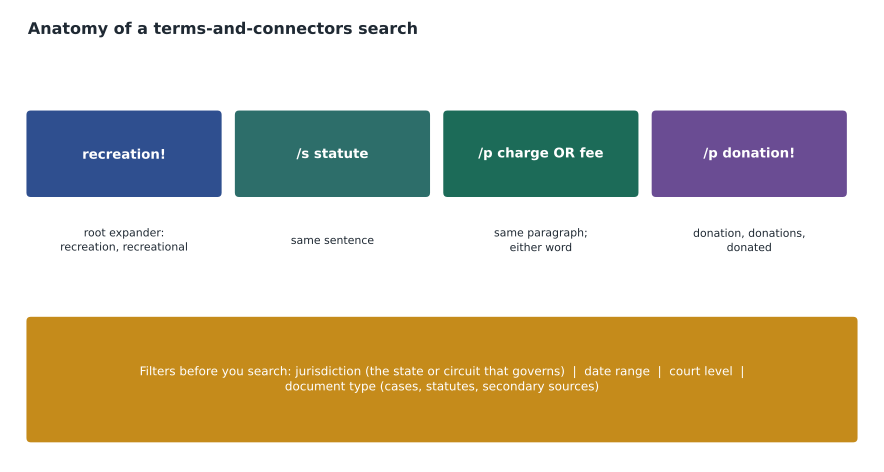
Kinsella suggests a routine for any database search. Start with a jurisdiction filter, because results from the wrong jurisdiction are noise. Run a natural-language search to find a few good cases. Read their headnotes and the language courts actually use. Then build a precise terms-and-connectors search using that language, and use it to make sure you have found every relevant case. Finally, use the best cases to search outward through headnotes, key numbers and citators, which Lesson 5 covers.
Generative AI in legal research
Generative AI tools produce fluent text in response to prompts. They can summarize long documents, suggest search terms, explain doctrines in plain language, draft outlines and even propose arguments. They also have a well-documented failure mode: they can produce plausible but false statements, including invented cases with realistic names and citations. Tools built into the major research platforms are designed to ground their answers in the publisher's database and link to sources, which reduces but does not eliminate the problem. General-purpose chatbots that are not connected to a legal database are riskier still.
The case that made the risk famous is Mata v. Avianca, Inc., 678 F. Supp. 3d 443 (S.D.N.Y. 2023). Lawyers opposing a motion to dismiss filed a brief citing several decisions that did not exist; one of them had used ChatGPT and did not verify the results, and when the court questioned the citations, the lawyers did not promptly come clean. Judge P. Kevin Castel sanctioned the two lawyers and their firm under Federal Rule of Civil Procedure 11, imposing a 5,000-dollar penalty and requiring them to send letters to the judges falsely named as authors of the fake opinions. The problem has not gone away. In Park v. Kim, 91 F.4th 610 (2d Cir. 2024), the Second Circuit referred a lawyer to its grievance panel for citing a nonexistent case generated by ChatGPT. In July 2025, in Johnson v. Dunn, a federal judge in the Northern District of Alabama disqualified lawyers from a large firm from continuing in the case and publicly reprimanded them after filings cited AI-generated cases that did not exist.
Professional rules for AI use
No special rule is needed to make AI misuse sanctionable; existing rules already cover it. Under Rule 11 and its state equivalents, a lawyer who signs a filing certifies that its legal contentions are warranted by existing law after a reasonable inquiry. Under the Model Rules of Professional Conduct, lawyers owe competence (Rule 1.1, whose comment 8 includes understanding the benefits and risks of relevant technology), confidentiality of client information (Rule 1.6), candor toward the tribunal (Rule 3.3), and supervision of others' work (Rules 5.1 and 5.3).
In July 2024 the American Bar Association issued Formal Opinion 512 on generative AI tools. It concludes that lawyers using these tools must have a reasonable understanding of their capabilities and limitations, though they need not become experts; must independently verify output to an appropriate degree; must protect client confidences and, before entering confidential information into a self-learning tool, generally obtain the client's informed consent; must consider whether to tell clients about AI use; must follow court rules on disclosure; and may not bill clients for time saved by AI or charge for learning to use a tool they would use for all clients. Many state bars have issued their own guidance.
Courts have responded unevenly. After Mata, a number of individual judges issued standing orders requiring lawyers to certify whether they used generative AI and that they verified its output. Some courts adopted local rules. The Fifth Circuit proposed a rule requiring certification in 2023 but announced in 2024 that it would not adopt it, noting that existing rules already require accuracy and that using AI is no excuse. Before filing in any court, check its local rules and the assigned judge's standing orders. Citation manuals have reacted too: the 22nd edition of The Bluebook, published in 2025, added a rule on citing AI output, which Lesson 10 discusses.
Worked problem
Using AI responsibly on the memo problem
Marcus Webb asks a general-purpose AI chatbot whether farm hayrides are covered by recreational use statutes. It replies confidently that they are, citing three state supreme court cases with names, reporter citations and quotations. What should he do?
Show solution
- Treat the answer as a lead, not authority. A general chatbot is not connected to a verified legal database.
- Look up every cited case on Westlaw, Lexis, Bloomberg Law or CourtListener using the citation and the case name. Confirm that each exists, says what the chatbot claims, and has not been reversed or overruled.
- Check each quotation against the opinion itself.
- If a case cannot be found, assume it does not exist. Do not cite it, and do not ask the chatbot to confirm its own answer, which proves nothing.
- Protect confidentiality: do not paste client names or confidential facts into a tool unless the employer has approved it and the client has consented where required.
Answer: Marcus finds that one of the three cases is real but involves a snowmobile trail, not a hayride, and the other two do not exist. The useful thing the chatbot gave him was a vocabulary: "recreational use statute" and "recreational purpose." Everything else he had to verify, which took longer than starting with a secondary source would have.
A balanced view
Kinsella does not want Section B to fear the tools. She tells them that AI features on the research platforms can be genuinely useful for summarizing long opinions, suggesting search terms, comparing a jurisdiction's statute with others, and catching issues a researcher might have missed. Many firms now expect associates to use them. The skill that matters is the one this course teaches: knowing what authority looks like, where it comes from, how much it weighs, and how to verify it. A lawyer who has that skill can use AI as a fast research assistant. A lawyer who lacks it will not know when the assistant is wrong.
Jordan Kimura says it sounds like the rule he learned as a logistics officer: trust, but verify, and never sign for something you have not counted. Kinsella says she plans to borrow it.
Summary and key terms
- Westlaw (KeyCite, Key Numbers), Lexis (Shepard's) and Bloomberg Law (BCite) are the main commercial platforms; each has exclusive content and built-in generative AI tools.
- Free sources include govinfo, Congress.gov, uscode.house.gov, the eCFR, court websites, CourtListener (now including the Caselaw Access Project collection), Google Scholar and Cornell LII.
- Free sources lack editorial headnotes, classification systems and reliable citators, so validation takes extra care.
- Use natural-language search to get started and terms-and-connectors search for precision, always with jurisdiction filters.
- Generative AI can invent authority; Mata v. Avianca and later cases show that courts sanction lawyers who cite fake cases.
- ABA Formal Opinion 512 requires understanding the tools, verifying output, protecting confidentiality and billing fairly; check local rules and standing orders on AI disclosure.
- Terms-and-connectors search
- A precise search using operators such as AND, OR, phrases and proximity connectors; also called Boolean search.
- Root expander
- A symbol, usually !, that finds all words beginning with the given root.
- CourtListener
- A free case law and docket database run by the nonprofit Free Law Project.
- govinfo
- The Government Publishing Office's site providing authenticated federal legal documents.
- Hallucination
- A false statement generated by an AI tool, such as an invented case or quotation.
- ABA Formal Opinion 512
- The ABA's 2024 ethics opinion on lawyers' use of generative AI tools.
Practice problems
Work each problem on paper first, then reveal the answer to check.
Write a terms-and-connectors search to find cases discussing whether a parking fee counts as a charge under a recreational use statute.
Show answer
One version: recreation! /s statute /p "parking fee" OR parking /s charge. Then filter by jurisdiction. Exact syntax varies by platform.
You found a case on Google Scholar that supports your point perfectly. What else must you do before citing it?
Show answer
Check that it is still good law with a citator on a commercial platform (or, if none is available, by searching for later cases citing it), confirm the citation and pinpoint pages, and read the whole opinion to be sure the point is its holding.
According to ABA Formal Opinion 512, may a lawyer bill a client for three hours of work that an AI tool completed in ten minutes?
Show answer
No. A lawyer billing hourly may bill only for time actually spent, which can include time spent prompting and reviewing output, but not time saved.
A judge's standing order requires a certification about generative AI use, but the court's local rules say nothing. Which governs your filing before that judge?
Show answer
Both apply. You must comply with the local rules and the assigned judge's standing order, so file the certification.
Lesson quiz · 5 questions
Score 60% or more to complete this lesson.
Create a free account to save your progress, take quizzes and earn a certificate.