
LAWU-104 · Lesson 8 of 12 · 20 min
Regulations and agency materials
▶ Video coming soon A video version of this lesson is on the way.
Samuel Tate starts the eighth class with a number: the Code of Federal Regulations runs to more than two hundred printed volumes. Federal statutes fill a few dozen. "For every page Congress writes," he says, "agencies write several more. If you represent a business, an employer, a hospital or a bank, much of the law your client lives under is in regulations, and a great deal more is in guidance documents that are not regulations at all." Professor Kinsella adds that regulations are also where new lawyers most often miss the controlling law, because they research the statute and stop.
Why agencies make law
Congress often writes statutes in general terms and delegates to an executive agency the job of filling in details, enforcing the law and deciding individual cases. The Occupational Safety and Health Act, for example, directs the Secretary of Labor to set workplace safety standards; the standards themselves are regulations. The Clean Air Act directs the Environmental Protection Agency to set air quality standards. Agencies act only within the authority Congress gives them, and a regulation that exceeds that authority or conflicts with the statute is invalid.
Agencies make law in two main ways. Through rulemaking, they adopt regulations, also called rules, that apply generally to future conduct. Through adjudication, they decide particular disputes, such as whether an employer committed an unfair labor practice or whether a person is entitled to benefits, and those decisions can serve as precedent within the agency. Agencies also issue guidance: policy statements, interpretive rules, manuals, FAQs and letters that explain how the agency reads the statute and its regulations.
Rulemaking by notice and comment
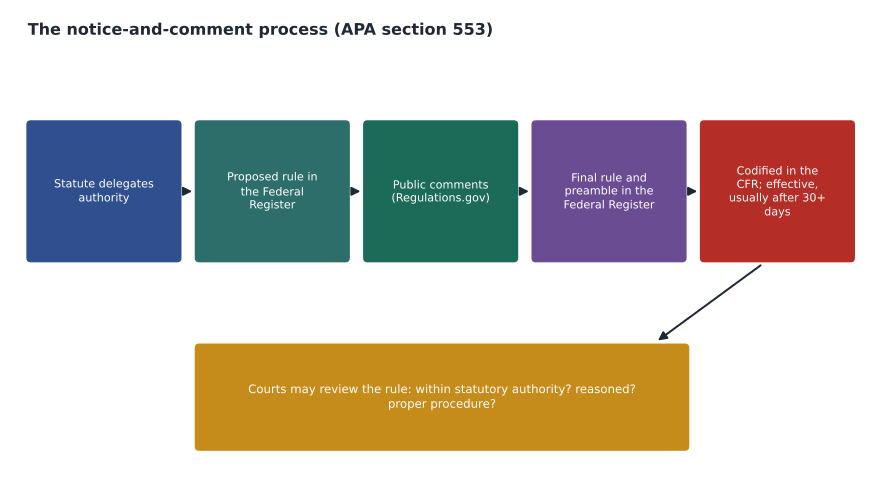
Most federal regulations are adopted through informal or notice-and-comment rulemaking under section 553 of the Administrative Procedure Act (APA), 5 U.S.C. § 553. The agency publishes a notice of proposed rulemaking in the Federal Register, describing the proposed rule and its legal basis; the public submits comments, usually through Regulations.gov; and the agency then publishes a final rule with a statement of basis and purpose responding to significant comments. A final rule usually takes effect at least thirty days after publication. Interpretive rules, policy statements and procedural rules are exempt from notice and comment.
Each step leaves a research trail. The proposed rule, the public comments, the final rule and its long explanatory preamble are all available, and the preamble is often the best explanation of what a regulation means and why the agency adopted it. The rulemaking docket on Regulations.gov collects the documents for each rulemaking. Agencies also publish their regulatory plans twice a year in the Unified Agenda of Regulatory and Deregulatory Actions, which helps researchers spot rules that are coming.
The Federal Register and the CFR
The Federal Register, published every business day since 1936 by the Office of the Federal Register and the Government Publishing Office, contains proposed rules, final rules, notices, and presidential documents such as executive orders and proclamations. It is chronological, like the Statutes at Large. Final rules are then codified by subject in the Code of Federal Regulations (CFR), which has fifty titles. CFR titles do not always match US Code titles: labor regulations are in title 29 of both, but environmental regulations are in title 40 of the CFR while the major environmental statutes are in title 42 of the Code.
The print CFR is revised once a year in four staggered parts: titles 1 through 16 as of January 1, titles 17 through 27 as of April 1, titles 28 through 41 as of July 1, and titles 42 through 50 as of October 1. Because rules change constantly, the print edition is always somewhat out of date. The Electronic Code of Federal Regulations (eCFR), maintained by the Office of the Federal Register, is updated daily and is the best free source for the current text; it is authoritative, though the annual print edition remains the official legal edition. The eCFR also offers a point-in-time feature for comparing versions on past dates.
To cite a regulation, give the CFR title, section and year: 29 C.F.R. § 1910.1200 (2025) is the hazard communication standard in the Occupational Safety and Health Administration's general industry regulations. To cite a rule as published in the Federal Register, give the volume, first page and date: OSHA's 2024 amendments to that standard appear at 89 Fed. Reg. 44,144 (May 20, 2024). Lesson 10 covers citation in more detail.
| Feature | Federal statutes | Federal regulations |
|---|---|---|
| Made by | Congress and the President | Executive agencies under delegated authority |
| Chronological publication | Statutes at Large | Federal Register |
| Subject codification | United States Code (54 titles) | Code of Federal Regulations (50 titles) |
| Current free version | uscode.house.gov | eCFR |
| Annotated version | USCA, USCS | Commercial platforms link regulations to cases and statutes |
| Validity limit | The Constitution | The Constitution and the enabling statute |
Finding regulations
There are several routes into the regulations. The annotated codes cross-reference the regulations that implement each statute, which is often the fastest route. The CFR has an index and a parallel table of authorities and rules that lists, for each statutory section, the CFR parts issued under it. Agency websites organize their regulations, guidance and enforcement materials by topic. And full-text searching on the eCFR or commercial platforms works well once you know the agency's vocabulary.
Updating regulations means checking two things: whether the CFR section has been amended since the version you read, and whether a proposed rule might change it soon. On the eCFR, check the "up to date as of" date and the recent changes list. On the commercial platforms, use the citator for regulations, which shows amendments, proposed rules and cases that have discussed or invalidated the regulation. Federal Register documents also carry a "List of CFR Sections Affected" that tracks changes.
Guidance documents
Agencies issue far more guidance than regulations: manuals, FAQs, opinion letters, enforcement policies and informal explanations. Guidance documents generally do not have the force of law, because they did not go through notice and comment, but they tell regulated parties how the agency will interpret and enforce the law, and in practice clients often follow them closely. Agencies typically publish guidance on their websites. The Department of Labor's opinion letters on wage-and-hour questions, the IRS's revenue rulings and the EEOC's enforcement guidance are familiar examples.
Kinsella warns that guidance changes with administrations. Agencies withdraw and reissue guidance frequently, and an opinion letter that was on an agency's website last year may have been withdrawn. Always confirm the current status of any guidance you rely on, and note the date.
Agency adjudication
Many agencies decide cases through administrative law judges and agency appeals boards. The National Labor Relations Board, the Social Security Administration, immigration courts and many others produce large bodies of decisions, which are published on agency websites and on the commercial platforms. Agency decisions can bind the agency in later cases, and federal courts review them under deferential standards for factual findings. Researching an area governed by an agency often means reading its decisions as carefully as court opinions.
How courts treat agency interpretations
For forty years, courts reviewing an agency's interpretation of a statute it administered followed Chevron U.S.A. Inc. v. Natural Resources Defense Council, Inc., 467 U.S. 837 (1984): if the statute was ambiguous, a court deferred to the agency's reasonable interpretation. In Loper Bright Enterprises v. Raimondo, 603 U.S. 369 (2024), the Supreme Court overruled Chevron. It held that the Administrative Procedure Act requires courts to exercise their independent judgment in deciding whether an agency acted within its statutory authority, and that courts may not defer to an agency's interpretation simply because a statute is ambiguous.
Loper Bright did not make agency views irrelevant. Courts may still give weight to an agency's interpretation under Skidmore v. Swift & Co., 323 U.S. 134 (1944), depending on the thoroughness of its consideration, the validity of its reasoning, its consistency over time and other factors that give it power to persuade. When a statute expressly delegates discretionary authority to an agency, for example to define a term or to fill in details, courts respect that delegation within constitutional limits. And the Court stated that earlier cases that relied on Chevron are not automatically overruled; their specific holdings remain subject to statutory stare decisis.
Deference to an agency's interpretation of its own regulations, known as Auer deference, survives in a narrowed form. In Kisor v. Wilkie, 588 U.S. 558 (2019), the Court held that such deference applies only if the regulation is genuinely ambiguous after a court exhausts the traditional tools of interpretation, the agency's reading is reasonable, and the interpretation reflects the agency's authoritative, considered judgment. Separately, under the major questions doctrine described in West Virginia v. EPA, 597 U.S. 697 (2022), courts expect clear congressional authorization before an agency claims power to decide questions of vast economic and political significance.
For a researcher, the practical consequence is that a regulation or agency interpretation is not the end of the inquiry. A memo on a regulatory question should identify the statute, the regulation, any guidance, and the cases deciding whether the agency's position is a valid reading of the statute, and it should note when the leading cases rested on Chevron, because their reasoning may now be vulnerable even if their holdings stand.
Worked problem
A regulation-driven question
Hannah Lindqvist's sister runs a small bakery with eighteen employees and asks whether the bakery must keep chemical hazard information for its cleaning products. Outline the research.
Show solution
- Identify the statute: the Occupational Safety and Health Act authorizes workplace safety standards; it does not answer the question itself.
- Find the regulation: the hazard communication standard, 29 C.F.R. § 1910.1200, which requires employers to keep safety data sheets for hazardous chemicals and train employees. Read its scope and exemptions, including those for consumer products used as consumers would use them.
- Check currency on the eCFR, including the standard's 2024 amendments aligning it with a later revision of the Globally Harmonized System, and their phased compliance dates.
- Read OSHA's guidance and interpretation letters on cleaning products, confirming each letter's current status.
- Check whether the bakery's state runs its own OSHA-approved state plan, which may have different or stricter rules.
- Look for cases or review commission decisions if the application is unclear.
Answer: The answer turns on the regulation's text, its consumer-product exemption, OSHA's interpretation letters and possibly state plan rules. The statute alone would not have answered it.
State administrative law
States have their own agencies, administrative procedure acts and administrative codes. Most publish a state register, the equivalent of the Federal Register, and an administrative code, the equivalent of the CFR, usually online through the secretary of state's office. State administrative materials vary greatly in organization and accessibility, and older versions can be hard to find. Commercial platforms cover state regulations, but less completely than state statutes. Many states have their own deference doctrines, and several have rejected deference to agency interpretations by statute or decision.
Executive orders and other presidential documents
Presidents issue executive orders, proclamations and memoranda. Executive orders direct the operations of the executive branch and must rest on constitutional or statutory authority. They are published in the Federal Register, compiled in title 3 of the CFR, and available on govinfo and the Federal Register's website. An executive order may require agencies to begin rulemaking, but it generally does not itself bind private parties unless it rests on statutory authority that permits that. Researchers working on federal programs, contracting or immigration often need to track executive orders as closely as statutes.
Reading a regulation's preamble
When a final rule is published in the Federal Register, it is preceded by a preamble that can run to hundreds of pages. The preamble summarizes the rule, explains the agency's legal authority, responds to significant public comments, and often explains how the agency intends particular provisions to apply. It is not codified in the CFR, so a researcher who reads only the eCFR will miss it. Courts frequently consult preambles to understand a regulation, and agencies treat them as authoritative statements of their views. Kinsella tells Section B to read the preamble whenever the meaning of a regulation matters, and to cite the Federal Register page where the relevant explanation appears.
Agencies also publish their regulatory dockets, including the public comments. Comments from industry groups, advocacy organizations and other agencies can reveal how a provision was expected to work in practice and which problems the agency chose not to address, which can be useful in interpretation and in litigation challenging a rule.
Summary and key terms
- Agencies make law through rulemaking, adjudication and guidance, within authority delegated by statute.
- APA notice-and-comment rulemaking leaves a research trail: proposed rule, comments, final rule and preamble, collected on Regulations.gov.
- The Federal Register publishes rules chronologically; the 50-title CFR codifies them; the eCFR is updated daily and has point-in-time versions.
- Guidance documents generally lack the force of law but guide compliance; confirm they have not been withdrawn.
- Loper Bright (2024) overruled Chevron: courts decide statutory meaning independently, may give Skidmore weight to agency views, and respect express delegations; earlier Chevron-based holdings are not automatically overruled.
- Auer deference survives in narrowed form under Kisor; the major questions doctrine requires clear authorization for major agency actions.
- States have their own registers, administrative codes and deference rules.
- Regulation (rule)
- A general statement of law issued by an agency under delegated authority.
- Rulemaking by notice and comment
- The APA section 553 process of proposing a rule, inviting comments and publishing a final rule.
- Federal Register
- The daily federal publication of rules, proposed rules, notices and presidential documents.
- Code of Federal Regulations
- The subject codification of federal regulations in 50 titles.
- Guidance document
- An agency statement of interpretation or policy that generally lacks the force of law.
- Skidmore weight
- Respect courts give an agency interpretation according to its power to persuade.
- Loper Bright
- The 2024 Supreme Court decision overruling Chevron deference.
Practice problems
Work each problem on paper first, then reveal the answer to check.
Where would you find the current text of a federal regulation amended last week?
Show answer
The eCFR, which is updated daily, or a commercial platform; the final rule itself appears in the Federal Register. The annual print CFR would not yet reflect it.
After Loper Bright, must a court accept an agency's reasonable interpretation of an ambiguous statute?
Show answer
No. The court must exercise independent judgment about the statute's meaning. It may give the agency's view weight according to its power to persuade under Skidmore, and it must respect an express delegation of discretionary authority.
An agency's FAQ on its website explains how it reads a regulation. Does the FAQ have the force of law?
Show answer
Generally not. It is guidance that did not go through notice and comment. It is still important evidence of how the agency will act, and a court might defer to it in narrow circumstances under Kisor if the regulation is genuinely ambiguous and the FAQ reflects the agency's authoritative judgment.
In which CFR title would you expect to find executive orders compiled?
Show answer
Title 3, which compiles presidential documents.
Lesson quiz · 5 questions
Score 60% or more to complete this lesson.
Create a free account to save your progress, take quizzes and earn a certificate.