
LAWU-104 · Lesson 1 of 12 · 24 min
The US legal system
▶ Video coming soon A video version of this lesson is on the way.
Professor Orla Kinsella begins the first Legal Research and Writing class at Larkhaven Law School by handing every student in Section B an index card and asking them to write down, in one sentence, what a lawyer does. When she collects the cards, most say some version of "argues for clients" or "knows the law." She reads a few aloud and then writes her own answer on the board: "A lawyer finds out what the law is, applies it to a client's facts, and says so clearly in writing." Most of a lawyer's working life, she tells the class, is spent doing those three things, and only a small part of it happens in a courtroom. This course is about all three.
Kinsella spent six years as a staff attorney at a state supreme court, writing bench memos that told the justices what the parties had argued and what the law actually said, and then six more years at a mid-size litigation firm. She says she has read thousands of briefs and memos, and that the difference between the good ones and the bad ones is almost never intelligence. It is whether the writer found the right authority, understood how much weight it carried, and explained it so a busy reader could follow. "Every one of those skills can be learned," she says. "That is what we will do this year."
Daniel Reyes, who worked as a paralegal at a personal-injury firm in El Paso before law school, says he spent three years pulling cases off Westlaw and still is not sure he understood why some of them mattered and others did not. Kinsella tells him that is exactly where the course starts. Before anyone can research well, they have to understand the structure the law comes from: who makes it, which courts decide what, and how the pieces fit together. Jordan Kimura, the Army veteran who runs the section's study group, writes "org chart first" at the top of his notes.
Course plan and the memo problem
The fall semester has two halves. In the first, Section B will learn the sources of American law and how to find them: cases, statutes, regulations and the secondary sources that explain them. In the second, they will learn to write the document that first-year associates write more than any other, the objective office memo. Kinsella explains that in October she will hand out a memo assignment built on a fictional state, so that everyone researches the same closed set of authorities and the grading can focus on analysis and writing. The spring course, Legal Research and Writing II, turns to persuasive writing: briefs and oral argument.
Samuel Tate, the reference librarian assigned to Section B, visits the first class to introduce himself. He tells the students that the law library is still the best place to learn research, even though almost everything they will use is online, because the print collection shows how the sources are organized. He invites them to a library orientation the following week, where they will hold the United States Reports, a volume of a regional reporter and an annotated code, and see how each one connects to the databases they will use every day.
Sources of law: primary and secondary
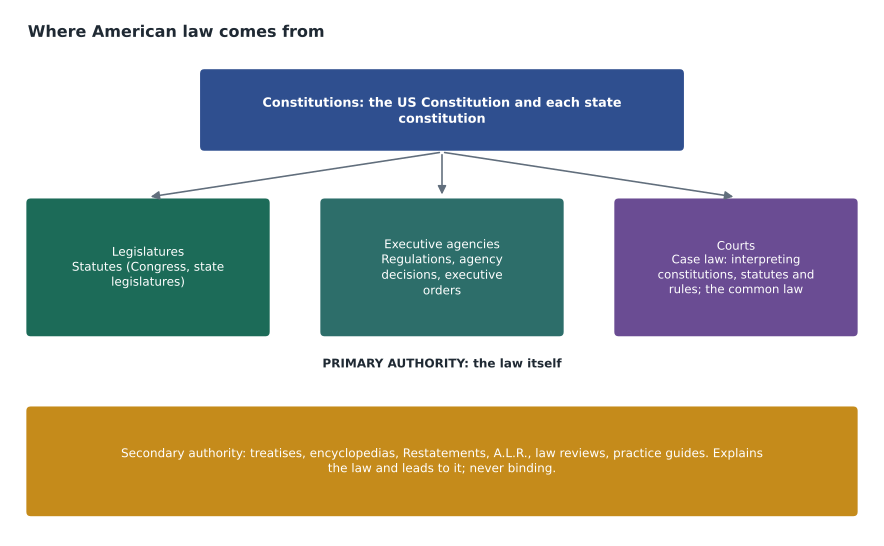
The first distinction a researcher must master is between primary and secondary authority. Primary authority is the law itself: constitutions, statutes, regulations, court decisions and a handful of other sources such as treaties, executive orders and court rules. Secondary authority is writing about the law: treatises, law review articles, legal encyclopedias, practice guides, Restatements and similar works. A court must follow primary authority that binds it. It may consult secondary authority, and sometimes relies on it heavily, but it never has to follow it.
Kinsella stresses that the line is about what a source is, not how good it is. A brilliant treatise is still secondary authority. An obscure unpublished trial court order is primary authority, even if it carries almost no weight. Researchers use secondary sources to understand an area of law and to find primary authority quickly, and then cite the primary authority in their own writing.
Primary authority comes from all three branches of government. Legislatures enact statutes. Executive agencies adopt regulations under powers delegated by statute and issue decisions in adjudications. Courts decide cases and, in doing so, interpret constitutions, statutes and regulations and develop the common law in areas such as contracts, torts and property where much of the law is still judge-made. The executive also acts through executive orders and proclamations, which can be primary authority when they rest on constitutional or statutory power.
Federalism: two systems of law
The United States has at least fifty-one legal systems running side by side: the federal system and one for each state, plus the District of Columbia, the territories and the governments of federally recognized tribes. Each state has its own constitution, legislature, agencies and courts. The federal government has only the powers the Constitution grants it, though those powers are broad. Under the Supremacy Clause in Article VI, valid federal law prevails over conflicting state law.
For a researcher, federalism means that the first question about any problem is whose law governs. A contract dispute between two businesses is usually governed by state contract law, even if the case ends up in federal court. A claim of employment discrimination may arise under a federal statute, Title VII, a state statute, or both. A criminal charge may be federal or state. Kinsella tells the class that many research mistakes start with researching the wrong jurisdiction's law, and that the habit of asking which law applies should become automatic.
Priya Natarajan asks how a federal court decides state-law questions. Kinsella explains that when a federal court hears a state-law claim, usually because the parties are citizens of different states, it applies the substantive law of the relevant state as that state's highest court has declared it, under Erie Railroad Co. v. Tompkins, 304 U.S. 64 (1938), which Section B is studying in Civil Procedure. If the state's highest court has not decided the question, the federal court predicts how it would rule, and in many states it may certify the question to the state supreme court for an answer.
The federal courts
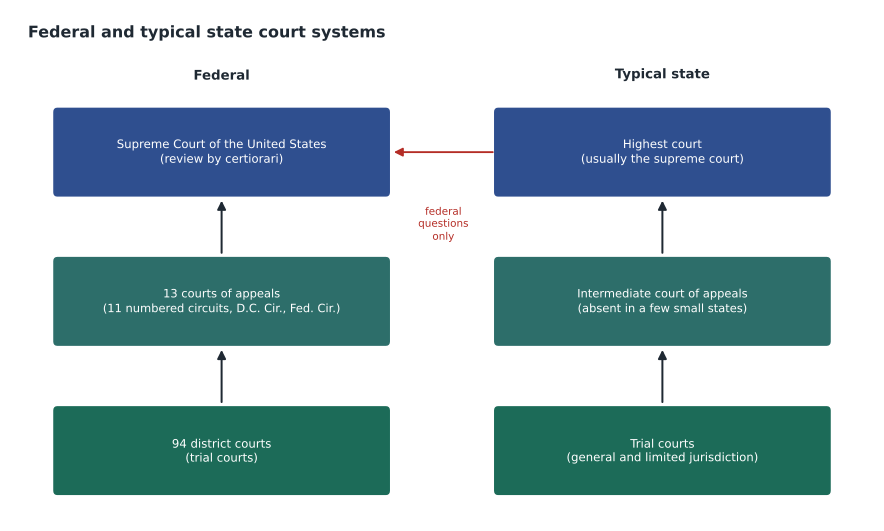
The federal judiciary has three main levels. At the bottom are the United States district courts, the trial courts, of which there are 94, at least one in every state. In the middle are the thirteen United States courts of appeals: eleven numbered circuits, the District of Columbia Circuit, and the Federal Circuit, which hears appeals in subject areas such as patents and claims against the United States rather than by geography. At the top is the Supreme Court of the United States, which hears most of its cases by granting a petition for a writ of certiorari and decides only a small fraction of the petitions it receives each year.
There are also specialized federal courts, such as the bankruptcy courts, which operate as units of the district courts, the Court of Federal Claims, the Tax Court and the Court of International Trade. Federal judges in the district courts, courts of appeals and Supreme Court hold office during good behavior under Article III, which means in practice for life. Magistrate judges and bankruptcy judges serve fixed terms and handle work referred to them.
Each court of appeals hears appeals from the district courts in its circuit. The Second Circuit, for example, covers New York, Connecticut and Vermont; the Ninth covers California and most of the West. Decisions of a court of appeals bind the district courts within that circuit and later panels of the same court, but not courts in other circuits. That geography matters enormously when you research federal law: a Fifth Circuit decision controls in Texas federal courts and is merely persuasive in New York.
State courts
Most litigation in the United States happens in state courts, which hear the great majority of contract, tort, property, family and criminal cases. State court systems vary but usually follow the same three-level pattern as the federal system: trial courts, an intermediate court of appeals, and a court of last resort, usually called the supreme court. Many states also have trial courts of limited jurisdiction for small claims, traffic matters or probate. A handful of smaller states, such as Delaware, Maine, Rhode Island and Vermont, have no intermediate appellate court, so appeals go directly to the state's highest court.
Court names are not consistent from state to state, and Kinsella warns that they can mislead. In New York, the trial court of general jurisdiction is called the Supreme Court, the intermediate court is the Appellate Division, and the highest court is the Court of Appeals. In Maryland, the highest court was called the Court of Appeals until it was renamed the Supreme Court of Maryland in December 2022. Texas and Oklahoma each have two courts of last resort, one for civil and one for criminal cases. A researcher must always check which court decided a case before deciding how much it matters.
The US Supreme Court can review a decision of a state's highest court only on a question of federal law, such as whether a state statute violates the federal Constitution. On questions of state law, the state's highest court has the final word. When a state supreme court interprets its own state constitution, it may give more protection than the federal Constitution requires, and if its decision rests on an adequate and independent state ground, the US Supreme Court will not review it.
| Level | Federal system | Typical state system |
|---|---|---|
| Trial | 94 district courts (plus bankruptcy units and specialized courts) | Courts of general jurisdiction, often called superior, circuit or district courts; limited-jurisdiction courts for small claims, traffic, probate |
| Intermediate appeal | 13 courts of appeals: 11 numbered circuits, the D.C. Circuit and the Federal Circuit | Court of appeals or appellate division; absent in a handful of smaller states |
| Highest court | Supreme Court of the United States (discretionary review by certiorari) | Usually the supreme court; the final word on that state's law |
| Binding effect | A circuit's decisions bind district courts in that circuit | Highest court binds all courts in the state; intermediate court rules vary |
The three branches as sources of law
Statutes are the most important source of law in many modern practice areas. Congress enacts federal statutes, which are published first as slip laws, then in the chronological Statutes at Large, and then arranged by subject in the United States Code. State legislatures follow similar patterns, with session laws and state codes. Lesson 7 covers how to find and update statutes and how to research their legislative history.
Agencies make law in two main ways. They write regulations, also called rules, usually through the notice-and-comment process of the Administrative Procedure Act, and they decide individual matters through adjudication. Federal regulations are published in the Federal Register and codified in the Code of Federal Regulations. Lesson 8 covers agency materials, including how courts now review agency interpretations after the Supreme Court overruled the Chevron doctrine in Loper Bright Enterprises v. Raimondo, 603 U.S. 369 (2024).
Courts make law by deciding cases. In the common-law tradition the United States inherited from England, judges' decisions are law in their own right, and a court's reasoning in one case guides later courts facing similar facts. Courts also have the power of judicial review, established for federal courts in Marbury v. Madison, 5 U.S. (1 Cranch) 137 (1803): they may refuse to give effect to statutes and executive actions that violate the Constitution. Lesson 2 covers the doctrine of precedent that makes case law work.
Marcus Webb, the engineer, asks why a researcher cannot just read the statute and stop there. Kinsella says that he often can start there, but rarely stop there. Courts interpret statutory words, decide how they apply to facts the legislature never imagined, and sometimes strike statutes down. An agency may have filled in details by regulation. The statute itself may have been amended last month. "The statute is where you begin," she says. "The cases and regulations tell you what it means today."
Worked problem
Which law, which court?
A client in Ohio buys a used truck from a dealer in Indiana. The truck's odometer had been rolled back. The client wants to sue the dealer. Federal law, the federal odometer statute, gives a private right of action for odometer fraud with intent to defraud, and Ohio and Indiana each have consumer protection statutes. Where can the client sue, and whose law will govern?
Show solution
- Identify the claims: a federal statutory claim for odometer fraud, plus state-law claims such as fraud and a state consumer protection claim.
- Federal court: the federal claim arises under federal law, so a federal district court has federal question jurisdiction, and it can hear closely related state claims under supplemental jurisdiction. Diversity may also exist because the parties are citizens of different states.
- State court: state courts generally have concurrent jurisdiction over federal claims unless Congress makes federal jurisdiction exclusive, so the client could also sue in an Ohio or Indiana state court, subject to personal jurisdiction over the dealer.
- Governing law: federal law governs the federal claim wherever it is heard. The state claims are governed by whichever state's law the forum's choice-of-law rules select, which may be Ohio law, Indiana law, or a mix.
Answer: The research must cover the federal statute and federal cases interpreting it, and the consumer protection and fraud law of whichever state's law will apply. Choosing the court affects which appellate decisions bind: a federal court in Ohio follows the Sixth Circuit; a state court in Indiana follows Indiana's appellate courts.
Where the law is published
Every source of primary law has an official home and usually several unofficial ones. Federal statutes appear officially in the Statutes at Large and the United States Code, published by the government, and unofficially in annotated codes published by Thomson Reuters (United States Code Annotated) and LexisNexis (United States Code Service). Supreme Court decisions appear officially in the United States Reports and unofficially in the Supreme Court Reporter and the Lawyers' Edition. Federal appellate decisions appear in the Federal Reporter and district court decisions in the Federal Supplement, both published by Thomson Reuters under the West brand, which also publishes the regional reporters that collect state appellate decisions.
Today almost everyone reads these sources online, through commercial services such as Westlaw, Lexis and Bloomberg Law or through free government and nonprofit sites such as govinfo, Congress.gov and CourtListener. The print volumes still matter, though, because citation formats are built on them. When a lawyer cites a case as 576 U.S. 644, the numbers mean volume 576 of the United States Reports, page 644, whether or not anyone opens the book. Lesson 4 covers the research platforms and Lesson 10 covers citation.
A research habit for the whole year
Kinsella closes the first class with a habit she wants every student to adopt before they research anything. Before typing a single search, write down five things: the jurisdiction whose law probably governs; the court where the matter is or might be; the area of law; the key facts; and the question you are trying to answer, phrased as a question. Tate adds a sixth from the librarian's side: write down what you already know and where you learned it, so that you can tell later which ideas came from authority and which came from memory or assumption.
Hannah Lindqvist, the former history teacher, says that it sounds like the way she used to teach students to approach primary documents: know who wrote it, when, for whom, and why. Kinsella agrees. Legal research is a form of historical and textual research with very high stakes, she says, because a client's money, liberty or business may depend on whether you found the case that changes the answer.
Summary and key terms
- Primary authority is the law itself (constitutions, statutes, regulations, cases); secondary authority explains the law and binds no court.
- The United States has a federal legal system and a separate system in each state; the first research question is which jurisdiction's law governs.
- Federal courts: 94 district courts, 13 courts of appeals and the Supreme Court. Most litigation happens in state courts, which usually have trial, intermediate appellate and highest courts.
- Court names vary from state to state; always check which court decided a case.
- The US Supreme Court reviews state decisions only on federal questions; a state's highest court has the last word on state law.
- Statutes, regulations and cases each have official and unofficial publications; citations are built on the print reporters and codes even when you read online.
- Primary authority
- The law itself: constitutions, statutes, regulations, court decisions and similar sources issued by a government body with lawmaking power.
- Secondary authority
- Commentary on the law, such as treatises, law review articles, encyclopedias and Restatements; persuasive only.
- Federalism
- The division of power between the national government and the states, each with its own laws and courts.
- Certiorari
- The writ by which the US Supreme Court agrees to review a lower court decision; review is discretionary.
- Judicial review
- The power of courts to refuse to enforce laws or government actions that violate the Constitution.
- Common law
- Law developed by judges through decisions in individual cases, as distinct from statutes.
Practice problems
Work each problem on paper first, then reveal the answer to check.
Is a well-known treatise on contracts primary or secondary authority?
Show answer
Secondary. However respected it is, it explains the law rather than being the law, and no court is bound to follow it.
A Ninth Circuit decision interprets a federal statute. Must a federal district court in Boston follow it?
Show answer
No. Boston is in the First Circuit. The Ninth Circuit decision is persuasive there, though it may be influential if the First Circuit has not addressed the issue.
The Supreme Court of Ohio interprets an Ohio statute. Can the US Supreme Court review that interpretation?
Show answer
Not as a matter of Ohio law. The state's highest court has the final word on what its statute means. The US Supreme Court could review only a federal question, such as whether the statute as interpreted violates the federal Constitution.
Name the three levels of the federal court system and the number of courts at the first two levels.
Show answer
District courts (94), courts of appeals (13, including the D.C. Circuit and the Federal Circuit), and the Supreme Court of the United States.
Lesson quiz · 5 questions
Score 60% or more to complete this lesson.
Create a free account to save your progress, take quizzes and earn a certificate.