
LAWU-104 · Lesson 2 of 12 · 21 min
Precedent and the weight of authority
▶ Video coming soon A video version of this lesson is on the way.
Professor Kinsella opens the second class with a stack of six printouts and asks Section B to rank them from most to least important for a lawyer advising a client in a federal case in Ohio. The stack holds a US Supreme Court decision, a Sixth Circuit decision, a Seventh Circuit decision, an unpublished Sixth Circuit opinion, a federal district court decision from Cleveland, and a California Court of Appeal decision. After ten minutes of debate, the class gets the top and bottom right and argues about everything in between. "That argument," Kinsella says, "is the subject of today's class. Finding a case is only half the job. The other half is knowing what it is worth."
Stare decisis
The doctrine of precedent, usually called stare decisis (Latin for "to stand by things decided"), is the principle that courts follow earlier decisions on the same legal question. It promotes consistency, predictability and fairness: similar cases should be decided alike, and people should be able to plan their affairs around settled law. It also restrains judges, who are expected to decide cases by applying law rather than personal preference.
Stare decisis works in two directions. Vertical stare decisis means that lower courts must follow the decisions of the courts above them in the same system. A federal district court in Ohio must follow the Sixth Circuit and the Supreme Court. Horizontal stare decisis means that a court generally follows its own earlier decisions. A three-judge panel of the Sixth Circuit is bound by earlier published Sixth Circuit panel decisions unless the full court, sitting en banc, or the Supreme Court has overruled them.
Vertical precedent is absolute in principle: a lower court has no power to disregard a higher court's holding, even if it thinks the higher court was wrong. Horizontal precedent is strong but flexible. The Supreme Court has said that stare decisis is not an inexorable command and has identified factors that bear on whether to overrule an earlier decision, including the quality of its reasoning, the workability of the rule it set, its consistency with related decisions, developments since it was decided, and reliance interests. The Court applied those factors in overruling earlier precedent in cases such as Dobbs v. Jackson Women's Health Organization, 597 U.S. 215 (2022), and Loper Bright Enterprises v. Raimondo, 603 U.S. 369 (2024).
Binding and persuasive authority
Binding authority, also called mandatory authority, is primary law that a particular court must follow. Persuasive authority is anything a court may consider but need not follow: decisions of courts in other jurisdictions, decisions of lower courts, secondary sources, and even dissents and dicta. Whether a source is binding depends on the court deciding the case, not on the source alone. The same Sixth Circuit opinion is binding in a federal court in Detroit and persuasive in a federal court in Chicago.
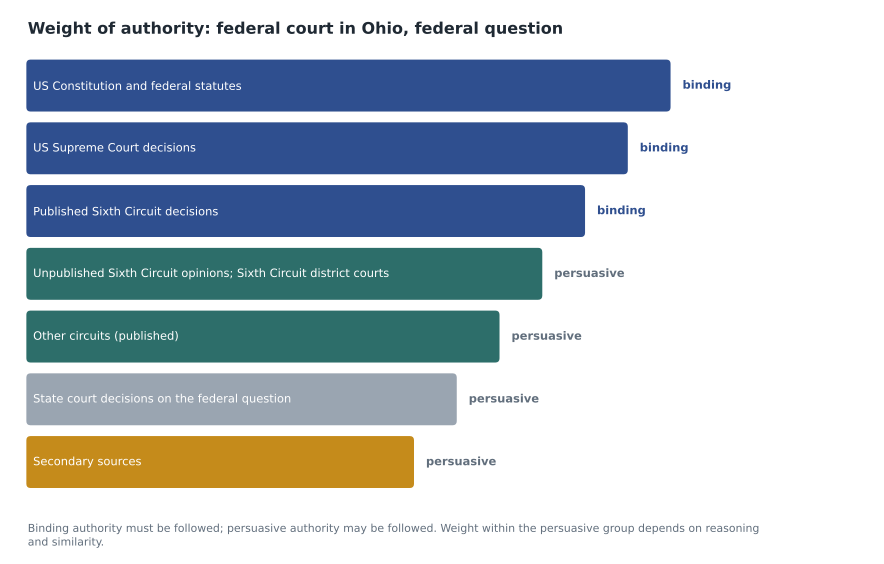
For federal questions in federal court, the binding authorities are the Constitution, federal statutes and valid regulations, decisions of the Supreme Court, and published decisions of the court of appeals for the circuit where the court sits. For state-law questions in state court, the binding authorities are the state's constitution, statutes and regulations, decisions of the state's highest court, and, in most states, decisions of the intermediate appellate court, though the rules about which intermediate decisions bind which trial courts vary from state to state.
When a federal court decides a question of state law, the binding authority is the state's highest court. Decisions of the state's intermediate appellate courts are strong evidence of state law, and a federal court usually follows them unless it is convinced the highest court would decide otherwise. A federal court of appeals' prediction about state law does not bind the state's own courts.
Holding and dicta
Not everything in an opinion is precedent. The holding is the court's resolution of the legal question actually presented and necessary to the decision. Dicta (short for obiter dicta, "things said in passing") are statements in the opinion that were not necessary to decide the case, such as comments on hypothetical facts, discussion of issues the court did not need to reach, or broad generalizations. Holdings bind; dicta persuade, sometimes powerfully, especially when they come from the Supreme Court.
Separating holding from dicta is a skill, not a formula. Kinsella offers a practical test: ask what rule the court had to adopt to reach its result on these facts. Anything broader than that may be dicta. The test is not mechanical, because courts often state their reasoning in general terms, and later courts sometimes read an earlier holding narrowly to avoid it or broadly to extend it. Lesson 6 returns to holdings when Section B learns to brief cases.
Concurring and dissenting opinions are not holdings. A concurrence agrees with the result but offers different or additional reasoning; a dissent disagrees with the result. Both can be persuasive, and dissents sometimes become the law later. In the Supreme Court, when no single rationale commands a majority, lower courts apply the rule of Marks v. United States, 430 U.S. 188 (1977), under which the holding is the position taken by the justices who concurred in the judgment on the narrowest grounds, a rule that is notoriously hard to apply.
Published and unpublished opinions
Federal courts of appeals decide most of their cases in unpublished opinions, sometimes called nonprecedential dispositions, which the court designates as not binding on later panels. Each circuit's local rules say what effect such opinions have. Since 2007, Federal Rule of Appellate Procedure 32.1 has prohibited the federal courts of appeals from restricting citation of unpublished opinions issued on or after January 1, 2007, but it leaves each circuit free to decide how much weight they carry. In most circuits, unpublished opinions may be cited as persuasive authority but do not bind.
The status of unpublished opinions was hotly debated around 2000. In Anastasoff v. United States, 223 F.3d 898 (8th Cir. 2000), a panel held that a rule declaring unpublished opinions nonprecedential was unconstitutional, but the decision was vacated as moot by the full court. In Hart v. Massanari, 266 F.3d 1155 (9th Cir. 2001), the Ninth Circuit upheld its own rule. The debate led to Rule 32.1. Kinsella tells the class that despite the label, unpublished opinions are readily available on every research platform and on free sites, and they are often the best evidence of how a circuit actually applies a doctrine to everyday facts.
State courts have their own rules. Some allow citation of unpublished decisions freely, some only as persuasive authority, and some, such as California, generally prohibit citing unpublished appellate opinions at all, with narrow exceptions. Before citing any unpublished decision, check the court's rules.
Trial court decisions
Federal district court decisions do not bind other district judges, even in the same district, and do not bind the same judge in a later case, though judges tend to follow their own prior reasoning. They are persuasive authority. They are still useful, because district courts decide many questions that the courts of appeals never reach, especially on procedure and discovery, and because they show how a rule plays out on detailed facts. State trial court decisions are often not published at all, and their persuasive value is usually low.
| Source | Federal question | Ohio-law question (diversity case) |
|---|---|---|
| US Supreme Court | Binding | Binding only on federal issues; not on what Ohio law means |
| Sixth Circuit, published | Binding | Binding on the court's own prediction of Ohio law unless Ohio courts have since spoken |
| Sixth Circuit, unpublished | Persuasive | Persuasive |
| Other circuits | Persuasive | Persuasive |
| Supreme Court of Ohio | Persuasive at most | Binding |
| Ohio courts of appeals | Persuasive at most | Strong evidence of Ohio law; usually followed |
| Other district courts | Persuasive | Persuasive |
| Treatises, Restatements, law reviews | Persuasive | Persuasive |
Measuring persuasive weight
When there is no binding authority, the persuasive weight of a source depends on several factors. The rank of the court matters: a decision from another state's supreme court usually counts for more than one from its trial courts. The reasoning matters: a careful, well-explained opinion persuades more than a conclusory one. Similarity matters: a case on closely similar facts, applying a statute with the same language, counts for more than a distant analogy. Trends matter: if most courts to consider an issue have reached the same answer, that majority view carries weight, and a recent trend can matter more than an old majority.
Reputation matters too, more than courts admit. Some courts are known for expertise in particular areas: the Delaware Court of Chancery in corporate law, the Second Circuit in securities law, the Federal Circuit in patent law, the New York courts in commercial law. A decision by a respected judge, or one that has been cited approvingly many times, may carry special weight. And secondary sources vary: a Restatement section that courts have widely adopted can be very influential, while a student note rarely is.
Overruled, superseded and abrogated
Precedent can lose its force. A case is overruled when a court with authority to do so expressly rejects its holding in a later case. It is reversed when a higher court sets aside the judgment in the same case on appeal. A decision interpreting a statute can be superseded when the legislature amends the statute. A case is said to be abrogated when a later decision of a higher court undermines it without expressly overruling it. Lesson 5 covers citators such as KeyCite and Shepard's, which flag these events, and Kinsella warns that citing a case without checking whether it is still good law is one of the fastest ways for a new lawyer to embarrass a supervisor and harm a client.
Overruling can happen quietly. When the Supreme Court overruled Chevron U.S.A. Inc. v. Natural Resources Defense Council, Inc., 467 U.S. 837 (1984), in Loper Bright, it said that earlier cases relying on Chevron were not overruled automatically and that their specific holdings remained subject to statutory stare decisis. That kind of nuance does not show up in a red flag on a screen. A researcher has to read the overruling case.
Worked problem
Ranking the six printouts
Return to Kinsella's stack. The client is litigating a federal statutory claim in the US District Court for the Southern District of Ohio. Rank the six authorities: (1) a US Supreme Court decision directly on point; (2) a published Sixth Circuit decision on point; (3) a published Seventh Circuit decision on point; (4) an unpublished Sixth Circuit opinion on point; (5) a decision of the Northern District of Ohio; (6) a California Court of Appeal decision interpreting the same federal statute.
Show solution
- The Supreme Court decision binds every federal court and ranks first.
- The published Sixth Circuit decision binds district courts in Ohio, which is in the Sixth Circuit; it ranks second, and it must yield only if it conflicts with the Supreme Court decision.
- The unpublished Sixth Circuit opinion does not bind, but it reflects how the controlling court of appeals applies the rule; it is usually the most persuasive of the remaining sources.
- The Seventh Circuit decision and the Northern District of Ohio decision are both persuasive. Which counts for more depends on the quality of reasoning and closeness of facts; many lawyers would rank the other circuit's published decision ahead of a single district court.
- The California state court decision on a federal statute is persuasive at most and usually carries the least weight here.
Answer: Binding: (1), then (2). Persuasive, in rough order: (4), then (3) and (5), with their order depending on reasoning and facts, and finally (6). The class's disagreement about the middle was not a failure; it was the beginning of real legal analysis.
Conflicts among authorities
When binding authorities appear to conflict, a researcher works through a few questions. Is one of them from a higher court? Then it controls. Are both from the same court? Then the later decision usually controls if it overruled the earlier one, but in the federal courts of appeals, an earlier published panel decision generally controls over a later conflicting panel decision until the full court resolves the conflict. Can the two be reconciled because they turn on different facts or different statutory language? Courts prefer to reconcile precedent rather than declare a conflict.
When persuasive authorities split, as often happens among the federal circuits, the split itself is important information. A circuit split is one of the main reasons the Supreme Court grants certiorari. In a memo, a researcher should describe the split, identify which side the controlling jurisdiction is likely to take and why, and avoid pretending the law is settled when it is not.
Jordan Kimura asks how a new associate is supposed to keep all of this in mind under deadline. Kinsella answers with a checklist she still uses: for every authority you plan to rely on, write down the court, the date, whether it is published, whether it is binding where your case will be decided, whether it is still good law, and whether your point comes from its holding or its dicta. "If you can fill in those six blanks," she says, "you know what the case is worth."
Summary and key terms
- Stare decisis requires lower courts to follow higher courts in the same system (vertical) and leads courts to follow their own precedents (horizontal), though courts of last resort may overrule.
- Whether authority is binding depends on the court deciding the case; the same decision can be binding in one court and persuasive in another.
- Only the holding binds; dicta, concurrences and dissents are persuasive.
- Unpublished federal appellate opinions issued since 2007 can be cited under FRAP 32.1, but most circuits treat them as nonprecedential; state rules vary.
- Persuasive weight depends on the court's rank, the quality of reasoning, similarity of facts and law, the trend of authority and the court's reputation.
- Always confirm that authority has not been reversed, overruled, superseded or abrogated, and read the later case rather than relying on a flag.
- Stare decisis
- The doctrine that courts follow precedent on the same legal question.
- Binding (mandatory) authority
- Primary law that a particular court must follow.
- Persuasive authority
- Any authority a court may consider but need not follow.
- Holding
- The court's resolution of the legal question necessary to decide the case.
- Dicta
- Statements in an opinion that were not necessary to the decision.
- En banc
- A hearing or decision by all active judges of a court of appeals rather than a three-judge panel.
- Circuit split
- Disagreement among federal courts of appeals on the same legal question.
Practice problems
Work each problem on paper first, then reveal the answer to check.
A Fifth Circuit panel wants to reach a result contrary to an earlier published Fifth Circuit panel decision. Can it?
Show answer
Generally not. Under the rule of orderliness followed in the federal circuits, a panel is bound by earlier published panel decisions unless the full court sitting en banc or the Supreme Court has overruled them, or an intervening change in law has undermined them.
In an opinion holding that a contract was formed, the court remarks that it would have reached a different result if the offer had been made by text message. Is that remark binding?
Show answer
No. It concerns facts not before the court and was not necessary to the decision, so it is dicta. It may still be persuasive.
May a lawyer cite an unpublished Third Circuit opinion from 2015 in a brief to the Third Circuit?
Show answer
Yes. FRAP 32.1 bars courts of appeals from prohibiting citation of unpublished opinions issued on or after January 1, 2007. The Third Circuit treats such opinions as not precedential, so the lawyer should cite it as persuasive and follow the court's local rules.
A federal court in Pennsylvania must decide a question of Pennsylvania law that the Supreme Court of Pennsylvania has never addressed. Two Pennsylvania Superior Court decisions answer it. What should the federal court do?
Show answer
Predict how the Supreme Court of Pennsylvania would rule, giving significant weight to the intermediate appellate decisions, which it will usually follow unless persuaded the high court would decide differently. It might also consider certifying the question if Pennsylvania permits certification.
Lesson quiz · 5 questions
Score 60% or more to complete this lesson.
Create a free account to save your progress, take quizzes and earn a certificate.