
LAWU-104 · Lesson 12 of 12 · 22 min
Capstone: writing and editing an objective memo
▶ Video coming soon A video version of this lesson is on the way.
Section B's memo drafts were due on Tuesday, November 10, 2026. A week later, on November 17, Professor Kinsella held individual conferences, fifteen minutes each, in which she went through each draft line by line. On the Thursday before Thanksgiving break, she brings the whole section together for a final class. She says the drafts were better than most first drafts she sees from new associates, and that nearly all of them made the same three mistakes: rules stated without explanation, conclusions buried at the end, and sentences that made the reader work too hard. This lesson covers the writing and editing that fix those problems, and then presents a model memo for the Coldbrook problem so that Section B can compare it with their own.
The closed universe
The memo assignment used a closed universe of fictional authorities, so that every student worked from the same materials. For reference, here they are in summary. All of them are invented for the course; none is a real statute or case, though the statute is modeled on the recreational use statutes most states have enacted.
- Westmarch Recreational Use Act, Westm. Code §§ 41-505 to 41-508. Section 41-505 states the purpose: to encourage owners of land to make land available to the public for recreational purposes by limiting their liability. Section 41-506 defines "owner" to include a possessor of land, "recreational purpose" to include "hunting, fishing, hiking, camping, picnicking, nature study, hayrides, and viewing or enjoying scenic, historical or agricultural sites," and "charge" as "the admission price or fee asked in return for invitation or permission to enter or go upon the land." Section 41-507 provides that an owner "owes no duty of care to keep the premises safe for entry or use by others for recreational purposes, or to give any warning of a dangerous condition." Section 41-508 provides that the Act does not limit liability "(a) for willful or malicious failure to guard or warn against a dangerous condition, use, structure, or activity; or (b) for injury suffered in any case where the owner charges the person who enters or goes on the land for the recreational use."
- Stavros v. Kettering Timber Co., 412 Westm. 88 (2009) (Westmarch Supreme Court): a hunter injured on timber company land opened for free hunting could not sue; the Act's purpose is to reward landowners who open land without charge, and its protections are construed to achieve that purpose.
- Pell v. City of Brennan Falls, 39 Westm. App. 2d 155 (2015): a mandatory eight-dollar parking fee, with no practical alternative way to enter the park, was a charge; substance controls over labels.
- Ibarra v. Westmarch Department of Natural Resources, 420 Westm. 610 (2018) (Westmarch Supreme Court): a trail user injured by a washed-out bridge could not recover; "willful" requires actual knowledge of a dangerous condition, knowledge that injury is probable rather than merely possible, and a conscious failure to act to avoid it. Mere negligence, even gross negligence, is not enough. The court also noted that the statutory list of recreational purposes is illustrative, not exhaustive.
- Quill v. Fenwick Farms, 51 Westm. App. 2d 302 (2021): a farm's corn maze had a donation box at the entrance with a sign suggesting three dollars for a local food bank; visitors entered freely whether or not they paid. The donation was not a charge. The court said the result could differ if, "by pressure or practice," payment were effectively required.
Writing for a busy reader
Legal readers are busy, skeptical and often reading on a screen. Kinsella's first principle is to put the point first: at the start of the memo (the brief answer), at the start of each section (the conclusion in CREAC), and at the start of each paragraph (a topic sentence that states the paragraph's point). A reader who reads only the first sentence of each paragraph should be able to follow the argument. Her second principle is to use headings that say something: "The donation request was probably not a charge" tells the reader more than "Charge."
Plain, precise sentences
Good legal writing is plain and precise. Prefer short and medium-length sentences, with the subject and verb close together and near the beginning. Use active voice when the actor matters ("Felix Merriwether filled the rut in April" rather than "the rut was filled"). Cut throat-clearing phrases ("It is important to note that") and legalese ("said hayride," "heretofore"). Use the same term for the same thing throughout: if you call the payment a "donation" in one paragraph and a "fee" in the next, the reader will wonder whether you mean different things, and in legal writing the difference can be the whole case.
Precision also means quoting the statute exactly when its words are at issue, using the defined terms the statute uses, and distinguishing carefully between what a court held and what it said in passing. Kinsella's red pen in the drafts most often marked vague verbs: courts do not "say" or "feel"; they hold, reason, conclude, explain, note, reject or distinguish, and each verb means something different.
Editing in layers
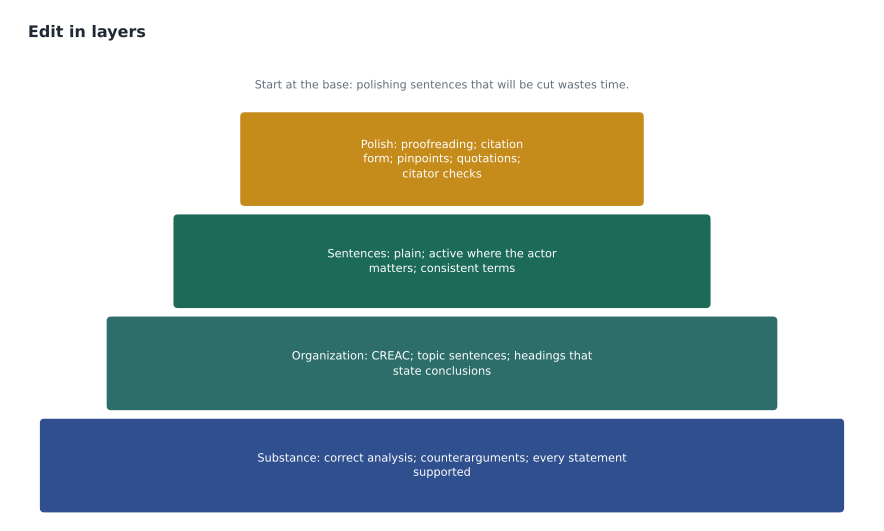
Kinsella teaches editing in layers, because no one can catch everything in a single pass. First, edit for substance: is the analysis correct and complete, are counterarguments addressed, and is every legal statement supported? Second, edit for organization: does each section follow CREAC, does each paragraph have a topic sentence, and do headings track the analysis? Third, edit for sentences: cut wordiness, fix passive voice where the actor matters, and make terms consistent. Fourth, proofread and cite-check: spelling, grammar, citation form, pinpoints, quotations and citator checks. Reading the memo aloud, or reading it on paper rather than on a screen, catches errors that silent reading misses.
Generative AI and the memo
The course policy allowed students to use AI tools on the research platforms to brainstorm search terms and to check their grammar, but not to draft analysis, and required them to verify everything against the closed-universe materials. Kinsella reports that two drafts contained a sentence describing a holding that none of the four cases contained, apparently suggested by an AI tool. She uses it as the course's last lesson about verification: in practice, that sentence could have led to a sanctions order. Every statement of law in a memo must be traceable to an authority the writer has read.
The model memo
What follows is Kinsella's model memo. It is not the only good answer; several students reached different conclusions on the willful-misconduct exception and supported them well. Its structure, candor and use of authority are what Section B should study.
MEMORANDUM. To: Supervising Attorney. From: Associate. Date: November 9, 2026. Re: Coldbrook Orchard; Garrow claim; immunity under the Westmarch Recreational Use Act.
QUESTION PRESENTED. Under the Westmarch Recreational Use Act, is Coldbrook Orchard immune from a negligence claim by a visitor who broke her ankle falling from a free hayride, where a sign invited voluntary donations to the Westmarch 4-H, a volunteer held a donation bucket at the wagon steps, and an employee had told the owner a week earlier that a rut on the hayride route had reappeared after rain?
BRIEF ANSWER. Probably yes, but the willful-misconduct exception presents a real risk that depends on facts we do not yet have. Ms. Garrow was on the land for a recreational purpose, and the hayride donation was probably not a "charge": as in Quill, riders could ride whether or not they paid, and the money went to a charity rather than to the orchard. The greater risk is the exception for willful failure to guard or warn. Under Ibarra, Mr. Merriwether's failure to act after learning of the rut is willful only if he knew injury was probable and consciously failed to act. If he dismissed the report or did nothing, a court could find the exception satisfied; if he reasonably believed the rut was minor or took steps to address it, the Act likely bars the claim.
STATEMENT OF FACTS. Coldbrook Orchard is a family-owned apple orchard in Westmarch owned and operated by Ada and Felix Merriwether. Each fall it opens its grounds to the public without an admission charge. Visitors may pick apples, which they pay for by the pound at a checkout stand, and on weekends may ride a tractor-drawn hay wagon on a fifteen-minute loop through the orchard. A sign at the wagon read: "Hayrides free. Donations to Westmarch 4-H welcome, suggested 5 dollars." A 4-H volunteer stood at the wagon steps holding a donation bucket. According to the orchard, nobody was refused a ride for not donating. Ms. Garrow's demand letter states that riders "were expected to pay" and that she put five dollars in the bucket; the orchard has no record either way. The donations went to the 4-H club, not to the orchard. Parking was free.
On Saturday, September 26, 2026, Ms. Garrow, who had earlier bought about twenty dollars' worth of apples, rode the hayride. Near the end of the loop the wagon's right wheel dropped into a rut, the wagon lurched, and she fell from the side, breaking her ankle. Mr. Merriwether filled the same rut with gravel in April. On or about September 19, the teenage employee who drives the tractor told him the rut had "come back" after heavy rain and was "pretty deep." Mr. Merriwether says he told the driver to slow down at that spot and planned to fill it after the weekend. We do not know whether the driver slowed down on September 26, whether other riders had been jostled at the rut, or whether the wagon had side rails at the point where Ms. Garrow fell.
DISCUSSION. The Act protects Coldbrook unless an exception applies. Section 41-507 provides that an owner owes no duty to keep premises safe for recreational users or to warn them of dangerous conditions. Westm. Code § 41-507. The Supreme Court of Westmarch construes the Act to serve its stated purpose of encouraging landowners to open land to the public. Stavros v. Kettering Timber Co., 412 Westm. 88, 92 (2009); see Westm. Code § 41-505. Coldbrook is an "owner" because it possesses the land. Id. § 41-506. The disputed questions are whether Ms. Garrow was on the land for a recreational purpose, whether Coldbrook charged her, and whether its conduct was willful.
A. Ms. Garrow was on the land for a recreational purpose. The Act defines recreational purpose to include "hayrides" and "viewing or enjoying ... agricultural sites." Id. § 41-506. The list is illustrative, not exhaustive. Ibarra v. Westmarch Dep't of Nat. Res., 420 Westm. 610, 615 (2018). Ms. Garrow may argue that her visit was commercial because she bought apples. But she was injured while riding the hayride, an activity the statute names expressly. A court is likely to focus on the activity during which the injury occurred, so this element is likely satisfied.
B. The donation request was probably not a charge. The Act does not protect an owner who "charges the person" for the recreational use. Westm. Code § 41-508(b). A charge is "the admission price or fee asked in return for invitation or permission to enter or go upon the land." Id. § 41-506. The Westmarch courts look to substance rather than labels: a payment is a charge if it is required, formally or in practice, as a condition of entry or use. Pell v. City of Brennan Falls, 39 Westm. App. 2d 155, 159 (2015). A truly voluntary donation is not. Quill v. Fenwick Farms, 51 Westm. App. 2d 302, 306 (2021).
In Pell, the city required every visitor to pay an eight-dollar parking fee and offered no practical way to enter the park without paying. 39 Westm. App. 2d at 157. The court held that the fee was a charge despite its label, because it functioned as the price of entry. Id. at 159. In Quill, by contrast, a farm placed a donation box at its corn maze entrance with a sign suggesting a three-dollar donation to a food bank, and visitors entered whether or not they paid. 51 Westm. App. 2d at 304. The court held that the donation was not a charge, while noting that the result could differ if "by pressure or practice" payment were effectively required. Id. at 306.
Coldbrook's hayride falls on the Quill side of the line. The sign told riders the rides were "free" and described the payment as a donation, and the money went to the 4-H club rather than to Coldbrook. Nothing suggests anyone was refused a ride. Ms. Garrow will argue that the volunteer with the bucket at the wagon steps created pressure to pay, and that Coldbrook benefited commercially because hayrides drew customers who bought apples. The first argument has some force under Quill's "pressure or practice" language, but a volunteer holding a bucket is not the kind of required payment Pell treated as a charge, and Ms. Garrow's own statement that riders were "expected" to pay does not show that anyone was required to pay. The commercial-benefit argument is weaker: the statute asks whether the owner charged for the recreational use, and Ms. Garrow paid for apples, not for the ride. A court is therefore likely to hold that Coldbrook did not charge her, unless discovery shows that riders were in fact turned away or pressured.
C. Whether Coldbrook's failure to fix or warn of the rut was willful is uncertain. The Act does not protect an owner from liability for a "willful or malicious failure to guard or warn against a dangerous condition." Westm. Code § 41-508(a). Willfulness requires actual knowledge of a dangerous condition, knowledge that injury is probable rather than merely possible, and a conscious failure to act to avoid it; negligence, even gross negligence, is not enough. Ibarra, 420 Westm. at 618. In Ibarra, park staff knew a footbridge had been damaged by a storm and had scheduled repairs, but had not closed the trail; the court held that their delay was at most negligent, because they did not know injury was probable and had taken steps to address the hazard. Id. at 619.
Coldbrook's position resembles Ibarra in some respects: Mr. Merriwether had filled the rut before, planned to fill it again, and told the driver to slow down at that spot. Those facts suggest he did not consciously disregard a probable danger. But Ms. Garrow will argue that he had actual knowledge that the rut was "pretty deep," that a lurching wagon carrying passengers made injury probable, and that he kept running the hayride for a week without filling the rut, posting a warning or rerouting the wagon. Unlike Ibarra, where staff could not easily close a long trail, Coldbrook could have rerouted the loop or filled the rut in an hour. If the driver did not slow down, or if other riders had already been jostled at the rut, a court could find that Mr. Merriwether knew injury was probable. On the current facts the exception probably does not apply, but this is the issue most likely to defeat summary judgment.
CONCLUSION. Coldbrook is probably immune under the Act. Ms. Garrow was engaged in a recreational purpose and the voluntary donation was likely not a charge. The main risk is the willful-misconduct exception. We should promptly interview the tractor driver about what Mr. Merriwether said and whether he slowed down at the rut on September 26; ask whether other riders were jostled there; photograph the route and the wagon; confirm that no one was refused a ride for not donating; and preserve any records of the April repair. These facts will determine whether we can resolve the claim early under the Act.
What the model memo shows
Kinsella points out the features she wants Section B to notice. The brief answer gives a direct prediction and identifies the main risk. The facts include the bad facts, the plaintiff's version and the unknowns. Each disputed issue has a heading that states a conclusion, a synthesized rule with citations, an explanation of the cases with their key facts and reasoning, an application that compares and contrasts, a fair counterargument and an honest assessment. The language of prediction is calibrated: "probably," "likely," "uncertain." And the conclusion turns the analysis into action, with specific next steps.
Priya Natarajan points out that her own draft concluded that the willful exception clearly did not apply. Kinsella says that conclusion was defensible, but that the model memo's more cautious assessment is the safer advice, because the facts that would change the answer were still unknown. "The partner can live with uncertainty," she says. "What the partner cannot live with is surprise."
| Layer | Ask yourself |
|---|---|
| Substance | Did I answer the question asked? Is every element addressed? Are counterarguments assessed honestly? Is every legal statement supported by authority I read? |
| Organization | Does each disputed issue follow CREAC? Does each paragraph start with its point? Do headings state conclusions? |
| Sentences | Are sentences plain and precise? Are terms consistent? Is the predictive language calibrated? |
| Citation | Are citations in correct form with pinpoints? Are quotations exact? Has every authority been validated? |
| Polish | Proofread on paper or aloud; check names, dates and numbers against the file |
Summary and key terms
- Put the point first: in the brief answer, in each section and in each paragraph; use headings that state conclusions.
- Write plain, precise sentences with consistent terms and exact statutory language; choose verbs that accurately describe what courts did.
- Edit in layers: substance, organization, sentences, then proofreading and cite-checking.
- Every statement of law must be traceable to an authority you have read; AI suggestions must be verified.
- The model memo shows a calibrated prediction, candid facts, CREAC analysis with explanation and counterarguments, and concrete next steps.
- Closed universe
- A writing assignment limited to a fixed set of provided authorities.
- Topic sentence
- The first sentence of a paragraph, stating its point.
- Calibrated prediction
- Predictive language that matches the writer's actual confidence, such as likely or uncertain.
- Cite-checking
- Verifying the form, accuracy and validity of every citation.
- Willful (Westmarch Act)
- In the course's fictional statute, actual knowledge of a danger, knowledge that injury is probable, and a conscious failure to act.
Practice problems
Work each problem on paper first, then reveal the answer to check.
Rewrite in plain English: 'It is important to note that said hayride was operated by an employee of the orchard.'
Show answer
'An orchard employee drove the hayride.'
Why does the model memo include Ms. Garrow's claim that riders were 'expected to pay' even though it hurts the client?
Show answer
Because an objective memo must present the unfavorable facts so the reader can rely on the prediction; leaving it out would make the analysis untrustworthy and could lead to bad advice.
In the model memo, what single fact would most change the willful-misconduct analysis?
Show answer
Evidence that Mr. Merriwether knew injury was probable and did nothing, for example that riders had already been hurt or jostled at the rut and the driver did not slow down, would strongly support the exception.
What should you check in the final proofreading layer?
Show answer
Spelling, grammar, names, dates and numbers against the file, citation form and pinpoints, exact quotations, and that every authority has been validated.
Lesson quiz · 5 questions
Score 60% or more to complete this lesson.
Create a free account to save your progress, take quizzes and earn a certificate.