
LAWU-104 · Lesson 3 of 12 · 21 min
Secondary sources and research strategy
▶ Video coming soon A video version of this lesson is on the way.
Samuel Tate runs the third class in the law library's reading room. On each table he has set a different book: a volume of a multivolume treatise on contracts, a volume of American Jurisprudence Second, a bound volume of the Restatement (Second) of Torts, an American Law Reports annotation, a law review, and a thin practice guide on landlord-tenant law published by a state bar. He gives each table a research question and fifteen minutes, with one rule: no computers. When the time is up, every table has found at least one relevant case. "You just did what experienced lawyers do on day one of a new problem," Tate says. "You started with someone who has already done the work."
Why start with secondary sources
Secondary sources explain the law, organize it and point to the primary authority that matters. For a researcher facing an unfamiliar issue, they do three things that a database search cannot. They supply vocabulary: the terms of art that courts actually use, which make later searches far more effective. They supply context: how the issue fits into the larger body of law, what the elements are, and where the disputes lie. And they supply leads: citations to the leading cases, statutes and regulations, often in every jurisdiction.
Professor Kinsella, who joins the class halfway through, tells Section B that the most common research mistake she saw in practice was a new associate typing a few words into a search box, getting back hundreds of cases, and reading them at random. "The search engine will always give you something," she says. "It will not tell you whether you are asking the right question. A good secondary source will." She adds a warning: secondary sources are not citable as the law. Use them to find and understand primary authority, then cite the primary authority, unless the secondary source itself is the best available support for a point, as with a widely adopted Restatement rule.
Legal encyclopedias
The two national legal encyclopedias are American Jurisprudence Second (Am. Jur. 2d), published by Thomson Reuters, and Corpus Juris Secundum (C.J.S.), also now published by Thomson Reuters. Each covers the whole of American law in hundreds of alphabetical topics, stating general rules with footnotes to cases from many jurisdictions. Several states have their own encyclopedias, such as California Jurisprudence and Texas Jurisprudence. Encyclopedias are good for a quick overview and vocabulary, but they are shallow and general, and courts rarely cite them for anything contested.
Treatises and hornbooks
A treatise is a book, often multivolume, that analyzes one area of law in depth. Classic examples include Williston on Contracts and Corbin on Contracts, Wright and Miller's Federal Practice and Procedure, Nimmer on Copyright, and Collier on Bankruptcy. Treatises written by recognized authorities can be highly persuasive, and courts cite the leading ones regularly. They are updated by supplements, pocket parts or new editions, and online versions are updated more often. Always check the currency of the version you use.
Hornbooks and student treatises, such as Prosser and Keeton on Torts or Chemerinsky's Constitutional Law, explain an area of law in one volume for students. Nutshells and study aids are shorter still. They are useful for learning a subject but less useful for practice research, because they cite fewer cases and are updated less often.
Restatements of the Law
The American Law Institute, an organization of judges, lawyers and academics founded in 1923, publishes Restatements of the Law, which state the rules of common-law subjects in black-letter form, followed by comments, illustrations and reporters' notes. Restatements exist for contracts, torts, property, agency, conflict of laws, restitution, trusts and other areas, many now in their second or third series. Courts often adopt Restatement sections as the law of their jurisdiction, which can turn a secondary source into the basis of binding precedent.
Restatements are especially persuasive where courts in the jurisdiction have already adopted them. Section 402A of the Restatement (Second) of Torts, for example, shaped strict products liability across the country, and section 90 of the Restatement (Second) of Contracts on promissory estoppel is widely cited. Researchers should always check whether courts in the relevant jurisdiction have adopted, modified or rejected the particular section, which the reporters' notes and annotated case citations help reveal. The ALI also publishes Principles of the Law, which recommend reforms, and model codes such as the Model Penal Code, and, with the Uniform Law Commission, the Uniform Commercial Code.
American Law Reports
American Law Reports (A.L.R.) annotations are long articles that collect and analyze cases on a narrow legal question from every jurisdiction that has addressed it. A typical annotation sets out the issue, summarizes the general rule and the minority views, and then sorts the cases by jurisdiction and outcome. When an A.L.R. annotation exists on your question, it can save days of work. Annotations appear in several series, including A.L.R. Federal for federal issues, and are updated with supplements. They are excellent finding tools but are rarely cited as authority.
Law reviews and journals
Law reviews are scholarly journals, most published by law schools and edited by students. They contain articles by professors and practitioners and shorter notes and comments by students. Articles range from deep doctrinal analysis to theory, history and empirical work. For a researcher, a good article on a narrow issue can provide an exhaustive survey of authority and a sophisticated analysis, especially on new or unsettled questions. Bar journals and specialized practitioner journals publish shorter, more practical pieces.
Law review articles can be found through HeinOnline, which holds scanned journals back to their first volumes, through Westlaw, Lexis and Bloomberg Law, and increasingly for free through law school repositories, SSRN and Google Scholar. Index tools such as the Index to Legal Periodicals and LegalTrac help find older articles. Courts cite law review articles, though less often than they once did, and the weight of an article depends heavily on its author and the quality of its analysis.
Practice guides, form books and CLE materials
Practice guides are written by practitioners for practitioners, usually for a single state or a particular court. They explain procedures, deadlines and strategy and often include checklists and forms. State bar associations and continuing legal education providers publish many of them, and commercial publishers produce series such as the Rutter Group guides in California. Form books, such as American Jurisprudence Legal Forms and Pleading and Practice Forms, provide model documents. These sources are the fastest route to how things are actually done in a particular court, but they are not citable for contested points of law.
| Source | Best for | Cite it? |
|---|---|---|
| Legal encyclopedia (Am. Jur. 2d, C.J.S., state encyclopedias) | Quick overview, vocabulary, first leads | Rarely |
| Treatise | Deep analysis of one area; leading cases; persuasive commentary | Yes, the leading ones, for analysis or when cases are thin |
| Restatement | Black-letter rules courts often adopt; comments and illustrations | Yes, especially where adopted in the jurisdiction |
| A.L.R. annotation | All cases on a narrow issue, sorted by jurisdiction and outcome | Rarely; use to find cases |
| Law review article | New or unsettled issues; exhaustive research; theory | Sometimes, depending on author and analysis |
| Practice guide or form book | Procedure, deadlines, strategy and forms in a particular court | Rarely for law; useful in practice |
A research strategy
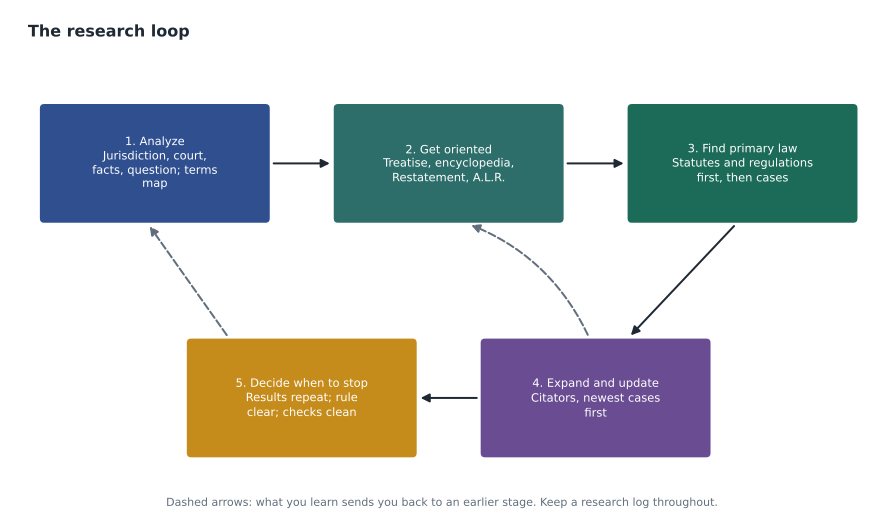
Kinsella gives Section B a research plan they will use all year. It has five stages, and the stages loop: what you learn in one often sends you back to an earlier one.
First, analyze the problem. Write down the jurisdiction, the court, the key facts, the legal question and any terms of art you already know. Generate search terms by thinking about the parties, places, objects, actions, legal theories and remedies involved, including synonyms and related concepts. Kinsella calls this a "terms map."
Second, get oriented with secondary sources. Read a treatise section, encyclopedia article, Restatement section or A.L.R. annotation to learn the vocabulary, the elements and the leading authorities. Note every promising primary authority it cites.
Third, find the controlling primary law. Look first for constitutional provisions, statutes and regulations, because they control if they apply. Then find the cases interpreting them, or, for common-law questions, the cases establishing the rules. Use citations from secondary sources, annotated codes, digests and headnotes, and full-text searches.
Fourth, expand and update. Use citators to find later cases citing your best authorities and to confirm they are still good law. Read the newest cases first, because they often summarize the older ones and reflect current law.
Fifth, decide when to stop. You are done when your searches keep returning authorities you have already found, when you can explain the rule and its exceptions with confidence, and when your citator checks are clean. Tate adds that you should also stop and ask for help if a reasonable amount of searching has turned up nothing. "An hour of silence with a database is often a sign that you are using the wrong words or the wrong source," he says. "Ask a librarian. That is what we are here for."
Keeping a research log
A research log records what you searched, where, with what terms, and what you found. It sounds tedious, and Daniel Reyes admits he never kept one as a paralegal. Kinsella explains why it matters. It prevents you from repeating searches. It lets a supervisor see what you covered and spot gaps. It lets you pick up the work after an interruption, and it lets you reconstruct your research if a question comes up weeks later. A simple table with columns for the date, the source, the search or path used, the results and next steps is enough.
Logs also protect against a subtler problem: confirmation bias. Researchers tend to stop when they find authority that supports the answer they hoped for. A log that shows only favorable results should prompt you to search deliberately for contrary authority. An objective memo, which Section B will write later in the semester, is worthless if it hides the cases that cut against the client.
Worked problem
Building a terms map
A client runs a small orchard that lets the public pick apples. A visitor was hurt when a farm wagon giving free hayrides hit a rut. The client wants to know whether it can be held liable. Build a terms map and choose a first secondary source.
Show solution
- Parties: landowner, farm, orchard, occupier, visitor, invitee, licensee, recreational user.
- Places and things: land, premises, farm, orchard, wagon, hayride, tractor, rut, road.
- Actions and theories: negligence, premises liability, duty of care, failure to warn, dangerous condition, willful or malicious conduct.
- Defenses and relief: immunity, recreational use statute, assumption of risk, release, damages.
- First source: a secondary source that collects state recreational use statutes, such as an A.L.R. annotation on landowner liability under such statutes or a torts treatise section on premises liability, to learn the vocabulary ("charge," "recreational purpose," "willful or malicious failure to guard or warn") and the leading cases.
Answer: The terms map shows that the key phrase is "recreational use statute," which most states have, and that the likely issues are whether the activity was recreational, whether the landowner charged a fee, and whether any exception for willful misconduct applies. That is far more productive than searching "farm hayride injury." This is, in fact, the memo problem Section B will receive in October.
Choosing sources by question type
Different questions call for different starting points. For a broad question in an unfamiliar area, start with an encyclopedia or hornbook. For a question about a specific statute, start with an annotated code, which lists cases and secondary sources under each section. For a narrow, recurring issue that many courts have addressed, look for an A.L.R. annotation. For a new or unsettled question, look for law review articles and recent cases. For a procedural question in a particular court, look at the court's rules and a practice guide. And for a question about what a particular judge expects, look at the judge's standing orders and recent decisions.
Hannah Lindqvist asks whether all of this is still necessary now that research platforms offer artificial intelligence tools that answer questions in plain English. Kinsella says the next lesson will cover those tools, but that her answer is yes. An AI summary can be a useful starting point, much like an encyclopedia, but it can be wrong, it can miss the controlling authority, and it can invent sources that do not exist. "Everything you learn about secondary sources applies to AI output," she says. "Use it to orient yourself and generate leads. Then verify every lead in the primary law."
Secondary sources online and in print
Most secondary sources are now available on the commercial platforms, often with links from each footnote to the cited case or statute, which makes them faster to use than the print versions. But each platform licenses different titles: a treatise may be on Westlaw but not Lexis, or available only in print or on a publisher's own site. Before concluding that no treatise covers your topic, check the library catalog, which lists print and electronic holdings across platforms, and ask a librarian. Tate shows Section B how to search the catalog by subject heading, which finds treatises that a keyword search on a platform would miss.
Summary and key terms
- Secondary sources supply vocabulary, context and leads; start most new research with them.
- Encyclopedias give quick overviews; treatises give depth and can be persuasive; Restatements state rules courts often adopt; A.L.R. annotations collect cases on narrow issues; law reviews analyze new and unsettled questions; practice guides explain how things are done.
- Cite primary authority for the law; cite secondary sources only when they add something the primary law cannot, such as an adopted Restatement rule.
- Follow a research loop: analyze the problem, get oriented, find controlling primary law, expand and update, and decide when to stop.
- Keep a research log, and search deliberately for authority that cuts against your client.
- Treatise
- An in-depth book, often multivolume, analyzing one area of law.
- Restatement
- An American Law Institute work stating common-law rules in black-letter form with comments and illustrations.
- A.L.R. annotation
- An article in American Law Reports collecting and analyzing cases on a narrow legal question.
- Law review
- A scholarly legal journal, usually student-edited and published by a law school.
- Practice guide
- A practitioner-oriented source explaining procedures and strategy, often for one state or court.
- Terms map
- A list of search terms organized by parties, places, things, actions, theories and remedies.
Practice problems
Work each problem on paper first, then reveal the answer to check.
You must research a narrow question that courts across the country have addressed: whether a store owes a duty to protect customers from criminal attacks in its parking lot. Which secondary source is likely to be most efficient?
Show answer
An A.L.R. annotation, if one exists, because it collects and sorts the cases from every jurisdiction on exactly that question. A torts treatise section would be a good alternative.
Your jurisdiction's highest court has expressly adopted section 90 of the Restatement (Second) of Contracts. How much weight should you give the section's comments?
Show answer
Substantial persuasive weight. The section's rule is now part of the jurisdiction's law through the court's adoption, and courts there are likely to look to the comments and illustrations to interpret it, unless the court adopted the section with modifications.
Why should you read the newest cases first when you begin reading primary authority?
Show answer
Because they reflect current law, often summarize and cite the earlier cases, and reveal whether older authorities have been limited or overruled.
When do you know you can stop researching?
Show answer
When new searches keep returning authorities you have already found, you can explain the rule and its exceptions confidently, and your citator checks show your authorities are still good law. If a reasonable search finds nothing, ask for help rather than continuing blindly.
Lesson quiz · 5 questions
Score 60% or more to complete this lesson.
Create a free account to save your progress, take quizzes and earn a certificate.