
LAWU-104 · Lesson 10 of 12 · 20 min
Bluebook citation
▶ Video coming soon A video version of this lesson is on the way.
On the day Professor Kinsella teaches citation, she brings a thick blue spiral-bound book and drops it on the desk. "Some of you will come to hate this," she says. "Some of you will become the person in your firm everyone asks." She explains why citation matters. A citation tells the reader where to find your authority, how much weight it carries, and how it supports your point. A judge reading a brief uses citations to decide in seconds whether an authority is binding, recent and on point. Sloppy citations signal sloppy research, and in Kinsella's experience as a staff attorney, judges notice. Daniel Reyes says he formatted citations for three years as a paralegal and still found the rules mysterious. Kinsella promises that by the end of class he will understand the logic, even if he still needs to look up the details.
The citation manuals
The Bluebook: A Uniform System of Citation is compiled by the editors of the Columbia Law Review, the Harvard Law Review, the University of Pennsylvania Law Review and the Yale Law Journal. It is the dominant citation guide in American law schools, law reviews and many courts. The 22nd edition was published in May 2025. It has two main parts: the Bluepages, a section at the front written for practitioners and court documents, and the whiterules, written for law review footnotes. The tables at the back list abbreviations for courts, reporters, states, periodicals and common words, and the jurisdiction tables tell you which reporters to cite for each state.
The ALWD Guide to Legal Citation, prepared with the Association of Legal Writing Directors, is an alternative manual that many legal writing programs use because it presents one set of rules for all documents; its citations largely match Bluebook practitioner style. The Indigo Book is a free, public-domain manual that implements the Bluebook's system in plain language. And many courts have their own local citation rules, which override the manuals in documents filed with them. California and New York, for example, have official style manuals for their courts.
Kinsella tells Section B to use the Bluepages for their memos and briefs, because those are practitioner documents, and to check the local rules of any court before filing anything.
The logic of a case citation
A full case citation has five basic parts: the case name, the reporter volume, the reporter abbreviation, the first page, and a parenthetical with the court and year. If you are citing a particular passage, which you almost always should be, add a pinpoint page after the first page. Thus: Erie R.R. Co. v. Tompkins, 304 U.S. 64, 78 (1938). The pinpoint 78 sends the reader to the page where the Court declared that there is no federal general common law.
Each part follows rules. The case name uses the parties' surnames or entity names, abbreviates certain words according to Table 6 in citations (but not in textual sentences), and uses only the first party on each side. In practitioner documents, case names are italicized or underlined. The reporter abbreviation comes from Table 1; if a case is in the official and unofficial reporters, the jurisdiction table tells you which to cite. The parenthetical identifies the court unless the reporter makes it obvious: no court is needed for U.S. Reports because only the Supreme Court is reported there, but a Federal Reporter citation needs the circuit, as in (2d Cir. 2024), and a regional reporter citation needs the state and court, as in (N.Y. 1928).
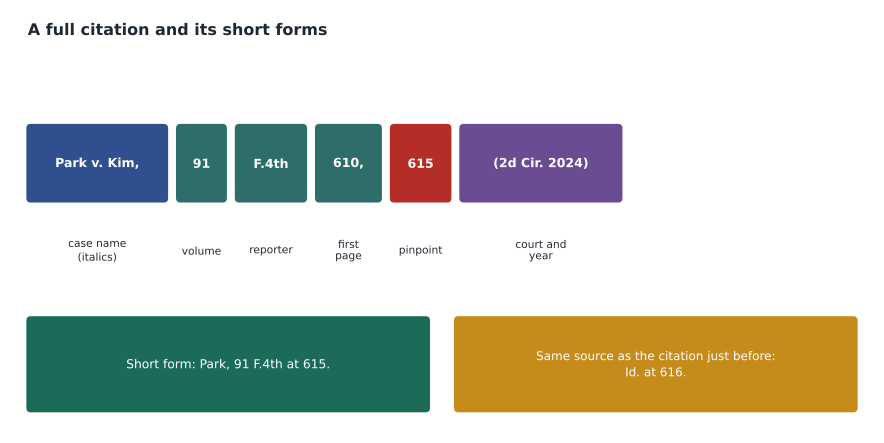
Short forms
After citing a case in full once, later citations use short forms. The most common is the case name (usually the first party), the volume, the reporter, and "at" with the pinpoint page: Erie, 304 U.S. at 78. When you cite the same authority as the immediately preceding citation, use "Id." with a new pinpoint if needed: Id. at 79. Id. refers only to the immediately preceding authority, so if the preceding citation contained more than one source, id. cannot be used. Short forms for statutes and regulations follow similar logic.
Statutes, regulations and constitutions
Cite federal statutes to the United States Code by title, section and year of the code edition: 42 U.S.C. § 2000e-2(a) (2018). Many practitioners omit the year for current federal code sections, and the Bluepages permit that in some situations; check the rules and your court's practice. Cite a statute's popular name when it helps the reader: Title VII of the Civil Rights Act of 1964, 42 U.S.C. § 2000e-2. Cite state statutes in the format shown in the jurisdiction tables, which vary from state to state. Cite regulations to the CFR by title, section and year: 29 C.F.R. § 1910.1200 (2025). Cite constitutional provisions without a date unless they have been repealed or amended: U.S. Const. art. III, § 2.
Signals
Signals are italicized words placed before a citation to show how the authority supports the proposition. No signal means the authority directly states the proposition or is quoted. "See" means the authority clearly supports the proposition but does not state it directly, so the reader must make an inference. "See also" adds authority for a proposition already supported. "Cf." means the authority supports an analogous proposition. "Compare ... with ..." contrasts authorities. "But see" indicates clear contrary support, and "But cf." contrary support by analogy. "See generally" points to helpful background. "E.g." means the authority is one of several examples, and can be combined with other signals, as in "See, e.g.,".
Using the wrong signal misleads the reader. Citing a case with no signal tells a judge it says exactly what your sentence says; if the judge reads the case and finds that it only implies it, your credibility suffers. Kinsella advises new lawyers to use signals accurately and sparingly, and when in doubt to add an explanatory parenthetical that tells the reader exactly how the authority supports the point.
| Signal | Meaning |
|---|---|
| [no signal] | The authority directly states the proposition, or is quoted |
| E.g., | One of several authorities directly stating the proposition |
| See | Clearly supports the proposition, by inference |
| See also | Additional support for a proposition already supported |
| Cf. | Supports an analogous proposition |
| Compare ... with ... | Comparison of authorities that illustrates the point |
| But see | Clearly supports a contrary proposition |
| See generally | Helpful background |
Parentheticals
Explanatory parentheticals follow a citation and explain how the authority supports your point, usually in a participial phrase beginning with a present participle: Mata v. Avianca, Inc., 678 F. Supp. 3d 443 (S.D.N.Y. 2023) (sanctioning lawyers who submitted a brief citing nonexistent cases generated by an AI tool). Parentheticals are a powerful tool for summarizing cases compactly, especially for string citations of several authorities. Other parentheticals indicate weight or history: (en banc), (per curiam), (plurality opinion), (Scalia, J., dissenting). Subsequent history, such as aff'd, rev'd or cert. denied in some situations, follows the parenthetical.
Citing digital and AI sources
The 22nd edition substantially reworked the rules for internet and digital sources. When citing a web source, the Bluebook now expects the author to preserve an archived copy of the source as it existed when cited, using a tool such as Perma.cc or by keeping a copy on file, because web pages change and disappear. Cases and statutes should still be cited to reporters and codes when available, not to websites or databases, though a case not yet published in a reporter is cited with its docket number, a database identifier such as a WL or LEXIS number, the court and the exact date of decision, so that any reader can find it.
The 22nd edition also added a rule for citing the output of generative AI tools, which requires the author to preserve a copy of the output. The rule has been criticized by legal scholars, who point out that lawyers should rarely cite AI output at all: AI is a research tool, and what should be cited is the verified authority it helped you find. Kinsella agrees with the critics on that point. "The only time you cite what a chatbot said," she says, "is when what the chatbot said is itself the issue, for example in a case about AI errors."
Citation in practice
In practitioner documents, citations usually appear in the text as citation sentences or clauses, not in footnotes. A citation sentence follows the sentence it supports and ends with a period; a citation clause is set off by commas within a sentence and supports only part of it. Pinpoint citations are expected for every specific proposition. Quotations require exact accuracy, with alterations shown in brackets and omissions shown with ellipses. And every citation should be checked: right volume and page, right pinpoint, right court and year, and validated with a citator.
Kinsella shows Section B a paragraph from a real brief, with the names removed, that cited six cases without a single pinpoint and used "see" before quotations. She asks them to fix it. The exercise takes fifteen minutes. "Now imagine a judge's clerk doing that at eleven at night," she says. "Make the clerk's job easy, and the clerk will trust you."
Worked problem
Fixing citations in the memo draft
Priya Natarajan's first draft of a memo paragraph reads: 'Courts consider whether payment is required in practice. Pell v. City of Brennan Falls (2015). A voluntary donation is not a charge. See Quill v. Fenwick Farms, 51 Westm. App. 2d 302 (2021).' Using the citation format the assignment prescribes for the fictional Westmarch reporters, what is wrong, and how should it be fixed?
Show solution
- The Pell citation lacks the reporter, first page and pinpoint, and the parenthetical lacks the court. It should read: Pell v. City of Brennan Falls, 39 Westm. App. 2d 155, 159 (2015).
- The Quill citation needs a pinpoint for the specific proposition, and the signal should be omitted if Quill states the proposition directly: Quill v. Fenwick Farms, 51 Westm. App. 2d 302, 306 (2021).
- If Quill only implies the point, keep 'See' and add an explanatory parenthetical: (holding a donation box at a corn maze was not a charge where visitors could enter without paying).
- Case names should be italicized or underlined in the memo.
Answer: Corrected: 'Courts consider whether payment is required in practice. Pell v. City of Brennan Falls, 39 Westm. App. 2d 155, 159 (2015). A truly voluntary donation is not a charge. Quill v. Fenwick Farms, 51 Westm. App. 2d 302, 306 (2021).' The Westmarch reporter abbreviations are fictional, created for the closed-universe assignment, but the citation logic is the Bluebook's.
Learning the rules without memorizing them
No one memorizes the Bluebook. Kinsella recommends learning the core patterns by heart (full and short case citations, statutes, regulations, constitutions, signals, id.) and knowing where to look up the rest. Keep the Bluepages and the jurisdiction tables handy. Use citation tools on the research platforms to generate a first draft, but check every citation yourself, because automated tools make errors, especially with pinpoints, subsequent history and state-specific formats. And when a court's local rules differ from the Bluebook, follow the court.
Citing other sources
Secondary sources have their own formats. Books are cited by volume (if any), author, title, page or section, edition and year: for example, a treatise section might be cited to the author, the italicized title, the section number and the edition year. Law review articles are cited by author, article title in italics in practitioner documents, volume, abbreviated journal name, first page, pinpoint and year. Restatements are cited by series and section: Restatement (Second) of Contracts § 90 (Am. L. Inst. 1981). The Bluebook's tables give the abbreviations for journals and publishers. As with cases, always include a pinpoint for a specific proposition.
Court documents in the same case, such as the record, briefs and transcripts, are cited with short abbreviations listed in the Bluepages, for example a citation to the complaint by paragraph number. Local rules often govern these citations, and appellate courts frequently require citations to the record appendix or the electronic record. A new lawyer should check how the court wants the record cited before drafting a brief.
Finally, consistency matters. Pick a format for the elements the rules leave to the writer, such as whether to include the year for current code sections, and use it throughout the document. A reader who sees the same kind of source cited three different ways will wonder what else is inconsistent.
Summary and key terms
- The Bluebook (22nd edition, May 2025) is the dominant manual; use its Bluepages for practitioner documents; ALWD and the Indigo Book are alternatives; local court rules override all manuals.
- A full case citation: name, volume, reporter, first page, pinpoint, and a parenthetical with court and year.
- Short forms: Erie, 304 U.S. at 78; Id. at 79 (only for the immediately preceding single authority).
- Statutes: 42 U.S.C. section 2000e-2(a); regulations: 29 C.F.R. section 1910.1200 (year); constitutions without a date.
- Signals tell the reader how an authority supports a proposition; use them accurately and add explanatory parentheticals.
- The 22nd edition requires preserving archived copies of web sources and added a rule for AI output, which should rarely be cited; cite the verified authority instead.
- Pinpoint citation
- A reference to the specific page or section supporting a proposition.
- Short form
- An abbreviated citation used after an authority has been cited in full.
- Id.
- A short form referring to the immediately preceding authority.
- Signal
- An italicized word, such as see or cf., showing how an authority supports a proposition.
- Explanatory parenthetical
- A parenthetical after a citation explaining how the authority supports the point.
- Bluepages
- The Bluebook section setting out citation rules for practitioner documents.
Practice problems
Work each problem on paper first, then reveal the answer to check.
Write a full citation for a Supreme Court case reported at volume 603 of the United States Reports, page 369, decided in 2024, named Loper Bright Enterprises v. Raimondo, with a pinpoint to page 412.
Show answer
Loper Bright Enters. v. Raimondo, 603 U.S. 369, 412 (2024). (Enterprises is abbreviated in a citation under Table 6.)
Your previous citation was to two cases in a string cite. Can your next citation be 'Id. at 5'?
Show answer
No. Id. refers only to an immediately preceding citation to a single authority. Use a short form with the case name.
A case supports your proposition only by analogy. Which signal should you use?
Show answer
Cf., ideally with an explanatory parenthetical showing the analogy.
Why does the 22nd edition want authors to archive web sources?
Show answer
Because web pages change or disappear, and an archived copy lets readers see the source as it existed when it was cited.
Lesson quiz · 5 questions
Score 60% or more to complete this lesson.
Create a free account to save your progress, take quizzes and earn a certificate.