
LAWU-104 · Lesson 11 of 12 · 21 min
The objective memo
▶ Video coming soon A video version of this lesson is on the way.
On Tuesday, October 6, 2026, Professor Kinsella hands out the memo assignment. It arrives as an email from a fictional supervising attorney, written as if Section B were first-year associates at a firm representing Coldbrook Orchard, a family-owned apple orchard in the fictional State of Westmarch. A visitor named Tess Garrow broke her ankle on September 26, 2026, when she fell from a free hayride wagon that hit a rut. Her lawyer has sent a demand letter. The orchard's owners, Ada and Felix Merriwether, want to know whether the state's recreational use statute protects them. Attached to the email are the statute and four Westmarch appellate decisions. "Tell me whether the Act applies and how strong our position is," the email ends. "I need something I can rely on when I talk to the client and the insurer next week."
Kinsella explains what that last sentence means. The supervising attorney wants an objective memo: a candid prediction of how a court would decide the question, with the analysis that supports it, written so that a busy reader can rely on it. Unlike a brief, which argues for a client, a memo must present the law as it is, including the parts that hurt. A memo that tells the partner only what the client wants to hear is worse than no memo, because the partner may give bad advice in reliance on it.
The audience and purpose
The first reader of an office memo is usually a supervising lawyer who needs to make a decision: what to tell a client, whether to file a motion, whether to settle. That reader is intelligent and busy, knows the general area of law, and does not know the specific authorities you found. The memo may also be read later by others, placed in the file, and used months afterward when the issue resurfaces. It must therefore stand on its own, stating the facts it relies on and the authority for every legal statement.
Kinsella tells Section B to keep three questions in mind while writing: What does the reader need to know first? What does the reader need in order to trust my conclusion? What can the reader do with this? Everything in the memo should serve those questions.
The structure of a memo
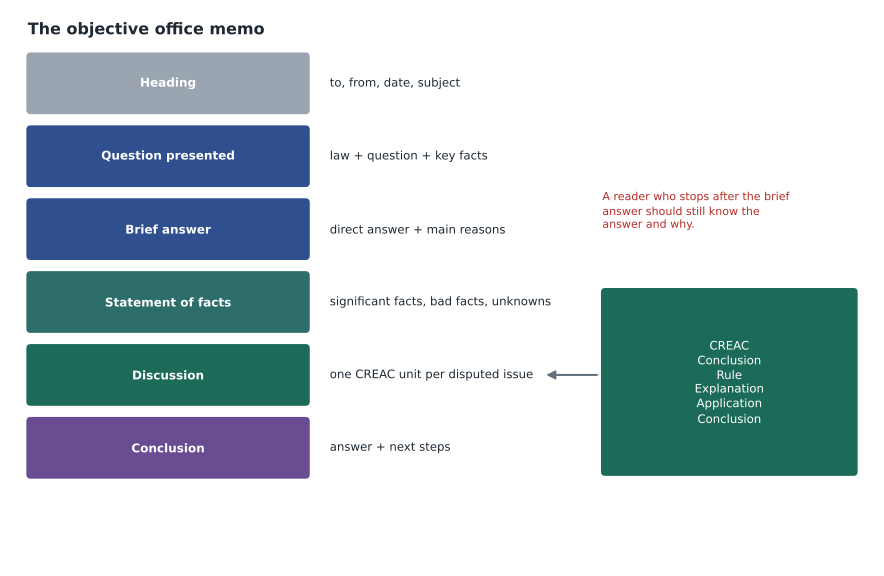
Office memo formats vary by firm and by supervisor, but most include the same sections in roughly this order.
- Heading: to, from, date and a short subject line identifying the client matter and issue.
- Question presented: the legal question, framed so that a reader who knows nothing about the case understands it. A good question presented combines the governing law, the legal question and the key facts, often in a single sentence beginning with "Under" or "Does" or "Whether."
- Brief answer: a direct answer to the question, usually beginning with a word such as "Probably yes" or "Likely not," followed by a few sentences giving the main reasons. A reader who stops here should know the answer and why.
- Statement of facts: the legally significant facts, stated objectively, including unfavorable facts and noting facts that are unknown or disputed. Background facts that help the reader follow the story may be included briefly.
- Discussion: the analysis, organized by issue and sub-issue, explaining the governing rules, how courts have applied them, how they apply to these facts, the counterarguments, and the likely result.
- Conclusion: a short summary of the answer and, often, recommendations for next steps, including facts to investigate.
IRAC and CREAC
The discussion section is where most of the work happens, and legal writers organize it with a few well-worn patterns. The best known is IRAC: issue, rule, application, conclusion. You state the issue, explain the governing rule, apply the rule to the facts, and state your conclusion. IRAC is useful for exam answers and for short analyses.
Most legal writing programs teach a refinement for memos, often called CREAC: conclusion, rule, explanation, application, conclusion. You begin each section with your conclusion, so the reader knows where you are going. You state the rule, synthesized from the authorities. You explain the rule by showing how courts have applied it in decided cases, with enough facts and reasoning that the reader can see the pattern. You apply the rule to your client's facts, comparing and contrasting them with the decided cases and addressing counterarguments. And you restate the conclusion. Some programs call the same structure CRuPAC, TREAT or CREXAC; the names differ, but the logic is the same.
The explanation step is where many new writers go wrong. They state a rule and then jump to their facts without showing how courts have applied the rule. Without explanation, the reader cannot judge whether your application is sound. A good explanation describes a decided case briefly: its key facts, the result and the court's reasoning, focused on the part relevant to your issue. Two or three well-chosen cases, showing results on both sides of the line, usually explain a rule better than a long list.
Organizing a multi-issue discussion
Most legal questions break into sub-issues, often corresponding to the elements of a statute or claim. A memo should address each element that is in genuine dispute in its own CREAC unit, and dispose quickly of elements that are clearly satisfied. Headings help the reader navigate. The order is usually logical (the order of the elements) or strategic (the most important or dispositive issue first).
For the Coldbrook problem, Kinsella suggests an outline. The overarching question is whether the orchard is immune from Garrow's negligence claim under the Westmarch Recreational Use Act. The Act requires several elements: the orchard must be an owner of land; Garrow must have entered or used the land for a recreational purpose; and neither exception may apply, neither a charge for the use nor a willful or malicious failure to guard or warn against a dangerous condition. Ownership is not disputed and can be handled in a sentence. Recreational purpose probably deserves a short analysis, because Garrow was both picking apples to buy and riding a hayride. The charge exception and the willful exception are the real issues and deserve full CREAC treatment.
| Section | Treatment | Main authorities |
|---|---|---|
| Overview: the Act and its elements | Short roadmap paragraph | Westmarch Code sections 41-505 to 41-508; Stavros |
| Owner of land | One or two sentences; not disputed | Statutory definition |
| Recreational purpose | Short CREAC | Definition in section 41-506; Ibarra (hayride on farm land) |
| The charge exception | Full CREAC | Section 41-508(b); Pell; Quill |
| The willful or malicious exception | Full CREAC | Section 41-508(a); Ibarra |
| Conclusion and next steps | Summary and facts to investigate | None |
Writing the rule and explanation
A rule statement should be synthesized, not copied. If the statute supplies the rule, quote the operative language and then state how the courts have interpreted it. If the cases supply it, combine them into one statement that covers them all. For the charge exception, a synthesized rule might read: "A landowner loses the Act's protection if it charges the person for the recreational use. A payment is a charge if it is required, formally or in practice, as a condition of entering or using the land, whatever it is called; a truly voluntary donation is not a charge." Each part of that sentence should be supported by a citation.
The explanation then illustrates the rule. A paragraph on Pell would describe the mandatory parking fee, the court's holding that it was a charge, and its reasoning that substance controls over labels. A paragraph on Quill would describe the corn maze donation box, the holding that it was not a charge, and the court's suggestion that the result would differ if payment were required in practice. Together, the two cases mark the line the client's facts must be measured against.
Application and counterarguments
The application compares the client's facts with the decided cases. The hayride sign said rides were free and suggested a donation to a third party, the Westmarch 4-H; like the donation box in Quill, it appears voluntary. Unlike the parking fee in Pell, payment was not a condition of riding. But a volunteer stood at the wagon steps with a bucket, some riders said they felt expected to pay, and the hayrides drew customers who bought apples. An objective memo addresses those facts head-on, explains why a court might nonetheless find a charge, and assesses how likely that is.
Addressing counterarguments is not optional in an objective memo. The reader needs to know the strongest argument the other side will make and why you think it will or will not succeed. Kinsella warns against two opposite errors: ignoring the counterargument, which makes the analysis untrustworthy, and giving it equal time when it is weak, which leaves the reader unsure what you actually think. Assess it honestly and say how strong it is.
Predicting and qualifying
A memo predicts. The language of prediction is calibrated: "will," "likely," "probably," "may," "could," "is unlikely to." Use the word that matches your confidence, and explain what could change the answer. If the result depends on facts you do not know, say so and identify them. For the Coldbrook memo, the key unknowns include whether any rider was refused or pressured for not paying, who controlled the donation money, whether the hayride was advertised as part of the paid apple-picking experience, and what Felix Merriwether knew about the rut, which bears on the willful exception.
Hannah Lindqvist asks whether it is acceptable to conclude that the answer is uncertain. Kinsella says yes, if it truly is, but that "it depends" is the beginning of an answer, not the end. Say what it depends on, which way it probably goes, and why. "Partners do not pay associates to tell them the law is complicated," she says. "They pay them to tell them what is most likely to happen and what to do about it."
The question presented and brief answer
Experienced writers often draft the question presented and brief answer last, after the discussion has clarified their thinking. A good question presented for the Coldbrook memo might read: "Under the Westmarch Recreational Use Act, is an orchard immune from a negligence claim by a visitor who fell from a free hayride, where a sign invited voluntary donations to a youth charity, a volunteer held a donation bucket at the wagon, and the owner had been told about a rut on the route a week earlier?" It combines the law, the question and the facts that matter to both exceptions.
A matching brief answer: "Probably yes, though the willful-misconduct exception presents some risk. The donation request was likely not a 'charge' because riding did not depend on payment, as in Quill. Whether Mr. Merriwether's failure to fix or warn of the rut was 'willful' depends on what he knew and did after he was told; under Ibarra, mere negligence is not enough, but conscious disregard of a known danger likely to cause serious injury would be." Lesson 12 completes the memo.
Writing the statement of facts
The statement of facts in an objective memo is not a story told for effect. It records the facts the analysis relies on, accurately and neutrally, with their sources. Kinsella gives Section B four rules. Include every legally significant fact, favorable or not; the partner must not be surprised later by a fact the associate knew. Distinguish what is established from what is alleged: "Ms. Garrow's demand letter states that riders were expected to pay" is accurate, while "riders were expected to pay" adopts her version. Identify what is unknown, because unknown facts often become the next steps. And organize the facts so a reader can follow them, usually chronologically, with a sentence or two of background first.
Avoid characterizing facts with conclusions. Calling the rut "dangerous" or the donation request "voluntary" in the facts section decides the very questions the discussion must analyze. Describe what happened and save the characterization for the analysis, where it can be supported.
Worked problem
Turning a summary into an analysis
Jordan Kimura's first draft of the charge section reads: 'In Pell, the court held that a parking fee was a charge. In Quill, the court held that a donation box was not a charge. Here, there was a donation bucket. Therefore the orchard did not charge.' What is missing?
Show solution
- Conclusion first: start with the answer to the sub-issue.
- Rule: state the synthesized rule (required as a condition of entry or use, in form or in practice).
- Explanation: give each case's key facts and reasoning, not just its result, so the reader sees why Pell and Quill came out differently.
- Application: compare the facts (sign said free; payment went to a charity; riders could ride without paying) and confront the bad facts (the volunteer with the bucket; riders feeling expected to pay; commercial benefit).
- Counterargument and assessment: explain why Garrow will argue payment was required in practice and how likely a court is to agree.
- Conclusion: restate the prediction with appropriate confidence.
Answer: Jordan's draft reaches the right conclusion but gives the reader no reason to trust it. Rewritten in CREAC form, the same section runs about four paragraphs and shows exactly why the bucket probably does not change the result.
Summary and key terms
- An objective memo predicts how a court will resolve a question, candidly, for a busy reader who must make a decision.
- Standard parts: heading, question presented, brief answer, statement of facts, discussion and conclusion.
- Organize each disputed issue with CREAC: conclusion, rule, explanation, application, conclusion.
- Synthesize rules from the authorities; explain them with the facts and reasoning of decided cases on both sides of the line.
- Address counterarguments honestly and assess their strength; use calibrated predictive language and identify unknown facts.
- Draft the question presented and brief answer last; a reader who stops after the brief answer should know the answer and why.
- Objective memo
- A document predicting how the law applies to a client's facts, presenting both favorable and unfavorable authority.
- Question presented
- A statement of the legal question combining the governing law, the question and the key facts.
- Brief answer
- A short, direct answer to the question presented with the main reasons.
- IRAC
- Issue, rule, application, conclusion: a basic pattern for legal analysis.
- CREAC
- Conclusion, rule, explanation, application, conclusion: the pattern most memos use for each issue.
- Rule explanation
- Discussion of how courts have applied a rule in decided cases, showing the facts and reasoning that matter.
Practice problems
Work each problem on paper first, then reveal the answer to check.
What is the main difference between an objective memo and a brief?
Show answer
A memo predicts the likely outcome candidly for the client's own lawyers, presenting unfavorable law; a brief argues for the client's position to a court.
Rewrite this question presented to make it useful: 'Is Coldbrook liable?'
Show answer
Include the law, the question and the key facts, for example: 'Under the Westmarch Recreational Use Act, does an orchard lose immunity under the charge exception where it offered free hayrides but invited voluntary donations to a charity at the wagon?'
Why does CREAC put the conclusion first?
Show answer
So the reader knows where the analysis is going and can read the rule, explanation and application with that conclusion in mind; busy readers may not reach the end.
A key fact is unknown. Should the memo ignore it?
Show answer
No. It should identify the fact, explain how it could change the analysis, and recommend investigating it.
Lesson quiz · 5 questions
Score 60% or more to complete this lesson.
Create a free account to save your progress, take quizzes and earn a certificate.