
LAWU-103 · Lesson 9 of 12 · 21 min
Strict liability: animals and abnormally dangerous activities
▶ Video coming soon A video version of this lesson is on the way.
Negligence asks whether the defendant was careful. Strict liability does not. A defendant subject to strict liability pays for harm its activity causes even if it took every reasonable precaution. Professor Brenneman tells Section B that strict liability is narrower than negligence but matters enormously where it applies, and that the fireworks show at the fair sits right on its contested border. "If Brightfall is strictly liable," he says, "Nadia does not need to prove anything about the rope line. She needs to prove that the show hurt her." This lesson covers the traditional areas of strict liability and the related doctrine of vicarious liability, which makes one person answer for another's torts.
Why strict liability?
Courts and scholars offer several reasons for imposing liability without fault in some settings. Some activities are so dangerous that even reasonable care leaves a significant residual risk, and the actor who chooses to engage in them for its own benefit should bear the cost of the harm they cause. Strict liability also encourages actors to consider whether to engage in the activity at all, or to move it somewhere safer, decisions that negligence law, which focuses on how carefully an activity is performed, does not reach. And it relieves plaintiffs of the often impossible task of proving exactly what went wrong when the evidence was destroyed in the explosion or fire.
Rylands v. Fletcher
The modern doctrine starts with an English case. In Rylands v. Fletcher (1868), mill owners hired contractors to build a reservoir on their land. Unknown to anyone, the site sat over old mine shafts connected to the plaintiff's coal mine. When the reservoir was filled, water burst through the shafts and flooded the mine. The mill owners were not negligent; the contractors may have been, but the court did not rely on that. Justice Blackburn, in the Exchequer Chamber, stated that a person who for his own purposes brings onto his land and collects and keeps there anything likely to do mischief if it escapes must keep it in at his peril, and if he does not, is answerable for all the damage that is the natural consequence of its escape. The House of Lords affirmed, with Lord Cairns adding that the rule applied to a non-natural use of land.
American courts initially split over Rylands. Some, like the New Hampshire Supreme Court in Brown v. Collins, 53 N.H. 442 (1873), rejected it as inconsistent with the principle that liability requires fault. Others adopted it. Over time, American law absorbed its core idea into the doctrine of strict liability for abnormally dangerous activities.
Animals
Liability for animals is one of the oldest forms of strict liability. The traditional rules, restated in the Restatement (Third) sections 21 to 23, distinguish three situations.
- Wild animals. A possessor of a wild animal, one not customarily domesticated in the community, such as a tiger, bear or venomous snake, is strictly liable for harm that results from the dangerous propensities characteristic of that kind of animal. Reasonable care in keeping it is no defense.
- Abnormally dangerous domestic animals. A possessor of a domestic animal, such as a dog, horse or bull, is strictly liable for harm caused by a dangerous tendency abnormal for that category of animal, if the possessor knows or has reason to know of it. This is the source of the so-called one-bite rule: once an owner knows the dog has bitten or shown a tendency to bite, the owner is strictly liable for later bites. Many states have replaced the rule for dogs with dog-bite statutes that impose strict liability for any bite, with exceptions for trespassers and provoked dogs.
- Trespassing livestock. A possessor of livestock is strictly liable for physical harm the livestock cause by intruding onto another's land, subject to fencing-out statutes in some western states that require landowners to fence livestock out to recover.
Otherwise, harm caused by domestic animals is governed by negligence. The 1,300-pound steer that knocked down Harold Lindgren was a domestic animal with no known dangerous tendency; it panicked in a fire. Its owner, a 4-H exhibitor, is not strictly liable under the traditional rules, though the fair and the exhibitor may have been negligent in securing it. Brenneman notes that cattle are large and can be dangerous, but that the law asks whether the dangerous tendency is abnormal for the category of animal, and panicking in a fire is not.
Abnormally dangerous activities
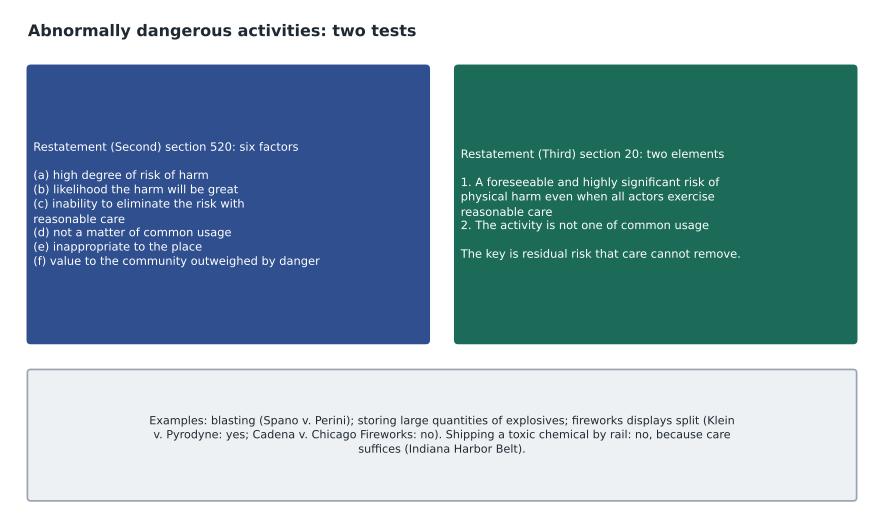
The Restatement (Second) of Torts sections 519 and 520 adopted strict liability for abnormally dangerous activities, listing six factors for courts to weigh: (a) the existence of a high degree of risk of some harm to persons, land or chattels; (b) the likelihood that the harm will be great; (c) the inability to eliminate the risk by the exercise of reasonable care; (d) the extent to which the activity is not a matter of common usage; (e) the inappropriateness of the activity to the place where it is carried on; and (f) the extent to which its value to the community is outweighed by its dangerous attributes. No single factor is decisive, and whether an activity is abnormally dangerous is a question of law for the court.
The Restatement (Third) section 20 simplifies the test. An activity is abnormally dangerous if it creates a foreseeable and highly significant risk of physical harm even when reasonable care is exercised by all actors, and it is not one of common usage. The key element is the residual risk that remains after reasonable care. An activity whose dangers can be controlled by care is left to negligence.
Blasting and explosives
Blasting with explosives is the classic abnormally dangerous activity. In Spano v. Perini Corp., 25 N.Y.2d 11, 250 N.E.2d 31 (1969), construction blasting damaged a nearby garage. The New York Court of Appeals overruled an earlier rule that had required proof of negligence unless debris physically invaded the plaintiff's land, holding that a blaster is strictly liable for damage caused by concussion as well. The court reasoned that the question was not whether blasting was lawful or useful, but who should bear the cost of the damage it inevitably caused.
Where courts refuse strict liability
Courts have resisted extending strict liability to activities whose risks can be controlled by care. Indiana Harbor Belt Railroad Co. v. American Cyanamid Co., 916 F.2d 1174 (7th Cir. 1990), is the leading example. A rail tank car leaked acrylonitrile, a flammable and toxic chemical, in a switching yard near Chicago, and the railroad that owned the yard sued the shipper for the cleanup cost. Judge Richard Posner held that the shipper was not strictly liable. The leak was caused by a defect in the car that ordinary care could have caught, so negligence liability would give adequate incentives for safety. And strict liability against the shipper would not sensibly lead it to reroute shipments, since nearly every rail line passes through cities. Posner emphasized that the question is whether the activity's risks can be reduced by due care, not whether the substance is dangerous.
Fireworks displays: a split
Whether fireworks displays are abnormally dangerous is a question on which courts have disagreed. In Klein v. Pyrodyne Corp., 117 Wash. 2d 1, 810 P.2d 917 (1991), spectators at a Fourth of July display were injured when a shell fell from its mortar box, ignited on the ground and sprayed burning fragments into the crowd. The Washington Supreme Court held that a public fireworks display is an abnormally dangerous activity, reasoning that it presents a high risk of serious injury even when carefully conducted, that it is not a matter of common usage because relatively few people conduct public displays, and that the evidence of what went wrong is usually destroyed in the explosion. In Cadena v. Chicago Fireworks Manufacturing Co., 297 Ill. App. 3d 945, 697 N.E.2d 802 (1998), an Illinois appellate court reached the opposite result, holding that a fireworks display was not ultrahazardous because the risks could be adequately controlled through reasonable care and the activity was regulated by statute. Courts elsewhere have gone both ways.
Worked problem
Is Brightfall strictly liable to Nadia?
Nadia Okoro was struck by burning debris from a low-bursting six-inch shell at a public display run by a licensed contractor. Brightfall argues that it followed industry practices and that, in any case, strict liability does not apply to fireworks displays.
Show solution
- Risk despite care: even well-run displays sometimes produce low breaks and stray debris; the risk of serious burns to spectators remains when everyone exercises reasonable care.
- Common usage: public displays with professional shells are conducted by a small number of licensed operators, not by people generally (Klein). Backyard consumer fireworks might be different.
- Place: launching six-inch shells near a crowded lawn and hay storage at a fairground cuts in favor of strict liability under the Second Restatement factors.
- Contrary view: in a state following Cadena, the court would say that care, such as proper separation distances and shell inspection, can adequately control the risk, so negligence suffices.
Answer: In a state following Klein, Brightfall is strictly liable for Nadia's injuries without proof of negligence. In a state following Cadena, she must prove negligence, though the code violation (Lesson 4) makes that likely. Either way, she will plead both.
Limits on strict liability
Strict liability is not unlimited. It extends only to harm within the scope of the abnormal risk that makes the activity strictly liable. In Foster v. Preston Mill Co., 44 Wash. 2d 440, 268 P.2d 645 (1954), vibrations from blasting caused mother minks at a nearby mink ranch to kill their kittens. The Washington Supreme Court held the blaster not strictly liable, because the risk that makes blasting abnormally dangerous is the risk of flying debris and concussion, not the reaction of nervous animals. Under the same reasoning, the steer's panic at the fair might be outside the scope of strict liability for fireworks, even if fire-related damage like the Pedersen barn is within it.
The plaintiff's own conduct also matters. Ordinary contributory negligence was traditionally not a defense to strict liability, but knowingly and unreasonably subjecting oneself to the risk was. Most comparative fault jurisdictions now reduce a strict liability plaintiff's recovery by her share of fault, and the Restatement (Third) section 25 adopts that approach.
Nuisance
A related body of law governs ongoing interferences with land. A private nuisance is a substantial and unreasonable interference with another's use and enjoyment of land, such as persistent noise, smoke or odors. The interference may be intentional and unreasonable, or negligent, reckless or the result of an abnormally dangerous activity. Courts weigh the gravity of the harm against the utility of the conduct and consider the character of the neighborhood. A public nuisance is an unreasonable interference with a right common to the general public, such as obstructing a highway; private plaintiffs can sue only if they suffer harm different in kind from the public at large. In recent decades, public nuisance has been invoked in litigation against manufacturers of lead paint, opioids and other products, with mixed results; the Oklahoma Supreme Court in State ex rel. Hunter v. Johnson & Johnson, 2021 OK 54, rejected the state's public nuisance claim against an opioid manufacturer.
Remedies for nuisance can be injunctions or damages. In Boomer v. Atlantic Cement Co., 26 N.Y.2d 219, 257 N.E.2d 870 (1970), neighbors of a large cement plant proved a nuisance from dust and vibration. The New York Court of Appeals, unwilling to shut down a major employer, granted an injunction that would be lifted when the plant paid permanent damages for the harm to the neighbors' land, in effect letting the plant buy the right to continue.
Vicarious liability
Vicarious liability makes one person liable for another's tort because of their relationship, without any fault of their own. The most important form is respondeat superior: an employer is liable for torts committed by its employees acting within the scope of their employment. Conduct is within the scope if it is the kind the employee is employed to perform, occurs substantially within authorized time and space limits, and is actuated at least in part by a purpose to serve the employer. Under that test, Varrow Security is likely liable for Dwayne Pruitt's detention of Theo Garza in Lesson 1, because detaining suspected thieves is what Pruitt was hired to do, even if he did it badly. An employee on a frolic of his own, pursuing purely personal ends, is outside the scope.
An employer is generally not liable for the torts of an independent contractor, one whose physical conduct the employer does not control. Brightfall was the Agricultural Society's contractor, not its employee. But the general rule has major exceptions. A hiring party remains liable for its own negligence in selecting, instructing or supervising a contractor. And a hiring party is liable for a contractor's negligence in carrying out a nondelegable duty, including work that is inherently dangerous unless special precautions are taken, and abnormally dangerous activities. Courts have applied the inherently dangerous work exception to fireworks displays, so the Agricultural Society may be liable for Brightfall's negligence even though it hired a licensed professional. A land possessor who holds premises open to the public also often has a nondelegable duty to keep them reasonably safe for invitees.
Summary and key terms
- Strict liability imposes liability without fault for harm from certain activities, reflecting residual risk, activity-level choices and proof problems.
- Rylands v. Fletcher imposed strict liability for the escape of dangerous things brought onto land for a non-natural use.
- Possessors are strictly liable for wild animals, for domestic animals with known abnormally dangerous tendencies, and for trespassing livestock; dog-bite statutes often go further.
- Abnormally dangerous activities are judged by the Second Restatement's six factors or the Third Restatement's test of highly significant risk despite reasonable care plus uncommon usage.
- Blasting is the classic example (Spano v. Perini); courts refuse strict liability when care can control the risk (Indiana Harbor Belt) and split on fireworks displays (Klein v. Pyrodyne; Cadena).
- Strict liability covers only harm within the abnormal risk (Foster v. Preston Mill); employers are vicariously liable for employees' torts within the scope of employment, and hiring parties remain liable for contractors' breach of nondelegable duties.
- Strict liability
- Liability imposed without proof of negligence or intent.
- Abnormally dangerous activity
- An activity creating a highly significant risk of physical harm even with reasonable care, and not of common usage.
- One-bite rule
- The rule making a dog owner strictly liable once the owner knows of the dog's dangerous tendency.
- Private nuisance
- A substantial and unreasonable interference with the use and enjoyment of land.
- Public nuisance
- An unreasonable interference with a right common to the general public.
- Respondeat superior
- The doctrine making employers liable for employees' torts within the scope of employment.
- Independent contractor
- A person hired to do work whose physical conduct the hiring party does not control.
- Nondelegable duty
- A duty for which the hiring party remains liable even if it hires a contractor to perform it.
Practice problems
Work each problem on paper first, then reveal the answer to check.
A zoo's tiger escapes despite state-of-the-art enclosures and injures a visitor. Is the zoo liable even though it was careful?
Show answer
Under the traditional rule, yes, because possessors of wild animals are strictly liable for harm from their dangerous propensities. Some states make an exception for public zoos, treating them under negligence.
Why did Judge Posner refuse to impose strict liability on the chemical shipper in Indiana Harbor Belt?
Show answer
Because the accident was the kind ordinary care could prevent, so negligence liability gave sufficient safety incentives, and strict liability would not sensibly change where or how the chemical was shipped.
A delivery driver, on his route, stops to visit a friend across town and hits a pedestrian on the way. Is his employer vicariously liable?
Show answer
Probably not if the detour was a substantial departure for purely personal purposes, a frolic. A minor detour, or one partly serving the employer, would likely remain within the scope of employment.
Under Foster v. Preston Mill, why was a blaster not strictly liable for the deaths of mink kittens?
Show answer
Because the harm was outside the scope of the risk that makes blasting abnormally dangerous, which is debris and concussion damage, not the reaction of sensitive animals to vibrations.
Lesson quiz · 5 questions
Score 60% or more to complete this lesson.
Create a free account to save your progress, take quizzes and earn a certificate.